
PUBLISHER: Mordor Intelligence | PRODUCT CODE: 2072739

PUBLISHER: Mordor Intelligence | PRODUCT CODE: 2072739
Healthcare AI Consulting Services - Market Share Analysis, Industry Trends & Statistics, Growth Forecasts (2026 - 2031)
According to Mordor Intelligence, the healthcare AI consulting services market is expected to increase from USD 8.75 billion in 2025 to USD 9.63 billion in 2026 and reach USD 17.15 billion by 2031, growing at a CAGR of 12.24% over 2026-2031.
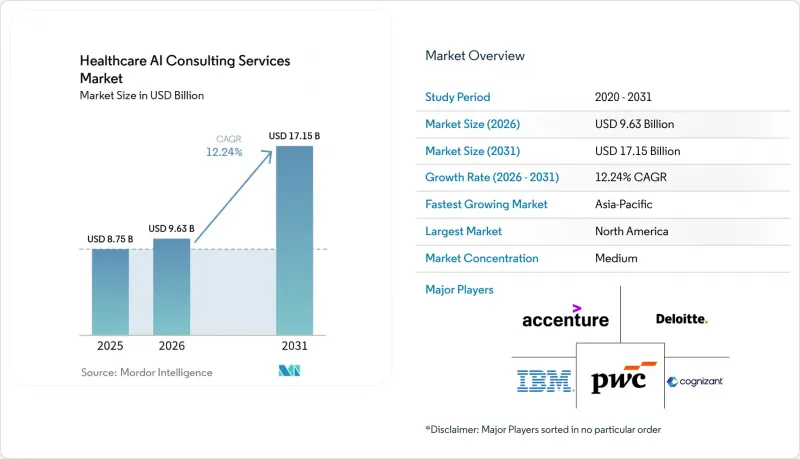
This report is Segmented by Service Type (Strategy and Advisory, and Others), Deployment Model (On-Premise, Cloud-Based, and Hybrid), End User (Healthcare Providers, and Others), Application (Clinical Decision Support, and Others), and Geography (North America, Europe, Asia-Pacific, Middle East and Africa, South America). The Market Forecasts are Provided in Terms of Value (USD).
Global Healthcare AI Consulting Services Market Trends and Insights
Growing Adoption of AI-Driven Clinical Decision Support Systems
Hospitals and health systems are moving from limited pilots to live use of AI-driven clinical decision support, and that shift is creating steady demand for design, validation, integration, and optimization work in the healthcare AI consulting services market. The FDA's reissued Clinical Decision Support Software guidance in January 2026 sharpened the boundary between non-device CDS functions and regulated software, which increases the need for outside advisory support on system design and compliance mapping in the United States. That same guidance also leaves room for faster deployment of AI-assisted recommendations when each function is carefully mapped against the statutory criteria, so consulting teams that can do this precisely are gaining importance. The work is no longer limited to model selection, because organizations also need help aligning model outputs with clinical workflow, escalation rules, documentation standards, and oversight controls. This expands the scope of the healthcare AI consulting services market from implementation alone to a broader mix of validation, monitoring, and governance support. It also raises the value of consultants that can translate regulatory language into practical operating rules for health systems and software vendors.
Rising Healthcare-Cost Pressures Pushing Efficiency-Focused AI Consulting
Healthcare cost pressure is acting as a direct catalyst for AI consulting demand rather than slowing spending in the healthcare AI consulting services market. Health systems are now asking for tightly scoped programs tied to measurable workflow gains, claims efficiency, and staff time savings instead of longer strategy-heavy engagements. This has made administrative and financial workflows one of the fastest entry points for consulting-led AI deployment, because leaders can track cycle time, rework, throughput, and denial outcomes with less ambiguity than many clinical use cases. Aetna's second-generation Claims Assist Manager, launched in May 2026, reduced processing time for complex claims by more than 20%, which shows why payer and provider organizations are directing consulting budgets toward repeatable operational use cases.The healthcare AI consulting services market is therefore seeing stronger demand for short-cycle implementation, workflow redesign, and benefits tracking support. Firms that can prove rapid execution in revenue cycle and adjacent back-office areas are better positioned to win follow-on work across a broader enterprise estate.
Data-Privacy and Security Concerns Under HIPAA/GDPR
Privacy and security issues slow projects in the healthcare AI consulting services market mainly by extending deployment timelines instead of stopping demand outright. AI tools that process protected health information require risk analysis, access control review, workflow documentation, and contract controls before they move into production, which adds sequencing pressure to already complex health system programs. This is more difficult for organizations operating across both U.S. and European jurisdictions, because logging, documentation, and governance needs cannot be treated as one common process when the underlying legal frameworks differ. The result is a larger compliance workload per engagement, but it also delays the proof points that many buyers want before approving broader rollout budgets. This creates a short-term drag on the healthcare AI consulting services market even while it expands the scope of individual consulting assignments. It also favors providers that can reduce friction by combining privacy, technical controls, and operating model support in one program.
Other drivers and restraints analyzed in the detailed report include:
- Emerging Demand for Foundation-Model Fine-Tuning to Meet Data-Sovereignty Rules
- Increasing Regulatory Focus on Responsible AI Governance in Healthcare
- Shortage of AI-Skilled Healthcare Workforce
For complete list of drivers and restraints, kindly check the Table Of Contents.
Segment Analysis
Implementation and integration held 37.14% of revenue in 2025, which shows that the healthcare AI consulting services market is still centered on production deployment rather than early-stage ideation. Health systems are using consultants to connect AI models with live EHR environments, fit outputs into existing clinical pathways, and build monitoring processes that satisfy both IT and clinical governance needs. This makes implementation work larger in scope than simple technical activation, because it also includes workflow redesign, testing, and operational handoff. AI model development and customization is the fastest-growing service type and is projected to expand at a 12.77% CAGR from 2026 to 2031. That growth reflects rising demand for locally tuned models in regulated healthcare settings and for use cases that cannot rely on generic model behavior.
The healthcare AI consulting services market is also becoming more layered within this service split. Strategy and Advisory, Data and Governance Consulting, and Regulatory and Compliance Consulting hold smaller shares, but they are becoming recurring mandates as organizations move from first deployment to control, optimization, and audit readiness. This means implementation projects often create downstream demand for governance and compliance scopes rather than ending once a model is live.
Cloud-based AI solutions accounted for 55.46% of revenue in 2025, which makes cloud the leading infrastructure layer for the healthcare AI consulting services market. That position reflects the growing need to support enterprise-scale AI workloads, broader data access, and faster deployment cycles across providers, payers, and digital health platforms. Earlier cloud transitions in EHR environments, telehealth systems, and data-intensive workloads have already created a base of organizations that are technically ready for AI but still need outside help to operationalize it. Cloud-based AI solutions are also the fastest-growing deployment segment and are expected to be forecasted at 12.68% CAGR through 2031. This makes cloud consulting central to the next phase of the healthcare AI consulting services market, especially where orchestration, interoperability, monitoring, and security have to be handled together.
On-premise AI solutions still retain a meaningful role in organizations that face strict residency rules, highly controlled network environments, or internal preferences for direct infrastructure oversight. This is especially relevant in settings where sensitive workloads cannot be moved easily into shared hosted environments. Hybrid Solutions are therefore emerging as the practical middle path, because many health systems need flexibility across cloud, local processing, and application-specific environments.
Complete Report Scope:
- By Service Type
- Strategy and Advisory
- Implementation and Integration
- AI Model Development and Customization
- Data and Governance Consulting
- Regulatory and Compliance Consulting
- Others
- By Deployment Model
- On-Premise AI Solutions
- Cloud-Based AI Solutions
- Hybrid Solutions
- By End User
- Healthcare Providers
- Healthcare Payers
- Life Sciences and Pharma Companies
- MedTech and Device Companies
- Healthcare IT and Digital Health Companies (incl. startups)
- Government and Public Health Agencies
- By Application
- Clinical Decision Support and Diagnostics
- Medical Imaging
- Population Health and Predictive Analytics
- Drug Discovery and Development
- Administrative and Operational Optimization (incl. RCM)
- Others
- By Clinical Setting
- Inpatient
- Outpatient
- Emergency and Urgent Care
- By Geography
- North America
- United States
- Canada
- Mexico
- Europe
- Germany
- United Kingdom
- France
- Italy
- Spain
- Rest of Europe
- Asia-Pacific
- China
- Japan
- India
- Australia
- South Korea
- Rest of Asia-Pacific
- Middle East and Africa
- GCC
- South Africa
- Rest of Middle East and Africa
- South America
- Brazil
- Argentina
- Rest of South America
- North America
Geography Analysis
North America accounted for 53.13% of global revenue in 2025, which kept it as the largest regional block in the healthcare AI consulting services market. The United States supports that position through mature digital infrastructure, high consulting spend per health system, and a regulatory environment that creates both compliance work and clearer buying triggers. The launch of Aetna's second-generation Claims Assist Manager in May 2026 and the continued scaling of AI-enabled payer operations show how operational use cases are translating into real consulting demand in the region. Canada and Mexico also contribute through public digital health activity and commercial healthcare modernization programs. California's AB-2575 adds another layer of importance because it introduces specific liability rules for AI-based clinical decision support and is likely to influence compliance planning beyond one state.
Europe remains the second-largest region in the healthcare AI consulting services market, led by Germany, the United Kingdom, and France. Germany's environment is shaped by digital health reimbursement structures and by practical interpretation of the EU AI Act, with BfArM publishing guidance in 2025 on how AI-based medical products should be classified under the relevant European frameworks. France is also becoming more important as sovereign deployment rules and national health data strategy priorities raise demand for localized architecture, governance, and implementation support. The United Kingdom, Italy, and Spain remain active adoption markets, while the rest of Europe continues to build momentum through broader digital health programs.
Asia-Pacific is the fastest-growing region and is anticipated to expand at a 13.92% CAGR from 2026 to 2031, which gives it the strongest growth profile in the healthcare AI consulting services market. Growth across China, South Korea, and India is not uniform, because each market is being shaped by different combinations of reimbursement policy, digital health infrastructure, and public program design. South Korea's 2026 mandate for AI cancer screening under national health insurance creates immediate implementation and compliance work, while India's National Digital Health Mission continues to support interoperable data standards across a large and diverse care base. Middle East and Africa is being driven mainly by GCC smart health programs, and South America is progressing through private insurer adoption led by countries such as Brazil and Argentina. This means the healthcare AI consulting services market is broadening geographically, but the pace of consulting demand still depends heavily on policy execution, public digital infrastructure, and local system readiness.
- Accenture
- Bain & Company
- Boston Consulting Group (BCG)
- Capgemini
- Cognizant
- Deloitte
- EY
- GE Healthcare Consulting
- HCLTech
- IBM
- Infosys
- IQVIA
- KPMG
- McKinsey & Company
- Optum Advisory
- Philips Healthcare Consulting
- PwC
- SAS Institute
- Siemens Healthineers Consulting
- Tata Consultancy Services (TCS)
- Wipro
- ZS Associates
Additional Benefits:
- The market estimate (ME) sheet in Excel format
- 3 months of analyst support
TABLE OF CONTENTS
1 Introduction
- 1.1 Study Assumptions and Market Definition
- 1.2 Scope of the Study
2 Research Methodology
3 Executive Summary
4 Market Landscape
- 4.1 Market Overview
- 4.2 Market Drivers
- 4.2.1 Growing Adoption of AI-Driven Clinical Decision Support Systems
- 4.2.2 Rising Healthcare-Cost Pressures Pushing Efficiency-Focused AI Consulting
- 4.2.3 Increasing Cloud Migration of Healthcare IT Infrastructure
- 4.2.4 Shift Toward Outcome-Based Consulting Fee Models Enabling Risk-Sharing
- 4.2.5 Emerging Demand for Foundation-Model Fine-Tuning to Meet Data-Sovereignty Rules
- 4.2.6 Increasing Regulatory Focus on Responsible AI Governance in Healthcare
- 4.3 Market Restraints
- 4.3.1 Data-Privacy and Security Concerns Under HIPAA/GDPR
- 4.3.2 Shortage of AI-Skilled Healthcare Workforce
- 4.3.3 Vendor-Liability Uncertainty in AI-Caused Misdiagnosis Litigation
- 4.3.4 High Implementation and Integration Costs Across Legacy Healthcare Systems
- 4.4 Value-Chain Analysis
- 4.5 Regulatory Landscape
- 4.6 Technological Outlook
- 4.7 Porter's Five Forces Analysis
- 4.7.1 Threat of New Entrants
- 4.7.2 Bargaining Power of Suppliers
- 4.7.3 Bargaining Power of Buyers
- 4.7.4 Threat of Substitutes
- 4.7.5 Competitive Rivalry
5 Market Size & Growth Forecasts (Value, USD)
- 5.1 By Service Type
- 5.1.1 Strategy and Advisory
- 5.1.2 Implementation and Integration
- 5.1.3 AI Model Development and Customization
- 5.1.4 Data and Governance Consulting
- 5.1.5 Regulatory and Compliance Consulting
- 5.1.6 Others
- 5.2 By Deployment Model
- 5.2.1 On-Premise AI Solutions
- 5.2.2 Cloud-Based AI Solutions
- 5.2.3 Hybrid Solutions
- 5.3 By End User
- 5.3.1 Healthcare Providers
- 5.3.2 Healthcare Payers
- 5.3.3 Life Sciences and Pharma Companies
- 5.3.4 MedTech and Device Companies
- 5.3.5 Healthcare IT and Digital Health Companies (incl. startups)
- 5.3.6 Government and Public Health Agencies
- 5.4 By Application
- 5.4.1 Clinical Decision Support and Diagnostics
- 5.4.2 Medical Imaging
- 5.4.3 Population Health and Predictive Analytics
- 5.4.4 Drug Discovery and Development
- 5.4.5 Administrative and Operational Optimization (incl. RCM)
- 5.4.6 Others
- 5.5 By Clinical Setting
- 5.5.1 Inpatient
- 5.5.2 Outpatient
- 5.5.3 Emergency and Urgent Care
- 5.6 By Geography
- 5.6.1 North America
- 5.6.1.1 United States
- 5.6.1.2 Canada
- 5.6.1.3 Mexico
- 5.6.2 Europe
- 5.6.2.1 Germany
- 5.6.2.2 United Kingdom
- 5.6.2.3 France
- 5.6.2.4 Italy
- 5.6.2.5 Spain
- 5.6.2.6 Rest of Europe
- 5.6.3 Asia-Pacific
- 5.6.3.1 China
- 5.6.3.2 Japan
- 5.6.3.3 India
- 5.6.3.4 Australia
- 5.6.3.5 South Korea
- 5.6.3.6 Rest of Asia-Pacific
- 5.6.4 Middle East and Africa
- 5.6.4.1 GCC
- 5.6.4.2 South Africa
- 5.6.4.3 Rest of Middle East and Africa
- 5.6.5 South America
- 5.6.5.1 Brazil
- 5.6.5.2 Argentina
- 5.6.5.3 Rest of South America
- 5.6.1 North America
6 Competitive Landscape
- 6.1 Market Concentration
- 6.2 Market Share Analysis
- 6.3 Company Profiles (includes Global level Overview, Market level overview, Core Segments, Financials as available, Strategic Information, Market Rank/Share for key companies, Products & Services, Recent Developments)
- 6.3.1 Accenture
- 6.3.2 Bain & Company
- 6.3.3 Boston Consulting Group (BCG)
- 6.3.4 Capgemini
- 6.3.5 Cognizant
- 6.3.6 Deloitte
- 6.3.7 EY
- 6.3.8 GE Healthcare Consulting
- 6.3.9 HCLTech
- 6.3.10 IBM
- 6.3.11 Infosys
- 6.3.12 IQVIA
- 6.3.13 KPMG
- 6.3.14 McKinsey & Company
- 6.3.15 Optum Advisory
- 6.3.16 Philips Healthcare Consulting
- 6.3.17 PwC
- 6.3.18 SAS Institute
- 6.3.19 Siemens Healthineers Consulting
- 6.3.20 Tata Consultancy Services (TCS)
- 6.3.21 Wipro
- 6.3.22 ZS Associates
7 Market Opportunities & Future Outlook
- 7.1 White-space & Unmet-need Assessment

