PUBLISHER: Mordor Intelligence | PRODUCT CODE: 2072747

PUBLISHER: Mordor Intelligence | PRODUCT CODE: 2072747
AI In Respiratory Monitoring - Market Share Analysis, Industry Trends & Statistics, Growth Forecasts (2026 - 2031)
According to Mordor Intelligence, the AI in respiratory monitoring market is expected to grow from USD 1.08 billion in 2025 to USD 1.21 billion in 2026 and is forecasted to reach USD 2.39 billion by 2031 at 14.52% CAGR over 2026-2031.
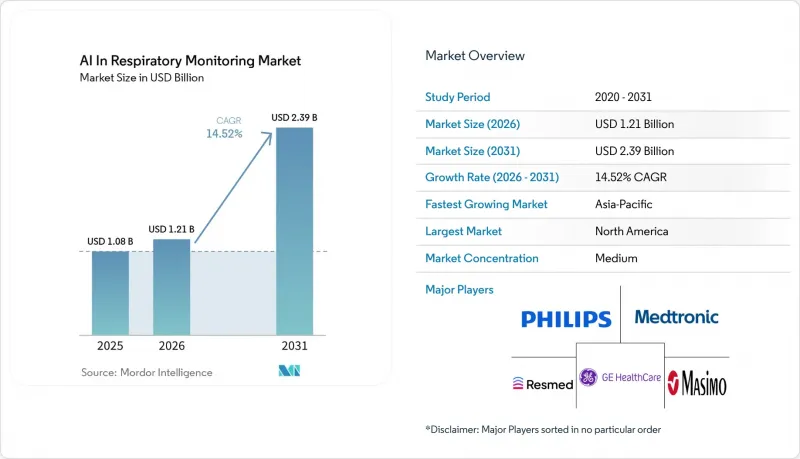
This report is Segmented by Component (Software, Services), Device Type (Wearable Respiratory Monitoring Devices, and Others), Technology (Machine Learning and Predictive Analytics, and Others), Application (Chronic Respiratory Disease Management, and Others), End-User (Hospitals and Clinics, and Others), and Geography (North America, Europe, Asia-Pacific, and Others). Value (USD) Forecasts.
Global AI In Respiratory Monitoring Market Trends and Insights
Increasing Adoption of AI-Enabled Respiratory Wearables
The AI in respiratory monitoring market is gaining momentum from wearable devices that are moving into regulated and billable care pathways. In August 2025, Respiree received a second FDA 510(k) clearance that expanded its RS001 chest-worn cardiorespiratory wearable from inpatient use into home settings through the connected 1Bio platform.That clearance matters because it shows regulatory comfort with continuous wireless streaming outside the hospital, which supports wider use in post-acute respiratory programs. The AI in respiratory monitoring market is also seeing stronger demand for patch and chest-worn formats that reduce friction for longer monitoring periods. This shifts value toward vendors that pair wearables with clinical dashboards, alert logic, and data continuity rather than relying on device sales alone. It also raises the pace of product iteration, because once wearables enter clinical workflows, accuracy, comfort, battery life, and reimbursement fit start to matter at the same time.
Integration of Predictive Analytics into Critical-Care Ventilators
The AI in respiratory monitoring market is also being lifted by predictive analytics that are moving ventilators from alarm response toward active therapy optimization. A prospective real-world evidence study tied to the automated ventilation software package was also listed with a January 2026 update, which shows that validation work is continuing in routine ICU settings. The practical effect is staffing leverage, because more automation can help one intensivist and a limited respiratory team oversee a larger patient load without lowering surveillance intensity. The AI in respiratory monitoring market therefore benefits not only from clinical utility, but also from workforce economics inside acute care hospitals. Vendors with larger proprietary patient datasets are better positioned here, because procurement committees increasingly want evidence from real-world use rather than only lab performance.
Limited Annotated Datasets for Rare Respiratory Disorders
The AI in respiratory monitoring market still faces a real data ceiling in rare respiratory disorders where labeled cases remain limited. A 2025 systematic review in Frontiers in Digital Health found strong performance for several AI and machine learning approaches in COPD exacerbation and readmission prediction, but it also noted persistent limits in generalizability when external validation datasets were missing. This is a structural issue because rarer disorders generate the least training data while often needing the most proactive monitoring. The AI in respiratory monitoring market therefore remains skewed toward common and well-reimbursed conditions such as COPD, OSA, and acute respiratory deterioration. Until multi-institution annotation pipelines improve, niche respiratory applications will continue to face slower adoption and tougher scrutiny from hospital buyers.
Other drivers and restraints analyzed in the detailed report include:
- Remote Patient-Monitoring Reimbursement Expansion
- Hospital Demand for Workflow Automation to Mitigate Respiratory Therapist Shortages
- Cyber-Security and HIPAA Concerns Streaming Physiological Data
For complete list of drivers and restraints, kindly check the Table Of Contents.
Segment Analysis
Software held 62.24% of the AI in respiratory monitoring market share in 2025, and it is also anticipated as the fastest-growing component with a 15.75% CAGR through 2031. The AI in respiratory monitoring market is showing clear value concentration in software because recurring licensing, cloud analytics, and algorithm updates scale more efficiently than physical devices. This dynamic makes revenue streams less dependent on shipment volumes and more dependent on data continuity, model refresh cycles, and clinical workflow adoption. Services remain important, but they mostly support installation, integration, training, and optimization rather than acting as the primary revenue driver. The segment structure therefore reflects how respiratory AI monetizes intelligence layers more effectively than hardware layers.
The AI in respiratory monitoring market also shows that software strength is tied to platform lock-in, not only to innovation speed. Hospitals that already calibrated one vendor's respiratory algorithms against their own patient mix face operational and financial friction when switching platforms. Within the AI in respiratory monitoring industry, this creates a moat for incumbents that can prove reimbursable outcomes such as event prevention and lower readmissions. The result is a software segment where retention economics matter almost as much as technical capability.
Wearable respiratory monitoring devices held 57.63% of revenue in 2025, while ventilation and critical care monitoring systems are projected to grow at a 16.90% CAGR through 2031. The AI in respiratory monitoring market is seeing wearables lead today because more patients with COPD, OSA, and post-acute respiratory needs are being managed outside hospitals. Smaller, less obtrusive form factors also make longer observation windows easier in both home and ambulatory settings. At the same time, the fastest growth is shifting toward ventilator-linked intelligence where AI software improves weaning support, alarm interpretation, and patient-ventilator synchronization. That growth is being driven by clinical intensity and software upgrade value rather than by unit volume alone.
Devices that transmit respiratory waveforms into analytical platforms carry more strategic value than standalone sensors that only record measurements. Within the AI in respiratory monitoring industry, that trend favors platform vendors that can convert raw waveforms into actionable clinical outputs across many patients at once. It is likely to compress margins for hardware-only manufacturers that do not control analytics, connectivity, or clinical reporting.
Complete Report Scope:
- By Component
- Software
- Services
- By Device Type
- Wearable Respiratory Monitoring Devices
- Ventilation and Critical Care Monitoring Systems
- Non-Invasive Monitoring Devices
- Sleep and Breathing Disorder Monitoring Devices
- Respiratory Imaging and Advanced Diagnostics Systems
- By Technology
- Machine Learning and Predictive Analytics
- Deep Learning
- Computer Vision (Imaging and waveform analysis)
- Edge AI and Real-Time Processing
- By Application
- Chronic Respiratory Disease Management
- Sleep and Breathing Disorder Monitoring
- Critical Care and Acute Respiratory Monitoring
- Fitness and Wellness Monitoring
- Post-Acute and Home Respiratory Care
- By End-User
- Hospitals and Clinics
- Home-Care Settings
- Long-Term Care and Home Healthcare Providers
- Diagnostic Laboratories
- Other End-Users
- By Geography
- North America
- United States
- Canada
- Mexico
- Europe
- Germany
- United Kingdom
- France
- Italy
- Spain
- Rest of Europe
- Asia-Pacific
- China
- Japan
- India
- Australia
- South Korea
- Rest of Asia-Pacific
- Middle East and Africa
- GCC
- South Africa
- Rest of Middle East and Africa
- South America
- Brazil
- Argentina
- Rest of South America
- North America
Geography Analysis
North America held 44.37% of the AI in respiratory monitoring market share in 2025, which makes it the largest regional revenue base. The AI in respiratory monitoring market is strongest in this region because reimbursement infrastructure, digital workflow maturity, and clinical validation activity are deeper than in other geographies. CMS reinforced that position through the 2026 physician fee schedule updates that lowered the respiratory remote therapeutic monitoring billing threshold to 2 days of transmitted data within a 30-day period. That policy makes home respiratory monitoring more commercially viable and strengthens the software and services layers that sit around connected devices.
Europe remains the second-largest geography in the AI in respiratory monitoring market, with Germany and the UK acting as the main anchor countries. Germany is particularly important because reimbursement routes for digital health applications create a clearer path for software-led respiratory monitoring adoption. The region also benefits from strong hospital engineering standards and established critical care device ecosystems. At the same time, the AI in respiratory monitoring market faces a more demanding compliance path in Europe for clinical AI tools, which raises the burden on validation and documentation for new entrants.
Asia-Pacific is projected to be the fastest-growing geography at a 17.41% CAGR through 2031, which reflects the strongest expansion profile in the AI in respiratory monitoring market. Growth is being driven by China's push toward domestic AI medical devices, Japan's aging population, and India's expanding digital health infrastructure. The region is also benefiting from manufacturing depth in sensors and connected devices, which supports broader rollout of wearable and home-based respiratory systems. This makes Asia-Pacific important not only as a sales region but also as a supply and innovation base. South America and the Middle East and Africa remain smaller in current revenue terms, yet adoption is building in metropolitan tertiary-care centers and digitally advancing health systems.
- Aidence B.V.
- AireHealth Inc.
- Alveo AI
- Beckton Dickinson
- Dragerwerk
- EnsoData Inc.
- GE Healthcare
- Hamilton Medical
- Health Care Originals Inc.
- Koninklijke Philips
- Lunit
- Masimo
- Medtronic
- Nihon Kohden
- NuvoAir AB
- Resmed
- Smiths Group
- Spire Health
- VitalConnect Inc.
- Zebra Medical Vision Ltd.
Additional Benefits:
- The market estimate (ME) sheet in Excel format
- 3 months of analyst support
TABLE OF CONTENTS
1 Introduction
- 1.1 Study Assumptions and Market Definition
- 1.2 Scope of the Study
2 Research Methodology
3 Executive Summary
4 Market Landscape
- 4.1 Market Overview
- 4.2 Market Drivers
- 4.2.1 Increasing Adoption of AI-Enabled Respiratory Wearables
- 4.2.2 Integration of Predictive Analytics into Critical-Care Ventilators
- 4.2.3 Remote Patient-Monitoring Reimbursement Expansion
- 4.2.4 Hospital Demand for Workflow Automation to Mitigate Respiratory Therapist Shortages
- 4.2.5 Miniaturization of MEMS Sensors Enabling Continuous At-Home Monitoring
- 4.2.6 Real-Time Multimodal Data Fusion for Early COPD Exacerbation Alerts
- 4.3 Market Restraints
- 4.3.1 Limited Annotated Datasets for Rare Respiratory Disorders
- 4.3.2 Cyber-Security and HIPAA Concerns Streaming Physiological Data
- 4.3.3 Clinician Skepticism Toward "Black Box" AI Algorithms
- 4.3.4 High Integration Costs in Legacy Hospital IT Stacks
- 4.4 Supply/Value Chain Analysis
- 4.5 Regulatory Landscape
- 4.6 Technological Outlook
- 4.7 Porter's Five Forces Analysis
- 4.7.1 Threat of New Entrants
- 4.7.2 Bargaining Power of Suppliers
- 4.7.3 Bargaining Power of Buyers
- 4.7.4 Threat of Substitutes
- 4.7.5 Competitive Rivalry
5 Market Size & Growth Forecasts (Value, USD)
- 5.1 By Component
- 5.1.1 Software
- 5.1.2 Services
- 5.2 By Device Type
- 5.2.1 Wearable Respiratory Monitoring Devices
- 5.2.2 Ventilation and Critical Care Monitoring Systems
- 5.2.3 Non-Invasive Monitoring Devices
- 5.2.4 Sleep and Breathing Disorder Monitoring Devices
- 5.2.5 Respiratory Imaging and Advanced Diagnostics Systems
- 5.3 By Technology
- 5.3.1 Machine Learning and Predictive Analytics
- 5.3.2 Deep Learning
- 5.3.3 Computer Vision (Imaging and waveform analysis)
- 5.3.4 Edge AI and Real-Time Processing
- 5.4 By Application
- 5.4.1 Chronic Respiratory Disease Management
- 5.4.2 Sleep and Breathing Disorder Monitoring
- 5.4.3 Critical Care and Acute Respiratory Monitoring
- 5.4.4 Fitness and Wellness Monitoring
- 5.4.5 Post-Acute and Home Respiratory Care
- 5.5 By End-User
- 5.5.1 Hospitals and Clinics
- 5.5.2 Home-Care Settings
- 5.5.3 Long-Term Care and Home Healthcare Providers
- 5.5.4 Diagnostic Laboratories
- 5.5.5 Other End-Users
- 5.6 By Geography
- 5.6.1 North America
- 5.6.1.1 United States
- 5.6.1.2 Canada
- 5.6.1.3 Mexico
- 5.6.2 Europe
- 5.6.2.1 Germany
- 5.6.2.2 United Kingdom
- 5.6.2.3 France
- 5.6.2.4 Italy
- 5.6.2.5 Spain
- 5.6.2.6 Rest of Europe
- 5.6.3 Asia-Pacific
- 5.6.3.1 China
- 5.6.3.2 Japan
- 5.6.3.3 India
- 5.6.3.4 Australia
- 5.6.3.5 South Korea
- 5.6.3.6 Rest of Asia-Pacific
- 5.6.4 Middle East and Africa
- 5.6.4.1 GCC
- 5.6.4.2 South Africa
- 5.6.4.3 Rest of Middle East and Africa
- 5.6.5 South America
- 5.6.5.1 Brazil
- 5.6.5.2 Argentina
- 5.6.5.3 Rest of South America
- 5.6.1 North America
6 Competitive Landscape
- 6.1 Market Concentration
- 6.2 Market Share Analysis
- 6.3 Company Profiles (includes Global level Overview, Market level overview, Core Segments, Financials as available, Strategic Information, Market Rank/Share for key companies, Products & Services, Recent Developments)
- 6.3.1 Aidence B.V.
- 6.3.2 AireHealth Inc.
- 6.3.3 Alveo AI
- 6.3.4 Becton, Dickinson & Company
- 6.3.5 Dragerwerk AG & Co. KGaA
- 6.3.6 EnsoData Inc.
- 6.3.7 GE Healthcare
- 6.3.8 Hamilton Medical AG
- 6.3.9 Health Care Originals Inc.
- 6.3.10 Koninklijke Philips N.V.
- 6.3.11 Lunit Inc.
- 6.3.12 Masimo Corporation
- 6.3.13 Medtronic plc
- 6.3.14 Nihon Kohden Corporation
- 6.3.15 NuvoAir AB
- 6.3.16 ResMed Inc.
- 6.3.17 Smiths Medical (ICU Medical)
- 6.3.18 Spire Health
- 6.3.19 VitalConnect Inc.
- 6.3.20 Zebra Medical Vision Ltd.
7 Market Opportunities & Future Outlook
- 7.1 White-space & Unmet-need Assessment

