PUBLISHER: Mordor Intelligence | PRODUCT CODE: 2072750

PUBLISHER: Mordor Intelligence | PRODUCT CODE: 2072750
Cotton Harvesting Machinery - Market Share Analysis, Industry Trends & Statistics, Growth Forecasts (2026 - 2031)
According to Mordor Intelligence, the cotton harvester market size is projected to grow from USD 3.81 billion in 2025 and USD 4.03 billion in 2026 to USD 5.34 billion by 2031, registering a CAGR of 5.79% between 2026 and 2031.
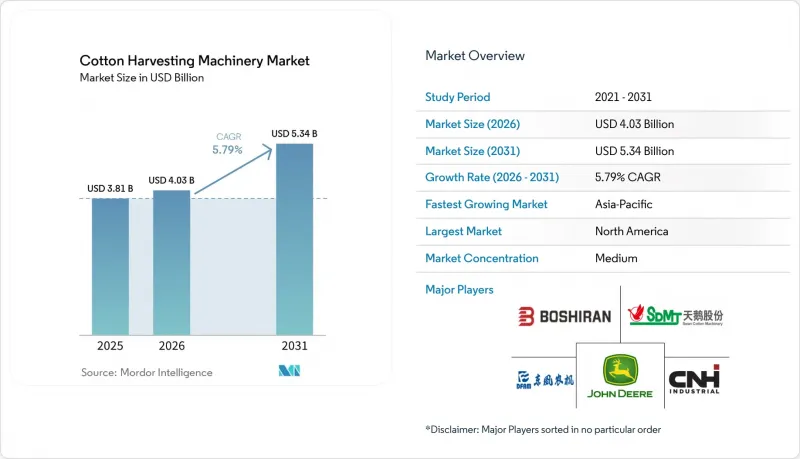
This report is Segmented by Type (Spindle Pickers and Stripper Harvesters), by Mechanism (Self-Propelled and Tractor-Mounted), by Power Source (Diesel-Powered, Electric-Powered, and Others), and by Geography (North America, Asia-Pacific, and Others). The Market Forecasts are Provided in Terms of Value (USD).
Global Cotton Harvesting Machinery Market Trends and Insights
Escalating Farm-Labor Shortages and Wage Inflation
Cotton-picking labor pools shrank significantly across leading producing regions between 2021 and 2025, pushing growers toward mechanized solutions. The United States H-2A program certified more than 398,258 positions in fiscal 2025, yet seasonal labor shortages persisted in major agricultural states. Rising Adverse Effect Wage Rates, including increases in California, are strengthening the economic case for large-scale mechanized cotton harvesting. China's Xinjiang region experienced rural-to-urban migration, reducing the availability of cotton pickers and accelerating the adoption of mechanization across the region. In India, government support programs have increased subsidies for agricultural machinery in labor-deficit states where manual harvesting costs remain high. Australia also faced shortages of seasonal agricultural labor, prompting growers in key cotton-producing valleys to lease additional harvesters rather than expand manual crews. Together, these labor and wage pressures are shortening the payback period for mechanized harvesting and sustaining demand for cotton-harvesting equipment.
Rapid Adoption of Automation, Artificial Intelligence, and GPS-Guided Precision Harvesting
Cotton harvesters are evolving into connected, precision-agriculture platforms designed to enhance traceability, operational efficiency, and fiber-quality management. At the Consumer Electronics Show 2024, John Deere showcased automated cotton harvesting technologies integrated with the CP770 cotton picker, enabling real-time monitoring of module production, moisture, weight, GPS location, and harvest data. The system supports digital data sharing across cotton harvesting and gin-management workflows. These advanced harvesting capabilities enable growers to optimize harvesting decisions, minimize manual processes, and improve cotton traceability from the field to end use. Meanwhile, manufacturers are integrating advanced satellite-guided auto-steering technologies into cotton harvesters to enhance field precision and operational efficiency at lower implementation costs compared to imported navigation systems. These technological advancements are delivering immediate operational benefits, encouraging growers in major cotton-producing countries such as the United States, China, and Australia to accelerate equipment upgrades despite fluctuations in cotton prices.
High Upfront Purchase and Life-Cycle Maintenance Costs
A six-row spindle picker is typically priced at premium levels, reflecting its advanced automation, large-scale harvesting efficiency, and high operational capacity, equal to 15-20 years of net income for a 10-hectare farm in Gujarat or Kaduna. Annual upkeep includes spindle replacement, hydraulic rebuilds, and telematics fees. Even with subsidies, growers still face significant financing requirements that exceed typical rural credit ceilings. In Africa, limited access to affordable financing and high interest rates constrain adoption despite rising labor costs. Brazilian mid-sized farms face high equipment costs that absorb a large share of annual revenue. Specialty financiers carry residual-value risk, limiting lease offerings where acreage fluctuates significantly year to year. Until capital costs fall or flexible financing models expand, high entry prices will continue to restrict penetration in smallholder regions.
Other drivers and restraints analyzed in the detailed report include:
- Government Subsidy Programs Accelerating Mechanization in China, India, and the United States
- Rising Global Cotton Consumption and Acreage Expansion
- Cotton-Price Volatility Delaying Capital-Equipment Spending
For complete list of drivers and restraints, kindly check the Table Of Contents.
Segment Analysis
Spindle pickers accounted for 54.2% of the cotton harvester market share in 2025, reflecting their dominance in premium-grade upland and long-staple production. Stripper harvesters ranked second-largest, favored in once-over dryland operations across Texas, Oklahoma, and Australia. Their widespread adoption is driven by lower contamination rates, higher fiber retention efficiency, and compatibility with large-scale mechanized harvesting operations.
Stripper harvesters are projected to register the quickest 6.4% CAGR between 2026 and 2031 as dryland acreage expands in the United States and Brazil, while spindle units are set to advance more modestly over the same span. Fuel savings of 18% on once-over passes, a 20% speed gain on Deere's CS770, and rising cultivar tolerance for aggressive stripping methods all support the lead growth rate. Replacement demand in China and Turkey will still sustain spindle sales, as stringent fiber-quality penalties remain. The combined effect leaves the cotton harvester market size more balanced by 2031, without dislodging spindle leadership. Rising investments in mechanization and continuous advancements in harvesting technology are anticipated to further drive demand in both developed and emerging cotton markets.
Complete Report Scope:
- By Type
- Spindle Pickers
- Stripper Harvesters
- By Mechanism
- Self-propelled
- Tractor-mounted
- By Power Source
- Diesel-powered
- Electric-powered
- Hybrid-powered
- By Geography
- North America
- United States
- Canada
- Rest of the North America
- South America
- Brazil
- Argentina
- Rest of the South America
- Europe
- Germany
- Spain
- Greece
- Rest of Europe
- Asia-Pacific
- China
- India
- Australia
- Rest of Asia-Pacific
- Middle East
- Turkey
- Israel
- Rest of the Middle East
- Africa
- Egypt
- South Africa
- Rest of the Africa
- North America
Geography Analysis
North America generated 36.8% of 2025 revenue, and the region is projected to grow at a steady pace driven by rising farm-labor costs and increasing adoption of mechanized and precision agriculture practices. Leading equipment manufacturers continue to strengthen their presence through advanced technology integration and automation capabilities, supporting ongoing replacement and upgrade demand even during periods of cotton price softness.
Asia-Pacific is forecast to record the fastest 8.3% CAGR through 2031, supported by government subsidies and productivity improvement programs that reduce payback periods for mechanized harvesting equipment. High mechanization levels in China are generating steady replacement demand, while Australia continues to demonstrate strong adoption of advanced harvesting systems. In India, compact and affordable picker development is estimated to unlock adoption in smallholder farms that currently rely on manual harvesting, significantly expanding the addressable market across fragmented landholding structures.
South America is projected to advance steadily, led by Brazil where expanding cotton acreage and mechanization are supporting equipment demand, while credit programs are steering adoption toward more affordable machinery options. Argentina's import-related constraints and currency volatility continue to influence purchasing behavior. Europe holds a smaller share of revenue, with regulatory compliance requirements and higher operational costs limiting new equipment adoption despite underlying acreage expansion in select regions. The Middle East and Africa together account for a modest share, where policy support is improving mechanization in some markets, but limited financing access and weak service infrastructure continue to restrict large-scale adoption in several sub-Saharan regions.
- Deere & Company.
- CNH Industrial N.V.
- Mahindra and Mahindra Ltd.
- OJSC "Gomselmash"
- Shandong Swan Cotton Industrial Machinery Stock Co., Ltd.
- Changzhou Dongfeng Agricultural Machinery Group Co., Ltd.
- Xinjiang Boshiran Intelligent Agricultural Machinery Co., Ltd.
- Hubei Fotma Machinery Co., Ltd.
- Jiangsu World Agricultural Machinery Co., Ltd.
- ColhiCana Agricultural Machinery
Additional Benefits:
- The market estimate (ME) sheet in Excel format
- 3 months of analyst support
TABLE OF CONTENTS
1 Introduction
- 1.1 Study Assumptions and Market Definition
- 1.2 Scope of the Study
2 Research Methodology
3 Executive Summary
4 Market Landscape
- 4.1 Market Overview
- 4.2 Market Drivers
- 4.2.1 Escalating farm-labor shortages and wage inflation
- 4.2.2 Rapid adoption of automation, artificial intelligence, and GPS-guided precision harvesting
- 4.2.3 Government subsidy programs accelerating mechanization in China, India, and the United States
- 4.2.4 Rising global cotton consumption and acreage expansion
- 4.2.5 Proliferation of on-board round-bale module builders that cut logistics costs
- 4.2.6 Emergence of pay-per-use harvesting-as-a-service platforms in developing markets
- 4.3 Market Restraints
- 4.3.1 High upfront purchase and life-cycle maintenance costs
- 4.3.2 Cotton-price volatility delaying capital-equipment spending
- 4.3.3 Sparse dealer telematics infrastructure hindering predictive-maintenance adoption in emerging regions
- 4.3.4 Stricter soil-compaction and emission regulations raising redesign and compliance expenses
- 4.4 Regulatory Landscape
- 4.5 Technological Outlook
- 4.6 Porters Five Forces
- 4.6.1 Threat of New Entrants
- 4.6.2 Bargaining Power of Suppliers
- 4.6.3 Bargaining Power of Buyers
- 4.6.4 Threat of Substitute Products
- 4.6.5 Competitive Rivalry
5 Market Size and Growth Forecasts (Value)
- 5.1 By Type
- 5.1.1 Spindle Pickers
- 5.1.2 Stripper Harvesters
- 5.2 By Mechanism
- 5.2.1 Self-propelled
- 5.2.2 Tractor-mounted
- 5.3 By Power Source
- 5.3.1 Diesel-powered
- 5.3.2 Electric-powered
- 5.3.3 Hybrid-powered
- 5.4 By Geography
- 5.4.1 North America
- 5.4.1.1 United States
- 5.4.1.2 Canada
- 5.4.1.3 Rest of the North America
- 5.4.2 South America
- 5.4.2.1 Brazil
- 5.4.2.2 Argentina
- 5.4.2.3 Rest of the South America
- 5.4.3 Europe
- 5.4.3.1 Germany
- 5.4.3.2 Spain
- 5.4.3.3 Greece
- 5.4.3.4 Rest of Europe
- 5.4.4 Asia-Pacific
- 5.4.4.1 China
- 5.4.4.2 India
- 5.4.4.3 Australia
- 5.4.4.4 Rest of Asia-Pacific
- 5.4.5 Middle East
- 5.4.5.1 Turkey
- 5.4.5.2 Israel
- 5.4.5.3 Rest of the Middle East
- 5.4.6 Africa
- 5.4.6.1 Egypt
- 5.4.6.2 South Africa
- 5.4.6.3 Rest of the Africa
- 5.4.1 North America
6 Competitive Landscape
- 6.1 Market Concentration
- 6.2 Strategic Moves
- 6.3 Market Share Analysis
- 6.4 Company Profiles (Includes Global Level Overview, Market Level Overview, Core Segments, Financials as Available, Strategic Information, Market Rank/Share for Key Companies, Products and Services, and Recent Developments)
- 6.4.1 Deere & Company.
- 6.4.2 CNH Industrial N.V.
- 6.4.3 Mahindra and Mahindra Ltd.
- 6.4.4 OJSC "Gomselmash"
- 6.4.5 Shandong Swan Cotton Industrial Machinery Stock Co., Ltd.
- 6.4.6 Changzhou Dongfeng Agricultural Machinery Group Co., Ltd.
- 6.4.7 Xinjiang Boshiran Intelligent Agricultural Machinery Co., Ltd.
- 6.4.8 Hubei Fotma Machinery Co., Ltd.
- 6.4.9 Jiangsu World Agricultural Machinery Co., Ltd.
- 6.4.10 ColhiCana Agricultural Machinery
7 Market Opportunities and Future Outlook

