PUBLISHER: Mordor Intelligence | PRODUCT CODE: 2072758

PUBLISHER: Mordor Intelligence | PRODUCT CODE: 2072758
Laser Hair Removal - Market Share Analysis, Industry Trends & Statistics, Growth Forecasts (2026 - 2031)
According to Mordor Intelligence, the laser hair removal market size is expected to grow from USD 1.49 billion in 2025 to USD 1.72 billion in 2026 and is forecast to reach USD 3.44 billion by 2031 at 14.88% CAGR over 2026-2031.
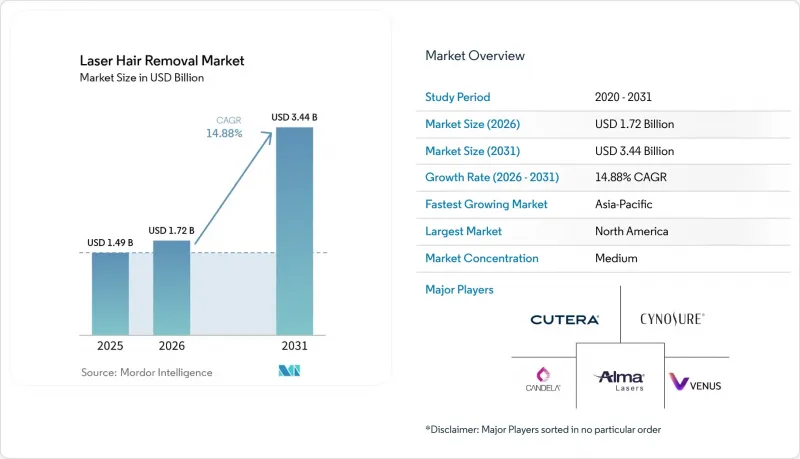
This report is Segmented by Laser Type (Diode, Alexandrite, Nd:yag, Ruby, IPL, Hybrid/Multi-Wavelength), Product Type (Standalone, Multi-Functional), End User (Clinics, Aesthetic Centers, Hospitals, Home Use), Gender (Female, Male), Technology (Single/Multi-Wavelength, Combination), Channel (Online, Offline), and Geography (North America, Europe, Asia-Pacific, MEA, South America). Forecasts in Value (USD).
Global Laser Hair Removal Market Trends and Insights
Rising Preference for Non-Invasive Aesthetic Procedures
Many consumers now view laser hair removal as a regular personal care service rather than an occasional luxury. This shift is significant, as it boosts repeat visits and encourages larger multi-session packages in the laser hair removal market. By August 2025, Milan Laser Hair Removal had expanded to over 400 locations across 38 U.S. states, focusing on lifetime guarantee packages instead of one-off sessions. This approach ties customers to a longer relationship, making it challenging for them to switch once treatment begins. It also benefits larger operators, allowing them to distribute marketing and service costs across a wider clinic network. Consequently, the market is witnessing a distinct divide: organized chains are thriving, while smaller providers struggle, often relying on single-visit demand.
Technology Shift Toward Faster Multi-Wavelength Platforms
Innovations in devices are not only enhancing clinical outcomes but also reshaping the economics of treatment rooms. In April 2025, Candela announced that its GLX Delivery System, paired with GentleMax Pro Plus, cut the time between treatments by 81% and reduced session durations by 21%. Following suit, Sciton unveiled its OMNI platform in June 2025. This 5,000W system, featuring a blend of 760 nm, 810/940 nm, and 1060 nm wavelengths, caters to all skin types and practice sizes. Such advancements enable clinics to manage high volumes more efficiently, broadening patient eligibility and optimizing room usage. In contrast, clinics sticking to older, single-wavelength systems may struggle with reduced throughput and limited treatment options. This widening gap is bolstering premium positioning in the market and intensifying the urgency for upgrades.
High Upfront Cost of Professional Systems and Recurring Maintenance
Smaller operators face significant challenges due to the high initial investment required for professional systems. Annual maintenance costs, accounting for 10% to 15% of the system's price, further strain profitability for clinics with lower treatment volumes. This issue is more pronounced in regions like parts of the Middle East, South America, and emerging Asia-Pacific markets, where limited financing options and high import duties increase costs. InMode, in its full-year 2025 results, announced plans to launch two new laser-based platforms in 2026, reflecting a rapid product cycle. This shortens the timeframe before systems become outdated, creating difficulties for clinics still paying off older equipment and widening the gap between large networks and smaller operators.
Other drivers and restraints analyzed in the detailed report include:
- Home-Use Laser Hair Removal Device Adoption Through E-Commerce and DTC Channels
- Expansion of Premium Aesthetic Clinic Networks and Franchises
- Risk of Burns, Pigment Changes, and Operator-Dependency in Treatment Outcomes
For complete list of drivers and restraints, kindly check the Table Of Contents.
Segment Analysis
In 2025, the diode laser held 34.45% of the global laser hair removal market share, making it the leading laser type. Its popularity stems from a strong clinical track record, broad vendor availability, and lower capital costs compared to premium alternatives. Diode systems are well-suited for high-volume clinics due to their balance of efficacy and operational practicality across diverse patient groups. With a dermal penetration of 3 mm to 4 mm, they effectively target follicles in light-to-medium skin types while minimizing epidermal absorption.
Nd:YAG is projected to grow at a 15.35% CAGR from 2026 to 2031, making it the fastest-growing laser type. Its safety profile for darker Fitzpatrick IV-VI skin types is driving demand in multicultural markets. The 1064 nm wavelength offers deeper penetration and reduces epidermal injury risk when applied correctly. Alexandrite remains a strong choice for lighter skin treatments due to higher melanin absorption and faster cycles. Ruby is becoming obsolete, while IPL faces competition from advanced laser platforms. Hybrid and multi-wavelength platforms are gaining traction, supported by FDA clearance for dual-wavelength emission across all Fitzpatrick types, pushing the market toward inclusivity.
Standalone laser devices accounted for 56.88% of product-type revenue in 2025, as clinics favored systems that are easier to train on, maintain, and purchase. These platforms are ideal for clinics focused solely on hair removal, maintaining relevance in single-service practices. Their established base remains significant due to gradual replacement cycles.
Multi-functional devices are expected to grow at a 15.78% CAGR from 2026 to 2031 as clinics aim to maximize revenue per machine. Sciton's OMNI platform, launched in June 2025, and Alma Harmony, introduced in March 2025, reflect this trend. These platforms support multiple indications, spreading equipment costs across procedures and increasing utilization. They also create upgrade pressure on older standalone systems, signaling a shift toward platform-based economics in the market.
Complete Report Scope:
- By Laser Type
- Diode Laser
- Alexandrite Laser
- Nd:YAG Laser
- Ruby Laser
- Intense Pulsed Light Devices
- Hybrid and Multi-Wavelength Systems
- By Product Type
- Standalone Laser Devices
- Multi-Functional Laser Devices
- By End User
- Dermatology Clinics
- Beauty and Aesthetic Centers
- Hospitals
- Home Use
- By Gender
- Female
- Male
- By Technology
- Single-Wavelength Technology
- Multi-Wavelength Technology
- Combination Laser Technology
- By Distribution Channel
- Online Retail
- Offline Retail
- By Geography
- North America
- United States
- Canada
- Mexico
- Europe
- Germany
- United Kingdom
- France
- Italy
- Spain
- Rest of Europe
- Asia-Pacific
- China
- India
- Japan
- Australia
- South Korea
- Rest of Asia-Pacific
- Middle East and Africa
- GCC
- South Africa
- Rest of Middle East and Africa
- South America
- Brazil
- Argentina
- Rest of South America
- North America
Geography Analysis
In 2025, North America dominated the global laser hair removal market, holding a significant 41.25% share. The region benefits from a dense clinic network, strong awareness of aesthetic procedures, and the presence of leading device OEMs. The U.S. remains the largest national market, with major chains achieving nationwide reach. By August 2025, Milan Laser Hair Removal operated over 400 locations across 38 states, while LaserAway expanded to over 200 clinics in 35 states, improving access and driving price normalization across metropolitan areas.
Canada, though earlier in its clinic expansion cycle, is progressing steadily. In May 2025, Laser Clinics Canada opened its 8th location at Vaughan Mills and announced plans to expand to 40 locations nationwide. Mexico, while smaller, is an emerging market supported by urban middle-class spending and medical tourism. The Asia-Pacific region is projected to grow at a 16.52% CAGR from 2026 to 2031, making it the fastest-growing region. China leads the region, with regulatory access improving as Cynosure Lutronic's Clarity II received hair reduction approval from the National Medical Products Administration in February 2026.
Japan advanced when Clarity II gained PMDA clearance for long-term hair reduction in January 2026, a notable achievement in a market known for stringent device approvals. South Korea influences regional standards with its dense clinic network, training culture, and strong role in aesthetic exports. India is a high-growth market driven by its young urban population, expanding clinic network, and growing e-commerce access to home-use devices. Australia shows steady growth due to strong awareness and an established professional services base. Europe remains a mature but receptive market, with Germany, the UK, France, Italy, and Spain driving demand. The EU MDR framework favors products with robust clinical documentation.
- Alma Lasers
- Asclepion Laser Technologies GmbH
- Bison Medical Co., Ltd.
- Braun GmbH
- Candela Medical
- Cutera
- Cynosure, LLC
- DEKA M.E.L.A. S.r.l.
- Fotona d.o.o.
- Home Skinovations Ltd.
- InMode Ltd.
- Koninklijke Philips
- Lumenis
- Lutronic
- Lynton Lasers
- Quanta System S.p.A.
- Sciton
- Solta Medical, Inc.
- Tria Beauty, Inc.
- Venus Concept Inc.
- Viora Ltd.
Additional Benefits:
- The market estimate (ME) sheet in Excel format
- 3 months of analyst support
TABLE OF CONTENTS
1 INTRODUCTION
- 1.1 Study Assumptions and Market Definition
- 1.2 Scope of the Study
2 RESEARCH METHODOLOGY
3 EXECUTIVE SUMMARY
4 MARKET LANDSCAPE
- 4.1 Market Overview
- 4.2 Market Drivers
- 4.2.1 Rising Preference for Non-Invasive Aesthetic Procedures
- 4.2.2 Expansion of Premium Aesthetic Clinic Networks and Franchise Models
- 4.2.3 Technology Shift Toward Faster Multi-Wavelength Platforms
- 4.2.4 Home-Use Device Adoption Through E-Commerce and Consumer Electronics Retail
- 4.2.5 Male Grooming Normalization in High-Disposable-Income Urban Segments
- 4.2.6 Demand for Skin-Tone Inclusive Systems in Multicultural Markets
- 4.3 Market Restraints
- 4.3.1 Risk of Burns, Pigment Changes, and Operator-Dependent Outcomes
- 4.3.2 High Upfront Cost of Professional Systems and Recurring Treatment Costs
- 4.3.3 At-Home IPL and Low-Cost Device Substitution Pressure
- 4.3.4 Limited Efficacy on Light Hair, Hormonal Regrowth, and Darker Skin Without Proper Settings
- 4.4 Value/Supply Chain Analysis
- 4.5 Regulatory Landscape
- 4.6 Technological Outlook
- 4.7 Pricing Analysis
- 4.8 Porter's Five Forces Analysis
- 4.8.1 Threat of New Entrants
- 4.8.2 Bargaining Power of Suppliers
- 4.8.3 Bargaining Power of Buyers
- 4.8.4 Threat of Substitutes
- 4.8.5 Industry Rivalry
5 MARKET SIZE AND GROWTH FORECASTS (VALUE, USD)
- 5.1 By Laser Type
- 5.1.1 Diode Laser
- 5.1.2 Alexandrite Laser
- 5.1.3 Nd:YAG Laser
- 5.1.4 Ruby Laser
- 5.1.5 Intense Pulsed Light Devices
- 5.1.6 Hybrid and Multi-Wavelength Systems
- 5.2 By Product Type
- 5.2.1 Standalone Laser Devices
- 5.2.2 Multi-Functional Laser Devices
- 5.3 By End User
- 5.3.1 Dermatology Clinics
- 5.3.2 Beauty and Aesthetic Centers
- 5.3.3 Hospitals
- 5.3.4 Home Use
- 5.4 By Gender
- 5.4.1 Female
- 5.4.2 Male
- 5.5 By Technology
- 5.5.1 Single-Wavelength Technology
- 5.5.2 Multi-Wavelength Technology
- 5.5.3 Combination Laser Technology
- 5.6 By Distribution Channel
- 5.6.1 Online Retail
- 5.6.2 Offline Retail
- 5.7 By Geography
- 5.7.1 North America
- 5.7.1.1 United States
- 5.7.1.2 Canada
- 5.7.1.3 Mexico
- 5.7.2 Europe
- 5.7.2.1 Germany
- 5.7.2.2 United Kingdom
- 5.7.2.3 France
- 5.7.2.4 Italy
- 5.7.2.5 Spain
- 5.7.2.6 Rest of Europe
- 5.7.3 Asia-Pacific
- 5.7.3.1 China
- 5.7.3.2 India
- 5.7.3.3 Japan
- 5.7.3.4 Australia
- 5.7.3.5 South Korea
- 5.7.3.6 Rest of Asia-Pacific
- 5.7.4 Middle East and Africa
- 5.7.4.1 GCC
- 5.7.4.2 South Africa
- 5.7.4.3 Rest of Middle East and Africa
- 5.7.5 South America
- 5.7.5.1 Brazil
- 5.7.5.2 Argentina
- 5.7.5.3 Rest of South America
- 5.7.1 North America
6 COMPETITIVE LANDSCAPE
- 6.1 Market Concentration
- 6.2 Market Share Analysis
- 6.3 Company Profiles (includes Global Level Overview, Market Level Overview, Core Segments, Financials as available, Strategic Information, Market Rank/Share, Products and Services, Recent Developments)
- 6.3.1 Alma Lasers Ltd.
- 6.3.2 Asclepion Laser Technologies GmbH
- 6.3.3 Bison Medical Co., Ltd.
- 6.3.4 Braun GmbH
- 6.3.5 Candela Corporation
- 6.3.6 Cutera, Inc.
- 6.3.7 Cynosure, LLC
- 6.3.8 DEKA M.E.L.A. S.r.l.
- 6.3.9 Fotona d.o.o.
- 6.3.10 Home Skinovations Ltd.
- 6.3.11 InMode Ltd.
- 6.3.12 Koninklijke Philips N.V.
- 6.3.13 Lumenis Be Ltd.
- 6.3.14 Lutronic Corporation
- 6.3.15 Lynton Lasers Ltd.
- 6.3.16 Quanta System S.p.A.
- 6.3.17 Sciton, Inc.
- 6.3.18 Solta Medical, Inc.
- 6.3.19 Tria Beauty, Inc.
- 6.3.20 Venus Concept Inc.
- 6.3.21 Viora Ltd.
7 MARKET OPPORTUNITIES AND FUTURE OUTLOOK
- 7.1 White-Space and Unmet-Need Assessment

