PUBLISHER: Mordor Intelligence | PRODUCT CODE: 2072811

PUBLISHER: Mordor Intelligence | PRODUCT CODE: 2072811
United States Adhesion Barrier - Market Share Analysis, Industry Trends & Statistics, Growth Forecasts (2026 - 2031)
According to Mordor Intelligence, the united states adhesion barrier market size is expected to grow from USD 292.69 million in 2025 to USD 311.21 million in 2026 and is forecast to reach USD 435.43 million by 2031 at 6.95% CAGR over 2026-2031.
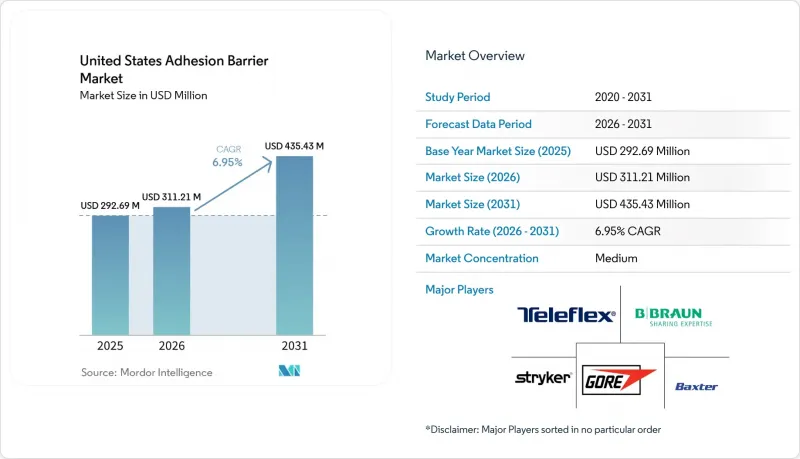
This report is Segmented by Product Type (Synthetic, Natural), Formulation (Film and Mesh, Gel, Liquid), Absorbability (Absorbable, Non-Absorbable), Application (General/Abdominal, Gynecological, Orthopedic, Cardiovascular, Neurological, Urological, Reconstructive Surgeries), and End User (Hospitals, Ascs, Specialty Clinics). The Market Forecasts are Provided in Terms of Value (USD).
United States Adhesion Barrier Market Trends and Insights
Rising Robotic and Minimally Invasive Surgery Volumes
Robotic surgery is expanding the procedural base that can support faster adoption in the United States adhesion barrier market. Robotic-assisted procedures now account for 22% of all surgeries performed in the United States, and adoption remains strongest in major hospital systems that continue to deploy newer platforms. This shift matters because much of the installed product base in the United States adhesion barrier market still centers on rigid film formats that fit open surgery better than trocar-based access. As a result, the growth of robotic and minimally invasive surgery is pushing the United States adhesion barrier market toward gels, sprays, and other conformable products that can be delivered through smaller ports and over uneven tissue surfaces. The stronger the shift toward these procedures, the more the United States adhesion barrier market rewards developers that can reduce handling friction in laparoscopic and robotic settings. That format transition is already visible in the faster expected growth rate of gels compared with the overall category.
Bundled Payment Pressure to Reduce Adhesion-Related Readmissions
Bundled payment reform is making complication avoidance more financially relevant in the United States adhesion barrier market. CMS finalized the TEAM model with mandatory implementation starting January 1, 2026, across 741 hospitals in 188 metropolitan statistical areas, and the covered episodes include major bowel procedures and spinal fusion. These episodes matter because adhesions affect up to 93% of patients after abdominal or pelvic surgery, while open surgery and colorectal surgery are associated with much higher readmission risk from adhesion-related complications. Readmissions also feed directly into the quality and repayment logic of TEAM, which gives hospital administrators a clearer basis for evaluating prevention tools in the United States adhesion barrier market. CMS has also shortened the HRRP measurement window from 3 years to 2 years for FY2026, which makes recent performance more visible and raises the cost of preventable readmission events. Together, these payment changes are moving the United States adhesion barrier market closer to a risk-management purchase decision instead of a purely discretionary clinical add-on.
Uneven Reimbursement Recognition Across Procedure Settings
Reimbursement remains one of the clearest limits on adoption in the United States adhesion barrier market. CMS recognizes adhesion barriers under HCPCS Level II code C1765, but payment treatment still varies by payer, procedure, and site of care, and many ASC and outpatient settings must absorb the cost within existing facility fees. That gap is especially relevant for gynecological and minimally invasive procedures because those cases are moving into settings where margins are tighter and product-specific payment support is less consistent. The pressure is stronger in 2026 because HRRP changes broaden the readmission measurement base while not creating a uniform reimbursement pathway for adhesion prevention products. Clinical guidance supports use in selected settings, but endorsement alone has not converted into consistent coding and payment treatment across the United States adhesion barrier market. Until that changes, many facilities will continue to weigh barrier use against immediate case economics instead of total complication costs over the full episode of care.
Other drivers and restraints analyzed in the detailed report include:
- Product Innovation in Bioresorbable and Sprayable Barriers
- Expansion of Ambulatory Surgical Centers in the United States
- Surgeons' Preference for Technique-Only Adhesion Prevention
For complete list of drivers and restraints, kindly check the Table Of Contents.
Segment Analysis
Synthetic products held 53.48% of United States adhesion barrier market share in 2025, which made them the largest product type in the category. Their lead reflects long-standing use in hospital operating rooms, broad familiarity among surgical teams, and the presence of established FDA-cleared platforms. Hyaluronic acid and regenerated cellulose variants remain central within this segment, while polyethylene glycol systems are gaining relevance in neurological and cardiovascular use where conformable coverage is important. Natural barriers are projected to grow at a 7.36% CAGR through 2031, which makes them the fastest-growing product type in the United States adhesion barrier market.
That faster growth reflects interest in collagen and fibrin materials that align with a tissue-mimicking profile and lower local inflammatory response. Peer-reviewed research on postoperative adhesions continues to support the value of bioresorbable chemistries derived from endogenous or biologically familiar molecules such as chondroitin sulfate, hyaluronic acid, and fibrin. The FDA pathway used for Oxiplex also shows that novel formulations can still enter the US adhesion barrier industry when they are supported by procedure-specific evidence and clear device controls. As hospital sourcing shifts toward biocompatibility and differentiated outcomes, companies with both synthetic depth and natural material exposure should be better placed in the United States adhesion barrier market.
Film and mesh formulations accounted for 44.17% of the United States adhesion barrier market size in 2025, which kept them in the leading position by formulation. Their strength remains tied to open abdominal, pelvic, and gynecological procedures where placement over exposed tissue is straightforward and familiar. Baxter's Seprafilm continues to represent the best-known commercial architecture in this part of the United States adhesion barrier market and is supported by broad clinical familiarity. Even so, this format is structurally less suited to laparoscopic and robotic delivery than newer gel and spray approaches.
Gel formulations are forecast to grow at an 8.87% CAGR through 2031, which is the fastest pace among all formulation types. That growth comes from better compatibility with minimally invasive access and from the ability to conform to irregular tissue surfaces that rigid films may not cover well. Research on sprayable hydrogels also shows that liquid and near-liquid delivery systems could widen the format mix further if they move from laboratory work into clinical use. The gap between film leadership and gel growth shows that the United States adhesion barrier industry is shifting from familiarity-led selection toward access-compatible selection.
Complete Report Scope:
- By Product Type
- Synthetic Adhesion Barriers
- Hyaluronic Acid
- Regenerated Cellulose
- Polyethylene Glycol
- Other Synthetic Adhesion Barriers
- Natural Adhesion Barriers
- Collagen
- Fibrin
- Synthetic Adhesion Barriers
- By Formulation
- Film and Mesh
- Gel
- Liquid
- By Absorbability
- Absorbable
- Non-Absorbable
- By Application
- General and Abdominal Surgeries
- Gynecological Surgeries
- Orthopedic Surgeries
- Cardiovascular Surgeries
- Neurological Surgeries
- Urological Surgeries
- Reconstructive Surgeries
- By End User
- Hospitals
- Ambulatory Surgical Centers
- Specialty Clinics
List of Companies Covered in this Report:
- Anika Therapeutics
- B. Braun
- Baxter
- Cardinal Health
- C. R. Bard, Inc.
- CG Bio Co., Ltd.
- Dragerwerk AG and Co. KGaA
- Ethicon
- FzioMed Inc.
- Gunze Limited
- Hollister
- Integra LifeSciences
- Johnson & Johnson
- Leader Biomedical, Inc.
- Medtronic
- Sanofi
- Seikagaku
- Stryker
- Teleflex
- Terumo
- W. L. Gore and Associates, Inc.
Additional Benefits:
- The market estimate (ME) sheet in Excel format
- 3 months of analyst support
TABLE OF CONTENTS
1 Introduction
- 1.1 Study Assumptions & Market Definition
- 1.2 Scope of the Study
2 Research Methodology
3 Executive Summary
4 Market Landscape
- 4.1 Market Overview
- 4.2 Market Drivers
- 4.2.1 Rising Robotic and Minimally Invasive Surgery Volumes
- 4.2.2 Bundled Payment Pressure to Reduce Adhesion-Related Readmissions
- 4.2.3 Product Innovation in Bioresorbable and Sprayable Barriers
- 4.2.4 Expansion of Ambulatory Surgical Centers in the United States
- 4.2.5 Surgeon Awareness of Postoperative Adhesion Burden
- 4.2.6 Institutional "Zero-Adhesion" Protocols and Value Committees
- 4.3 Market Restraints
- 4.3.1 High Upfront Cost Versus Standard Sutures and Drains
- 4.3.2 Uneven Reimbursement Recognition Across Procedure Settings
- 4.3.3 Surgeons' Preference for Technique-Only Adhesion Prevention
- 4.3.4 Product Performance Variability in Complex Surgical Fields
- 4.4 Value / Supply-Chain Analysis
- 4.5 Regulatory Landscape
- 4.6 Technological Outlook
- 4.7 Porter's Five Forces Analysis
- 4.7.1 Threat of New Entrants
- 4.7.2 Bargaining Power of Suppliers
- 4.7.3 Bargaining Power of Buyers
- 4.7.4 Threat of Substitutes
- 4.7.5 Industry Rivalry
5 Market Size & Growth Forecasts
- 5.1 By Product Type
- 5.1.1 Synthetic Adhesion Barriers
- 5.1.1.1 Hyaluronic Acid
- 5.1.1.2 Regenerated Cellulose
- 5.1.1.3 Polyethylene Glycol
- 5.1.1.4 Other Synthetic Adhesion Barriers
- 5.1.2 Natural Adhesion Barriers
- 5.1.2.1 Collagen
- 5.1.2.2 Fibrin
- 5.1.1 Synthetic Adhesion Barriers
- 5.2 By Formulation
- 5.2.1 Film and Mesh
- 5.2.2 Gel
- 5.2.3 Liquid
- 5.3 By Absorbability
- 5.3.1 Absorbable
- 5.3.2 Non-Absorbable
- 5.4 By Application
- 5.4.1 General and Abdominal Surgeries
- 5.4.2 Gynecological Surgeries
- 5.4.3 Orthopedic Surgeries
- 5.4.4 Cardiovascular Surgeries
- 5.4.5 Neurological Surgeries
- 5.4.6 Urological Surgeries
- 5.4.7 Reconstructive Surgeries
- 5.5 By End User
- 5.5.1 Hospitals
- 5.5.2 Ambulatory Surgical Centers
- 5.5.3 Specialty Clinics
6 Competitive Landscape
- 6.1 Market Concentration
- 6.2 Market Share Analysis
- 6.3 Company Profiles (includes Global level Overview, Market-level Overview, Core Segments, Financials, Strategic Information, Market Rank/Share, Products & Services, Recent Developments)
- 6.3.1 Anika Therapeutics, Inc.
- 6.3.2 B. Braun Melsungen AG
- 6.3.3 Baxter International Inc.
- 6.3.4 Cardinal Health, Inc.
- 6.3.5 C. R. Bard, Inc.
- 6.3.6 CG Bio Co., Ltd.
- 6.3.7 Dragerwerk AG and Co. KGaA
- 6.3.8 Ethicon Inc.
- 6.3.9 FzioMed Inc.
- 6.3.10 Gunze Limited
- 6.3.11 Hollister Incorporated
- 6.3.12 Integra LifeSciences Holdings Corporation
- 6.3.13 Johnson & Johnson
- 6.3.14 Leader Biomedical, Inc.
- 6.3.15 Medtronic plc
- 6.3.16 Sanofi S.A.
- 6.3.17 Seikagaku Corporation
- 6.3.18 Stryker Corporation
- 6.3.19 Teleflex Incorporated
- 6.3.20 Terumo Corporation
- 6.3.21 W. L. Gore and Associates, Inc.
7 Market Opportunities & Future Outlook
- 7.1 White-space & Unmet-need Assessment

