PUBLISHER: Mordor Intelligence | PRODUCT CODE: 2072814

PUBLISHER: Mordor Intelligence | PRODUCT CODE: 2072814
United States Veterinary Equipment and Disposables - Market Share Analysis, Industry Trends & Statistics, Growth Forecasts (2026 - 2031)
According to Mordor Intelligence, the united states veterinary equipment and disposables market size was valued at USD 1.06 billion in 2025 and is estimated to grow from USD 1.11 billion in 2026 to reach USD 1.48 billion by 2031, at a CAGR of 5.92% during the forecast period (2026-2031).
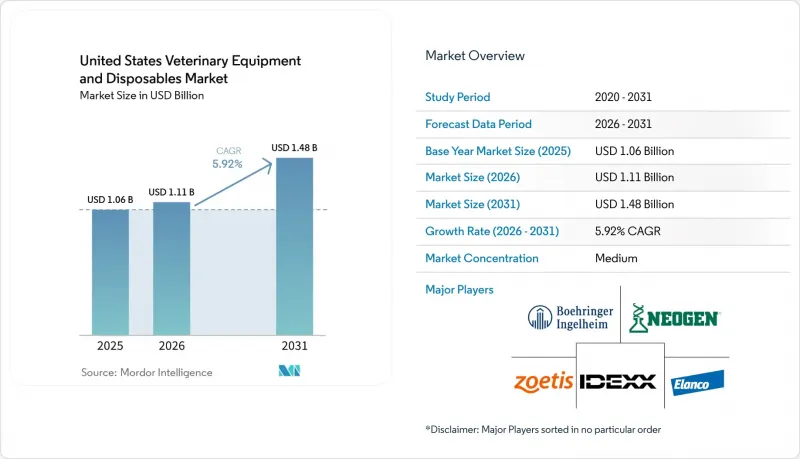
This report is Segmented by Product (Equipment and Accessories {Anesthesia Equipment, and More}, Disposables and Consumables {Syringes and Needles, and More}), Animal Type (Small Animals, Large Animals), Usage (Surgical, Diagnostic, Monitoring), End Use (Veterinary Clinics, Hospitals, Research Institutes, and More). The Market Forecasts are Provided in Terms of Value (USD).
United States Veterinary Equipment and Disposables Market Trends and Insights
Rising Companion Animal Procedural Volume
The United States veterinary equipment and disposables market is being driven first by the scale of companion animal ownership and care activity. The American Pet Products Association reported that 53% of US households owned dogs and 39% owned cats in 2025, while the American Veterinary Medical Association reported 87.3 million owned dogs and 76.3 million owned cats in the country. That larger patient pool lifts demand for vaccinations, routine surgeries, dental procedures, imaging, and in-clinic diagnostic tests. The care burden is also becoming more complex because pets are living with more chronic conditions that require repeated monitoring and longer treatment pathways. The American Veterinary Medical Association also stated in 2026 that more than half of US dogs and cats are overweight or obese, which raises anesthesia and perioperative risk and supports wider use of monitoring equipment and critical care consumables.
Shift Toward Single-Use Infection-Control Consumables
The United States veterinary equipment and disposables market is also moving toward single-use sterile products in surgical and critical care settings. High-throughput clinics want faster room turnover, simpler traceability, and lower sterilization burden, which makes syringes, drapes, IV accessories, and other disposable items more attractive. Corporate networks are also standardizing their supply lists, which narrows approved vendor pools and increases the repeat purchase rate for compliant consumables. Covetrus said its VetSuite network delivered more than USD 30 million in realized savings to independent clinics since launch, which shows how group purchasing is making higher-standard consumables easier to adopt at scale. The result is a demand pattern in which consumables growth is becoming less tied to one-time capital cycles and more tied to daily clinical throughput.
High Upfront Cost Of Imaging And Surgical Platforms
The United States veterinary equipment and disposables market still faces a meaningful barrier from the upfront cost of advanced equipment. CT systems, MRI platforms, digital radiography units, and endoscopy towers require capital budgets that many independent and single-site practices cannot support without financing. The American Veterinary Medical Association cited CareCredit survey findings showing that cost was the primary concern for 80% of pet owners considering specialty veterinary care, which makes clinics more cautious about investing in equipment that depends on steady, high-value case flow. Large groups can spread procurement costs across multiple facilities and negotiate stronger supplier terms, while smaller operators carry the full exposure of each purchase. Section 179 support and financing options help the United States veterinary equipment and disposables market, but they do not fully close the gap between corporate networks and independent practices.
Other drivers and restraints analyzed in the detailed report include:
- Section 179 Supported Capital Equipment Purchases
- Growth of High-Acuity Referral and Specialty Veterinary Care
- Shortage Of Credentialed Veterinary Technicians For Advanced Equipment
For complete list of drivers and restraints, kindly check the Table Of Contents.
Segment Analysis
Equipment and accessories captured 57.48% of the United States veterinary equipment and disposables market share in 2025, which reflects the large installed base of anesthesia, monitoring, imaging, and fluid management systems across the country. The United States veterinary equipment and disposables market still leans toward capital equipment because these platforms anchor surgical, emergency, and inpatient workflows in both general and specialty settings. Anesthesia equipment and patient monitors remain central to procedure volume because they are needed across elective surgery, urgent interventions, and ICU care. Research equipment and rescue or resuscitation systems remain smaller categories, but they hold a stable place in referral hospitals, veterinary schools, and teaching facilities.
Disposables and consumables will post the fastest growth, with the United States veterinary equipment and disposables market size for this segment projected to expand at 7.36% CAGR through 2031. This segment benefits from high reorder frequency in syringes and needles, IV accessories, infusion sets, tubes, catheters, drapes, sutures, and wound care materials. Standardization by larger clinic groups is making purchasing more predictable, and that favors vendors with broad product coverage and integrated ordering support. Covetrus said its VetSuite network has delivered savings to independent practices nationwide, which supports the adoption of standardized consumables that previously competed mainly on unit price.
Small animals accounted for 59.17% of the segment in 2025, which keeps companion animal medicine at the center of the United States veterinary equipment and disposables market. That position is tied to strong household ownership of dogs and cats and to owner willingness to approve more testing, surgery, and preventive care than in the past. In-clinic chemistry systems, hematology analyzers, anesthesia platforms, and monitoring equipment are seeing wider use because general practices are handling a broader range of cases before referral. The United States veterinary equipment and disposables market also benefits from a more wellness-oriented approach in companion animal care, which lifts recurring demand for point-of-care diagnostics and everyday consumables.
Large animals are the fastest-growing segment, and the United States veterinary equipment and disposables market size for this segment is forecast to rise at 8.87% CAGR through 2031. Growth here is supported by a stronger interest in portable ultrasound, point-of-care blood analysis, and field-ready fluid management products that can be used outside fixed clinical infrastructure. Zoetis announced in February 2026 that it would acquire Neogen's animal genomics business, which points to growing demand for more precise diagnostic and monitoring approaches in livestock health. The American Pet Products Association also reported that 2 million US households own horses, which supports mobile care demand in equine settings where distance and access still shape equipment choice.
Complete Report Scope:
- By Product
- Equipment and Accessories
- Anesthesia Equipment
- Temperature Management Equipment
- Fluid Management Equipment
- Patient Monitoring Equipment
- Research Equipment
- Rescue and Resuscitation Equipment
- Other Equipment and Accessories
- Disposables and Consumables
- Syringes and Needles
- Bandages and Wound Care Products
- Infusion Sets and IV Accessories
- Tubes and Catheters
- Surgical Consumables
- Equipment and Accessories
- By Animal Type
- Small Animals
- Large Animals
- By Usage
- Surgical
- Diagnostic
- Monitoring
- By End Use
- Veterinary Clinics
- Veterinary Hospitals
- Veterinary Research Institutes
- Academic Institutions
List of Companies Covered in this Report:
- Avante Health Solutions
- B. Braun
- Boehringer Ingelheim
- Covetrus
- Elanco
- Ethicon
- Henry Schein
- IDEXX
- Integra LifeSciences
- Jorgensen Laboratories
- Johnson & Johnson
- Masimo
- Medtronic
- Midmark
- Mindray Animal Medical Technology Co., Ltd.
- Neogen
- Nonin Medical
- Patterson Companies
- Sklar Surgical Instruments
- STERIS
- Vetland Medical Sales and Services, LLC
- VIMIAN Group AB
- Zoetis
Additional Benefits:
- The market estimate (ME) sheet in Excel format
- 3 months of analyst support
TABLE OF CONTENTS
1 Introduction
- 1.1 Study Assumptions & Market Definition
- 1.2 Scope of the Study
2 Research Methodology
3 Executive Summary
4 Market Landscape
- 4.1 Market Overview
- 4.2 Market Drivers
- 4.2.1 Rising Companion Animal Procedural Volume
- 4.2.2 Shift Toward Single-Use Infection-Control Consumables
- 4.2.3 Section 179 Supported Capital Equipment Purchases
- 4.2.4 Growth of High-Acuity Referral and Specialty Veterinary Care
- 4.2.5 Expansion of Portable and Point-of-Care Diagnostics
- 4.2.6 Rising Demand for Workflow-Safe, Low-Labor Clinical Consumables
- 4.3 Market Restraints
- 4.3.1 High Upfront Cost of Imaging and Surgical Platforms
- 4.3.2 Shortage of Credentialed Veterinary Technicians for Advanced Equipment
- 4.3.3 Reimbursement Friction and Price Sensitivity Among Pet Owners
- 4.3.4 Procurement Delays From Highly Regulated Supply Chains
- 4.4 Value / Supply-Chain Analysis
- 4.5 Regulatory Landscape
- 4.6 Technological Outlook
- 4.7 Porter's Five Forces Analysis
- 4.7.1 Threat of New Entrants
- 4.7.2 Bargaining Power of Suppliers
- 4.7.3 Bargaining Power of Buyers
- 4.7.4 Threat of Substitutes
- 4.7.5 Industry Rivalry
5 Market Size & Growth Forecasts
- 5.1 By Product
- 5.1.1 Equipment and Accessories
- 5.1.1.1 Anesthesia Equipment
- 5.1.1.2 Temperature Management Equipment
- 5.1.1.3 Fluid Management Equipment
- 5.1.1.4 Patient Monitoring Equipment
- 5.1.1.5 Research Equipment
- 5.1.1.6 Rescue and Resuscitation Equipment
- 5.1.1.7 Other Equipment and Accessories
- 5.1.2 Disposables and Consumables
- 5.1.2.1 Syringes and Needles
- 5.1.2.2 Bandages and Wound Care Products
- 5.1.2.3 Infusion Sets and IV Accessories
- 5.1.2.4 Tubes and Catheters
- 5.1.2.5 Surgical Consumables
- 5.1.1 Equipment and Accessories
- 5.2 By Animal Type
- 5.2.1 Small Animals
- 5.2.2 Large Animals
- 5.3 By Usage
- 5.3.1 Surgical
- 5.3.2 Diagnostic
- 5.3.3 Monitoring
- 5.4 By End Use
- 5.4.1 Veterinary Clinics
- 5.4.2 Veterinary Hospitals
- 5.4.3 Veterinary Research Institutes
- 5.4.4 Academic Institutions
6 Competitive Landscape
- 6.1 Market Concentration
- 6.2 Market Share Analysis
- 6.3 Company Profiles (includes Global Level Overview, Market-level Overview, Core Segments, Financials, Strategic Information, Market Rank/Share, Products & Services, Recent Developments)
- 6.3.1 Avante Animal Health
- 6.3.2 B. Braun Vet Care GmbH
- 6.3.3 Boehringer Ingelheim Animal Health
- 6.3.4 Covetrus, Inc.
- 6.3.5 Elanco Animal Health Incorporated
- 6.3.6 Ethicon US, LLC
- 6.3.7 Henry Schein, Inc.
- 6.3.8 IDEXX Laboratories, Inc.
- 6.3.9 Integra LifeSciences Holdings Corporation
- 6.3.10 Jorgensen Laboratories
- 6.3.11 Johnson & Johnson
- 6.3.12 Masimo Corporation
- 6.3.13 Medtronic plc
- 6.3.14 Midmark Corporation
- 6.3.15 Mindray Animal Medical Technology Co., Ltd.
- 6.3.16 Neogen Corporation
- 6.3.17 Nonin Medical, Inc.
- 6.3.18 Patterson Companies, Inc.
- 6.3.19 Sklar Surgical Instruments
- 6.3.20 STERIS plc
- 6.3.21 Vetland Medical Sales and Services, LLC
- 6.3.22 VIMIAN Group AB
- 6.3.23 Zoetis Inc.
7 Market Opportunities & Future Outlook
- 7.1 White-space & Unmet-need Assessment

