PUBLISHER: Mordor Intelligence | PRODUCT CODE: 2072840

PUBLISHER: Mordor Intelligence | PRODUCT CODE: 2072840
United States Rice Flour - Market Share Analysis, Industry Trends & Statistics, Growth Forecasts (2026 - 2031)
According to Mordor Intelligence, the united states rice flour market size was valued at USD 138.2 million in 2025 and is estimated to grow from USD 148.5 million in 2026 to reach USD 212.5 million by 2031, at a CAGR of 6.2% during the forecast period 2026 to 2031.
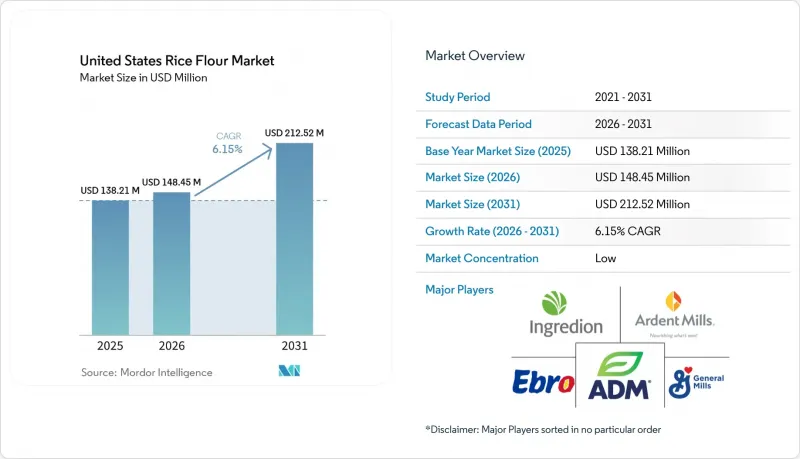
This report is Segmented by Source (White Rice Flour, Brown Rice Flour), Nature (Conventional, Organic), End Use (Retail, Foodservice/HoReCa, Industrial), and Geography (United States). The Market Forecasts are Provided in Terms of Value (USD).
United States Rice Flour Market Trends and Insights
Rising Demand for Gluten-Free Products
The single most powerful tailwind behind the United States rice flour market is the structural growth of medically motivated and lifestyle-driven gluten-free consumption. Approximately 1% of the United States population carries a celiac diagnosis, but the functionally relevant consumer cohort, those who actively avoid gluten regardless of formal diagnosis, is estimated at up to 6% of Americans, according to research published in Seed World in January 2026. A critical second-order dynamic is that this driver is increasingly originating not from specialty retailers but from mainstream mass-market brands, as large CPG companies like General Mills reformulate core SKUs such as Cheerios and Betty Crocker baking mixes to include or qualify as rice-flour-based gluten-free alternatives. General Mills. This mainstreaming effect shifts rice flour from a specialty ingredient into a commodity procurement category, which fundamentally changes volume expectations and contract structures for millers. The FDA's allergen-labeling guidance (2025 revised edition) reinforces manufacturer incentives to verify and label gluten-free status, accelerating reformulation timelines and locking in rice flour as a preferred base.
Increasing Consumer Inclination towards Clean-Label Formulations
Clean-label demand is reshaping ingredient procurement in a way that disproportionately benefits rice flour over synthetic thickeners and modified starches. The non-obvious dimension of this driver is an industrial shift: Ingredion's R&D expenditure reached USD 71 million in FY2025, with clean-label starches and functional ingredient systems as a primary investment pillar, while the company's Indianapolis-based texture and healthful solutions facility is receiving a USD 100 million capital infusion, a signal that large ingredient companies see clean-label reformulation as a multi-year volume shift, not a trend. When food manufacturers swap out synthetic binders for rice flour in commercial baking and snack production, the resulting demand is sticky because re-reformulating back carries labeling and consumer-perception costs. The USDA NOP's compliance requirements for organic claims create an additional layer of traceability that positions certified domestic rice flour suppliers advantageously against imported alternatives.
Competition from Other Gluten-Free Flours
The United States rice flour market faces stronger competition from almond, oat, cassava, coconut, and chickpea flours, especially in premium retail channels where brand stories and nutrition positioning strongly shape shelf appeal. Chickpea and almond flour have built added traction among buyers who prioritize protein or keto positioning, which makes them a visible alternative for consumers who do not select products mainly for texture or neutral taste. This weakens rice flour's exclusivity in clean-label and gluten-free positioning because several substitutes can now make similar front-of-pack claims. Even so, rice flour still holds a technical edge in coatings, sauces, and extruded snacks where neutral flavor and predictable behavior matter more than high-protein branding. Rice also benefits from a food safety and formulation advantage because it is not among the FDA's major allergens, unlike tree nuts and some legume-based alternatives that can complicate labeling and plant handling. The restraint is real, but it is stronger in consumer-facing premium formats than in industrial uses, where performance still carries more weight than diet fashion
Other drivers and restraints analyzed in the detailed report include:
- Growth of Rice Flour in Infant and Specialty Diet Products
- Expansion of Rice Flour in Snack and Convenience Foods
- Price Volatility in United States Rice Inputs and Contract Sourcing Pressure
For complete list of drivers and restraints, kindly check the Table Of Contents.
Segment Analysis
White rice flour held 75.23% of the United States rice flour market in 2025, a position rooted in decades of established use across commercial baking, industrial coatings, and foodservice thickening applications. Its fine, neutral-flavored profile integrates seamlessly into a wide range of processed food formulations without altering the sensory characteristics of the host product, a property that makes it the default specification for contract manufacturers supplying major CPG brands. Pillsbury's Gluten Free All-Purpose Flour Blend, which uses rice flour as its primary base, is among the best-known retail expressions of white rice flour's mainstream penetration, illustrating how consumer product reformulation at scale sustains bulk demand for millers.
Brown rice flour, the fastest-growing segment at a projected CAGR of 7.24% through 2031, benefits from a structural advantage that white rice flour does not share: its whole-grain positioning aligns with fiber and nutrient-density claims increasingly demanded by formulators targeting the health and wellness consumer. The global rise in whole-grain label claims, reinforced by General Mills' FY2026 commitment to delivering at least 8 g of whole grain per serving across its Big G cereals portfolio, signals that ingredient procurement is shifting toward whole-grain-compatible inputs at scale. Lundberg Family Farms' proprietary breeding investments, which delivered the Regenerative Organic Certified Black Pearl and Red Jasmine varieties in 2025, strengthen the specialty brown rice supply base and underpin premium brown rice flour positioning in natural retail channels.
Complete Report Scope:
- By Source
- White Rice Flour
- Brown Rice Flour
- By Nature
- Conventional
- Organic
- By End Use
- Retail
- Foodservice/HoReCa
- Industrial
List of Companies Covered in this Report:
- Archer Daniels Midland Company
- Ingredion Incorporated
- Ebro Foods S.A.
- Ardent Mills LLC
- General Mills, Inc.
- Associated British Foods plc
- Bunge Global SA
- Cargill, Incorporated
- Bob's Red Mill Natural Foods, Inc.
- Koda Farms, Inc.
- Lundberg Family Farms
- Riceland Foods, Inc.
- Eden Foods, Inc.
- Woodland Foods, Ltd.
- Mahatma
- Royal Umbrella
- Thai Rice
- Burapa Prosper Co., Ltd.
- KRONER-STARKE GmbH
- Caremoli Group
- Shipton Mill Ltd.
Additional Benefits:
- The market estimate (ME) sheet in Excel format
- 3 months of analyst support
TABLE OF CONTENTS
1 INTRODUCTION
- 1.1 Study Assumptions and Market Definition
- 1.2 Scope of the Study
2 RESEARCH METHODOLOGY
3 EXECUTIVE SUMMARY
4 MARKET LANDSCAPE
- 4.1 Market Overview
- 4.2 Market Drivers
- 4.2.1 Rising Demand for Gluten-Free Products
- 4.2.2 Increasing Consumer Inclination towards Clean-Label Formulations
- 4.2.3 Growth of Rice Flour in Infant and Specialty Diet Products
- 4.2.4 Expansion of Rice Flour in Snack and Convenience Foods
- 4.2.5 Premiumization of Organic and Non-GMO Pantry Staples
- 4.2.6 Functional Milling Advances for Finer Texture and Better Binding
- 4.3 Market Restraints
- 4.3.1 Competition from Other Gluten-Free Flours
- 4.3.2 Price Volatility in United States Rice Inputs and Contract Sourcing Pressure
- 4.3.3 Low Consumer Awareness Beyond Niche Gluten-Free Buyers
- 4.3.4 Labeling, Certification, and Traceability Burden for Organic and Non-GMO Claims
- 4.4 Supply Chain Outlook
- 4.5 Regulatory Landscape
- 4.6 Technological Outlook
- 4.7 Porter's Five Forces
- 4.7.1 Bargaining Power of Suppliers
- 4.7.2 Bargaining Power of Buyers
- 4.7.3 Threat of New Entrants
- 4.7.4 Threat of Substitutes
- 4.7.5 Competitive Rivalry
5 MARKET SIZE AND GROWTH FORECASTS (VALUE AND VOLUME)
- 5.1 By Source
- 5.1.1 White Rice Flour
- 5.1.2 Brown Rice Flour
- 5.2 By Nature
- 5.2.1 Conventional
- 5.2.2 Organic
- 5.3 By End Use
- 5.3.1 Retail
- 5.3.2 Foodservice/HoReCa
- 5.3.3 Industrial
6 COMPETITIVE LANDSCAPE
- 6.1 Market Concentration
- 6.2 Strategic Moves
- 6.3 Market Ranking Analysis
- 6.4 Company Profiles (Includes Global-level Overview, Market-level Overview, Core Segments, Financials, Strategic Info, Market Rank/Share, Products & Services, Recent Developments)
- 6.4.1 Archer Daniels Midland Company
- 6.4.2 Ingredion Incorporated
- 6.4.3 Ebro Foods S.A.
- 6.4.4 Ardent Mills LLC
- 6.4.5 General Mills, Inc.
- 6.4.6 Associated British Foods plc
- 6.4.7 Bunge Global SA
- 6.4.8 Cargill, Incorporated
- 6.4.9 Bob's Red Mill Natural Foods, Inc.
- 6.4.10 Koda Farms, Inc.
- 6.4.11 Lundberg Family Farms
- 6.4.12 Riceland Foods, Inc.
- 6.4.13 Eden Foods, Inc.
- 6.4.14 Woodland Foods, Ltd.
- 6.4.15 Mahatma
- 6.4.16 Royal Umbrella
- 6.4.17 Thai Rice
- 6.4.18 Burapa Prosper Co., Ltd.
- 6.4.19 KRONER-STARKE GmbH
- 6.4.20 Caremoli Group
- 6.4.21 Shipton Mill Ltd.
7 MARKET OPPORTUNITIES AND FUTURE OUTLOOK

