PUBLISHER: Mordor Intelligence | PRODUCT CODE: 2072856

PUBLISHER: Mordor Intelligence | PRODUCT CODE: 2072856
Life Science Software - Market Share Analysis, Industry Trends & Statistics, Growth Forecasts (2026 - 2031)
According to Mordor Intelligence, the life science software market size is expected to grow from USD 19.85 billion in 2025 to USD 22.08 billion in 2026 and is forecast to reach USD 37.65 billion by 2031 at 11.65% CAGR over 2026-2031.
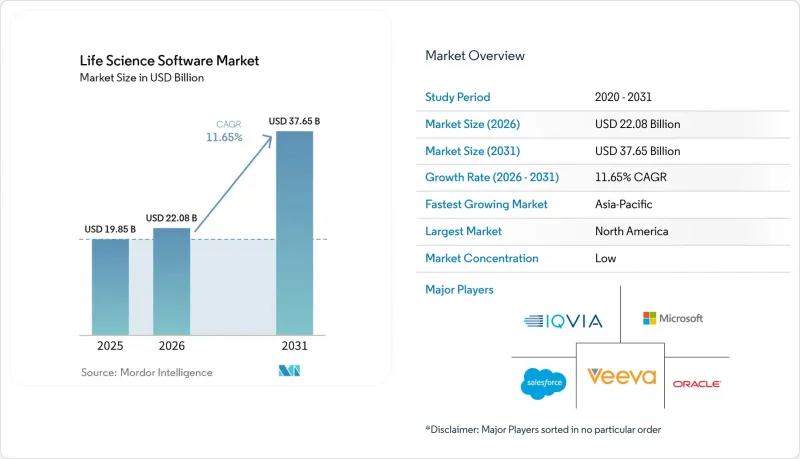
This report is Segmented by Software Type (LIMS, ELN, CTMS, RIMS, SDMS, Bioinformatics, Pharmacovigilance, QMS, Others), Deployment (Cloud, On-Premises), Application (R&D, Drug Discovery, Clinical Trials, Compliance, Manufacturing, Others), End User (Pharma, Biotech, CRO, CDMO, Academic, Medical Devices, Others), and Geography (North America, Europe, Asia-Pacific, and More). Forecasts in Value (USD).
Global Life Science Software Market Trends and Insights
Rising Demand for Regulatory-Ready Data Traceability Across the Product Lifecycle
Traceability has become a critical design requirement in the life sciences software market, moving beyond a documentation task at the end of an audit cycle. Companies now demand systems that maintain data lineage across laboratory work, quality events, manufacturing records, and regulatory submissions while ensuring validation control. This shift is driving preference for platforms with robust audit trails, stringent user controls, and resilient change-management structures. Vendors embedding compliance into daily operations are gaining traction, as tools lacking comprehensive records of decisions, edits, and approvals are losing relevance.
AI-Assisted Scientific Workflow Automation and Decision Support
AI is now integral to the life sciences software market, particularly in clinical, commercial, and research workflows. IQVIA's launch of IQVIA.ai in 2026 demonstrated how vendors are embedding AI into enterprise platforms, supported by over 100 AI patents and 150+ intelligent agents. With 19 of the top 20 pharmaceutical companies already using IQVIA agents, AI adoption has moved beyond pilot stages. Similarly, Benchling introduced Model Hub, integrating AI tools into validated R&D environments. These advancements highlight the growing demand for modern ELN, LIMS, and connected data platforms, as AI outputs in regulated settings require governance and traceability.
High Switching Costs From Deep Workflow Embedding and Data Migration Costs
Switching costs significantly hinder the life science software market. Core platforms are deeply integrated with validated workflows, linked records, and downstream systems, making transitions complex. Migration involves data mapping, retesting, user retraining, document updates, and managing historical records, transforming it into an operational challenge rather than a simple software installation. Larger companies plan migrations over multi-year cycles, while smaller firms often retain older systems until compliance demands force upgrades. Although the market is open to innovation, vendor displacement progresses slower than demand growth.
Other drivers and restraints analyzed in the detailed report include:
- Expansion of Cloud-Native and Interoperable Life Science Data Architectures
- Increased Use of Software to Shorten Validation and Audit Preparation Cycles
- Validation Burden and Change-Control Risk in Regulated Environments
For complete list of drivers and restraints, kindly check the Table Of Contents.
Segment Analysis
In 2025, laboratory information management systems (LIMS) held a 28.00% share of the software segment, reinforcing their critical role in the life science software market. LIMS platforms are indispensable, connecting sample tracking, instrument outputs, quality reviews, and regulated data management across laboratories. Their centrality in pharmaceutical quality control, bioanalytical labs, and contract research organizations (CROs) makes them difficult to replace. Clinical trial management systems (CTMS) are projected to grow at a 12.45% CAGR through 2031, driven by the increasing complexity and data demands of modern trial designs.
The industry is shifting toward platforms that streamline study coordination, site activities, transparency mandates, and patient data collection. Thermo Fisher Scientific's acquisition of Clario in 2026 highlighted the strategic importance of CTMS capabilities. Electronic lab notebooks, regulatory information management systems, and scientific data management systems are gaining traction as organizations transition to integrated digital records. Bioinformatics and pharmacovigilance software are also becoming essential as AI-driven analytics are embedded into core workflows.
In 2025, cloud deployment accounted for 51.44% of the market share, establishing its dominance in the life science software sector. It is projected to grow at a 12.77% CAGR through 2031, reflecting its leadership in adoption and future spending. Buyers now view cloud as a viable regulated architecture, supported by vendors offering preconfigured controls, integration capabilities, and specialized functionalities.
Salesforce's Life Sciences Cloud and Agentforce platform gained enterprise adoption from major players like Takeda, Novartis, and AstraZeneca in 2025, showcasing confidence in cloud-native systems for regulated use. While on-premises systems remain relevant for specific needs like data residency and sensitive records, the market is increasingly favoring hybrid and cloud-first models for scalability, interoperability, and AI integration.
Complete Report Scope:
- By Software Type
- Laboratory Information Management Systems
- Electronic Lab Notebooks
- Clinical Trial Management Systems
- Regulatory Information Management Systems
- Scientific Data Management Systems
- Bioinformatics Software
- Pharmacovigilance Software
- Quality Management Software
- Other Life Science Software Types
- By Deployment
- Cloud
- On-Premises
- By Application
- Research and Development
- Drug Discovery
- Clinical Trials
- Regulatory Compliance
- Manufacturing Operations
- Quality Management
- Commercial Operations and Customer Engagement
- Other Applications in Life Science Software
- By End User
- Pharmaceutical Companies
- Biotechnology Companies
- Contract Research Organizations
- Contract Development and Manufacturing Organizations
- Academic and Research Institutes
- Medical Device Companies
- Other End Users in Life Science Software
- By Geography
- North America
- United States
- Canada
- Mexico
- Europe
- Germany
- United Kingdom
- France
- Italy
- Spain
- Rest of Europe
- Asia-Pacific
- China
- India
- Japan
- Australia
- South Korea
- Rest of Asia-Pacific
- Middle East and Africa
- GCC
- South Africa
- Rest of Middle East and Africa
- South America
- Brazil
- Argentina
- Rest of South America
- North America
Geography Analysis
In 2025, North America held a 38.99% share of the life science software market, maintaining its position as the largest regional block. The region benefits from a high concentration of pharmaceutical, biotechnology, and medical device companies operating under strict digital documentation standards. A mature SaaS ecosystem and a strong base of funded biotech firms further drive software adoption. Microsoft's collaboration with Mayo Clinic in June 2026 to develop an advanced AI model for healthcare highlights North America's continued leadership in life sciences data infrastructure.
Europe remains a key player in the life science software market, with demand shaped by compliance timelines and formal process controls. Countries like Germany, France, and the UK anchor regional demand through strong pharmaceutical production, research capabilities, and regulated data management needs. The region is also fostering local specialists, particularly in submission and pharmacovigilance workflows, where regulatory specificity is critical. Ennov's submission of one of four eCTD 4.0 test sequences to the EMA pilot program demonstrates the growing visibility of European-native vendors in high-control software segments.
Asia-Pacific is projected to grow at a 12.95% CAGR through 2031, making it the fastest-growing region in the life science software market. China and India drive this growth with increased clinical trial activity, outsourced research capacity, and digital regulatory processes. China's "AI+" pharmaceutical supervision initiative in April 2026 and the Biomedical New Technology Clinical Research Regulation effective May 2026 have strengthened the demand for compliant software systems.
- Agilent Technologies
- Aris Global
- Benchling, Inc.
- Cegedim SA
- Clario
- Dassault Systemes
- Dotmatics
- Fujitsu
- Genedata
- HCLTech
- IQVIA
- LabWare, Inc.
- Medidata Solutions, Inc.
- Microsoft
- Oracle
- PerkinElmer
- Salesforce, Inc.
- SAP
- SAS Institute
- Thermo Fisher Scientific
- Veeva Systems
- Waters Corporation
- ZS Associates, Inc.
Additional Benefits:
- The market estimate (ME) sheet in Excel format
- 3 months of analyst support
TABLE OF CONTENTS
1 INTRODUCTION
- 1.1 Study Assumptions and Market Definition
- 1.2 Scope of the Study
2 RESEARCH METHODOLOGY
3 EXECUTIVE SUMMARY
4 MARKET LANDSCAPE
- 4.1 Market Overview
- 4.2 Market Drivers
- 4.2.1 Rising Demand for Regulatory-Ready Data Traceability Across the Product Lifecycle
- 4.2.2 Expansion of Cloud-Native and Interoperable Life Science Data Architectures
- 4.2.3 AI-Assisted Scientific Workflow Automation and Decision Support
- 4.2.4 Increased Use of Software to Shorten Validation and Audit Preparation Cycles
- 4.2.5 Integration Pressure From Partner, CRO, and CDMO Ecosystems
- 4.3 Market Restraints
- 4.3.1 High Switching Costs From Deep Workflow Embedding and Data Migration Complexity
- 4.3.2 Validation Burden and Change-Control Risk in Regulated Environments
- 4.3.3 Fragmented Legacy Stack Across R&D, Quality, and Commercial Teams
- 4.3.4 Interoperability Gaps Across Instruments, EHR Adjacent Systems, and External Data Feeds
- 4.4 Supply/Value Chain Analysis
- 4.5 Regulatory Landscape
- 4.6 Technological Outlook
- 4.7 Porter's Five Forces Analysis
- 4.7.1 Bargaining Power of Suppliers
- 4.7.2 Bargaining Power of Buyers
- 4.7.3 Threat of New Entrants
- 4.7.4 Threat of Substitutes
- 4.7.5 Competitive Rivalry
5 MARKET SIZE AND GROWTH FORECASTS (VALUE, USD)
- 5.1 By Software Type
- 5.1.1 Laboratory Information Management Systems
- 5.1.2 Electronic Lab Notebooks
- 5.1.3 Clinical Trial Management Systems
- 5.1.4 Regulatory Information Management Systems
- 5.1.5 Scientific Data Management Systems
- 5.1.6 Bioinformatics Software
- 5.1.7 Pharmacovigilance Software
- 5.1.8 Quality Management Software
- 5.1.9 Other Life Science Software Types
- 5.2 By Deployment
- 5.2.1 Cloud
- 5.2.2 On-Premises
- 5.3 By Application
- 5.3.1 Research and Development
- 5.3.2 Drug Discovery
- 5.3.3 Clinical Trials
- 5.3.4 Regulatory Compliance
- 5.3.5 Manufacturing Operations
- 5.3.6 Quality Management
- 5.3.7 Commercial Operations and Customer Engagement
- 5.3.8 Other Applications in Life Science Software
- 5.4 By End User
- 5.4.1 Pharmaceutical Companies
- 5.4.2 Biotechnology Companies
- 5.4.3 Contract Research Organizations
- 5.4.4 Contract Development and Manufacturing Organizations
- 5.4.5 Academic and Research Institutes
- 5.4.6 Medical Device Companies
- 5.4.7 Other End Users in Life Science Software
- 5.5 By Geography
- 5.5.1 North America
- 5.5.1.1 United States
- 5.5.1.2 Canada
- 5.5.1.3 Mexico
- 5.5.2 Europe
- 5.5.2.1 Germany
- 5.5.2.2 United Kingdom
- 5.5.2.3 France
- 5.5.2.4 Italy
- 5.5.2.5 Spain
- 5.5.2.6 Rest of Europe
- 5.5.3 Asia-Pacific
- 5.5.3.1 China
- 5.5.3.2 India
- 5.5.3.3 Japan
- 5.5.3.4 Australia
- 5.5.3.5 South Korea
- 5.5.3.6 Rest of Asia-Pacific
- 5.5.4 Middle East and Africa
- 5.5.4.1 GCC
- 5.5.4.2 South Africa
- 5.5.4.3 Rest of Middle East and Africa
- 5.5.5 South America
- 5.5.5.1 Brazil
- 5.5.5.2 Argentina
- 5.5.5.3 Rest of South America
- 5.5.1 North America
6 COMPETITIVE LANDSCAPE
- 6.1 Market Concentration
- 6.2 Market Share Analysis
- 6.3 Company Profiles (includes Global Level Overview, Market Level Overview, Core Segments, Financials as available, Strategic Information, Market Rank/Share, Products and Services, Recent Developments)
- 6.3.1 Agilent Technologies, Inc.
- 6.3.2 ArisGlobal LLC
- 6.3.3 Benchling, Inc.
- 6.3.4 Cegedim SA
- 6.3.5 Clario
- 6.3.6 Dassault Systemes SE
- 6.3.7 Dotmatics
- 6.3.8 Fujitsu Limited
- 6.3.9 Genedata AG
- 6.3.10 HCLTech
- 6.3.11 IQVIA Holdings Inc.
- 6.3.12 LabWare, Inc.
- 6.3.13 Medidata Solutions, Inc.
- 6.3.14 Microsoft Corporation
- 6.3.15 Oracle Corporation
- 6.3.16 PerkinElmer, Inc.
- 6.3.17 Salesforce, Inc.
- 6.3.18 SAP SE
- 6.3.19 SAS Institute Inc.
- 6.3.20 Thermo Fisher Scientific Inc.
- 6.3.21 Veeva Systems Inc.
- 6.3.22 Waters Corporation
- 6.3.23 ZS Associates, Inc.
7 MARKET OPPORTUNITIES AND FUTURE OUTLOOK
- 7.1 White-space and Unmet-Need Assessment

