PUBLISHER: Mordor Intelligence | PRODUCT CODE: 2072879

PUBLISHER: Mordor Intelligence | PRODUCT CODE: 2072879
U.S. Beef - Market Share Analysis, Industry Trends & Statistics, Growth Forecasts (2026 - 2031)
According to Mordor Intelligence, in 2025, the U.S. beef market was valued at USD 63.97 billion, with projections to reach USD 72.64 billion by 2031, growing at a CAGR of 2.1% from 2026 to 2031.
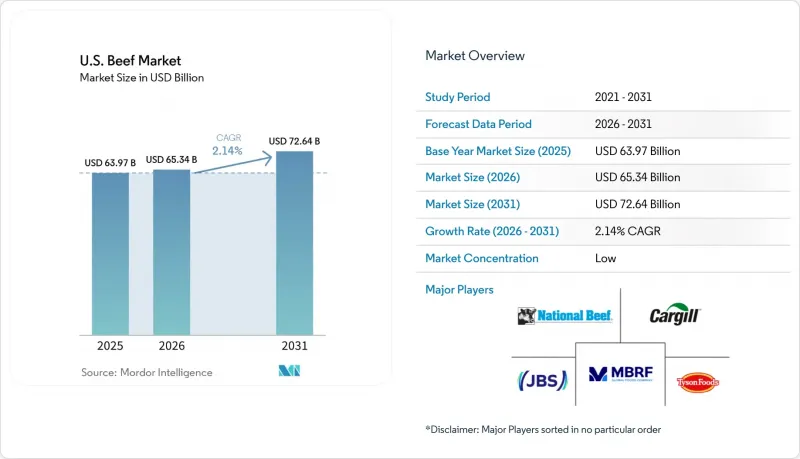
This report is Segmented by Product Type (Fresh Beef, Processed Beef, Frozen/Chilled Beef, Canned Beef), Nature (Conventional, Specialty Beef), and Distribution Channel (On-Trade, Off-Trade [Supermarkets/Hypermarkets, Specialty Stores, Online Retailers, Others]). The Market Forecasts are Provided in Terms of Value (USD) and Volume (Units).
U.S. Beef Market Trends and Insights
Consumer Dietary Preferences and Protein Trends
Despite ongoing price hikes, beef firmly retains its status as a dietary staple. In 2025, per capita retail beef disappearance stood at 59.3 pounds, a slight uptick from 59.1 pounds in 2024. This stability comes even as ground beef prices surged to USD 6.32 per pound and beef steaks climbed to USD 12.22 per pound, marking year-on-year jumps of 12.8% and 16.6%, respectively, as reported by the US Department of Labor in August 2025. In 2024, over 90% of US consumers viewed beef positively or neutrally, with more than 70% recognizing meat and poultry as "nutrient powerhouses." Furthermore, 90% of consumers acknowledged the nutritional importance of protein. A less-discussed aspect is beef's cost advantage over chicken when considering protein value per gram. This advantage bolsters beef's central role in meals, even amidst rising retail prices. Additionally, the growing adoption of GLP-1 medications, which generally curtail caloric intake, has spurred a heightened demand for nutrient-dense, high-protein meals. This trend inherently favors beef over its lower-protein processed counterparts.
Rising Demand for Shelf-Stable Beef Snacks in Convenience Channels
The meat snack segment is expanding rapidly within processed beef, driven by high-protein diets and busy lifestyles. In 2024, millennials made up 62% of new meat product unit sales, while 53% of consumers combined scratch-cooked and semi-prepared items, boosting demand for convenience-format beef. At Expo West 2025, brands like Chomps, Archer, and Think Jerky showcased beef sticks and jerky as portable protein, aligning with mainstream retailers. As traditional grocery stores lose share to supercenters and online platforms, shelf-stable beef snacks are gaining popularity. Convenience-store operators, seeking higher-margin impulse items, are increasing their ambient beef snack offerings. Hormel Foods is capitalizing on this trend, with Q1 fiscal 2026 investments in an ambient meat snack facility in Jiaxing, China, and the May 2026 launch of the SPAM(R) Dog for roller grills and convenience-store channels.
Shifting Dietary Trends Toward Plant-Based and Alternative Proteins
Plant-based meats pose a long-term challenge to beef but remain a limited immediate threat. Between 2021 and 2024, weekly consumption of meat alternatives in the U.S. fell from 31% to 24%, while the share of Americans on a plant-based diet dropped from 6% to 3%. A September 2025 survey of 2,200 U.S. adults showed 60% reduced or avoided beef due to high prices, rising to 72% if prices increased further. Additionally, 35% considered non-meat alternatives for cost reasons, climbing to 53% among Gen Z. Research published in May 2026 in Applied Economic Perspectives and Policy, analyzing data from 136,553 U.S. households, found plant-based alternatives substituted some beef categories but complemented others. Consumers were more price-sensitive to plant-based products than beef, limiting substitution at current price gaps. This indicates plant-based alternatives impact beef most when beef prices are high, a trend likely to persist during the current cattle cycle.
Other drivers and restraints analyzed in the detailed report include:
- Premiumization via Grass-Fed and Antibiotic-Free Processed Beef Claims
- Supply-Chain Traceability and Transparency
- Strict Sanitary/Phytosanitary and Trade Barriers
For complete list of drivers and restraints, kindly check the Table Of Contents.
Segment Analysis
In 2025, Fresh Beef held a 63.32% share of the US beef market, highlighting its dominance in the retail and foodservice sectors. Beef appeared on 88% of US menus, and in 2024, 48% of consumers ate a beef burger at a restaurant within the past week. Ground beef led fresh retail volume. Retail fresh beef prices averaged USD 8.01 per pound in 2024, up from USD 7.60 in 2023, due to tight cattle supplies and high carcass values. On July 4, 2025, boxed beef prices hit a record USD 388.64 per hundredweight. Processed and Canned Beef cater to niche markets, with products like deli roast beef and corned beef hash gaining popularity in convenience stores and home meal prep. Hormel relaunched its NATURAL CHOICE Deli Roast Beef line in April 2024, and MARY KITCHEN introduced Skillet extensions in January 2026. These segments benefit from consumers seeking affordable prepared beef options.
Frozen/Chilled Beef is the fastest-growing segment, with a CAGR of 2.35% from 2026 to 2031, driven by rising imports reshaping the US beef supply. Between 2020 and 2024, the US frozen beef import value rose by 82.6%. In 2024, the US became the largest global importer of fresh and chilled beef, accounting for 18.1% of global import value. By April 25, 2026, US imports of fresh and frozen beef reached 637,648 metric tons, a 16.1% year-on-year increase. South American shipments from Brazil, Argentina, Paraguay, and Uruguay in Q1 2026 surged to 194,564 metric tons, 130% higher than two years earlier. This import surge, driven by domestic supply shortages, is expected to sustain Frozen/Chilled Beef growth through the cattle cycle recovery, likely extending to 2028-2029.
Complete Report Scope:
- By Product Type
- Fresh Beef
- Processed Beef
- Frozen/Chilled Beef
- Canned Beef
- By Nature
- Conventional
- Specialty Beef
- By Distribution Channel
- On-Trade
- Off-Trade
- Supermarkets/Hypermarkets
- Specialty Stores
- Online Retailers
- Others
List of Companies Covered in this Report:
- Tyson Foods, Inc.
- Danish Crown
- Cargill Incorporated
- Marfrig Global Foods S.A.
- NH Foods Ltd.
- Minerva Foods
- St. Helen's Meat Packers
- Hormel Foods Corporation
- JBS N.V.
- National Beef Packing Company, LLC
- Vion Food Group
- Omasake Wagyu
- Mishima Reserve
- Nebraska Star Beef
- Imperial American Wagyu Beef
- Creekstone Farms Premium Beef LLC
- Hida Beef Brand Promotion Association
- Black Hawk Farms
- Allied Beef Pty Ltd
- Jack's Creek
Additional Benefits:
- The market estimate (ME) sheet in Excel format
- 3 months of analyst support
TABLE OF CONTENTS
1 INTRODUCTION
- 1.1 Study Assumptions and Market Definition
- 1.2 Scope of the Study
2 RESEARCH METHODOLOGY
3 EXECUTIVE SUMMARY
4 MARKET LANDSCAPE
- 4.1 Market Overview
- 4.2 Market Drivers
- 4.2.1 Consumer dietary preferences and protein trends
- 4.2.2 Supply-chain traceability and transparency
- 4.2.3 Rising demand for shelf-stable beef snacks (jerky, biltong) in convenience channels
- 4.2.4 Premiumization via grass-fed and antibiotic-free processed beef claims
- 4.2.5 Cultural and lifestyle associations with beef
- 4.2.6 Technology and production-system innovations
- 4.3 Market Restraints
- 4.3.1 Shifting dietary trends toward plant-based and alternative proteins
- 4.3.2 Animal-welfare and ethical-consumption pressures
- 4.3.3 Strict sanitary/phytosanitary and trade barriers
- 4.3.4 Environmental and climate-change regulations
- 4.4 Value Chain Analysis
- 4.5 Regulatory Landscape
- 4.6 Porter's Five Forces
- 4.6.1 Bargaining Power of Suppliers
- 4.6.2 Bargaining Power of Buyers
- 4.6.3 Threat of New Entrants
- 4.6.4 Threat of Substitutes
- 4.6.5 Competitive Rivalry
5 MARKET SIZE AND GROWTH FORECASTS (VALUE AND VOLUME)
- 5.1 By Product Type
- 5.1.1 Fresh Beef
- 5.1.2 Processed Beef
- 5.1.3 Frozen/Chilled Beef
- 5.1.4 Canned Beef
- 5.2 By Nature
- 5.2.1 Conventional
- 5.2.2 Specialty Beef
- 5.3 By Distribution Channel
- 5.3.1 On-Trade
- 5.3.2 Off-Trade
- 5.3.2.1 Supermarkets/Hypermarkets
- 5.3.2.2 Specialty Stores
- 5.3.2.3 Online Retailers
- 5.3.2.4 Others
6 COMPETITIVE LANDSCAPE
- 6.1 Market Concentration
- 6.2 Strategic Moves
- 6.3 Market Share Analysis
- 6.4 Company Profiles (includes Global level Overview, Market level overview, Core Segments, Financials (if available), Strategic Information, Market Rank/Share, Products, Recent Developments)
- 6.4.1 Tyson Foods, Inc.
- 6.4.2 Danish Crown
- 6.4.3 Cargill Incorporated
- 6.4.4 Marfrig Global Foods S.A.
- 6.4.5 NH Foods Ltd.
- 6.4.6 Minerva Foods
- 6.4.7 St. Helen's Meat Packers
- 6.4.8 Hormel Foods Corporation
- 6.4.9 JBS N.V.
- 6.4.10 National Beef Packing Company, LLC
- 6.4.11 Vion Food Group
- 6.4.12 Omasake Wagyu
- 6.4.13 Mishima Reserve
- 6.4.14 Nebraska Star Beef
- 6.4.15 Imperial American Wagyu Beef
- 6.4.16 Creekstone Farms Premium Beef LLC
- 6.4.17 Hida Beef Brand Promotion Association
- 6.4.18 Black Hawk Farms
- 6.4.19 Allied Beef Pty Ltd
- 6.4.20 Jack's Creek
7 MARKET OPPORTUNITIES AND FUTURE OUTLOOK

