PUBLISHER: Mordor Intelligence | PRODUCT CODE: 2072890

PUBLISHER: Mordor Intelligence | PRODUCT CODE: 2072890
U.S. Potato Chips - Market Share Analysis, Industry Trends & Statistics, Growth Forecasts (2026 - 2031)
The U.S. market for baked potato chips is projected to grow at a robust 8.95% CAGR from 2026 to 2031, making baked chips the fastest-growing segment.
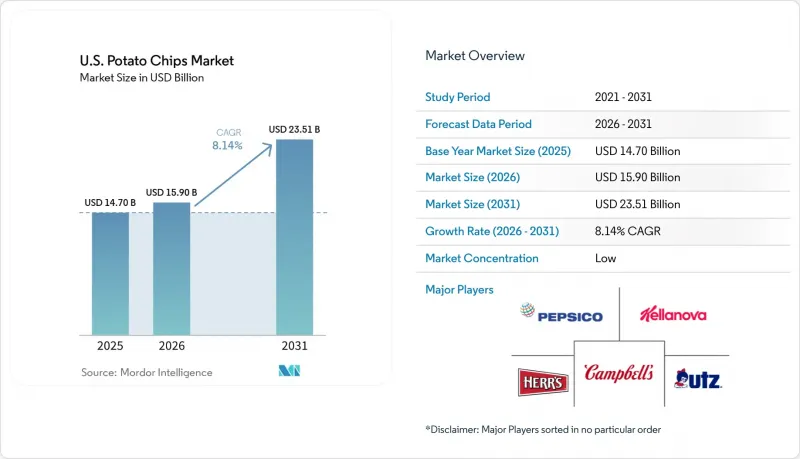
According to Mordor Intelligence, in 2025, the US potato chips market was valued at USD 14.70 billion. This report is Segmented by Product Type (Baked, Fried), Flavor (Plain/Salted, Flavored), Packaging Type (Single Serve, Family/Bulk Packs), Distribution Channel (Supermarkets/Hypermarkets, Convenience Stores, Online Retail Stores, Other Distribution Channels), and Geography (South, Midwest, West, Northeast). The Market Forecasts are Provided in Terms of Value (USD).
U.S. Potato Chips Market Trends and Insights
Health-Conscious Product Innovation
In the US potato chips market, mainstream brands are elevating their standards for oils, additives, and label claims. PepsiCo announced its commitment to eliminate artificial flavors and colors from its core Lay's products in the US by the close of 2025. Additionally, the company is enhancing Lay's Baked with olive oil and updating Lay's Kettle Cooked Reduced Fat to feature avocado oil. According to Potatoes USA, from July 2024 to March 2025, the retail sales volume of chips saw a 2.6% uptick, even as retail prices dipped by 0.96% per pound. This trend indicates a robust demand that isn't reliant on inflated pricing. Such behavior suggests that consumers are increasingly gravitating towards cleaner, premium products in their chip purchases, viewing them as standard rather than niche. As a result, the US potato chips market has established a higher cost baseline. The shift towards premium oils and cleaner ingredient lists demands heftier budgets for R&D, procurement, and compliance, a challenge for smaller producers to match.
Snacking Convenience and Lifestyle Trends
The US potato chips market is thriving as snacking outside formal meals gains popularity. Conagra Brands projects a 39% rise in away-from-home snacking occasions per person by 2027 compared to pre-pandemic levels, with chips remaining a top portable snack choice. In 2025, NACS reported the 23rd consecutive year of growth in US convenience store in-store sales, with salty snacks among the top-performing categories for sales and profits. Additionally, 95.2% of convenience store customers consumed their salty snacks on the same day, highlighting the rapid shelf-to-use transition. This rapid consumption supports the market, as repeat purchases rely more on daily routines, portability, and availability in convenient pack sizes.
Health Awareness and the Shift Toward Low-Fat Alternatives
Consumers in the U.S. potato chips market are increasingly leaning towards lower-fat and lighter snack options. According to the USDA, shipments of chipping potatoes from January to mid-July 2025 were down 15% from the previous year and 11% from the same period in 2023. This decline indicates that the growth in retail value is more a result of product mix and pricing strategies rather than a significant uptick in the volume of traditional fried chips. To maintain their volume in standard fried formats, producers may need to consider either reducing prices or offering more credible, health-oriented products. While there's still potential for growth in the U.S. potato chips market, the trend is clearly moving towards healthier-looking and more justifiable repeat-purchase formats.
Other drivers and restraints analyzed in the detailed report include:
- Plant-Based and Clean-Label Demand
- Flavor and Texture Experiential Snacking
- Regulatory Scrutiny on Nutrition Labeling and Acrylamide
For complete list of drivers and restraints, kindly check the Table Of Contents.
Segment Analysis
In 2025, fried potato chips accounted for 65.43% of the U.S. potato chips market, maintaining their position as the category leader by volume. USDA NASS reported that in 2024, potatoes used for chips and shoestrings totaled 55.8 million cwt, a 3% decrease from 57.8 million cwt in 2023. Despite this decline, fried chips remain a key processing use for potatoes in the U.S. NACS data showed that potato chips made up 32.9% of the salty snack segment in convenience stores, outperforming other salty snacks and tortilla or corn chips. This dominance is supported by large-scale frying infrastructure, consistent production capacity, and established supply agreements, which continue to favor fried chips in the U.S. potato chips market.
USDA and HHS dietary guidelines recommend limiting saturated fat intake to less than 10% of daily calories, driving demand for lower-fat chip options in schools, workplaces, and health-focused retail channels. Baked chips also reduce acrylamide risks by avoiding the high-temperature frying process used in traditional chips. The market is shifting toward products with reduced fat, cleaner oils, and simpler ingredient lists, which explains the growing popularity of baked chips in health-conscious assortments.
In 2025, plain or salted potato chips held a 56.87% market share, highlighting their popularity and regular household consumption. The BLS Consumer Expenditure Survey reported an average annual household spending of USD 178.53 on potato chips and snacks, with plain or salted chips being the most common choice. Their versatility allows them to pair well with dips, sandwiches, and beverages, or be enjoyed on their own. This flexibility makes the segment resilient, especially when consumers reduce spending on premium or novelty products in the US potato chips market.
The flavored potato chips segment in the US is projected to grow at a 9.03% CAGR from 2026 to 2031, the fastest among flavor categories. PepsiCo's Lay's brand introduced 40 limited-edition globally inspired flavors across North America for the FIFA World Cup 2026, including three US-exclusive variants, showcasing how major brands use global events to attract consumers. Additionally, NACS reported 435 new candy and salty snack items in the convenience channel in 2025, with flavor playing a key role in driving impulse purchases. These flavored launches consistently boost the US potato chips market, as each limited-edition release provides a unique reason for consumers to buy beyond routine pantry restocking.
Complete Report Scope:
- By Product Type
- Baked
- Fried
- By Flavor
- Plain/Salted
- Flavored
- By Packaging Type
- Single Serve
- Family/Bulk Packs
- By Distribution Channel
- Supermarkets/Hypermarkets
- Convenience Stores
- Online Retail Stores
- Other Distribution Channels
- By Region
- South
- Midwest
- West
- Northeast
List of Companies Covered in this Report:
- PepsiCo, Inc.
- Kellanova
- The Campbell's Company
- Utz Brands
- Herr Foods Inc
- Arca Continental
- Old Dutch Foods
- Better Made Snack Foods
- Martin's Potato Chips Inc
- Ballreich Snack Food Company
- Mikesell's Snack Food Company
- Dieffenbach's Potato Chips Inc
- Jackson's Food Company
- Great Lakes Potato Chips
- Deep River Snacks
- Shearer's Foods
- Saratoga Potato Chips LLC
- Mister Bee Potato Chips
- The Hain Celestial Group
- Good Health Natural Products Inc
Additional Benefits:
- The market estimate (ME) sheet in Excel format
- 3 months of analyst support
TABLE OF CONTENTS
1 INTRODUCTION
- 1.1 Study Assumptions and Market Definition
- 1.2 Scope of the Study
2 RESEARCH METHODOLOGY
3 EXECUTIVE SUMMARY
4 MARKET LANDSCAPE
- 4.1 Market Overview
- 4.2 Market Drivers
- 4.2.1 Health-conscious product innovation
- 4.2.2 Snacking convenience and lifestyle trends
- 4.2.3 Plant-based and clean-label demand
- 4.2.4 Aggressive marketing and branding by key players
- 4.2.5 Flavor and texture experiential snacking
- 4.2.6 Retail packaging and distribution innovations
- 4.3 Market Restraints
- 4.3.1 Health awareness and shift toward low-fat alternatives
- 4.3.2 Regulatory scrutiny on nutrition labeling and acrylamide
- 4.3.3 Labor shortages in potato farming and processing
- 4.3.4 Volatility in raw material prices
- 4.4 Consumer Behaviour Analysis
- 4.5 Regulatory Landscape
- 4.6 Porter's Five Forces
- 4.6.1 Bargaining Power of Suppliers
- 4.6.2 Bargaining Power of Buyers
- 4.6.3 Threat of New Entrants
- 4.6.4 Threat of Substitutes
- 4.6.5 Competitive Rivalry
5 MARKET SIZE AND GROWTH FORECASTS (VALUE)
- 5.1 By Product Type
- 5.1.1 Baked
- 5.1.2 Fried
- 5.2 By Flavor
- 5.2.1 Plain/Salted
- 5.2.2 Flavored
- 5.3 By Packaging Type
- 5.3.1 Single Serve
- 5.3.2 Family/Bulk Packs
- 5.4 By Distribution Channel
- 5.4.1 Supermarkets/Hypermarkets
- 5.4.2 Convenience Stores
- 5.4.3 Online Retail Stores
- 5.4.4 Other Distribution Channels
- 5.5 By Region
- 5.5.1 South
- 5.5.2 Midwest
- 5.5.3 West
- 5.5.4 Northeast
6 COMPETITIVE LANDSCAPE
- 6.1 Market Concentration
- 6.2 Strategic Moves
- 6.3 Market Share Analysis
- 6.4 Company Profiles (includes Global level Overview, Market level overview, Core Segments, Financials (if available), Strategic Information, Products, Recent Developments)
- 6.4.1 PepsiCo, Inc.
- 6.4.2 Kellanova
- 6.4.3 The Campbell's Company
- 6.4.4 Utz Brands
- 6.4.5 Herr Foods Inc
- 6.4.6 Arca Continental
- 6.4.7 Old Dutch Foods
- 6.4.8 Better Made Snack Foods
- 6.4.9 Martin's Potato Chips Inc
- 6.4.10 Ballreich Snack Food Company
- 6.4.11 Mikesell's Snack Food Company
- 6.4.12 Dieffenbach's Potato Chips Inc
- 6.4.13 Jackson's Food Company
- 6.4.14 Great Lakes Potato Chips
- 6.4.15 Deep River Snacks
- 6.4.16 Shearer's Foods
- 6.4.17 Saratoga Potato Chips LLC
- 6.4.18 Mister Bee Potato Chips
- 6.4.19 The Hain Celestial Group
- 6.4.20 Good Health Natural Products Inc
7 MARKET OPPORTUNITIES AND FUTURE OUTLOOK

