PUBLISHER: Mordor Intelligence | PRODUCT CODE: 2072906

PUBLISHER: Mordor Intelligence | PRODUCT CODE: 2072906
Alternative Credit Scoring - Market Share Analysis, Industry Trends & Statistics, Growth Forecasts (2026 - 2031)
According to Mordor Intelligence, the alternative credit scoring market size is expected to grow from USD 3.57 billion in 2025 to USD 4.22 billion in 2026 and is forecast to reach USD 11.07 billion by 2031 at 21.27% CAGR over 2026-2031.
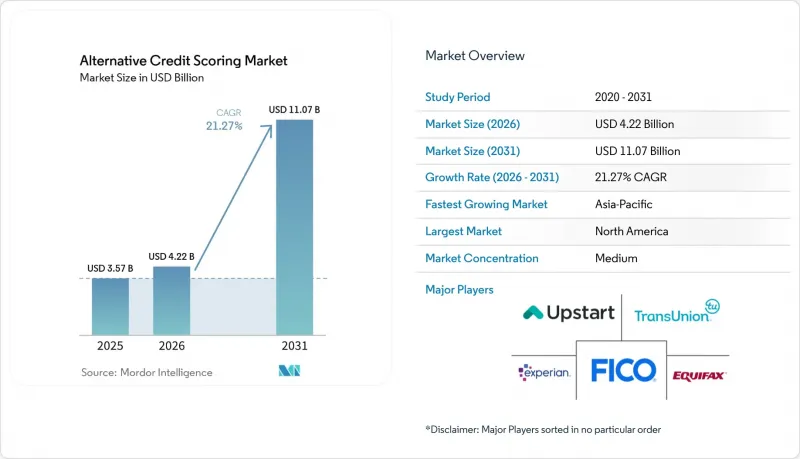
This report is Segmented by Data Source (Cash Flow and Banking Transaction Data, Utility, Telecom, and Recurring Bill Payments and More), by Application (Unsecured Consumer Lending, Mortgage and Secured Housing Finance, and More), by End User (Traditional Banks, and More), and Geography (North America, South America, and More). The Market Forecasts are Provided in Terms of Value (USD).
Global Alternative Credit Scoring Market Trends and Insights
Rising Thin-File and Credit Invisible Borrowers
The Federal Reserve estimated in October 2025 that 32 million United States adults remained either credit invisible or unscored, including 7 million with no credit bureau record and 25 million thin-file consumers with insufficient history for a score. The thin-file group is materially larger than the fully invisible population, which makes it a more meaningful commercial opportunity for lenders using non-bureau data. The IFC reported in May 2026 that 3 billion people globally lacked adequate credit histories and that the MSME financing gap ranged from USD 5 trillion to USD 7 trillion, including USD 1.9 trillion for women-led enterprises. India is moving this issue into policy execution through the Grameen Credit Score framework. At the same time, Credit Information Companies have also sought approval to include utility bill payments to deepen rural coverage. This supports the alternative credit scoring market because many thin-file consumers are already generating dense digital payment trails through wallets, bills, and informal commerce, even when bureau files remain limited.
Shift Toward Consent-Based Cash Flow Underwriting
The CFPB finalized personal financial data rights rules under Section 1033 in October 2024, requiring large United States financial institutions to make consumer-permissioned financial data available through standardized APIs by April 2026. Experian then launched Credit + Cashflow Score in November 2025 and reported predictive accuracy gains of more than 40% versus conventional models across personal loans, bankcards, lines of credit, and mortgages. PayPal's selection of Nova Credit's Cash Atlas platform in September 2025 showed that large payment companies are already using transaction-based underwriting to reach thin-file consumers through direct customer relationships. FICO also partnered with Plaid in November 2025 to deliver the next-generation UltraFICO Score via real-time cash flow connectivity, reducing adoption friction in existing lender workflows. The practical effect is that real-time data aggregators are moving upward in the lending stack. That shift is becoming a major growth engine for the alternative credit scoring market.
Consent Fatigue and Data Permission Drop Off
Repeated requests for access to banking, behavioral, and utility data do not scale smoothly with lender demand, especially among lower-income users with weaker digital literacy. This matters because the same borrowers are often the core target group for alternative credit models. The IFC noted that women in some markets rely on shared devices or operate under weak data protection settings, which means standard consent flows can exclude people who are already underserved. In India, the Digital Personal Data Protection Act will introduce enhanced consent management, data rights, and breach notification obligations from May 2027, raising operational requirements for lenders using app-based behavioral data. The result is a self-reinforcing risk for the alternative credit scoring market because lower consent rates can leave models trained on the most digitally engaged borrowers rather than the broader thin-file population.
Other drivers and restraints analyzed in the detailed report include:
- Embedded Lending Expansion Across Digital Platforms
- Regulated Demand for Explainable AI in Credit Decisions
- Adverse Action and Explainability Burden on Lenders
For complete list of drivers and restraints, kindly check the Table Of Contents.
Segment Analysis
Cash flow and banking transaction data accounted for 31.42% share of the market in 2025, making it the largest data source in the alternative credit scoring market. Lenders favor this data because overdraft activity, account tenure, and balance trends map closely to familiar credit concepts such as repayment consistency, file age, and income stability. Plaid's 2025 launch of Lendscore (LS1) demonstrated the strength of this approach by combining cash flow attributes with network-level signals and delivering up to 25% better predictive performance than traditional scores alone. Utility, telecom, and recurring bill payment data continue to hold a steady supporting role, especially in Sub-Saharan Africa and South Asia, where bank account access still trails mobile and utility usage.
Rental and housing-related data are also gaining a clearer place in the alternative credit scoring industry because FHFA approved VantageScore 4.0 for GSE-backed mortgage originations in 2025, and that model incorporates rental payment history. Behavioral, psychometric, and digital footprint data are the fastest-growing sources, with a projected 26.78% CAGR from 2026 to 2031, and vendors such as CredoLab and LenddoEFL turning device metadata, app activity, and geolocation patterns into score-ready signals. That expansion is moving faster than regulation in many countries, which keeps compliance questions open even as commercial adoption rises. E-commerce and digital commerce data are scaling especially fast in APAC, where Naver SmartStore transaction signals in South Korea and Grab merchant payment data in Southeast Asia are helping lenders move away from bureau-dependent models.
Complete Report Scope:
- By Data Source
- Cash-flow and Banking Transaction Data
- Utility, Telecom, and Recurring Bill Payments
- Rental, Housing, and Property-Related Data
- E-commerce, Digital Commerce, and Payment Platform Data
- Behavioral, Psychometric, and Digital Footprint Data
- Public Records, Employment, Income Verification, and Other Alternative Sources
- By Application
- Unsecured Consumer Lending
- Mortgage and Secured Housing Finance
- SME / MSME and Business Lending
- Rental and Tenant Screening
- Fraud Detection, Identity Verification, and Broader Risk Analytics
- Other Applications
- By End User
- Traditional Banks
- FinTech Lenders and Digital Banks
- Credit Unions and Community Lenders
- NBFCs and Specialty Finance Companies
- Embedded Finance and Commerce Platforms
- Credit Bureaus and Data Aggregators
- By Geography
- North America
- United States
- Canada
- Mexico
- South America
- Brazil
- Argentina
- Chile
- Peru
- Rest of South America
- Europe
- United Kingdom
- Germany
- France
- Italy
- Spain
- BENELUX (Belgium, Netherlands, and Luxembourg)
- NORDICS (Denmark, Finland, Iceland, Norway, and Sweden)
- Rest of Europe
- Asia-Pacific
- India
- China
- Japan
- Australia
- South Korea
- South East Asia (Singapore, Malaysia, Thailand, Indonesia, Vietnam, and Philippines)
- Rest of Asia-Pacific
- Middle East and Africa
- United Arab Emirates
- Saudi Arabia
- South Africa
- Nigeria
- Rest of Middle East and Africa
- North America
Geography Analysis
North America held 39.66% of the alternative credit scoring market share in 2025, maintaining its position as the largest regional base. The region benefits from a mature venture ecosystem, deep AI-native lending infrastructure, and the policy push behind consumer-permissioned data-sharing under Section 1033. FHFA's approval of VantageScore 4.0 for GSE mortgage originations, together with Equifax and TransUnion's pricing moves below FICO's 2026 mortgage score level, is widening the use of alternative data in the USD 13 trillion United States residential mortgage market. TransUnion's majority acquisition of Buro de Credito in Mexico and Upstart's move toward direct institutional status show that the region is still extending both data reach and lending capacity.
Asia-Pacific is projected to grow at 25.83% CAGR from 2026 to 2031, making it the fastest-growing region in the alternative credit scoring market. Growth reflects government-directed scoring mandates, mobile-first finance ecosystems, and super-app data layers that lack a close Western equivalent. South Korea's Financial Services Commission is developing a small-business scoring model that uses Naver SmartStore transaction data and Naver Place local business ratings, shifting early-stage business lending away from simple income checks toward growth potential. KakaoBank also extended its model to more than 70 financial institutions through a June 2025 partnership with NICE Credit Information, which turned a digital bank score into shared lending infrastructure. In India, Experian launched the Grameen Score in November 2025, while Credit Information Companies sought RBI approval to add utility bill data. In China, the State Council issued a 2026 implementation plan for a comprehensive enterprise credit evaluation system tied to SME finance and wider data mobilization goals.
Europe is advancing through PSD2-linked open banking adoption and the broader impact of Germany's 2026 SCHUFA reforms, while the United Kingdom now operates under a diverging post-GDPR automated decision-making framework. South America, especially Brazil, is moving through Open Finance, Pix Automatico, and credit portability, which improve the depth of real-time transaction data available for thin-file SME assessment. In the Middle East and Africa, Nova Credit's CRC Nigeria partnership addresses cross-border credit portability for Nigerians moving to the US, while Kenya and South Africa are seeing the early formation of structured alternatives built on behavioral and embedded lending models. Together, these patterns keep the alternative credit scoring market geographically uneven, but they also show that regions with weaker bureau coverage can move faster once policy and digital transaction rails are aligned.
- Experian plc
- Equifax, Inc.
- TransUnion
- Fair Isaac Corporation
- LexisNexis Risk Solutions
- Upstart Network, Inc.
- Zest AI, Inc.
- Nova Credit, Inc.
- CreditVidya
- CredoLab Pte. Ltd.
- LenddoEFL
- Trusting Social, Inc.
- Plaid Inc.
- Credit Karma, LLC
- CRIF S.p.A.
- Creditinfo Group hf.
- Provenir, Inc.
- Scienaptic AI, Inc.
- Tala Financial, Inc.
- Pagaya Technologies Ltd.
- Fintly
Additional Benefits:
- The market estimate (ME) sheet in Excel format
- 3 months of analyst support
TABLE OF CONTENTS
1 INTRODUCTION
- 1.1 Study Assumptions and Market Definition
- 1.2 Scope of the Study
2 RESEARCH METHODOLOGY
3 EXECUTIVE SUMMARY
4 MARKET LANDSCAPE
- 4.1 Market Overview
- 4.2 Market Drivers
- 4.2.1 Rising Thin File and Credit Invisible Borrowers
- 4.2.2 Shift Toward Consent Based Cash Flow Underwriting
- 4.2.3 Embedded Lending Expansion Across Digital Platforms
- 4.2.4 Regulated Demand for Explainable AI in Credit Decisions
- 4.2.5 Open Banking Data Permissioning Improving Score Quality
- 4.2.6 Cross Border Credit Portability for Migrants and SMEs
- 4.3 Market Restraints
- 4.3.1 Consent Fatigue and Data Permission Drop Off
- 4.3.2 Adverse Action and Explainability Burden on Lenders
- 4.3.3 Fragmented Data Rights and Storage Rules by Country
- 4.3.4 Model Drift from Rapidly Changing Consumer Behavior Signals
- 4.4 Value Chain Analysis
- 4.5 Regulatory Landscape
- 4.6 Technological Outlook
- 4.7 Porter's Five Forces Analysis
- 4.7.1 Threat of New Entrants
- 4.7.2 Bargaining Power of Buyers
- 4.7.3 Bargaining Power of Suppliers
- 4.7.4 Threat of Substitutes
- 4.7.5 Industry Rivalry
5 MARKET SIZE AND GROWTH FORECASTS
- 5.1 By Data Source
- 5.1.1 Cash-flow and Banking Transaction Data
- 5.1.2 Utility, Telecom, and Recurring Bill Payments
- 5.1.3 Rental, Housing, and Property-Related Data
- 5.1.4 E-commerce, Digital Commerce, and Payment Platform Data
- 5.1.5 Behavioral, Psychometric, and Digital Footprint Data
- 5.1.6 Public Records, Employment, Income Verification, and Other Alternative Sources
- 5.2 By Application
- 5.2.1 Unsecured Consumer Lending
- 5.2.2 Mortgage and Secured Housing Finance
- 5.2.3 SME / MSME and Business Lending
- 5.2.4 Rental and Tenant Screening
- 5.2.5 Fraud Detection, Identity Verification, and Broader Risk Analytics
- 5.2.6 Other Applications
- 5.3 By End User
- 5.3.1 Traditional Banks
- 5.3.2 FinTech Lenders and Digital Banks
- 5.3.3 Credit Unions and Community Lenders
- 5.3.4 NBFCs and Specialty Finance Companies
- 5.3.5 Embedded Finance and Commerce Platforms
- 5.3.6 Credit Bureaus and Data Aggregators
- 5.4 By Geography
- 5.4.1 North America
- 5.4.1.1 United States
- 5.4.1.2 Canada
- 5.4.1.3 Mexico
- 5.4.2 South America
- 5.4.2.1 Brazil
- 5.4.2.2 Argentina
- 5.4.2.3 Chile
- 5.4.2.4 Peru
- 5.4.2.5 Rest of South America
- 5.4.3 Europe
- 5.4.3.1 United Kingdom
- 5.4.3.2 Germany
- 5.4.3.3 France
- 5.4.3.4 Italy
- 5.4.3.5 Spain
- 5.4.3.6 BENELUX (Belgium, Netherlands, and Luxembourg)
- 5.4.3.7 NORDICS (Denmark, Finland, Iceland, Norway, and Sweden)
- 5.4.3.8 Rest of Europe
- 5.4.4 Asia-Pacific
- 5.4.4.1 India
- 5.4.4.2 China
- 5.4.4.3 Japan
- 5.4.4.4 Australia
- 5.4.4.5 South Korea
- 5.4.4.6 South East Asia (Singapore, Malaysia, Thailand, Indonesia, Vietnam, and Philippines)
- 5.4.4.7 Rest of Asia-Pacific
- 5.4.5 Middle East and Africa
- 5.4.5.1 United Arab Emirates
- 5.4.5.2 Saudi Arabia
- 5.4.5.3 South Africa
- 5.4.5.4 Nigeria
- 5.4.5.5 Rest of Middle East and Africa
- 5.4.1 North America
6 COMPETITIVE LANDSCAPE
- 6.1 Market Concentration
- 6.2 Strategic Moves
- 6.3 Market Share Analysis
- 6.4 Company Profiles (includes Global Level Overview, Market Level Overview, Core Segments, Financials as available, Strategic Information, Market Rank/Share, Products and Services, Recent Developments)
- 6.4.1 Experian plc
- 6.4.2 Equifax, Inc.
- 6.4.3 TransUnion
- 6.4.4 Fair Isaac Corporation
- 6.4.5 LexisNexis Risk Solutions
- 6.4.6 Upstart Network, Inc.
- 6.4.7 Zest AI, Inc.
- 6.4.8 Nova Credit, Inc.
- 6.4.9 CreditVidya
- 6.4.10 CredoLab Pte. Ltd.
- 6.4.11 LenddoEFL
- 6.4.12 Trusting Social, Inc.
- 6.4.13 Plaid Inc.
- 6.4.14 Credit Karma, LLC
- 6.4.15 CRIF S.p.A.
- 6.4.16 Creditinfo Group hf.
- 6.4.17 Provenir, Inc.
- 6.4.18 Scienaptic AI, Inc.
- 6.4.19 Tala Financial, Inc.
- 6.4.20 Pagaya Technologies Ltd.
- 6.4.21 Fintly
7 MARKET OPPORTUNITIES AND FUTURE OUTLOOK
- 7.1 White Space and Unmet Need Assessment

