PUBLISHER: Mordor Intelligence | PRODUCT CODE: 2072909

PUBLISHER: Mordor Intelligence | PRODUCT CODE: 2072909
SME Lending - Market Share Analysis, Industry Trends & Statistics, Growth Forecasts (2026 - 2031)
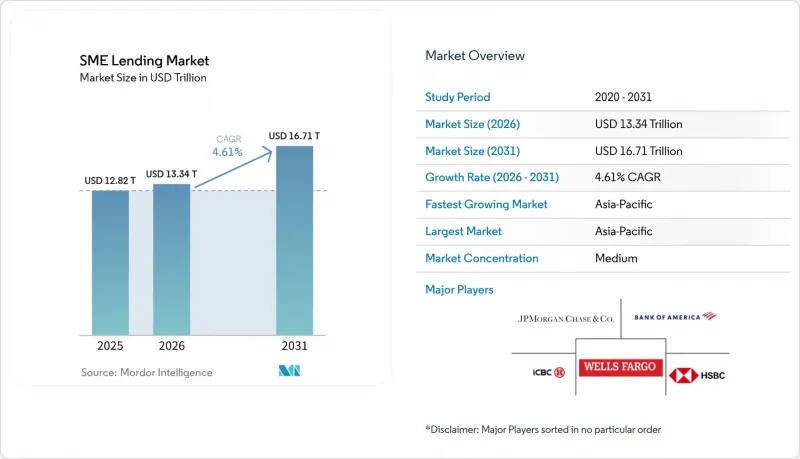
According to Mordor Intelligence, the SME lending market size is expected to grow from USD 12.82 trillion in 2025 to USD 13.34 trillion in 2026 and is forecast to reach USD 16.71 trillion by 2031 at 4.61% CAGR over 2026-2031.
This report is Segmented by Lender Type (Banks, and NBFCs and Fintechs), by Loan Type (Working Capital Loans, Term Loans, and More), by Collateral (Secured Lending and Unsecured Lending), by Loan Tenure (Short-Term (<1 Year), and More), by Borrower Size (Micro Enterprises, and More), and by Geography (North America, South America, and More). The Market Forecasts are Provided in Terms of Value (USD).
Global SME Lending Market Trends and Insights
Digitization of SME Underwriting Compresses Credit Cycles
The SME lending market is seeing faster approval and disbursement cycles as underwriting moves from document-heavy review to automated decisioning based on cash flow and transaction data. Funding Circle stated in its full-year 2025 results that its AI credit models are 3x better at discriminating risk than traditional bureau scores, drawing on 10 billion proprietary data points built over 15 years. FinRegLab also found that cash-flow variables from bank transaction data offer predictive power comparable to credit history in small-business underwriting. The combined models perform better than either source alone. Mastercard is extending open-finance credit analytics that combine payment network sales data with open banking cash-flow signals, supporting a move toward near-real-time monitoring rather than a static annual review. These changes reduce processing friction across the SME lending market and make smaller ticket loans more viable for both banks and non-bank lenders. As this model scales, the cost gap between large and small lenders narrows, which can support new regional entry into the SME lending market.
Working Capital Demand Driven by Cash Conversion Cycle Volatility
Working capital demand remains the clearest volume anchor in the SME lending market because operating cash needs have stayed elevated across supply chains, payment cycles, and procurement networks. Working capital loans accounted for 42.97% of total SME loan originations in 2025, indicating that liquidity support still matters more than long-duration investment credit across most borrower segments. Short-term loans are also the fastest-growing tenure band, with a 5.86% CAGR through 2031, which aligns with a broader shift toward revolving facilities, invoice-backed borrowing, and shorter repayment terms. Citi noted in its 2026 supply chain financing outlook that SMEs remain the most underserved group in trade finance and that AI is beginning to lower underwriting costs for these exposures at scale. This favors lenders that can see live business cash positions and receivable flows rather than relying only on annual statements. The result is a SME lending market expanding around recurring working capital needs, not just traditional term lending demand.
SME Default Risk Intensifies Under Prolonged Rate Pressure
The SME lending market continues to feel the effects of the tightening cycle that began in 2022, as credit stress typically emerges after rates have remained high for a sustained period. OECD data showed that SME bankruptcies rose by 11% in 2023 across the median tracked economy, and 25 of 32 countries reported increases. In Germany, the KfW-ifo Credit Barrier survey for Q4 2025 found that more than 40% of SMEs in retail and services reported credit access difficulties, which marked a record high for those sectors. The ECB also noted in May 2026 that insolvency trends and credit loss exposure remain uneven across countries, especially where SME lending is concentrated in local banking systems. The Bank of England added that SME lending remains costlier to serve than large corporate lending because of smaller ticket sizes and information asymmetry, leaving lenders more inclined to tighten supply when stress rises. This creates a difficult pattern in the SME lending market because lenders often cut off access before defaults actually peak, deepening liquidity strain for weaker borrowers.
Other drivers and restraints analyzed in the detailed report include:
- Embedded And Non-Bank Channels Redefine Origination Economics
- Policy-Backed Guarantees Unlock Credit Supply In Underserved Segments
- Formal Record Gaps Constrain Credit Decisioning For Micro Enterprises
For complete list of drivers and restraints, kindly check the Table Of Contents.
Segment Analysis
Banks held 77.21% of the SME lending market share in 2025, while NBFCs and fintechs are projected to expand at 9.02% CAGR through 2031. This split shows that the largest balance sheets still dominate formal credit delivery, especially in larger ticket sizes and longer-duration lending. At the same time, the fastest-growing segment of new business formation in the SME lending market is moving toward lenders that can approve and disburse smaller loans at lower processing costs. Funding Circle reported that credit extended rose 29% to GBP 2,453 million (USD 3.1 billion) in 2025, and profit before tax increased 6x to GBP 20.3 million (USD 25.7 million).
OakNorth also reported pre-tax profit of GBP 222.5 million (USD 289 million) in 2025, with gross originations growing 33% to GBP 2.8 billion (USD 3.7 billion) and cumulative lending facilities exceeding GBP 15.1 billion (USD 20 billion). These results indicate that digital and specialist lenders are now proving durable economics rather than relying solely on volume growth. For the SME lending industry, the main threat to incumbent banks is not a loss of funding scale, but a loss of customer access points and underwriting speed. That is why distribution partnerships, embedded channel access, and selective acquisitions look more rational than broad rate competition for many established lenders. The SME lending market is therefore developing into a two-speed structure, with banks retaining the largest loan books while non-bank players capture a larger share of the incremental flow.
Working capital loans accounted for 42.97% of the SME lending market in 2025, making them the largest loan category by volume. Invoice financing is the fastest-growing loan type, with a 8.29% CAGR from 2026 to 2031, indicating that receivables-led borrowing is moving closer to the center of the SME lending market. The shift is being reinforced by formal policy action, including the Reserve Bank of India's draft TReDS Directions 2026, which aims to streamline invoice financing rules, permit guarantee cover on TReDS exposures, and simplify onboarding for financiers. This matters because invoice products work well when borrowers need recurring liquidity but cannot offer fixed assets as security.
Term loans remain the second-largest category by volume in the SME lending market and continue to play a central role in funding equipment, expansion, and medium-term investment. Funding Circle said term loan originations increased 16% to GBP 1,638 million (USD 2.1 billion) in 2025. Equipment finance and trade finance serve distinct needs: the former is tied to productive asset purchases, while the latter is tied to supplier and buyer cycles. Citi's 2026 supply chain financing report noted that SMEs remain the most underserved group in trade finance, leaving room for specialized lenders and digital platforms to expand their product reach. As a result, the SME lending market is broadening not by replacing working capital loans, but by building more precise products around cash-flow timing, invoices, and supply-chain activity.
Complete Report Scope:
- By Lender Type
- Banks
- NBFCs and Fintechs
- By Loan Type
- Working Capital Loans
- Term Loans
- Equipment Financing
- Trade Finance Loans
- Invoice Financing
- Other Loan Types
- By Collateral
- Secured Lending
- Unsecured Lending
- By Loan Tenure
- Short-term (<1 year)
- Medium-term (1-5 years)
- Long-term (>5 years)
- By Borrower Size
- Micro Enterprises
- Small Enterprises
- Medium Enterprises
- By Geography
- North America
- United States
- Canada
- Mexico
- South America
- Brazil
- Argentina
- Chile
- Peru
- Rest of South America
- Europe
- United Kingdom
- Germany
- France
- Italy
- Spain
- BENELUX (Belgium, Netherlands, and Luxembourg)
- NORDICS (Denmark, Finland, Iceland, Norway, and Sweden)
- Rest of Europe
- Asia-Pacific
- India
- China
- Japan
- Australia
- South Korea
- South East Asia (Singapore, Malaysia, Thailand, Indonesia, Vietnam, and Philippines)
- Rest of Asia-Pacific
- Middle East and Africa
- United Arab Emirates
- Saudi Arabia
- South Africa
- Nigeria
- Rest of Middle East and Africa
- North America
Geography Analysis
Asia-Pacific accounted for 43.23% of the SME lending market share in 2025 and is projected to grow at a 5.74% CAGR through 2031, keeping the region in a rare position as both the largest and fastest-growing geography. India remains a major driver of that profile, with the MSME credit portfolio crossing INR 46 lakh crore (USD 553 billion) in April 2026. Bank credit to MSMEs in India also rose 24.6% year on year as of November 2025, lifting the segment's share of total bank credit to 18.5%. Policy support remains important across Asia-Pacific, including India's Mutual Credit Guarantee Scheme and the RBI's effort to formalize invoice financing rules. The region's position in the SME lending market reflects a mix of borrower scale, rapid digitization, and widening policy intervention rather than a single-country effect.
North America remains a high-volume part of the SME lending market because bank penetration is deep, but competitive pressure is shifting toward technology-enabled origination. JPMorgan Chase announced in March 2026 that it would commit USD 80 billion to small-business lending over 10 years and expand its client base from 7 million to 10 million businesses. The SBA's Made in America Loan Guarantee raised guarantee coverage to 90% for manufacturing SME loans and removed loan fees for small manufacturers in FY2026. SmartBiz's move into a bank charter in 2025 showed how platform lenders in the region are combining digital acquisition with stable balance-sheet funding. Mastercard's open-finance credit analytics also point to a broader North American shift from periodic review toward live transaction-led surveillance.
Europe remains one of the tighter parts of the SME lending market, with OECD data showing a 12% decline in new SME lending across the European Union in 2023 and restrictive conditions continuing into 2024. The European Investment Fund continues to provide the region's key de-risking platform, with cumulative guarantee commitments exceeding EUR 77 billion and another EUR 10 billion deployed under InvestEU. Germany's Q4 2025 KfW-ifo survey showed that more than 40% of SMEs in retail and services are facing difficulties accessing credit, underscoring the gap between demand and available supply. South America and Middle East, and Africa remain smaller in volume. Still, Brazil's rise in higher-risk MSME loans from 8.2% in January 2025 to 8.9% in September 2025 shows how sensitive these regions are to policy rates and credit-cycle stress.
- JPMorgan Chase and Co.
- Bank of America Corporation
- Wells Fargo and Company
- Industrial and Commercial Bank of China Limited
- HSBC Holdings plc
- HDFC Bank Limited
- ICICI Bank Limited
- American Express Company
- Funding Circle Holdings plc
- OnDeck Capital, Inc.
- BlueVine Inc.
- Kabbage, Inc.
- Lendio, Inc.
- OakNorth Bank plc
- Prospa Group Limited
- PayPal Holdings, Inc.
- Square, Inc.
- Biz2Credit Inc.
- Konfio, S.A.P.I. de C.V.
- Tide Platform Limited
- Iwoca Limited
Additional Benefits:
- The market estimate (ME) sheet in Excel format
- 3 months of analyst support
TABLE OF CONTENTS
1 INTRODUCTION
- 1.1 Study Assumptions and Market Definition
- 1.2 Scope of the Study
2 RESEARCH METHODOLOGY
3 EXECUTIVE SUMMARY
4 MARKET LANDSCAPE
- 4.1 Market Overview
- 4.2 Market Drivers
- 4.2.1 Digitization of SME underwriting and loan origination
- 4.2.2 Rising working capital demand from volatile cash conversion cycles
- 4.2.3 Growth of non-bank and embedded finance channels
- 4.2.4 Policy-backed credit guarantees and direct lending programs
- 4.2.5 Alternative data and cash-flow analytics improving approval rates
- 4.2.6 International trade and supply-chain financing needs among SMEs
- 4.3 Market Restraints
- 4.3.1 Elevated SME default risk during policy tightening cycles
- 4.3.2 Limited financial transparency and sparse formal records for smaller firms
- 4.3.3 Higher compliance burden in KYC, AML, and model governance
- 4.3.4 Collateral scarcity and weak asset coverage for unsecured lending
- 4.4 Value Chain Analysis
- 4.5 Regulatory Landscape
- 4.6 Technological Outlook
- 4.7 Porter's Five Forces Analysis
- 4.7.1 Bargaining Power of Suppliers
- 4.7.2 Bargaining Power of Buyers
- 4.7.3 Threat of New Entrants
- 4.7.4 Threat of Substitutes
- 4.7.5 Competitive Rivalry
5 MARKET SIZE AND GROWTH FORECASTS
- 5.1 By Lender Type
- 5.1.1 Banks
- 5.1.2 NBFCs and Fintechs
- 5.2 By Loan Type
- 5.2.1 Working Capital Loans
- 5.2.2 Term Loans
- 5.2.3 Equipment Financing
- 5.2.4 Trade Finance Loans
- 5.2.5 Invoice Financing
- 5.2.6 Other Loan Types
- 5.3 By Collateral
- 5.3.1 Secured Lending
- 5.3.2 Unsecured Lending
- 5.4 By Loan Tenure
- 5.4.1 Short-term (<1 year)
- 5.4.2 Medium-term (1-5 years)
- 5.4.3 Long-term (>5 years)
- 5.5 By Borrower Size
- 5.5.1 Micro Enterprises
- 5.5.2 Small Enterprises
- 5.5.3 Medium Enterprises
- 5.6 By Geography
- 5.6.1 North America
- 5.6.1.1 United States
- 5.6.1.2 Canada
- 5.6.1.3 Mexico
- 5.6.2 South America
- 5.6.2.1 Brazil
- 5.6.2.2 Argentina
- 5.6.2.3 Chile
- 5.6.2.4 Peru
- 5.6.2.5 Rest of South America
- 5.6.3 Europe
- 5.6.3.1 United Kingdom
- 5.6.3.2 Germany
- 5.6.3.3 France
- 5.6.3.4 Italy
- 5.6.3.5 Spain
- 5.6.3.6 BENELUX (Belgium, Netherlands, and Luxembourg)
- 5.6.3.7 NORDICS (Denmark, Finland, Iceland, Norway, and Sweden)
- 5.6.3.8 Rest of Europe
- 5.6.4 Asia-Pacific
- 5.6.4.1 India
- 5.6.4.2 China
- 5.6.4.3 Japan
- 5.6.4.4 Australia
- 5.6.4.5 South Korea
- 5.6.4.6 South East Asia (Singapore, Malaysia, Thailand, Indonesia, Vietnam, and Philippines)
- 5.6.4.7 Rest of Asia-Pacific
- 5.6.5 Middle East and Africa
- 5.6.5.1 United Arab Emirates
- 5.6.5.2 Saudi Arabia
- 5.6.5.3 South Africa
- 5.6.5.4 Nigeria
- 5.6.5.5 Rest of Middle East and Africa
- 5.6.1 North America
6 COMPETITIVE LANDSCAPE
- 6.1 Market Concentration
- 6.2 Strategic Moves
- 6.3 Market Share Analysis
- 6.4 Company Profiles (includes Global Level Overview, Market Level Overview, Core Segments, Financials as available, Strategic Information, Market Rank/Share, Products and Services, Recent Developments)
- 6.4.1 JPMorgan Chase and Co.
- 6.4.2 Bank of America Corporation
- 6.4.3 Wells Fargo and Company
- 6.4.4 Industrial and Commercial Bank of China Limited
- 6.4.5 HSBC Holdings plc
- 6.4.6 HDFC Bank Limited
- 6.4.7 ICICI Bank Limited
- 6.4.8 American Express Company
- 6.4.9 Funding Circle Holdings plc
- 6.4.10 OnDeck Capital, Inc.
- 6.4.11 BlueVine Inc.
- 6.4.12 Kabbage, Inc.
- 6.4.13 Lendio, Inc.
- 6.4.14 OakNorth Bank plc
- 6.4.15 Prospa Group Limited
- 6.4.16 PayPal Holdings, Inc.
- 6.4.17 Square, Inc.
- 6.4.18 Biz2Credit Inc.
- 6.4.19 Konfio, S.A.P.I. de C.V.
- 6.4.20 Tide Platform Limited
- 6.4.21 Iwoca Limited
7 MARKET OPPORTUNITIES AND FUTURE OUTLOOK
- 7.1 White-Space and Unmet-Need Assessment

