PUBLISHER: Mordor Intelligence | PRODUCT CODE: 2072932

PUBLISHER: Mordor Intelligence | PRODUCT CODE: 2072932
Cocktail Syrup - Market Share Analysis, Industry Trends & Statistics, Growth Forecasts (2026 - 2031)
According to Mordor Intelligence, the cocktail syrup market size is expected to grow from USD 5.65 billion in 2025 to USD 5.89 billion in 2026 and is forecast to reach USD 7.24 billion by 2031 at 4.21% CAGR over 2026-2031.
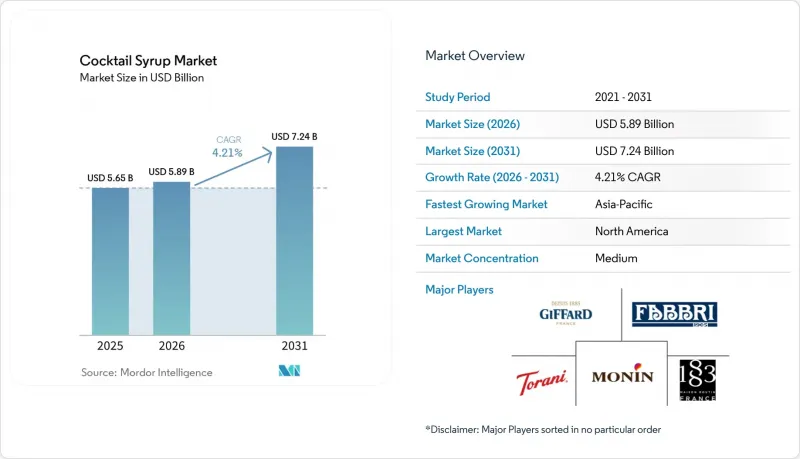
This report is Segmented by Product Type (Fruit Syrups, Herb and Spice Syrups, Vanilla Syrups, Other Product Types), Flavor (Sweet, Salty, Sour, Mint), Distribution Channel (On-Trade and Off-Trade), and Geography (North America, Europe, Asia-Pacific, South America, Middle East and Africa). The Market Forecasts are Provided in Terms of Value (USD) and Volume (Litres).
Global Cocktail Syrup Market Trends and Insights
Rising consumption of cocktails and mixed alcoholic beverages
The rising consumption of cocktails and mixed alcoholic beverages is a key driver of the global cocktail syrup market. Consumers are increasingly seeking premium, flavorful, and customized drinking experiences, leading to greater demand for cocktails across bars, restaurants, clubs, and home settings. Cocktail syrups play a crucial role in enhancing taste, consistency, and preparation efficiency, making them an essential ingredient in a wide range of alcoholic beverages. The growing popularity of classic cocktails, craft beverages, and innovative mixology trends has further accelerated syrup usage among bartenders and consumers. Additionally, the expansion of social drinking culture, rising disposable incomes, and increasing interest in at-home cocktail preparation are supporting market growth. The introduction of exotic, fruit-based, and botanical flavors by manufacturers is also attracting consumers looking for unique beverage experiences. As cocktail consumption continues to rise globally, demand for high-quality cocktail syrups is expected to increase steadily.
Expansion of hospitality and tourism industries
The expansion of the hospitality and tourism industries is a significant driver of the cocktail syrup market. As international travel continues to recover and grow, demand for premium food and beverage experiences across hotels, resorts, restaurants, bars, and entertainment venues is increasing. According to UN Tourism, global international tourist arrivals reached approximately 1.52 billion in 2025, reflecting a 4% increase from 2024 and the highest level ever recorded. The growing influx of tourists has encouraged hospitality establishments to expand their beverage offerings, including signature cocktails and premium mixed drinks. Cocktail syrups are widely used to enhance flavor variety, ensure consistency, and streamline beverage preparation in high-volume service environments. Additionally, rising investments in tourism infrastructure and luxury hospitality services are supporting the adoption of innovative cocktail ingredients.
High sugar content concerns among health-conscious consumers
High sugar content concerns among health-conscious consumers are limiting the growth potential of the cocktail syrup market. Traditional cocktail syrups often contain significant amounts of added sugars, which can conflict with the growing consumer preference for healthier beverage options. Rising awareness of health issues such as obesity, diabetes, and cardiovascular diseases has encouraged consumers to monitor and reduce their sugar intake. As a result, many consumers are opting for low-sugar, sugar-free, or naturally sweetened alternatives when selecting beverages. This shift is particularly evident among younger consumers and wellness-focused demographics who prioritize clean-label and functional ingredients. Additionally, stricter nutritional labeling requirements and public health campaigns promoting reduced sugar consumption are influencing purchasing decisions. Consequently, manufacturers face increasing pressure to reformulate products and develop healthier syrup alternatives to remain competitive in the market.
Other drivers and restraints analyzed in the detailed report include:
- Expansion of premium and craft beverage trends
- Increasing demand from bars, pubs, and restaurants
- Growing demand for low-calorie and sugar-free alternatives
For complete list of drivers and restraints, kindly check the Table Of Contents.
Segment Analysis
By product type, fruit syrups dominated the cocktail syrup market, accounting for 43.18% of total revenue in 2025. The segment's leadership is primarily driven by the widespread consumer preference for fruit-based flavors in both alcoholic and non-alcoholic beverages. Fruit syrups offer versatility across a broad range of cocktails, mocktails, sodas, and specialty drinks, making them a staple ingredient in bars, restaurants, and households. Popular flavors such as strawberry, mango, raspberry, passion fruit, and citrus varieties continue to experience strong demand due to their familiar taste profiles and broad consumer appeal. The growing trend of premium cocktails and craft beverages has further encouraged manufacturers to introduce innovative fruit syrup formulations with natural ingredients and reduced sugar content.
Herb and spice syrups are projected to be the fastest-growing product type in the cocktail syrup market, registering a CAGR of 6.01% through 2031. Growth in this segment is being fueled by rising consumer interest in unique and sophisticated flavor experiences that go beyond traditional fruit-based offerings. Bartenders and mixologists are increasingly incorporating flavors such as rosemary, basil, lavender, ginger, cinnamon, cardamom, and thyme into premium cocktail creations to enhance complexity and aroma. The popularity of craft cocktails and experiential drinking trends has created strong demand for specialty syrups that enable flavor customization. Furthermore, consumers are becoming more receptive to botanical and spice-infused beverages, particularly in premium hospitality venues and upscale restaurants.
Complete Report Scope:
- By Product Type
- Fruit Syrups
- Herb and Spice Syrups
- Vanilla Syrups
- Other Product types
- By Flavor
- Sweet
- Salty
- Sour
- Mint
- By Distribution Channel
- On-Trade
- Off-Trade
- Supermarkets/Hypermarkets
- Specialty Stores
- Online Retail Stores
- Other Distribution Channels
- By Geography
- North America
- United States
- Canada
- Mexico
- Rest of North America
- Europe
- United Kingdom
- Germany
- France
- Italy
- Spain
- Netherlands
- Sweden
- Belgium
- Poland
- Rest of Europe
- Asia-Pacific
- China
- Japan
- India
- South Korea
- Australia
- Indonesia
- Thailand
- Singapore
- Rest of Asia-Pacific
- South America
- Brazil
- Argentina
- Chile
- Colombia
- Peru
- Rest of South America
- Middle East and Africa
- United Arab Emirates
- South Africa
- Saudi Arabia
- Nigeria
- Egypt
- Morocco
- Turkey
- Rest of Middle East and Africa
- North America
Geography Analysis
North America accounted for the largest share of the global cocktail syrup market, representing 36.89% of total revenue in 2025. The region's leadership is supported by a well-established cocktail culture, high consumer spending on premium beverages, and the widespread presence of bars, restaurants, lounges, and hospitality venues. The United States remains the primary contributor, driven by strong demand for craft cocktails, flavored beverages, and innovative mixology experiences. Rising consumer preference for premium and customized drinks has encouraged beverage operators to expand their use of cocktail syrups across both alcoholic and non-alcoholic applications. In addition, the growing popularity of at-home cocktail preparation and premium beverage ingredients has further strengthened market demand.
Asia-Pacific is projected to be the fastest-growing region in the cocktail syrup market, expanding at a CAGR of 5.81% through 2031. Rapid urbanization, rising disposable incomes, and changing consumer lifestyles are driving increased demand for premium beverages and modern drinking experiences across the region. Countries such as China, India, Japan, South Korea, and Australia are witnessing growing consumption of cocktails, mocktails, specialty coffees, and flavored beverages, creating significant opportunities for syrup manufacturers. The expansion of international restaurant chains, cafes, bars, and hospitality establishments has further accelerated product adoption. Younger consumers are increasingly experimenting with new flavors and beverage formats, encouraging demand for innovative syrup varieties.
Europe represents a mature and significant market for cocktail syrups, supported by a strong cafe culture, established hospitality sector, and growing demand for premium and craft beverages. Consumers across the region increasingly favor natural, organic, and artisanal syrup formulations, encouraging product innovation among manufacturers. South America is experiencing steady market growth, driven by expanding urban populations, increasing tourism activities, and rising popularity of flavored alcoholic and non-alcoholic beverages. Meanwhile, the Middle East and Africa region is gradually emerging as a promising market due to the expansion of cafes, hotels, restaurants, and premium dining establishments.
- Monin S.A.S.
- R. Torre & Company, Inc. (Torani)
- Maison Routin SAS (1883 Maison Routin)
- Giffard & Cie
- Fabbri 1905 S.p.A.
- Teisseire SAS
- American Beverage Marketers, Inc. (Finest Call)
- Liber & Co.
- ODK S.r.l.
- Bristol Syrup Company Ltd
- Funkin Cocktails Ltd.
- Fee Brothers, Inc.
- Collins Brothers LLC
- Small Hand Foods, Inc.
- Sonoma Syrup Co.
- Toschi Vignola S.r.l.
- BG Reynolds, LLC
- Cocktail & Sons, Inc.
- The Simple Syrup Co.
- Liquid Alchemist LLC
Additional Benefits:
- The market estimate (ME) sheet in Excel format
- 3 months of analyst support
TABLE OF CONTENTS
1 INTRODUCTION
- 1.1 Study Assumptions and Market Definition
- 1.2 Scope of the Study
2 RESEARCH METHODOLOGY
3 EXECUTIVE SUMMARY
4 MARKET LANDSCAPE
- 4.1 Market Overview
- 4.2 Market Drivers
- 4.2.1 Rising consumption of cocktails and mixed alcoholic beverages
- 4.2.2 Expansion of hospitality and tourism industries
- 4.2.3 Expansion of premium and craft beverage trends
- 4.2.4 Increasing demand from bars, pubs, and restaurants
- 4.2.5 Growing popularity of flavored and customized drinks
- 4.2.6 Growth of home bartending and DIY cocktail culture
- 4.3 Market Restraints
- 4.3.1 High sugar content concerns among health-conscious consumers
- 4.3.2 Growing demand for low-calorie and sugar-free alternatives
- 4.3.3 Volatility in prices of sugar, fruits, and flavoring ingredients
- 4.3.4 Stringent food safety and labeling regulations
- 4.4 Consumer Behaviour Analysis
- 4.5 Regulatory Outlook
- 4.6 Porter's Five Forces Analysis
- 4.6.1 Bargaining Power of Suppliers
- 4.6.2 Bargaining Power of Buyers
- 4.6.3 Threat of New Entrants
- 4.6.4 Threat of Substitutes
- 4.6.5 Intensity of Competitive Rivalry
5 MARKET SIZE AND GROWTH FORECASTS (VALUE AND VOLUME)
- 5.1 By Product Type
- 5.1.1 Fruit Syrups
- 5.1.2 Herb and Spice Syrups
- 5.1.3 Vanilla Syrups
- 5.1.4 Other Product types
- 5.2 By Flavor
- 5.2.1 Sweet
- 5.2.2 Salty
- 5.2.3 Sour
- 5.2.4 Mint
- 5.3 By Distribution Channel
- 5.3.1 On-Trade
- 5.3.2 Off-Trade
- 5.3.2.1 Supermarkets/Hypermarkets
- 5.3.2.2 Specialty Stores
- 5.3.2.3 Online Retail Stores
- 5.3.2.4 Other Distribution Channels
- 5.4 By Geography
- 5.4.1 North America
- 5.4.1.1 United States
- 5.4.1.2 Canada
- 5.4.1.3 Mexico
- 5.4.1.4 Rest of North America
- 5.4.2 Europe
- 5.4.2.1 United Kingdom
- 5.4.2.2 Germany
- 5.4.2.3 France
- 5.4.2.4 Italy
- 5.4.2.5 Spain
- 5.4.2.6 Netherlands
- 5.4.2.7 Sweden
- 5.4.2.8 Belgium
- 5.4.2.9 Poland
- 5.4.2.10 Rest of Europe
- 5.4.3 Asia-Pacific
- 5.4.3.1 China
- 5.4.3.2 Japan
- 5.4.3.3 India
- 5.4.3.4 South Korea
- 5.4.3.5 Australia
- 5.4.3.6 Indonesia
- 5.4.3.7 Thailand
- 5.4.3.8 Singapore
- 5.4.3.9 Rest of Asia-Pacific
- 5.4.4 South America
- 5.4.4.1 Brazil
- 5.4.4.2 Argentina
- 5.4.4.3 Chile
- 5.4.4.4 Colombia
- 5.4.4.5 Peru
- 5.4.4.6 Rest of South America
- 5.4.5 Middle East and Africa
- 5.4.5.1 United Arab Emirates
- 5.4.5.2 South Africa
- 5.4.5.3 Saudi Arabia
- 5.4.5.4 Nigeria
- 5.4.5.5 Egypt
- 5.4.5.6 Morocco
- 5.4.5.7 Turkey
- 5.4.5.8 Rest of Middle East and Africa
- 5.4.1 North America
6 COMPETITIVE LANDSCAPE
- 6.1 Market Concentration
- 6.2 Strategic Moves
- 6.3 Market Share Analysis
- 6.4 Company Profiles (Includes Company Highlights, Strategic Information, Core Segments, Financials, Products & Services, Recent Developments)
- 6.4.1 Monin S.A.S.
- 6.4.2 R. Torre & Company, Inc. (Torani)
- 6.4.3 Maison Routin SAS (1883 Maison Routin)
- 6.4.4 Giffard & Cie
- 6.4.5 Fabbri 1905 S.p.A.
- 6.4.6 Teisseire SAS
- 6.4.7 American Beverage Marketers, Inc. (Finest Call)
- 6.4.8 Liber & Co.
- 6.4.9 ODK S.r.l.
- 6.4.10 Bristol Syrup Company Ltd
- 6.4.11 Funkin Cocktails Ltd.
- 6.4.12 Fee Brothers, Inc.
- 6.4.13 Collins Brothers LLC
- 6.4.14 Small Hand Foods, Inc.
- 6.4.15 Sonoma Syrup Co.
- 6.4.16 Toschi Vignola S.r.l.
- 6.4.17 BG Reynolds, LLC
- 6.4.18 Cocktail & Sons, Inc.
- 6.4.19 The Simple Syrup Co.
- 6.4.20 Liquid Alchemist LLC
7 MARKET OPPORTUNITIES AND FUTURE OUTLOOK

