PUBLISHER: Mordor Intelligence | PRODUCT CODE: 2072940

PUBLISHER: Mordor Intelligence | PRODUCT CODE: 2072940
Pipette Tips - Market Share Analysis, Industry Trends & Statistics, Growth Forecasts (2026 - 2031)
According to Mordor Intelligence, the pipette tips market size is expected to increase from USD 0.81 billion in 2025 to USD 0.87 billion in 2026 and reach USD 1.26 billion by 2031, growing at a CAGR of 7.73% over 2026-2031.
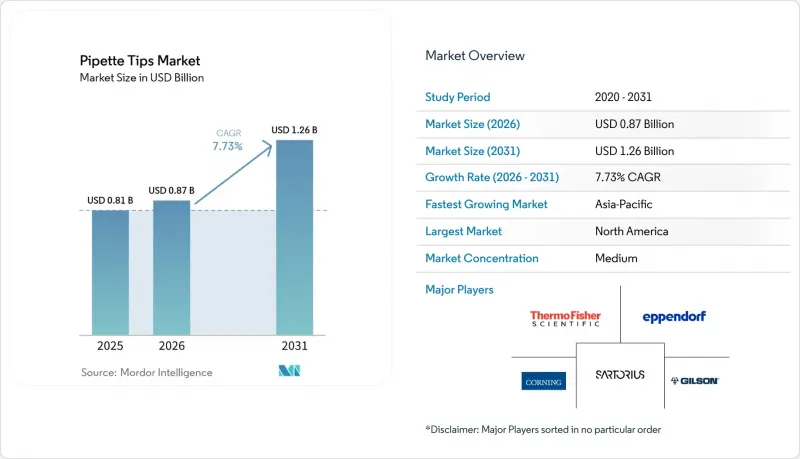
This report is Segmented by Product Type (Standard, Filtered, and More), Technology Type (Non-Robotic, Robotic), Application (Diagnostics and Healthcare, Pharma and Biotech, and More), End User (Diagnostics and Healthcare, Pharmaceutical and Biotechnology Companies, and More), and Geography (North America, Europe, Asia-Pacific, and More). The Market Forecasts are Provided in Terms of Value (USD).
Global Pipette Tips Market Trends and Insights
Rising High-Throughput Diagnostic and Research Workflows Drive Volume Consumption
High-throughput laboratories consume pipette tips at a significantly higher rate than traditional single-sample methods. For example, a single 96-well protocol can use 96 to 192 tips in one run, driving demand in plate-based testing, genomics, and drug discovery. In August 2025, Thermo Fisher Scientific opened a 375,000 sq ft carbon-neutral facility in Mebane, North Carolina, partially funded by a USD 192.5 million U.S. government contract. The facility is designed to produce 40 million pipette tips weekly, emphasizing the critical role of pipette tips in national health preparedness and laboratory operations. Advanced automation enables the production of 96 tips every 12 seconds, aligning manufacturing efficiency with rising laboratory demands. This increased capacity may lead to price pressures on imported standard formats in North America, requiring suppliers to focus on performance differentiation to maintain margins.
Automation Compatibility Becomes a Procurement Standard
Robotic liquid handling has redefined compatibility, requiring consumables to integrate seamlessly with automated systems. Research in 2025 demonstrated that an AI-driven computer vision model on the Opentrons OT-2 achieved 98% accuracy in detecting missing or incorrectly loaded pipette tips. Dimensional consistency is now critical, as inconsistent tip geometry can disrupt automated workflows and liquid handling. Suppliers unable to maintain tight tolerances may face challenges in automated procurement programs. Hamilton's GreenLine Tips, covering 85% of its catalog, combine quality assurance with sustainability, reflecting the market's shift toward precision-certified suppliers in automation-heavy accounts.
Plastic Waste Disposal Pressure and Recycling Gaps Create Procurement Risk
Laboratories generate significant volumes of plastic waste, with a 2025 study estimating 5.5 million tons of waste from around 20,500 research institutions globally. This waste has an environmental impact comparable to the CO2 emissions of over 1 million UK residents. Most recycling systems reject laboratory plastics due to contamination concerns, leaving incineration or landfill as the primary disposal methods. The EU's ESPR framework is driving stricter scrutiny on carbon disclosure, pushing buyers in Europe and North America to demand better end-of-life handling and lower embedded emissions. Suppliers without take-back programs, bio-based formulations, or recycling partnerships may face challenges in accessing the pipette tips market as sustainability becomes a key procurement factor. While demand for single-use tips persists, environmental performance will increasingly influence purchasing decisions.
Other drivers and restraints analyzed in the detailed report include:
- Single-Use Contamination Control Increases in Molecular Biology Workflows
- Growth in Sterile, RNase-Free, and DNase-Free Consumables Mirrors Biopharma Scale-Up
- Price Sensitivity in Volume-Based Laboratory Consumables Compresses Margins at Scale
For complete list of drivers and restraints, kindly check the Table Of Contents.
Segment Analysis
In 2025, standard tips held a 35.64% share of the pipette tips market, leading in routine tasks like buffer preparation and gel loading. This dominance reflects the affordability and availability required for high-volume, low-sensitivity tasks. Filtered tips are projected to grow at an 8.76% CAGR through 2031, driven by increased adoption of contamination-sensitive methods like NGS and qPCR. Low-retention tips, though a smaller segment, are gaining relevance in cell culture and biologics handling, where loss impacts assay quality.
Specialty formats, such as extended-length and wide-bore tips, cater to niche yet demanding tasks in automated screening and liquid-level detection. The market is shifting as filtered tips transition from a premium niche to routine procurement, particularly among large accounts with strict quality controls. Suppliers with automated molding for filter integration hold a competitive edge due to the complexity of scaling this process. Eppendorf introduced its ept.i.p.s. bio-based pipette tip line in 2025, utilizing 90% renewable materials from recycled cooking oil. Westburg Life Sciences expanded this trend in 2026 with TripleA PFAS-free pipette tips, emphasizing material compliance as a key differentiator.
Robotic tips accounted for 58.47% of the pipette tips market in 2025 and are projected to grow at a 9.12% CAGR through 2031. This growth highlights the untapped potential for automation in laboratory workflows. Laboratories adopting automated liquid handlers often remain within validated tip ecosystems for performance and compliance. Programs from Tecan, Hamilton, and Eppendorf strengthen this lock-in by tying qualification to specific platform and consumable combinations. Non-robotic tips, while relevant in teaching labs and field diagnostics, face slower growth due to the absence of validated workflow stickiness.
The competitive edge lies in ecosystem compatibility rather than pricing or catalog variety. Procurement teams increasingly prefer suppliers offering dimensional data and cross-platform validation upfront, shifting qualification responsibility to manufacturers. Companies supporting multi-vendor automation environments with consistent batch geometry gain an advantage. ISO 9001 and ISO 13485 standards favor vendors with superior quality documentation and dimensional control in pharmaceutical automation.
Complete Report Scope:
- By Product Type
- Standard
- Filtered
- Low-Retention
- Specialty and Other Product Types
- By Technology Type
- Non-Robotic
- Robotic
- By Application
- Diagnostics and Healthcare
- Pharma and Biotech
- Academia and Education
- Other Applications
- By End User
- Diagnostics and Healthcare
- Pharmaceutical and Biotechnology Companies
- Academic and Research Institutes
- Others
- By Geography
- North America
- United States
- Canada
- Mexico
- Europe
- Germany
- United Kingdom
- France
- Italy
- Spain
- Rest of Europe
- Asia-Pacific
- China
- India
- Japan
- Australia
- South Korea
- Rest of Asia-Pacific
- Middle East and Africa
- GCC
- South Africa
- Rest of Middle East and Africa
- South America
- Brazil
- Argentina
- Rest of South America
- North America
Geography Analysis
In 2025, North America held a 38.86% share of the pipette tips market, maintaining its leading position. The region benefits from a strong biotechnology and pharmaceutical base, established clinical testing infrastructure, and a focus on supply continuity following earlier shortages. Thermo Fisher Scientific opened a facility in Mebane, North Carolina, in August 2025, with a weekly capacity of at least 40 million tips, supported by U.S. government funding. This development strengthens domestic supply, reducing reliance on cross-border sources. Europe remains a key market, driven by robust pharmaceutical research in Germany, the United Kingdom, France, and the Netherlands, alongside strict accreditation standards. The EU's ESPR framework is accelerating the adoption of low-carbon and bio-based consumables.
Asia-Pacific is projected to grow at a 7.95% CAGR through 2031, making it the fastest-growing region in the pipette tips market. China's demand is fueled by investments in biotech parks, clinical laboratory networks, and biologics manufacturing. India is expanding diagnostic capacity, driving demand for standard high-volume tips and certified products for quality-focused laboratories. Japan, while mature, is shifting toward higher-value automated formats, supported by domestic biomanufacturing priorities. South Korea and Australia contribute with advanced genomics and life science research infrastructure. The region's growth is driven by a mix of China's scale, India's diagnostics expansion, and automation demand in developed research hubs.
The Middle East and Africa benefit from healthcare infrastructure investments, particularly in the GCC and South Africa, though import dependence and customs complexities limit faster growth. South America, led by Brazil and Argentina, has a strong pharmaceutical research base and increasing clinical trial activity, but price sensitivity and currency volatility challenge premium tip adoption. Dual-sourcing has become a common procurement strategy, with buyers engaging one global supplier and one regional backup to mitigate disruption risks. This approach expands the supplier pool while intensifying competition as suppliers strive to retain market share.
- Bio-Rad Laboratories
- Biotix, Inc.
- BrandTech Scientific, Inc.
- Cole-Parmer
- Corning
- Eppendorf
- Gilson Incorporated
- Greiner Bio One International
- Hamilton Company
- INTEGRA Biosciences
- Labcon North America, LLC
- Mettler Toledo
- Sarstedt AG and Co. KG
- Sartorius
- Socorex Isba SA
- Starlab International GmbH
- Tecan Group
- Thermo Fisher Scientific
- VWR International
Additional Benefits:
- The market estimate (ME) sheet in Excel format
- 3 months of analyst support
TABLE OF CONTENTS
1 INTRODUCTION
- 1.1 Study Assumptions and Market Definition
- 1.2 Scope of the Study
2 RESEARCH METHODOLOGY
3 EXECUTIVE SUMMARY
4 MARKET LANDSCAPE
- 4.1 Market Overview
- 4.2 Market Drivers
- 4.2.1 Rising High-Throughput Diagnostic and Research Workflows
- 4.2.2 Automation Compatibility Becomes a Procurement Standard
- 4.2.3 Single-Use Contamination Control Increases in Molecular Testing
- 4.2.4 Growth in Sterile, RNase-Free, and DNase-Free Consumables
- 4.2.5 Sustainability Procurement Shifts Toward Recyclable and Lower-Waste Tips
- 4.2.6 Localized Manufacturing and Dual-Sourcing Reduce Supply Risk
- 4.3 Market Restraints
- 4.3.1 Plastic Waste Disposal Pressure and Recycling Gaps
- 4.3.2 Price Sensitivity in Volume-Based Laboratory Consumables
- 4.3.3 Raw Material and Precision Mold Cost Volatility
- 4.3.4 Qualification Burden for Robotic and Specialty Tip Compatibility
- 4.4 Value/Supply Chain Analysis
- 4.5 Regulatory Landscape
- 4.6 Technological Outlook
- 4.7 Porter's Five Forces Analysis
- 4.7.1 Bargaining Power of Suppliers
- 4.7.2 Bargaining Power of Buyers
- 4.7.3 Threat of New Entrants
- 4.7.4 Threat of Substitutes
- 4.7.5 Intensity of Competitive Rivalry
5 MARKET SIZE AND GROWTH FORECASTS (VALUE, USD)
- 5.1 By Product Type
- 5.1.1 Standard
- 5.1.2 Filtered
- 5.1.3 Low-Retention
- 5.1.4 Specialty and Other Product Types
- 5.2 By Technology Type
- 5.2.1 Non-Robotic
- 5.2.2 Robotic
- 5.3 By Application
- 5.3.1 Diagnostics and Healthcare
- 5.3.2 Pharma and Biotech
- 5.3.3 Academia and Education
- 5.3.4 Other Applications
- 5.4 By End User
- 5.4.1 Diagnostics and Healthcare
- 5.4.2 Pharmaceutical and Biotechnology Companies
- 5.4.3 Academic and Research Institutes
- 5.4.4 Others
- 5.5 By Geography
- 5.5.1 North America
- 5.5.1.1 United States
- 5.5.1.2 Canada
- 5.5.1.3 Mexico
- 5.5.2 Europe
- 5.5.2.1 Germany
- 5.5.2.2 United Kingdom
- 5.5.2.3 France
- 5.5.2.4 Italy
- 5.5.2.5 Spain
- 5.5.2.6 Rest of Europe
- 5.5.3 Asia-Pacific
- 5.5.3.1 China
- 5.5.3.2 India
- 5.5.3.3 Japan
- 5.5.3.4 Australia
- 5.5.3.5 South Korea
- 5.5.3.6 Rest of Asia-Pacific
- 5.5.4 Middle East and Africa
- 5.5.4.1 GCC
- 5.5.4.2 South Africa
- 5.5.4.3 Rest of Middle East and Africa
- 5.5.5 South America
- 5.5.5.1 Brazil
- 5.5.5.2 Argentina
- 5.5.5.3 Rest of South America
- 5.5.1 North America
6 COMPETITIVE LANDSCAPE
- 6.1 Market Concentration
- 6.2 Market Share Analysis
- 6.3 Company Profiles (includes Global Level Overview, Market Level Overview, Core Segments, Financials as available, Strategic Information, Market Rank/Share, Products and Services, Recent Developments)
- 6.3.1 Bio-Rad Laboratories, Inc.
- 6.3.2 Biotix, Inc.
- 6.3.3 BrandTech Scientific, Inc.
- 6.3.4 Cole-Parmer Instrument Company, LLC
- 6.3.5 Corning Incorporated
- 6.3.6 Eppendorf SE
- 6.3.7 Gilson Incorporated
- 6.3.8 Greiner Bio-One International GmbH
- 6.3.9 Hamilton Company
- 6.3.10 INTEGRA Biosciences AG
- 6.3.11 Labcon North America, LLC
- 6.3.12 Mettler-Toledo International Inc.
- 6.3.13 Sarstedt AG and Co. KG
- 6.3.14 Sartorius AG
- 6.3.15 Socorex Isba SA
- 6.3.16 Starlab International GmbH
- 6.3.17 Tecan Trading AG
- 6.3.18 Thermo Fisher Scientific Inc.
- 6.3.19 VWR International, LLC
7 MARKET OPPORTUNITIES AND FUTURE OUTLOOK
- 7.1 White-Space and Unmet-Need Assessment

