PUBLISHER: Mordor Intelligence | PRODUCT CODE: 2072959

PUBLISHER: Mordor Intelligence | PRODUCT CODE: 2072959
United States Hospital Facilities - Market Share Analysis, Industry Trends & Statistics, Growth Forecasts (2026 - 2031)
According to Mordor Intelligence, the united states hospital facilities market size was valued at USD 1.79 trillion in 2025 and is estimated to grow from USD 1.93 trillion in 2026 to reach USD 2.81 trillion by 2031, at a CAGR of 7.85% during the forecast period (2026-2031).
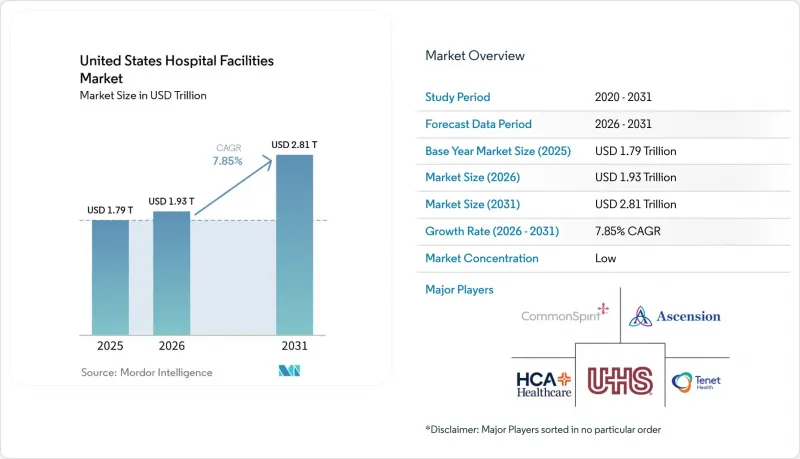
This report is Segmented by Patient Service (Inpatient, Outpatient), Facility Type (Public & Community, Private, State-Owned & Federal), Service Type (Acute Care, Cardiovascular, Cancer Care, Pathology/Diagnostics/Imaging, Obstetrics and Gynecology, Emergency & Trauma, Others), Bed Size (<100, 100-199, 200-299, 300+ Beds). The Market Forecasts are Provided in Terms of Value (USD).
United States Hospital Facilities Market Trends and Insights
Rising Outpatient Shift and Same-Day Surgery Mix
The United States hospital facilities market is being reshaped by a steady migration of surgical volume from inpatient campuses to outpatient settings. Research published in December 2025 confirmed that more than 65% of surgeries in the United States now occur in outpatient settings, and inpatient shares for hip and knee replacements fell after the pandemic, which shows that the shift has stayed in place rather than reversing. CMS reinforced this direction in 2026 by lifting total OPPS payments to USD 101.0 billion, up by USD 8.0 billion from 2025, while also starting the removal of 285 mainly musculoskeletal procedures from the Inpatient Only List. This matters because many of the procedures moving out of inpatient care were historically among the more profitable cases for hospital systems. When those procedures leave the main hospital campus, operators need outpatient departments and ambulatory surgery centers to keep referral flows and physician alignment intact. Medicare-certified ambulatory surgery centers reached 12,294 in 2025, and the sector captured 45% of total outpatient surgical volume, which shows that the United States hospital facilities market is not just growing, it is also changing where revenue is earned.
Hospital System Consolidation, Referral Capture, and Network Density
The United States hospital facilities market continues to favor systems that can control referral pathways across hospitals, clinics, outpatient sites, and surgery centers. The logic behind consolidation has shifted toward care-continuum control, because market leaders need local density and physician connectivity more than simple bed count. HCA Healthcare showed that approach in 2025 by adding nearly 100 outpatient business units and reporting net income of USD 6.8 billion, up 17.8% year over year, while also signaling that more capital remains available for future expansion in 2026 and 2027. Regulatory scrutiny is rising at the same time, as the FTC required Ascension to divest 7 ambulatory surgery centers in June 2026 to complete the AmSurg acquisition, which sets a clear limit on how fast networks can build outpatient scale through deals. The Department of Justice also sued NewYork-Presbyterian in 2026 over contract restrictions that it said raised healthcare costs, which shows that the United States hospital facilities market now faces antitrust pressure not only on mergers but also on payer contracting behavior. As a result, systems that can expand outpatient density and referral capture without relying on large transactions are likely to hold the more durable position.
Labor Shortages in Clinical and Facility Operations
Labor scarcity remains the most persistent structural restraint on the United States hospital facilities market. The Association of American Medical Colleges projected a physician shortage of 13,500 to 86,000 by 2036, and NIHCM noted that 31 of 35 physician specialties are expected to face supply gaps, which indicates that capacity expansion will continue to run into clinical staffing limits. Nursing pressure is also rising, and the AHA said the United States Chamber of Commerce expects 42 states to face nursing shortages by 2030. Advertised registered nurse salaries grew 26.6% faster than inflation over the last 4 years, which means revenue growth does not automatically translate into healthier margins for the United States hospital facilities market. Labor already represented 56% of total hospital costs, and the Veterans Health Administration reported a 50% year over year increase in severe occupational staffing shortages in FY2025, which points to continuing operational strain. This creates a practical limit for facility growth because beds can be licensed and buildings can be opened, but they cannot support clinical volume unless staffing standards are met.
Other drivers and restraints analyzed in the detailed report include:
- Technology-Enabled Bed and Throughput Optimization
- Aging Population and Chronic Disease Burden
- High Capital Intensity and Slow Payback for Facility Expansion
For complete list of drivers and restraints, kindly check the Table Of Contents.
Segment Analysis
Outpatient Services held 54.31% of the United States hospital facilities market share within the patient service segmentation in 2025, and the United States hospital facilities market size for this segment is projected to grow at a CAGR of 8.38% through 2031. That combination shows that outpatient care is already the larger revenue pool and is still widening its lead. The shift is structural because procedure migration has remained in place after the pandemic rather than reverting to earlier inpatient patterns. More than 65% of surgeries now take place in outpatient settings, which gives hospital systems a strong reason to invest in ambulatory networks and hospital-based outpatient departments. The United States hospital facilities market is therefore seeing service migration within the system rather than simple demand loss, especially when providers own the outpatient site of care.
Hospital-owned outpatient facilities performed 45% of outpatient surgeries in 2025, which shows that integrated systems can still retain a meaningful part of procedural revenue if they control the right assets. CMS also increased OPPS payment rates by 2.6% for 2026 services, which offers some support to hospital-based outpatient departments as they compete with freestanding centers. Inpatient Services still accounted for 45.69% of patient service revenue in 2025, and that base remains important because intensive care, complex surgery, and high-acuity chronic disease management cannot move easily into same-day settings. What changes in the United States hospital facilities market is the inpatient mix, because the remaining cases are increasingly more severe and more resource intensive. This leaves hospitals balancing two priorities at once, protecting high-acuity inpatient capacity while expanding outpatient access fast enough to hold referral relationships.
Public and Community Hospitals commanded 53.24% of revenue in 2025, which makes them the largest facility type in the United States hospital facilities market. Their lead reflects the broad access role they play across urban, suburban, and rural communities. These hospitals absorb large volumes of emergency care, uncompensated care, and medically necessary services that cannot be selected mainly on profit profile. That role gives them a durable place in the United States hospital facilities industry, even when margins are tight and capital budgets are under pressure. Private Hospitals operate a smaller share of the base, but they often run more capital-efficient models and capture a stronger mix of elective and commercially insured procedures.
State-Owned and Federal Hospitals are the fastest-growing facility type, with a CAGR of 8.52% through 2031. This faster expansion signals that public capacity investment is staying active even as many independent operators remain cautious on large projects. The United States hospital facilities industry still requires the same accreditation and licensing standards across public and private ownership models, which means compliance burdens do not fall simply because the owner changes. Public procurement cycles often stretch spending over longer periods, which supports a steadier buildout pattern across the forecast window. As a result, the United States hospital facilities market keeps its revenue base in community hospitals while a faster growth rate develops in publicly backed capacity additions.
Complete Report Scope:
- By Patient Service
- Inpatient Services
- Outpatient Services
- By Facility Type
- Public and Community Hospitals
- Private Hospitals
- State-Owned and Federal Hospitals
- By Service Type
- Acute Care
- Cardiovascular
- Cancer Care
- Pathology Lab, Diagnostics, and Imaging
- Obstetrics and Gynecology
- Emergency and Trauma Care
- Other Service Types
- By Bed Size
- Less Than 100 Beds
- 100 to 199 Beds
- 200 to 299 Beds
- 300 Beds and Above
List of Companies Covered in this Report:
- Advocate Health
- Ascension Health
- Banner Health
- Baptist Health
- Baylor Scott and White Health
- Bon Secours Mercy Health
- Cedars-Sinai
- Cleveland Clinic
- CommonSpirit Health
- HCA Healthcare, Inc.
- Houston Methodist
- Intermountain Health
- Kaiser Permanente
- Mass General Brigham
- Mayo Clinic
- NewYork-Presbyterian Hospital
- Northwell Health
- Northwestern Medicine
- OhioHealth
- Orlando Health
- Providence St. Joseph Health
- Sutter Health
- Tenet Healthcare
- Trinity Health
- UCSF Health
- Universal Health Services
- University of Pennsylvania Health System
- UPMC
Additional Benefits:
- The market estimate (ME) sheet in Excel format
- 3 months of analyst support
TABLE OF CONTENTS
1 Introduction
- 1.1 Study Assumptions & Market Definition
- 1.2 Scope of the Study
2 Research Methodology
3 Executive Summary
4 Market Landscape
- 4.1 Market Overview
- 4.2 Market Drivers
- 4.2.1 Rising Outpatient Shift and Same-Day Surgery Mix
- 4.2.2 Hospital System Consolidation, Referral Capture, and Network Density
- 4.2.3 Technology-Enabled Bed and Throughput Optimization
- 4.2.4 Aging Population and Chronic Disease Burden
- 4.2.5 Cyber Resilience and Continuity Spending for Connected Care
- 4.2.6 Private-Room Conversion and Infection-Control Retrofits
- 4.3 Market Restraints
- 4.3.1 Hospital-Acquired Infection Risk and Sterile Workflow Constraints
- 4.3.2 Labor Shortages in Clinical and Facility Operations
- 4.3.3 High Capital Intensity and Slow Payback for Facility Expansion
- 4.3.4 Antitrust Scrutiny on Cross-Market Consolidation
- 4.4 Value Chain Analysis
- 4.5 Regulatory Landscape
- 4.6 Technological Outlook
- 4.7 Porter's Five Forces Analysis
- 4.7.1 Bargaining Power of Buyers
- 4.7.2 Bargaining Power of Suppliers
- 4.7.3 Threat of New Entrants
- 4.7.4 Threat of Substitutes
- 4.7.5 Industry Rivalry
5 Market Size & Growth Forecasts (Value, USD)
- 5.1 By Patient Service
- 5.1.1 Inpatient Services
- 5.1.2 Outpatient Services
- 5.2 By Facility Type
- 5.2.1 Public and Community Hospitals
- 5.2.2 Private Hospitals
- 5.2.3 State-Owned and Federal Hospitals
- 5.3 By Service Type
- 5.3.1 Acute Care
- 5.3.2 Cardiovascular
- 5.3.3 Cancer Care
- 5.3.4 Pathology Lab, Diagnostics, and Imaging
- 5.3.5 Obstetrics and Gynecology
- 5.3.6 Emergency and Trauma Care
- 5.3.7 Other Service Types
- 5.4 By Bed Size
- 5.4.1 Less Than 100 Beds
- 5.4.2 100 to 199 Beds
- 5.4.3 200 to 299 Beds
- 5.4.4 300 Beds and Above
6 Competitive Landscape
- 6.1 Market Concentration
- 6.2 Market Share Analysis
- 6.3 Company Profiles (includes Global Level Overview, Market Level Overview, Core Segments, Financials as available, Strategic Information, Market Rank/Share, Products and Services, Recent Developments)
- 6.3.1 Advocate Health
- 6.3.2 Ascension Health
- 6.3.3 Banner Health
- 6.3.4 Baptist Health
- 6.3.5 Baylor Scott and White Health
- 6.3.6 Bon Secours Mercy Health
- 6.3.7 Cedars-Sinai
- 6.3.8 Cleveland Clinic
- 6.3.9 CommonSpirit Health
- 6.3.10 HCA Healthcare, Inc.
- 6.3.11 Houston Methodist
- 6.3.12 Intermountain Health
- 6.3.13 Kaiser Permanente
- 6.3.14 Mass General Brigham
- 6.3.15 Mayo Clinic
- 6.3.16 NewYork-Presbyterian Hospital
- 6.3.17 Northwell Health
- 6.3.18 Northwestern Medicine
- 6.3.19 OhioHealth
- 6.3.20 Orlando Health
- 6.3.21 Providence St. Joseph Health
- 6.3.22 Sutter Health
- 6.3.23 Tenet Healthcare Corporation
- 6.3.24 Trinity Health
- 6.3.25 UCSF Health
- 6.3.26 Universal Health Services, Inc.
- 6.3.27 University of Pennsylvania Health System
- 6.3.28 UPMC
7 Market Opportunities & Future Outlook
- 7.1 White-Space and Unmet-Need Assessment

