
PUBLISHER: Mordor Intelligence | PRODUCT CODE: 2072966

PUBLISHER: Mordor Intelligence | PRODUCT CODE: 2072966
Africa Feed Prebiotics - Market Share Analysis, Industry Trends & Statistics, Growth Forecasts (2026 - 2031)
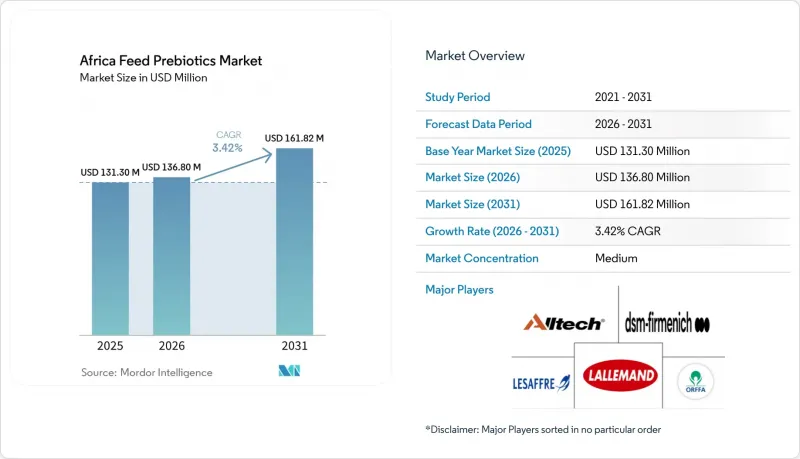
According to Mordor Intelligence, the africa feed prebiotics market size is anticipated to grow from USD 131.30 million in 2025 to USD 136.80 million in 2026 and is forecast to reach USD 161.82 million by 2031 at 3.42% CAGR over 2026-2031.
This report is Segmented by Sub Additive (Fructo-Oligosaccharides, Galacto-Oligosaccharides, Inulin, Lactulose, Mannan Oligosaccharides, Xylo Oligosaccharides, and Other Prebiotics), by Animal (Aquaculture, Poultry, Ruminants, and Swine), and by Geography (South Africa, Kenya, Egypt, and Rest of Africa). The Market Forecasts are Provided in Terms of Value (USD) and Volume (Metric Tons).
Africa Feed Prebiotics Market Trends and Insights
Poultry Feed Industrialization and Rising Antibiotic-Alternative Demand
The market is closely tied to the part of the poultry sector that is moving into formal, integrated production. Demand is strongest where broiler and layer operations are linked to retail chains, large processors, and buyers that require tighter residue control and documented feed practices. Uganda's Animal Feeds Act 2024 shows how regulatory systems in East Africa are beginning to formalize oversight of additives and create a clearer path for compliant suppliers. This shift matters because the Africa feed prebiotics market is not growing evenly across all farm sizes, and verified volumes still sit mostly with larger integrators. Suppliers that can support trials, application guidance, and buyer-facing documentation are therefore better placed than suppliers competing only on ingredient price.
Aquaculture Scale-Up in Egypt, Nigeria, and East Africa
It is gaining support in aquaculture, where intestinal stability directly affects survival, feed use, and disease control in dense systems. A 2025 review in Aquaculture showed that sustainable aquafeed development in Africa is increasingly linked to bioactive ingredients that support resilience and performance. WorldFish also described how local feed innovation in Nigeria is being used to improve fish farming outcomes and reduce reliance on inferior feed practices. The Africa feed prebiotics market benefits from this trend because aquaculture producers make additive decisions on operational loss prevention rather than on branding or welfare messaging alone. That economic logic gives prebiotic suppliers a clearer path into value-based selling when performance can be shown under local water, feed, and stocking conditions.
Price Sensitivity in Low-Margin Feed Formulations
It still faces a hard cost ceiling outside the most organized feed operations. Many mid-sized mills and informal producers review additives through an immediate payback lens, and that slows uptake when local efficacy data are limited or scattered. A 2025 review in Ruminants found that the body of quantitative evidence on the performance of natural feed additives in sub-Saharan Africa remains narrow, which helps explain why confidence remains weak among cautious buyers. This means the Africa feed prebiotics market grows much faster in export-linked or retail-linked systems than in broad informal feed channels. Until more local field data are visible and commercially relevant, price-sensitive buyers will continue to favor minimum-cost formulations over preventive gut health programs.
Other drivers and restraints analyzed in the detailed report include:
- Rising Focus on Gut Health, Feed Efficiency, and Flock Resilience
- Mycotoxin Pressure Raises Demand for Microbiome-Supporting Additives
- Dollar-Linked Import Dependence and Currency Volatility
For complete list of drivers and restraints, kindly check the Table Of Contents.
Segment Analysis
Market share in this segment remained concentrated in inulin, which held 26.6% of Africa feed prebiotics market share in 2025, and maintained the clearest commercial lead across formal feed channels. Inulin also posted the fastest forecast in this category, at 3.6% through 2031, suggesting continued preference rather than a mature ceiling. Afrikaanse Bedryfsontwikkeling (AFGRI) Animal Feeds described how inulin and related prebiotics support beneficial microbial activity and reduce intestinal conditions that favor pathogen growth. In the Africa prebiotics industry, this matters because poultry producers tend to choose solutions that support both gut consistency and usable field performance despite uneven ingredient quality.
Market size in this segment continues to rest on a wider portfolio than inulin alone, because yeast derivatives, live yeast, spent yeast, torula dried yeast, selenium yeast, and whey yeast each address different buyer priorities. Yeast derivatives remain the second-largest commercial group because they support microbiome function and fit well into contamination-management programs where mills want more than one layer of protection. The European Commission renewed authorization in 2026 for the Saccharomyces cerevisiae CBS 493.94 preparation from Alltech Ireland as a zootechnical additive and gut flora stabilizer for ruminants, thereby strengthening global scientific confidence in live yeast use. In the Africa feed prebiotics industry, this creates room for a tiered supplier strategy, with premium inulin at one end and more cost-accessible yeast-based options at the other.
Complete Report Scope:
- By Sub Additive
- Inulin
- Fructo Oligosaccharides
- Galacto Oligosaccharides
- Xylo Oligosaccharides
- Lactulose
- Mannan Oligosaccharides
- Other Prebiotics
- Animal Type
- Aquaculture
- Fish
- Shrimp
- Other Aquaculture Species
- Poultry
- Broiler
- Layer
- Other Poultry Birds
- Ruminants
- Beef Cattle
- Dairy Cattle
- Other Ruminants
- Swine
- Other Animals
- Aquaculture
- Country
- South Africa
- Kenya
- Egypt
- Rest of Africa
List of Companies Covered in this Report:
- Alltech, Inc.
- BENEO GmbH (Sudzucker AG)
- Orffa International Holding B.V. (Marubeni Corporation)
- Lesaffre et Compagnie
- Lallemand Inc.
- DSM-Firmenich AG
- Biochem Zusatzstoffe Handels- und Produktionsgesellschaft mbH
- Archer-Daniels-Midland Company
- Cargill, Incorporated
- Kemin Industries, Inc.
- De Heus Animal Nutrition B.V.
- Novonesis A/S
- Evonik Industries AG (RAG-Stiftung)
- Kerry Group plc
- BASF SE
Additional Benefits:
- The market estimate (ME) sheet in Excel format
- 3 months of analyst support
TABLE OF CONTENTS
1 INTRODUCTION
- 1.1 Study Assumptions and Market Definition
- 1.2 Scope of the Study
- 1.3 Research Methodology
2 REPORT OFFERS
3 EXECUTIVE SUMMARY AND KEY FINDINGS
4 KEY INDUSTRY TRENDS
- 4.1 Animal Headcount
- 4.1.1 Poultry
- 4.1.2 Ruminants
- 4.1.3 Swine
- 4.2 Feed Production
- 4.2.1 Aquaculture
- 4.2.2 Poultry
- 4.2.3 Ruminants
- 4.2.4 Swine
- 4.3 Regulatory Framework
- 4.3.1 Africa
- 4.4 Value Chain and Distribution Channel Analysis
- 4.5 Market Drivers
- 4.5.1 Poultry feed industrialization and rising antibiotic-alternative demand
- 4.5.2 Aquaculture scale-up in Egypt, Nigeria, and East Africa
- 4.5.3 Rising focus on gut health, feed efficiency, and flock resilience
- 4.5.4 Mycotoxin pressure raises demand for microbiome-supporting additives
- 4.5.5 Local premix and additive manufacturing improves product access
- 4.5.6 Export-oriented integrators need tighter food safety programs
- 4.6 Market Restraints
- 4.6.1 Price sensitivity in low-margin feed formulations
- 4.6.2 Dollar-linked import dependence and currency volatility
- 4.6.3 Patchy technical adoption beyond large integrators
- 4.6.4 Fragmented registration and label-compliance rules
5 Market Size and Growth Forecasts (Value and Volume)
- 5.1 By Sub Additive
- 5.1.1 Inulin
- 5.1.2 Fructo Oligosaccharides
- 5.1.3 Galacto Oligosaccharides
- 5.1.4 Xylo Oligosaccharides
- 5.1.5 Lactulose
- 5.1.6 Mannan Oligosaccharides
- 5.1.7 Other Prebiotics
- 5.2 Animal Type
- 5.2.1 Aquaculture
- 5.2.1.1 Fish
- 5.2.1.2 Shrimp
- 5.2.1.3 Other Aquaculture Species
- 5.2.2 Poultry
- 5.2.2.1 Broiler
- 5.2.2.2 Layer
- 5.2.2.3 Other Poultry Birds
- 5.2.3 Ruminants
- 5.2.3.1 Beef Cattle
- 5.2.3.2 Dairy Cattle
- 5.2.3.3 Other Ruminants
- 5.2.4 Swine
- 5.2.5 Other Animals
- 5.2.1 Aquaculture
- 5.3 Country
- 5.3.1 South Africa
- 5.3.2 Kenya
- 5.3.3 Egypt
- 5.3.4 Rest of Africa
6 COMPETITIVE LANDSCAPE
- 6.1 Key Strategic Moves
- 6.2 Market Share Analysis
- 6.3 Market Share Analysis
- 6.4 Company Profiles (Includes Global Level Overview, Market Level Overview, Core Business Segments, Financials, Headcount, Key Information, Market Rank, Market Share, Products and Services, and Analysis of Recent Developments).
- 6.4.1 Alltech, Inc.
- 6.4.2 BENEO GmbH (Sudzucker AG)
- 6.4.3 Orffa International Holding B.V. (Marubeni Corporation)
- 6.4.4 Lesaffre et Compagnie
- 6.4.5 Lallemand Inc.
- 6.4.6 DSM-Firmenich AG
- 6.4.7 Biochem Zusatzstoffe Handels- und Produktionsgesellschaft mbH
- 6.4.8 Archer-Daniels-Midland Company
- 6.4.9 Cargill, Incorporated
- 6.4.10 Kemin Industries, Inc.
- 6.4.11 De Heus Animal Nutrition B.V.
- 6.4.12 Novonesis A/S
- 6.4.13 Evonik Industries AG (RAG-Stiftung)
- 6.4.14 Kerry Group plc
- 6.4.15 BASF SE
7 KEY STRATEGIC QUESTIONS FOR FEED ADDITIVE CEOS

