
PUBLISHER: Mordor Intelligence | PRODUCT CODE: 2072971

PUBLISHER: Mordor Intelligence | PRODUCT CODE: 2072971
CBD Skincare - Market Share Analysis, Industry Trends & Statistics, Growth Forecasts (2026 - 2031)
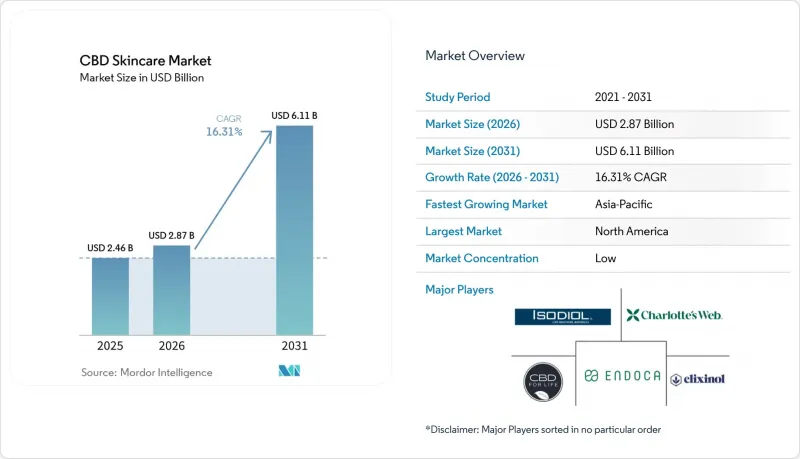
According to Mordor Intelligence, the CBD skincare market size is projected to be USD 2.46 billion in 2025, USD 2.87 billion in 2026, and reach USD 6.11 billion by 2031, growing at a CAGR of 16.31% from 2026 to 2031.
This report is Segmented by Product Type (Creams and Moisturizers, Serums, Oils, Cleansers, Masks, Other Types), Category (Mass, Premium), End User (Men, Women, Unisex), Distribution Channel (Supermarkets/Hypermarkets, Pharmacies and Drug Stores, Online Retail, Others), and Geography (North America, Europe, Asia-Pacific, South America, Middle East and Africa). The Market Forecasts are Provided in Terms of Value (USD).
Global CBD Skincare Market Trends and Insights
Rising consumer preference for natural and plant-based skincare products
Rising consumer preference for natural and plant-based skincare products is significantly shaping the growth of the CBD skincare market, as buyers increasingly move toward clean-label and wellness-focused beauty solutions. This shift is supported by heightened awareness of ingredient safety and growing demand for greater transparency in personal care formulations. A 2024 consumer survey commissioned by the National Sanitation Foundation revealed that 74% of U.S. consumers consider organic ingredients important in skincare and personal care products, reflecting strong acceptance of naturally derived formulations. The same survey also indicated that 65% of consumers prefer clear ingredient labeling to better understand and avoid potentially harmful substances. This evolving mindset is encouraging brands to reformulate products using botanical and plant-based ingredients, including cannabidiol (CBD). Consequently, the increasing inclination toward natural skincare is accelerating the adoption of CBD-based cosmetic products across global markets.
Growing awareness of CBD's anti-inflammatory and soothing properties
Growing awareness of CBD's anti-inflammatory and soothing properties is significantly contributing to the expansion of the CBD skincare market. Consumers are increasingly recognizing cannabidiol as a functional skincare ingredient that may help calm irritation, reduce redness, and support overall skin barrier health. This perception is particularly important for individuals dealing with sensitive skin conditions such as acne, eczema, and rosacea, where inflammation plays a central role. As dermatology-focused wellness trends continue to rise, CBD is being integrated into creams, serums, and moisturizers designed for targeted skin relief. Clinical interest and ongoing research into the interaction between cannabinoids and the skin's endocannabinoid system have further strengthened consumer confidence. In addition, the positioning of CBD as a plant-derived, non-psychoactive compound enhances its appeal in clean beauty formulations.
Regulatory uncertainty regarding CBD use in cosmetics across regions
Regulatory uncertainty regarding CBD use in cosmetics across different regions is a key factor limiting the growth of the CBD skincare market. The lack of uniform global standards for the classification, permissible concentration, and labeling of cannabidiol in cosmetic products creates compliance challenges for manufacturers. In several countries, CBD regulations remain fragmented, with differing interpretations of whether it is permitted in topical formulations derived from hemp or cannabis sources. This inconsistency complicates product development, cross-border trade, and market expansion strategies for skincare brands. Companies are often required to invest additional resources in legal compliance, testing, and certification to meet region-specific requirements. Moreover, evolving regulatory frameworks increase the risk of sudden policy changes that may impact product availability or formulation standards.
Other drivers and restraints analyzed in the detailed report include:
- Increasing prevalence of skin conditions such as acne, eczema, and psoriasis
- Rising demand for clean-label and wellness-oriented beauty products
- High product prices compared to conventional skincare alternatives
For complete list of drivers and restraints, kindly check the Table Of Contents.
Segment Analysis
Creams and moisturizers represented the largest product category in the CBD skincare market, accounting for 37.61% of total revenue in 2025. The segment's dominance is primarily attributed to the widespread consumer preference for daily-use skincare products that provide hydration, nourishment, and skin barrier protection. CBD-infused creams and moisturizers are increasingly favored for their potential soothing and anti-inflammatory properties, making them suitable for consumers dealing with dryness, irritation, redness, and sensitive skin conditions. Their ease of application and compatibility with existing skincare routines have further strengthened market penetration across a broad consumer base. In addition, manufacturers continue to introduce advanced formulations that combine CBD with botanical extracts, vitamins, and other active ingredients to enhance product efficacy.
Serums are projected to be the fastest-growing product segment in the CBD skincare market, registering a CAGR of 17.49% through 2031. The rapid growth is driven by increasing consumer interest in targeted skincare treatments that address specific concerns such as aging, hyperpigmentation, acne, and uneven skin texture. CBD serums typically contain higher concentrations of active ingredients and offer deeper skin penetration, making them attractive to consumers seeking visible and faster results. The premium positioning of serums within skincare regimens has also contributed to higher adoption rates, particularly among beauty-conscious consumers and younger demographics. Furthermore, ongoing product innovation, including formulations featuring CBD combined with hyaluronic acid, peptides, antioxidants, and plant-based extracts, is expanding the appeal of this category.
The mass-market category dominated the CBD skincare market in 2025, accounting for 61.17% of total revenue. The segment's leadership is largely driven by its affordability and widespread accessibility across multiple retail channels, including supermarkets, pharmacies, and online platforms. Consumers seeking the benefits of CBD-infused skincare often prefer mass-market products due to their competitive pricing and broad product availability. Manufacturers have also expanded their mass-market offerings by introducing a diverse range of creams, cleansers, moisturizers, and other everyday skincare solutions containing CBD. Strong consumer awareness of wellness-oriented skincare products has further supported demand within this category.
The premium category is expected to register the fastest growth in the CBD skincare market, expanding at a CAGR of 18.28% through 2031. Growth is being fueled by increasing consumer willingness to invest in high-quality skincare products that offer specialized formulations and enhanced performance. Premium CBD skincare products often incorporate higher concentrations of CBD along with clinically backed active ingredients, botanical extracts, and advanced delivery technologies. Rising demand for clean-label, natural, and luxury beauty products is further strengthening the appeal of premium offerings among affluent and skincare-conscious consumers. In addition, premium brands are benefiting from growing interest in personalized skincare routines and wellness-focused beauty solutions.
Complete Report Scope:
- By Product Type
- Creams and Moisturizers
- Serums
- Oils
- Cleansers
- Masks
- Other Product Types
- By Category
- Mass
- Premium
- By End User
- Men
- Women
- Unisex
- By Distribution Channel
- Supermarkets/Hypermarkets
- Pharmacies & Drug Stores
- Online Retail Stores
- Other Distribution Channels
- By Geography
- North America
- United States
- Canada
- Mexico
- Rest of North America
- Europe
- Germany
- United Kingdom
- Italy
- France
- Spain
- Netherlands
- Poland
- Belgium
- Sweden
- Rest of Europe
- Asia-Pacific
- China
- India
- Japan
- Australia
- Indonesia
- South Korea
- Thailand
- Singapore
- Rest of Asia-Pacific
- South America
- Brazil
- Argentina
- Colombia
- Chile
- Peru
- Rest of South America
- Middle East & Africa
- South Africa
- Saudi Arabia
- United Arab Emirates
- Nigeria
- Egypt
- Morocco
- Turkey
- Rest of Middle East and Africa
- North America
Geography Analysis
North America dominated the CBD skincare market in 2025, accounting for 42.61% of total revenue. The region's leadership is supported by strong consumer awareness of CBD-based wellness and personal care products, along with the early legalization and commercialization of hemp-derived CBD in key markets such as the United States and Canada. A well-established cosmetics and skincare industry, combined with high disposable income levels, has further accelerated product adoption. Consumers in the region show a strong preference for premium and functional skincare solutions that address concerns such as acne, aging, and skin sensitivity. In addition, the presence of leading CBD skincare brands and advanced retail infrastructure, including both online and offline channels, continues to reinforce North America's dominant position in the global market.
Asia-Pacific is expected to be the fastest-growing region in the CBD skincare market, registering a CAGR of 17.91% through 2031. Growth in the region is driven by rising consumer awareness of natural and plant-based skincare products, alongside increasing demand for wellness-oriented beauty solutions. Expanding middle-class populations, growing disposable incomes, and rapid urbanization are further supporting market expansion. Countries such as China, Japan, South Korea, and Australia are witnessing increased adoption of innovative skincare formulations, including CBD-infused products. The rapid growth of e-commerce platforms and social media influence has also played a significant role in boosting product visibility and consumer engagement. As regulatory frameworks gradually evolve and acceptance of CBD-based cosmetics increases, Asia-Pacific is expected to experience sustained and robust market growth.
Europe holds a significant share of the CBD skincare market, supported by strong demand for natural, organic, and clean-label beauty products, along with well-established cosmetic regulations that encourage product standardization and consumer trust. Countries such as the United Kingdom, Germany, and France are key contributors to regional demand, driven by growing interest in wellness and sustainable skincare solutions. South America is witnessing steady growth, fueled by increasing consumer awareness of herbal and plant-based skincare products and gradual expansion of premium beauty segments in countries like Brazil. Meanwhile, the Middle East and Africa region is at a relatively nascent stage but shows promising potential, driven by rising urbanization, increasing luxury beauty consumption, and expanding retail penetration.
- Charlotte's Web Holdings, Inc.
- Isodiol International Inc.
- Elixinol Global Limited
- Endoca B.V.
- CBD For Life, LLC
- Cannuka, Inc.
- Josie Maran Cosmetics, LLC
- The CBD Skincare Co.
- Myaderm Inc.
- Vertly, Inc.
- Herbivore Botanicals, LLC
- Leef Organics, LLC
- Lab To Beauty, LLC
- 707 Flora, LLC
- Sweet Earth Holdings Corporation
- Cannabliss Organic LLC
- Earthly Body, Inc.
- Kapu Maku LLC
- Medterra CBD, LLC
- Lord Jones, Inc.
Additional Benefits:
- The market estimate (ME) sheet in Excel format
- 3 months of analyst support
TABLE OF CONTENTS
1 INTRODUCTION
- 1.1 Study Assumptions and Market Definition
- 1.2 Scope of the Study
2 RESEARCH METHODOLOGY
3 EXECUTIVE SUMMARY
4 MARKET LANDSCAPE
- 4.1 Market Overview
- 4.2 Market Drivers
- 4.2.1 Rising consumer preference for natural and plant-based skincare products
- 4.2.2 Growing awareness of CBD's anti-inflammatory and soothing properties
- 4.2.3 Increasing prevalence of skin conditions such as acne, eczema, and psoriasis
- 4.2.4 Rising demand for clean-label and wellness-oriented beauty products
- 4.2.5 Strong influence of social media, celebrities, and wellness influencers
- 4.2.6 Growing investment and product innovation by skincare manufacturers
- 4.3 Market Restraints
- 4.3.1 Regulatory uncertainty regarding CBD use in cosmetics across regions
- 4.3.2 High product prices compared to conventional skincare alternatives
- 4.3.3 Limited clinical evidence supporting some CBD skincare claims
- 4.3.4 Potential safety concerns and adverse reaction risks among sensitive users
- 4.4 Consumer Behavior Analysis
- 4.5 Regulatory Landscape
- 4.6 Technological Outlook
- 4.7 Porter's Five Forces Analysis
- 4.7.1 Bargaining Power of Suppliers
- 4.7.2 Bargaining Power of Buyers
- 4.7.3 Threat of New Entrants
- 4.7.4 Threat of Substitutes
- 4.7.5 Intensity of Competitive Rivalry
5 MARKET SIZE & GROWTH FORECASTS (VALUE )
- 5.1 By Product Type
- 5.1.1 Creams and Moisturizers
- 5.1.2 Serums
- 5.1.3 Oils
- 5.1.4 Cleansers
- 5.1.5 Masks
- 5.1.6 Other Product Types
- 5.2 By Category
- 5.2.1 Mass
- 5.2.2 Premium
- 5.3 By End User
- 5.3.1 Men
- 5.3.2 Women
- 5.3.3 Unisex
- 5.4 By Distribution Channel
- 5.4.1 Supermarkets/Hypermarkets
- 5.4.2 Pharmacies & Drug Stores
- 5.4.3 Online Retail Stores
- 5.4.4 Other Distribution Channels
- 5.5 By Geography
- 5.5.1 North America
- 5.5.1.1 United States
- 5.5.1.2 Canada
- 5.5.1.3 Mexico
- 5.5.1.4 Rest of North America
- 5.5.2 Europe
- 5.5.2.1 Germany
- 5.5.2.2 United Kingdom
- 5.5.2.3 Italy
- 5.5.2.4 France
- 5.5.2.5 Spain
- 5.5.2.6 Netherlands
- 5.5.2.7 Poland
- 5.5.2.8 Belgium
- 5.5.2.9 Sweden
- 5.5.2.10 Rest of Europe
- 5.5.3 Asia-Pacific
- 5.5.3.1 China
- 5.5.3.2 India
- 5.5.3.3 Japan
- 5.5.3.4 Australia
- 5.5.3.5 Indonesia
- 5.5.3.6 South Korea
- 5.5.3.7 Thailand
- 5.5.3.8 Singapore
- 5.5.3.9 Rest of Asia-Pacific
- 5.5.4 South America
- 5.5.4.1 Brazil
- 5.5.4.2 Argentina
- 5.5.4.3 Colombia
- 5.5.4.4 Chile
- 5.5.4.5 Peru
- 5.5.4.6 Rest of South America
- 5.5.5 Middle East & Africa
- 5.5.5.1 South Africa
- 5.5.5.2 Saudi Arabia
- 5.5.5.3 United Arab Emirates
- 5.5.5.4 Nigeria
- 5.5.5.5 Egypt
- 5.5.5.6 Morocco
- 5.5.5.7 Turkey
- 5.5.5.8 Rest of Middle East and Africa
- 5.5.1 North America
6 COMPETITIVE LANDSCAPE
- 6.1 Market Concentration
- 6.2 Strategic Moves
- 6.3 Market Share Analysis
- 6.4 Company Profiles (Includes Company Highlights, Strategic Information, Core Segments, Financials, Products & Services, Recent Developments)
- 6.4.1 Charlotte's Web Holdings, Inc.
- 6.4.2 Isodiol International Inc.
- 6.4.3 Elixinol Global Limited
- 6.4.4 Endoca B.V.
- 6.4.5 CBD For Life, LLC
- 6.4.6 Cannuka, Inc.
- 6.4.7 Josie Maran Cosmetics, LLC
- 6.4.8 The CBD Skincare Co.
- 6.4.9 Myaderm Inc.
- 6.4.10 Vertly, Inc.
- 6.4.11 Herbivore Botanicals, LLC
- 6.4.12 Leef Organics, LLC
- 6.4.13 Lab To Beauty, LLC
- 6.4.14 707 Flora, LLC
- 6.4.15 Sweet Earth Holdings Corporation
- 6.4.16 Cannabliss Organic LLC
- 6.4.17 Earthly Body, Inc.
- 6.4.18 Kapu Maku LLC
- 6.4.19 Medterra CBD, LLC
- 6.4.20 Lord Jones, Inc.
7 MARKET OPPORTUNITIES & FUTURE OUTLOOK

