PUBLISHER: Mordor Intelligence | PRODUCT CODE: 2072985

PUBLISHER: Mordor Intelligence | PRODUCT CODE: 2072985
Hair Brush - Market Share Analysis, Industry Trends & Statistics, Growth Forecasts (2026 - 2031)
According to Mordor Intelligence, the hair brush market was valued at USD 5.40 billion in 2025 and reached USD 5.70 billion in 2026, with projections indicating growth to USD 7.90 billion by 2031 at a CAGR of 6.59% during the forecast period of 2026-2031.
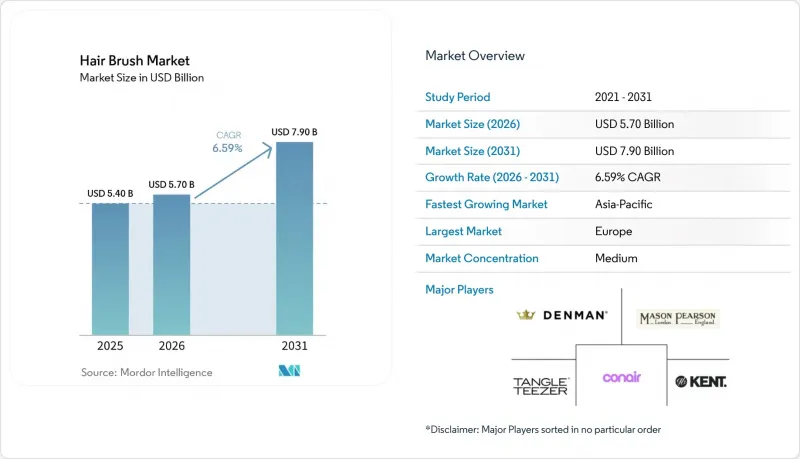
This report is Segmented by Product Type (Round Brush, Vent Brush, and More), Material (Synthetic and Organic/Natural), Application (Personal and Professional), Price Range (Mass and Premium), End User (Women, Men, and More), Distribution Channel (Supermarkets/Hypermarkets, Online Retail Stores, and More), and Geography (North America, Europe, and More). The Market Forecasts are Provided in Terms of Value (USD).
Global Hair Brush Market Trends and Insights
Growing awareness of hair care and personal grooming
Increasing consumer awareness regarding hair health, appearance management, and preventive hair care is a key factor driving the growth of the hair brush market. Hair brushes are now perceived not just as grooming tools but as essential products for maintaining scalp health, minimizing hair breakage, enhancing detangling efficiency, and supporting styling routines tailored to various hair types. This shift is evident in the growing consumer expenditure on hair care products. According to the U.S. Bureau of Labor Statistics, annual spending by American consumers on hair care products rose from USD 86.45 per consumer unit in 2023 to USD 101.14 in 2024, marking a year-over-year increase of nearly 17% . This increase in spending reflects a broader consumer inclination to invest in products and accessories that aid in hair maintenance and styling. Consequently, there is a rising demand for premium and specialized hair brushes. As consumers place greater emphasis on hair wellness alongside personal grooming, manufacturers are experiencing increased adoption of high-value brushes designed to address specific hair concerns. This trend is driving both volume growth and category premiumization in the global hair brush market.
Rising male grooming and self-care expenditure
The growing focus on male grooming, personal appearance, and self-care is becoming a key driver for the hair brush market. While traditionally dominated by female consumers, the market is now experiencing increased participation from men as grooming routines evolve to include hair styling, beard maintenance, scalp care, and overall hair health management. Consumers increasingly perceive grooming as an integral part of personal wellness and professional presentation, prompting a shift towards specialized grooming tools instead of basic hair maintenance products. This trend is particularly prominent among younger demographics, who are more inclined to invest in styling accessories and adopt structured grooming routines. Consequently, the expanding male grooming market is enlarging the consumer base for hair brushes and driving consistent demand across both mass-market and premium product segments.
Long product lifespan resulting in infrequent replacement cycles
The extended functional lifespan of hair brushes serves as a significant restraint on market growth, as it reduces purchase frequency and limits opportunities for recurring sales. Unlike consumable hair care products such as shampoos, conditioners, serums, and styling treatments that require regular replenishment, hair brushes can remain functional for several years with minimal maintenance. Consequently, demand is primarily replacement-driven rather than consumption-driven, resulting in a slower purchasing cycle. For many consumers, a hair brush is perceived as a durable household item rather than a product requiring frequent upgrades, particularly in the mass-market segment where basic plastic brushes sufficiently meet everyday grooming needs. While premium and hair-type-specific brushes have introduced new growth opportunities, the durable nature of the product continues to constrain replacement rates, thereby limiting the overall market's growth potential. Thus, the long lifecycle of hair brushes remains a structural challenge for industry players aiming for sustained volume growth.
Other drivers and restraints analyzed in the detailed report include:
- Influence of social media, beauty bloggers, and influencers on specialized hair care tools
- Premium hair care routines beyond shampoos and conditioners
- Availability of counterfeit and low-quality imitation products affecting premium brand sales
For complete list of drivers and restraints, kindly check the Table Of Contents.
Segment Analysis
In 2025, paddle brushes held a 46.34% share of the hair brush market. This dominance is attributed to their versatility across various hair textures, making them suitable for a wide range of consumers. Additionally, their compatibility with blow-drying techniques enhances their appeal among both professional stylists and individual users. Paddle brushes are widely adopted in salon environments for their efficiency in styling and smoothing hair, while their ease of use and effectiveness have also made them a popular choice for home use. These factors collectively contribute to their leading position in the market.
Cushion brushes are expected to be the fastest-growing product type, with a CAGR of 7.59% during 2026-2031. This growth is driven by increasing consumer demand for scalp-comfort features and the segment's alignment with flexible-base ionic designs. Round brushes maintain a stable position in professional blowout and volumizing applications, while vent brushes are gaining popularity on social media platforms due to their faster-drying capabilities. Detangling brushes, popularized by brands such as Tangle Teezer and The Wet Brush, have transitioned from niche products to mass-market staples, with ongoing innovations in bristle geometry ensuring their continued relevance. Other types, including teasing brushes and boar-bristle specialty formats, achieve above-average margins by catering to specific professional use cases.
Synthetic materials, including plastic, nylon, and mixed bristle configurations, accounted for 80.19% of the 2025 market share due to their lower manufacturing costs, consistent quality, and compatibility with ionic emitter integration. These materials are widely preferred by manufacturers as they offer scalability and uniformity in production processes. However, the growth of natural materials faces a structural supply-side constraint. Sourcing high-quality boar bristles and certified FSC bamboo at a commercial scale presents logistical challenges, including limited availability of raw materials and the complexities of maintaining sustainable sourcing practices. This creates a competitive advantage for brands that establish secure and reliable supply chains early, ensuring consistent access to these resources.
Organic and natural materials, such as bamboo, wood, boar bristles, and natural rubber cushion configurations, represent the fastest-growing category, with a compound annual growth rate (CAGR) of 8.83% projected for 2026-2031. This growth rate is the highest among all market segments and is driven by three key factors: increasing consumer preference for sustainable materials, premium brand narratives emphasizing craftsmanship, and heightened regulatory pressures in Europe. These regulations, under the EU Green Deal, progressively restrict the use of plastic packaging and materials. Additionally, the shift towards organic materials is supported by growing environmental awareness among consumers, who are increasingly seeking products that align with their values of sustainability and eco-friendliness. This trend is further amplified by brands leveraging storytelling to highlight the artisanal quality and environmental benefits of natural materials, thereby appealing to a broader audience.
Complete Report Scope:
- By Product Type
- Round Brush
- Vent Brush
- Paddle Brush
- Cushion Brush
- Detangling Brush
- Others
- By Material
- Synthetic
- Plastic
- Nylon
- Mixed synthetic bristles
- Organic/Natural
- Wooden brushes
- Bamboo brushes
- Boar-bristle brushes
- Natural rubber cushions
- Synthetic
- By Application
- Personal
- Professional
- By Price Range
- Mass
- Premium
- By End User
- Men
- Women
- Children
- By Distribution Channel
- Supermarkets/Hypermarkets
- Convenience Stores
- Specialty Beauty Stores
- Online Retail Stores
- Drug Stores/Pharmacies
- Other Distribution Channels
- By Geography
- North America
- United States
- Canada
- Mexico
- Rest of North America
- Europe
- United Kingdom
- Germany
- France
- Italy
- Spain
- Russia
- Sweden
- Belgium
- Poland
- Netherlands
- Rest of Europe
- Asia-Pacific
- China
- Japan
- India
- Thailand
- Singapore
- Indonesia
- South Korea
- Australia
- New Zealand
- Rest of Asia-Pacific
- South America
- Brazil
- Argentina
- Colombia
- Chile
- Rest of South America
- Middle East and Africa
- United Arab Emirates
- South Africa
- Saudi Arabia
- Nigeria
- Egypt
- Morocco
- Turkey
- Rest of Middle East and Africa
- North America
Geography Analysis
In 2025, Europe accounted for 32.02% of the global hair brush market, making it the largest regional market. This dominance is attributed to high consumer spending on personal care products, strong awareness of hair health and grooming, and the widespread use of premium beauty and styling tools. European consumers increasingly focus on specialized hair care solutions, driving demand for premium brushes designed for detangling, scalp care, styling, and damage prevention.
The Asia-Pacific hair brush market is projected to grow at the fastest CAGR of 7.18% during the forecast period. This growth is driven by rising disposable incomes, rapid urbanization, and increasing beauty consciousness among consumers. The region's large population, expanding middle-class demographic, and growing emphasis on personal grooming present significant opportunities for market expansion. Countries such as China, India, Japan, South Korea, and Southeast Asian nations are experiencing increased adoption of specialized hair care products as consumers become more aware of hair health, styling, and scalp wellness.
Across both developed and emerging markets, the hair brush industry benefits from evolving consumer preferences for comprehensive hair care routines and advanced grooming solutions. Europe continues to lead as the largest market due to its mature beauty and personal care landscape. However, Asia-Pacific is expected to contribute the highest incremental growth during the forecast period. North America remains a significant market, supported by strong consumer spending on premium grooming products and increasing demand for specialized styling tools. These regional dynamics are driving manufacturers to expand product portfolios, enhance omnichannel distribution strategies, and introduce innovative brush designs tailored to diverse consumer needs, hair types, and styling preferences.
- Conair LLC
- The Procter and Gamble Company
- Denman International Limited
- Tangle Teezer Limited
- Mason Pearson Bros. Ltd.
- G. B. Kent and Sons plc
- Revlon, Inc.
- Spectrum Brands Holdings, Inc.
- L'Oreal S.A.
- Dyson Ltd.
- Crave Naturals
- The Wet Brush
- Goody Products, Inc.
- Olivia Garden International LLC
- Ibiza Hair
- Paul Mitchell Systems
- BaByliss
- John Paul Mitchell Systems
- GHD
- Tek Salonsystem
Additional Benefits:
- The market estimate (ME) sheet in Excel format
- 3 months of analyst support
TABLE OF CONTENTS
1 INTRODUCTION
- 1.1 Study Assumptions and Market Definition
- 1.2 Scope of the Study
2 RESEARCH METHODOLOGY
3 EXECUTIVE SUMMARY
4 MARKET LANDSCAPE
- 4.1 Market Overview
- 4.2 Market Drivers
- 4.2.1 Growing awareness of hair care and personal grooming
- 4.2.2 Rising male grooming and self-care expenditure
- 4.2.3 Influence of social media, beauty bloggers, and influencers on specialized hair care tools
- 4.2.4 Advancements in brush technology, including ionic, heated, and smart designs
- 4.2.5 Rising demand for eco-friendly and sustainable hair care products
- 4.2.6 Premium hair care routines beyond shampoos and conditioners
- 4.3 Market Restraints
- 4.3.1 Long product lifespan resulting in infrequent replacement cycles
- 4.3.2 Availability of counterfeit and low-quality imitation products affecting premium brand sales
- 4.3.3 Fragmented market with intense competition leading to price wars and margin pressure
- 4.3.4 Environmental criticism of plastic-based grooming accessories
- 4.4 Consumer Behaviour Analysis
- 4.5 Regulatory Landscape
- 4.6 Technological Outlook
- 4.7 Porter's Five Forces
- 4.7.1 Threat of New Entrants
- 4.7.2 Bargaining Power of Buyers
- 4.7.3 Bargaining Power of Suppliers
- 4.7.4 Threat of Substitutes
- 4.7.5 Competitive Rivalry
5 MARKET SIZE AND GROWTH FORECASTS (VALUE)
- 5.1 By Product Type
- 5.1.1 Round Brush
- 5.1.2 Vent Brush
- 5.1.3 Paddle Brush
- 5.1.4 Cushion Brush
- 5.1.5 Detangling Brush
- 5.1.6 Others
- 5.2 By Material
- 5.2.1 Synthetic
- 5.2.1.1 Plastic
- 5.2.1.2 Nylon
- 5.2.1.3 Mixed synthetic bristles
- 5.2.2 Organic/Natural
- 5.2.2.1 Wooden brushes
- 5.2.2.2 Bamboo brushes
- 5.2.2.3 Boar-bristle brushes
- 5.2.2.4 Natural rubber cushions
- 5.2.1 Synthetic
- 5.3 By Application
- 5.3.1 Personal
- 5.3.2 Professional
- 5.4 By Price Range
- 5.4.1 Mass
- 5.4.2 Premium
- 5.5 By End User
- 5.5.1 Men
- 5.5.2 Women
- 5.5.3 Children
- 5.6 By Distribution Channel
- 5.6.1 Supermarkets/Hypermarkets
- 5.6.2 Convenience Stores
- 5.6.3 Specialty Beauty Stores
- 5.6.4 Online Retail Stores
- 5.6.5 Drug Stores/Pharmacies
- 5.6.6 Other Distribution Channels
- 5.7 By Geography
- 5.7.1 North America
- 5.7.1.1 United States
- 5.7.1.2 Canada
- 5.7.1.3 Mexico
- 5.7.1.4 Rest of North America
- 5.7.2 Europe
- 5.7.2.1 United Kingdom
- 5.7.2.2 Germany
- 5.7.2.3 France
- 5.7.2.4 Italy
- 5.7.2.5 Spain
- 5.7.2.6 Russia
- 5.7.2.7 Sweden
- 5.7.2.8 Belgium
- 5.7.2.9 Poland
- 5.7.2.10 Netherlands
- 5.7.2.11 Rest of Europe
- 5.7.3 Asia-Pacific
- 5.7.3.1 China
- 5.7.3.2 Japan
- 5.7.3.3 India
- 5.7.3.4 Thailand
- 5.7.3.5 Singapore
- 5.7.3.6 Indonesia
- 5.7.3.7 South Korea
- 5.7.3.8 Australia
- 5.7.3.9 New Zealand
- 5.7.3.10 Rest of Asia-Pacific
- 5.7.4 South America
- 5.7.4.1 Brazil
- 5.7.4.2 Argentina
- 5.7.4.3 Colombia
- 5.7.4.4 Chile
- 5.7.4.5 Rest of South America
- 5.7.5 Middle East and Africa
- 5.7.5.1 United Arab Emirates
- 5.7.5.2 South Africa
- 5.7.5.3 Saudi Arabia
- 5.7.5.4 Nigeria
- 5.7.5.5 Egypt
- 5.7.5.6 Morocco
- 5.7.5.7 Turkey
- 5.7.5.8 Rest of Middle East and Africa
- 5.7.1 North America
6 COMPETITIVE LANDSCAPE
- 6.1 Market Concentration
- 6.2 Strategic Moves
- 6.3 Market Share Analysis
- 6.4 Company Profiles (includes Global level Overview, Market level overview, Core Segments, Financials as available, Strategic Information, Market Rank/Share for key companies, Products and Services, and Recent Developments)
- 6.4.1 Conair LLC
- 6.4.2 The Procter and Gamble Company
- 6.4.3 Denman International Limited
- 6.4.4 Tangle Teezer Limited
- 6.4.5 Mason Pearson Bros. Ltd.
- 6.4.6 G. B. Kent and Sons plc
- 6.4.7 Revlon, Inc.
- 6.4.8 Spectrum Brands Holdings, Inc.
- 6.4.9 L'Oreal S.A.
- 6.4.10 Dyson Ltd.
- 6.4.11 Crave Naturals
- 6.4.12 The Wet Brush
- 6.4.13 Goody Products, Inc.
- 6.4.14 Olivia Garden International LLC
- 6.4.15 Ibiza Hair
- 6.4.16 Paul Mitchell Systems
- 6.4.17 BaByliss
- 6.4.18 John Paul Mitchell Systems
- 6.4.19 GHD
- 6.4.20 Tek Salonsystem
7 MARKET OPPORTUNITIES AND FUTURE OUTLOOK

