PUBLISHER: Mordor Intelligence | PRODUCT CODE: 2072989

PUBLISHER: Mordor Intelligence | PRODUCT CODE: 2072989
Congestive Heart Failure Drugs - Market Share Analysis, Industry Trends & Statistics, Growth Forecasts (2026 - 2031)
According to Mordor Intelligence, the congestive heart failure drugs market size was valued at USD 7.56 billion in 2025 and is estimated to grow from USD 8.56 billion in 2026 to reach USD 15.88 billion by 2031, at a CAGR of 13.16% during the forecast period (2026-2031).
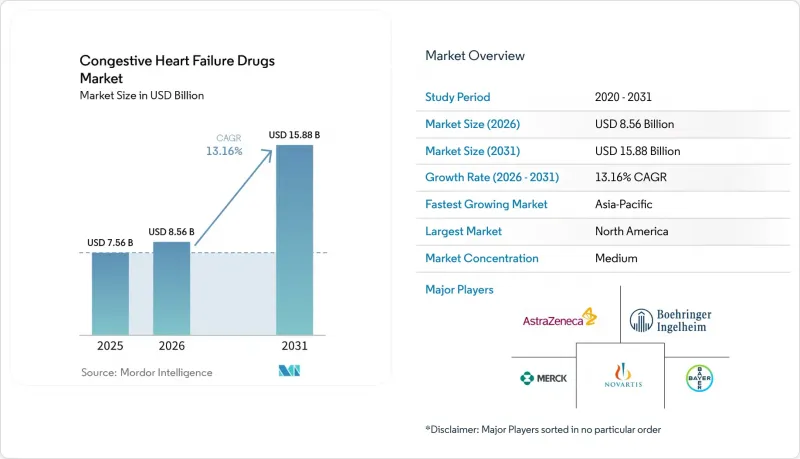
This report is Segmented by Drug Class (ACE Inhibitors, Arbs, Beta Blockers, Diuretics, Aldosterone Antagonists, SGLT2 Inhibitors, Arnis, Inotropes, Others), Route of Administration (Oral, Injectable, Others), Distribution Channel (Hospital, Retail, Online Pharmacies), and Geography (North America, Europe, Asia-Pacific, MEA, South America). Market Forecasts are Provided in Terms of Value (USD).
Global Congestive Heart Failure Drugs Market Trends and Insights
Expanding Guideline-Directed Therapy Adoption Across HF Phenotypes
The market for congestive heart failure drugs is benefiting from a treatment model that initiates core therapies earlier in the care pathway. Care teams now implement protocol-led combinations instead of adding medications one at a time as symptoms worsen. The 2025 ESC Focus Update granted dapagliflozin and empagliflozin Class IA status for HFmrEF and HFpEF, broadening treatment options for previously underserved patient groups. Similarly, Chinese expert guidance endorsed SGLT2 inhibitors for symptomatic HFrEF patients regardless of diabetes status, reflecting a global shift in treatment approaches. This has expanded the eligible patient base beyond the traditional HFrEF population, driving market growth.
Rising Heart Failure Prevalence Driven By Obesity, Diabetes, and Aging
The congestive heart failure drugs market is growing due to an increasing disease burden across age groups and risk profiles. In 2024, global obesity affected 878 million adults, with high BMI contributing to nearly 10% of cardiovascular deaths. By 2025, diabetes impacted 11.1% of adults aged 20-79, with over 40% of cases undiagnosed, leading to delayed treatment and higher drug dependency. Global heart failure prevalence reached 55.50 million cases in 2024, more than doubling since 1990, with a notable rise among younger adults. This trend supports market growth as earlier disease onset extends treatment duration and chronic therapy needs.
Generic And Tender Pressure On Mature Drug Classes
The congestive heart failure drugs market, dominated by mature therapies, faces significant pricing pressures. Established classes like ACE inhibitors, beta blockers, and the ARNI class are under growing generic competition, reducing revenue per prescription despite stable patient volumes. Entresto, the leading branded product in this segment, experienced U.S. generic entry in Q3 2025. Novartis reported a 42% year-on-year revenue decline to USD 1.3 billion in Q1 2026, highlighting the rapid revenue erosion following the loss of exclusivity. Volume-based procurement systems further compress prices and shift demand to low-cost suppliers, creating a divide where older drug classes retain large patient bases but contribute minimally to revenue growth, while branded growth relies on newer products.
Other drivers and restraints analyzed in the detailed report include:
- Approval Momentum For New Indications In HFmrEF And HFpEF
- Growth Of Home-Based And Outpatient Congestion Management
- Reimbursement Friction For Newer Therapies In Value-Based Settings
For complete list of drivers and restraints, kindly check the Table Of Contents.
Segment Analysis
In 2025, ACE inhibitors accounted for 28.60% of revenue, maintaining their position as the leading drug class due to their affordability, widespread availability, and established role in heart failure care. Their dominance reflects long-standing first-line use in national formularies and clinical guidelines, despite mature pricing. ARBs serve as alternatives for patients intolerant to ACE inhibitors, while beta blockers remain essential in guideline-directed therapy for HFrEF. Diuretics continue to see high prescription volumes, though newer delivery formats aim to enhance their value. Finerenone is redefining the aldosterone antagonist category by extending its use to HFmrEF and HFpEF after approvals in the U.S., Europe, and the UK.
The SGLT2 inhibitors market for congestive heart failure drugs is projected to grow at a 14.99% CAGR from 2026 to 2031, making it the fastest-growing drug class during this period. Growth is driven by full guideline support for ejection fraction and the commercial success of Jardiance and Farxiga, which already generate significant global revenues. A meta-analysis reinforced their clinical value in HFpEF, showing reduced hospitalization risks and improved patient outcomes, supporting broader adoption.
Complete Report Scope:
- By Drug Class
- ACE Inhibitors
- Angiotensin 2 Receptor Blockers
- Beta Blockers
- Diuretics
- Aldosterone Antagonists
- SGLT2 Inhibitors
- Angiotensin Receptor-Neprilysin Inhibitors
- Inotropes
- Other Drug Classes
- By Route of Administration
- Oral
- Injectable
- Other Routes of Administration
- By Distribution Channel
- Hospital Pharmacies
- Retail Pharmacies
- Online Pharmacies
- By Geography
- North America
- United States
- Canada
- Mexico
- Europe
- Germany
- United Kingdom
- France
- Italy
- Spain
- Rest of Europe
- Asia-Pacific
- China
- India
- Japan
- Australia
- South Korea
- Rest of Asia-Pacific
- Middle East and Africa
- GCC
- South Africa
- Rest of Middle East and Africa
- South America
- Brazil
- Argentina
- Rest of South America
- North America
Geography Analysis
In 2025, North America accounted for 39.52% of the congestive heart failure drugs market revenue, securing the largest market share. The U.S. drives this dominance with high drug spending, advanced cardiology infrastructure, and rapid adoption of updated guidelines across major healthcare systems. It was also the first market to approve key drugs in 2025 and 2026, including KERENDIA, AMVUTTRA, Lasix ONYU, and ENBUMYST. While generic sacubitril/valsartan entry in the U.S. is reducing branded ARNI revenue, it is expanding access for price-sensitive payers, maintaining broad treatment coverage.
Europe remains the second-largest region in the congestive heart failure drugs market, supported by the ESC guideline framework and specialist prescribing standards. Germany and the UK lead in adoption due to their influential review systems, which facilitate the transition of new therapies from approval to reimbursed care. In March 2026, the UK MHRA and the European Commission approved finerenone for adults with heart failure and LVEF of 40% or more, boosting the growth potential of the nonsteroidal MRA class. However, health technology assessment processes slow the rollout of premium products, creating a more measured access path compared to the U.S.
Asia-Pacific is projected to grow at a 15.26% CAGR from 2026 to 2031, making it the fastest-growing region in the congestive heart failure drugs market. China drives this growth with its large untreated population and price-led procurement strategies, which enhance access to mature cardiovascular drugs despite branded price pressures. India contributes with a growing patient base linked to aging, diabetes, and hypertension, while South Korea supports premium therapy adoption through its specialist care network. Japan shows steady growth, while South America, the Middle East, and Africa are emerging markets benefiting from urban aging, expanding cardiovascular centers, and improved reimbursement frameworks.
- Abbott Laboratories
- Alnylam Pharmaceuticals
- Amgen
- AstraZeneca
- Bayer
- Boehringer Ingelheim
- Bristol-Myers Squibb
- Eli Lilly and Company
- GlaxoSmithKline
- Johnson & Johnson
- Lexicon Pharmaceuticals, Inc.
- Merck
- Novartis
- Novo Nordisk
- Otsuka
- Pfizer
- Sanofi
- SQ Innovation, Inc.
- Teva Pharmaceutical Industries
- Viatris
Additional Benefits:
- The market estimate (ME) sheet in Excel format
- 3 months of analyst support
TABLE OF CONTENTS
1 INTRODUCTION
- 1.1 Study Assumptions and Market Definition
- 1.2 Scope of the Study
2 RESEARCH METHODOLOGY
3 EXECUTIVE SUMMARY
4 MARKET LANDSCAPE
- 4.1 Market Overview
- 4.2 Market Drivers
- 4.2.1 Expanding Guideline-Directed Therapy Adoption Across Ejection-Fraction Segments
- 4.2.2 Rising Heart Failure Prevalence Driven by Obesity, Diabetes, and Chronic Kidney Disease
- 4.2.3 Earlier Diagnosis and Longer Treatment Duration in Chronic Heart Failure
- 4.2.4 Approval Momentum for New Indications in HFmrEF And HFpEF
- 4.2.5 Shift Toward Multi-Drug, Long-Term Maintenance Regimens
- 4.2.6 Growth of Home-Based and Outpatient Congestion Management Therapies
- 4.3 Market Restraints
- 4.3.1 Generic and Tender Pressure on Mature Drug Classes
- 4.3.2 Safety Concerns, Tolerability Limits, and Dose-Optimization Complexity
- 4.3.3 High Monitoring Burden for Patients With Multi-Morbidity
- 4.3.4 Reimbursement Friction for Newer Therapies in Value-Constrained Markets
- 4.4 Value/ Supply-Chain Analysis
- 4.5 Regulatory Landscape
- 4.6 Technological Outlook
- 4.7 Porter's Five Forces Analysis
- 4.7.1 Threat of New Entrants
- 4.7.2 Bargaining Power of Suppliers
- 4.7.3 Bargaining Power of Buyers
- 4.7.4 Threat of Substitutes
- 4.7.5 Intensity of Competitive Rivalry
5 MARKET SIZE AND GROWTH FORECASTS (VALUE, USD)
- 5.1 By Drug Class
- 5.1.1 ACE Inhibitors
- 5.1.2 Angiotensin 2 Receptor Blockers
- 5.1.3 Beta Blockers
- 5.1.4 Diuretics
- 5.1.5 Aldosterone Antagonists
- 5.1.6 SGLT2 Inhibitors
- 5.1.7 Angiotensin Receptor-Neprilysin Inhibitors
- 5.1.8 Inotropes
- 5.1.9 Other Drug Classes
- 5.2 By Route of Administration
- 5.2.1 Oral
- 5.2.2 Injectable
- 5.2.3 Other Routes of Administration
- 5.3 By Distribution Channel
- 5.3.1 Hospital Pharmacies
- 5.3.2 Retail Pharmacies
- 5.3.3 Online Pharmacies
- 5.4 By Geography
- 5.4.1 North America
- 5.4.1.1 United States
- 5.4.1.2 Canada
- 5.4.1.3 Mexico
- 5.4.2 Europe
- 5.4.2.1 Germany
- 5.4.2.2 United Kingdom
- 5.4.2.3 France
- 5.4.2.4 Italy
- 5.4.2.5 Spain
- 5.4.2.6 Rest of Europe
- 5.4.3 Asia-Pacific
- 5.4.3.1 China
- 5.4.3.2 India
- 5.4.3.3 Japan
- 5.4.3.4 Australia
- 5.4.3.5 South Korea
- 5.4.3.6 Rest of Asia-Pacific
- 5.4.4 Middle East and Africa
- 5.4.4.1 GCC
- 5.4.4.2 South Africa
- 5.4.4.3 Rest of Middle East and Africa
- 5.4.5 South America
- 5.4.5.1 Brazil
- 5.4.5.2 Argentina
- 5.4.5.3 Rest of South America
- 5.4.1 North America
6 COMPETITIVE LANDSCAPE
- 6.1 Market Concentration
- 6.2 Market Share Analysis
- 6.3 Company Profiles (includes Global Level Overview, Market Level Overview, Core Segments, Financials as available, Strategic Information, Market Rank/Share, Products and Services, Recent Developments)
- 6.3.1 Abbott Laboratories
- 6.3.2 Alnylam Pharmaceuticals, Inc.
- 6.3.3 Amgen Inc.
- 6.3.4 AstraZeneca PLC
- 6.3.5 Bayer AG
- 6.3.6 Boehringer Ingelheim International GmbH
- 6.3.7 Bristol-Myers Squibb Company
- 6.3.8 Eli Lilly and Company
- 6.3.9 GSK plc
- 6.3.10 Johnson and Johnson
- 6.3.11 Lexicon Pharmaceuticals, Inc.
- 6.3.12 Merck & Co., Inc.
- 6.3.13 Novartis AG
- 6.3.14 Novo Nordisk A/S
- 6.3.15 Otsuka Pharmaceutical Co., Ltd.
- 6.3.16 Pfizer Inc.
- 6.3.17 Sanofi S.A.
- 6.3.18 SQ Innovation, Inc.
- 6.3.19 Teva Pharmaceutical Industries Ltd.
- 6.3.20 Viatris Inc.
7 MARKET OPPORTUNITIES AND FUTURE OUTLOOK
- 7.1 White-Space and Unmet-Need Assessment

