
PUBLISHER: Mordor Intelligence | PRODUCT CODE: 2073072

PUBLISHER: Mordor Intelligence | PRODUCT CODE: 2073072
IT-OT Convergence Hardware - Market Share Analysis, Industry Trends & Statistics, Growth Forecasts (2026 - 2031)
According to Mordor Intelligence, the IT-OT convergence hardware market size is expected to increase from USD 34.87 billion in 2025 to USD 38.72 billion in 2026 and reach USD 63.95 billion by 2031, growing at a CAGR of 10.54% over 2026-2031.
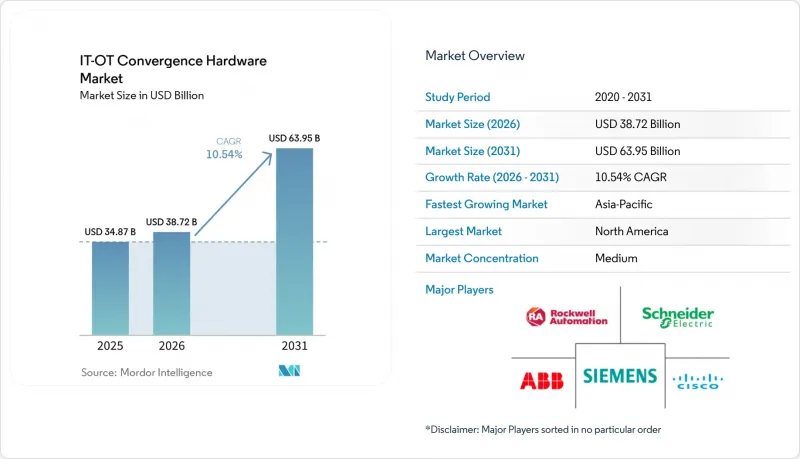
This report is Segmented by Component (Industrial Ethernet Switches and Routers, Industrial Gateways and Edge Devices, and More), Industry Vertical (Manufacturing, Energy and Utilities, Oil and Gas, and More), Organization Size (Large Enterprises, and Small and Medium-Sized Enterprises), Connectivity (Wired, and Wireless), and Geography. The Market Forecasts are Provided in Terms of Value (USD).
Global IT-OT Convergence Hardware Market Trends and Insights
Rising Adoption of Edge Computing Gateways
Edge gateways relocate compute from data centers to production lines, cutting round-trip latency from 50-100 milliseconds to below 15 milliseconds, aligning with the sub-20-millisecond limits of closed-loop control systems. The National Institute of Standards and Technology estimated a 10-20X return on investment for discrete-manufacturing edge projects in 2025, primarily through reduced downtime and lower bandwidth costs. Gateway vendors now integrate Trusted Platform Module 2.0 chips after the Cybersecurity and Infrastructure Security Agency started requiring cryptographic device identity in December 2025. Dual-SIM 5G radios plus multi-port Gigabit Ethernet are becoming baseline specifications, enabling hybrid backhaul paths that sustain deterministic traffic even if one link fails. These performance and security improvements collectively push enterprises toward distributed intelligence architectures that favor edge hardware over legacy switches.
Demand for Unified Cybersecurity Across IT and OT Networks
New regulations are collapsing the traditional air gap that once protected operational technology. CISA's August 2025 guidance compels continuous, passive discovery of every OT asset, rewarding appliances that inspect industrial protocols without disturbing real-time control messages. The European Union's NIS2 Directive introduced stiff fines for failures to report incidents, accelerating upgrades across 18 critical sectors. Hardware vendors responded by earning IEC 62443-4-2 certification; Fortinet's rugged firewall series is one early example. Germany's updated KRITIS regulation extended similar segmentation rules to utilities and chemical plants in 2025. Together, these mandates elevate security capabilities from optional add-ons to core purchase criteria.
Legacy System Incompatibility and High Retrofit Costs
Many plants still operate controllers installed in the 1990s that lack Ethernet ports, forcing the use of protocol converters and long shutdowns when adding gateways. A 2025 survey found that 60% of process manufacturers maintain at least one air-gapped network, fragmenting data and complicating analytics. Safety-instrumented system revalidation under IEC 61511 can stretch 6-12 months, effectively deferring convergence projects until scheduled plant turnarounds. The lingering influence of the Stuxnet attack reinforces a risk-averse mindset, making executives hesitant to connect legacy assets to corporate networks. These integration hurdles add premium labor costs and double the total expense compared with greenfield deployments.
Other drivers and restraints analyzed in the detailed report include:
- Expansion of Industrial IoT Platforms in Smart Factories
- Mainstreaming of 5G Private Networks in Manufacturing Plants
- Skills Gap in IT-OT Integration Engineering
For complete list of drivers and restraints, kindly check the Table Of Contents.
Segment Analysis
Edge devices commanded the growth spotlight, expanding at 12.72% a year, whereas industrial Ethernet switches and routers delivered a dominant 31.35% share of the IT-OT convergence hardware market size in 2025. Gateways now bundle container runtime environments, allowing predictive algorithms to run locally and cut cloud egress costs. Security appliances certified to IEC 62443-4-2 are the next high-velocity line as enterprises adopt zero-trust segmentation. Switch vendors, meanwhile, defend their franchises by embedding intrusion-detection functions, although commoditization risk looms if they fail to add analytics that justify price premiums.
OPC UA Field eXchange threatens proprietary fieldbus lock-in, so differentiation is tilting toward cybersecurity, onboard AI accelerators, and vertical certifications. Dell and Hewlett-Packard Enterprise both released rugged edge servers with conformal coating and extended temperature support to penetrate oilfield deployments. At the same time, NVIDIA Jetson-powered gateways illustrate how machine-vision workloads are migrating from racks to the factory floor. The result is a layered architecture in which edge hardware interprets data streams in real time while deterministic switches guarantee sub-microsecond synchronization for time-critical traffic, keeping both categories indispensable to the broader IT-OT convergence hardware market.
Manufacturing retained the revenue lead with 41.27% share in 2025, but grid modernization is pushing energy and utilities to record an 11.93% CAGR through 2031, outpacing discrete industries. Electric-vehicle charging, distributed solar in-feed, and real-time digital twins require deterministic Ethernet and hardened gateways able to withstand electromagnetic interference. Oil and gas offshore platforms are digitizing blowout preventers with explosion-proof switches, while chemical plants face KRITIS-driven security retrofits that dictate next-generation firewalls.
Transportation, driven by port automation and rail signaling, orders SIL-4 certified equipment where downtime risks human life. Healthcare facilities converge building automation with pharmaceutical production for continuous environmental monitoring that satisfies FDA 21 CFR Part 11 audits. Mining operations embrace autonomous haulage, and their high-altitude sites create demand for industrial PCs that operate reliably below freezing. Across each vertical, the IT-OT convergence hardware market share fluctuates by compliance burden and latency tolerance, yet the overarching migration toward digital twins ensures every sector incrementally widens its hardware footprint.
Complete Report Scope:
- By Component
- Industrial Ethernet Switches and Routers
- Industrial Gateways and Edge Devices
- Industrial PCs, Servers, and HMIs
- Network Security Appliances
- Other Components
- By Industry Vertical
- Manufacturing
- Energy and Utilities
- Oil and Gas
- Transportation and Logistics
- Healthcare and Lifesciences
- Mining
- Other Industry Verticals
- By Organization Size
- Large Enterprises
- Small and Medium-Sized Enterprises
- By Connectivity
- Wired
- Wireless
- By Geography
- North America
- United States
- Canada
- Mexico
- South America
- Brazil
- Argentina
- Rest of South America
- Europe
- Germany
- United Kingdom
- France
- Italy
- Spain
- Russia
- Rest of Europe
- Asia-Pacific
- China
- Japan
- South Korea
- India
- Australia and New Zealand
- Rest of Asia-Pacific
- Middle East
- Saudi Arabia
- United Arab Emirates
- Turkey
- Rest of Middle East
- Africa
- South Africa
- Egypt
- Rest of Africa
- North America
Geography Analysis
North America generated 35.19% of 2025 revenue thanks to robust automation demand across automotive, aerospace, and food processing clusters. Federal funding from the Infrastructure Investment and Jobs Act underwrites grid-modernization projects, while Cybersecurity and Infrastructure Security Agency (CISA) guidance accelerates security upgrades. Canadian mining and Mexican maquiladoras add further momentum, though talent shortages inflate deployment costs. This combination of policy support and industrial demand continues to anchor the region's leadership in advanced networking deployments.
Asia-Pacific, projected at a 12.26% CAGR, benefits from China's intelligent-manufacturing tax incentives and India's production-linked subsidies that reimburse up to half of qualifying hardware spend. Japan's Society 5.0 initiative nudges enterprise uptake despite demographic headwinds, and South Korea offsets labor scarcity with aggressive robotics adoption. Southeast Asian electronics exporters in Vietnam and Thailand also invest in deterministic network backbones to comply with Tier-1 supplier requirements. Strong government backing and export-oriented manufacturing ecosystems further reinforce the region's rapid growth trajectory.
Europe maintains steady, mid-single-digit growth held back by energy price volatility, yet Germany's updated KRITIS rules and France's "Industrie du Futur" program stimulate replacements of non-segmented switches. The Middle East funds petrochemical digitization and smart-city initiatives, using sovereign wealth resources to leapfrog legacy architectures. South America remains currency-constrained, with Brazil's mining firms leading selective upgrades, while Africa's adoption is concentrated in South Africa's deep-level gold mines and Egypt's emerging manufacturing corridor. Regional policy frameworks and infrastructure priorities continue to shape uneven but progressing adoption patterns.
- Cisco Systems Inc.
- Siemens AG
- Schneider Electric SE
- Rockwell Automation Inc.
- ABB Ltd.
- Belden Inc.
- Moxa Inc.
- Advantech Co. Ltd.
- HMS Networks AB
- Huawei Technologies Co. Ltd.
- Juniper Networks Inc.
- Fortinet Inc.
- Palo Alto Networks Inc.
- Dell Technologies Inc.
- Hewlett Packard Enterprise Company
- Phoenix Contact GmbH and Co. KG
- Delta Electronics Inc.
- Hirschmann Automation and Control GmbH
- Check Point Software Technologies Ltd.
- Trend Micro Inc.
Additional Benefits:
- The market estimate (ME) sheet in Excel format
- 3 months of analyst support
TABLE OF CONTENTS
1 INTRODUCTION
- 1.1 Study Assumptions and Market Definition
- 1.2 Scope of the Study
2 RESEARCH METHODOLOGY
3 EXECUTIVE SUMMARY
4 MARKET LANDSCAPE
- 4.1 Market Overview
- 4.2 Market Drivers
- 4.2.1 Rising Adoption of Edge Computing Gateways
- 4.2.2 Demand for Unified Cybersecurity across IT and OT Networks
- 4.2.3 Expansion of Industrial IoT Platforms in Smart Factories
- 4.2.4 Mainstreaming of 5G Private Networks in Manufacturing Plants
- 4.2.5 Convergence Requirements for Predictive Maintenance Analytics
- 4.2.6 Government Incentives for Digital Infrastructure Modernization
- 4.3 Market Restraints
- 4.3.1 Legacy System Incompatibility and High Retrofit Costs
- 4.3.2 Skills Gap in IT-OT Integration Engineering
- 4.3.3 Data Ownership and Governance Concerns
- 4.3.4 Macroeconomic Slowdowns Delaying Capex Cycles
- 4.4 Industry Value Chain Analysis
- 4.5 Regulatory Landscape
- 4.6 Technological Outlook
- 4.7 Impact of Macroeconomic Factors on the Market
- 4.8 Industry Attractiveness - Porter's Five Forces Analysis
- 4.8.1 Threat of New Entrants
- 4.8.2 Bargaining Power of Buyers
- 4.8.3 Bargaining Power of Suppliers
- 4.8.4 Threat of Substitutes
- 4.8.5 Intensity of Competitive Rivalry
- 4.9 Pricing Analysis
5 MARKET SIZE AND GROWTH FORECASTS (VALUE)
- 5.1 By Component
- 5.1.1 Industrial Ethernet Switches and Routers
- 5.1.2 Industrial Gateways and Edge Devices
- 5.1.3 Industrial PCs, Servers, and HMIs
- 5.1.4 Network Security Appliances
- 5.1.5 Other Components
- 5.2 By Industry Vertical
- 5.2.1 Manufacturing
- 5.2.2 Energy and Utilities
- 5.2.3 Oil and Gas
- 5.2.4 Transportation and Logistics
- 5.2.5 Healthcare and Lifesciences
- 5.2.6 Mining
- 5.2.7 Other Industry Verticals
- 5.3 By Organization Size
- 5.3.1 Large Enterprises
- 5.3.2 Small and Medium-Sized Enterprises
- 5.4 By Connectivity
- 5.4.1 Wired
- 5.4.2 Wireless
- 5.5 By Geography
- 5.5.1 North America
- 5.5.1.1 United States
- 5.5.1.2 Canada
- 5.5.1.3 Mexico
- 5.5.2 South America
- 5.5.2.1 Brazil
- 5.5.2.2 Argentina
- 5.5.2.3 Rest of South America
- 5.5.3 Europe
- 5.5.3.1 Germany
- 5.5.3.2 United Kingdom
- 5.5.3.3 France
- 5.5.3.4 Italy
- 5.5.3.5 Spain
- 5.5.3.6 Russia
- 5.5.3.7 Rest of Europe
- 5.5.4 Asia-Pacific
- 5.5.4.1 China
- 5.5.4.2 Japan
- 5.5.4.3 South Korea
- 5.5.4.4 India
- 5.5.4.5 Australia and New Zealand
- 5.5.4.6 Rest of Asia-Pacific
- 5.5.5 Middle East
- 5.5.5.1 Saudi Arabia
- 5.5.5.2 United Arab Emirates
- 5.5.5.3 Turkey
- 5.5.5.4 Rest of Middle East
- 5.5.6 Africa
- 5.5.6.1 South Africa
- 5.5.6.2 Egypt
- 5.5.6.3 Rest of Africa
- 5.5.1 North America
6 COMPETITIVE LANDSCAPE
- 6.1 Market Concentration
- 6.2 Strategic Moves
- 6.3 Market Share Analysis
- 6.4 Company Profiles (includes Global Level Overview, Market Level Overview, Core Segments, Financials as available, Strategic Information, Market Rank/Share, Products and Services, Recent Developments)
- 6.4.1 Cisco Systems Inc.
- 6.4.2 Siemens AG
- 6.4.3 Schneider Electric SE
- 6.4.4 Rockwell Automation Inc.
- 6.4.5 ABB Ltd.
- 6.4.6 Belden Inc.
- 6.4.7 Moxa Inc.
- 6.4.8 Advantech Co. Ltd.
- 6.4.9 HMS Networks AB
- 6.4.10 Huawei Technologies Co. Ltd.
- 6.4.11 Juniper Networks Inc.
- 6.4.12 Fortinet Inc.
- 6.4.13 Palo Alto Networks Inc.
- 6.4.14 Dell Technologies Inc.
- 6.4.15 Hewlett Packard Enterprise Company
- 6.4.16 Phoenix Contact GmbH and Co. KG
- 6.4.17 Delta Electronics Inc.
- 6.4.18 Hirschmann Automation and Control GmbH
- 6.4.19 Check Point Software Technologies Ltd.
- 6.4.20 Trend Micro Inc.
7 MARKET OPPORTUNITIES AND FUTURE OUTLOOK
- 7.1 White-Space and Unmet-Need Assessment

