PUBLISHER: Mordor Intelligence | PRODUCT CODE: 2073079

PUBLISHER: Mordor Intelligence | PRODUCT CODE: 2073079
Africa Cat Food - Market Share Analysis, Industry Trends & Statistics, Growth Forecasts (2026 - 2031)
According to Mordor Intelligence, the africa cat food market size is projected to grow from USD 248.21 million in 2025 to USD 270.46 million in 2026 and is forecast to reach USD 401.99 million by 2031 at 8.73% CAGR over 2026-2031.
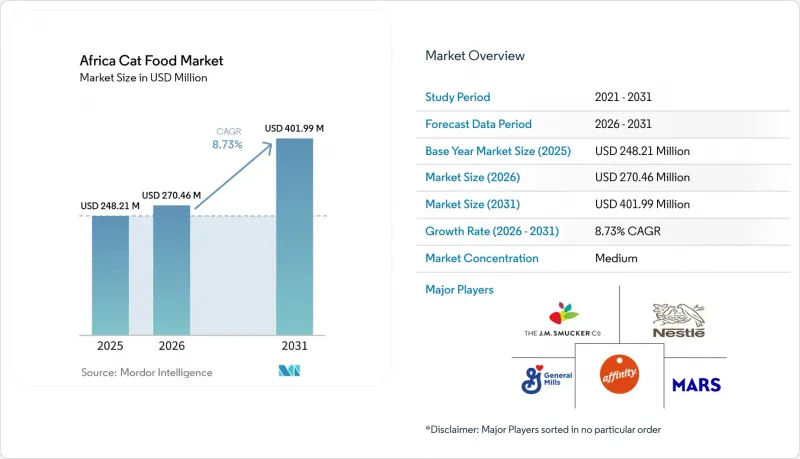
This report is Segmented by Pet Food Product (Food, Pet Nutraceuticals/Supplements, Pet Treats, and Pet Veterinary Diets), by Distribution Channel (Convenience Stores, Online Channel, Specialty Stores, Supermarkets/Hypermarkets, and Other Channels), and by Geography (South Africa and Rest of Africa). The Market Forecasts are Provided in Terms of Value (USD) and Volume (Metric Tons).
Africa Cat Food Market Trends and Insights
Rising Pet Humanization and Premiumization
The trend of pet humanization is influencing cat food purchases in the Africa cat food market, shifting the focus from basic feeding to nutrition-driven decision-making. This change is not solely dependent on income levels, as urban living in cities like Nairobi and Lagos makes cats a practical pet choice for smaller households. With the rise of apartment living and smaller family units, cats are increasingly preferred for their adaptability to confined spaces and lower maintenance requirements compared to other pets. This trend supports increased spending per pet in urban areas, where owners are willing to invest in higher-quality ingredients, tailored nutrition, and reputable brands. Additionally, ingredient transparency and clean-label positioning are gaining traction in markets such as South Africa, Nigeria, and Kenya. Consumers are becoming more conscious of the nutritional content and sourcing of cat food, leading to a growing demand for products that align with these preferences. These factors are driving the market toward premium dry food, functional products, and specialized nutrition offerings, catering to pet owners' evolving needs.
Expansion of Organized Pet Retail and E-Commerce
Organized pet retail is improving visibility, assortment, and purchase confidence in the Africa cat food market, especially in South Africa. Retail chains such as Petshop Science and broader modern trade networks are shifting cat food sales away from informal outlets and into environments where premium placement, shelf navigation, and repeat purchasing are easier to sustain. The online route is also strengthening as major delivery and marketplace platforms make routine replenishment faster for urban households. Amazon entered South Africa in May 2024 with a pet supplies category, which raised expectations around assortment and fulfillment speed in one of the region's most developed digital retail markets. In North Africa, specialized platforms in Egypt and Morocco show that organized pet commerce is developing beyond South Africa, providing the Africa cat food market with more formal touchpoints for premium, information-led sales.
Price Sensitivity in Mass-Market Households
Price remains one of the clearest limits on the Africa cat food market outside the most formal retail systems. In the November 2025 Sagaci Research survey, 48% of African pet owners still relied on table scraps as their main feeding method, indicating that commercial cat food has not yet become a default purchase for many households. The gap is wider in markets where organized retail is thin, and consumers face a narrow choice between higher-priced imported brands and informal feeding. Compliance also affects affordability, as South Africa's Fertilizers, Farm Feeds, Agricultural Remedies, and Stock Remedies Act 36 adds formulation and registration requirements that feed into retail pricing. Until lower-cost local production broadens supply at scale, the Africa cat food market will continue to face slower conversion from informal feeding in the mass segment.
Other drivers and restraints analyzed in the detailed report include:
- Growth in Veterinary-Recommended and Functional Nutrition
- Rising Indoor Cat Ownership and Demand for Life-Stage Nutrition
- Limited Cold-Chain Tolerance for Premium Wet Offerings
For complete list of drivers and restraints, kindly check the Table Of Contents.
Segment Analysis
Food held the largest market share in the Africa cat food market in 2025 at 78.5%, which confirms that everyday complete nutrition remains the commercial base of category demand. Food also reflects the fact that packaged dry and wet diets are still far more established than supplements, treats, or therapeutic products in routine feline feeding. Dry cat food, especially extruded kibble, remains the main volume driver because it aligns with affordability, shelf-life, and handling needs across many African markets. Wet cat food is smaller in volume, but it is building value in premium urban tiers where owners are more willing to pay for moisture-rich feeding and more specialized nutrition.
Pet nutraceuticals and supplements are the fastest-growing segment, with a 13.4% CAGR through 2031, driven by growing awareness of digestive support, skin health, and targeted functional ingredients. Extruded kibble works well in markets where refrigeration is limited, and households want portion control, easier storage, and lower spoilage risk. Pet nutraceuticals and pet treats are also gaining traction as cat ownership becomes more visible and emotionally driven in parts of South Africa and Kenya. Within the Africa cat food industry, this means value creation is gradually expanding beyond staple foods, even though complete nutrition remains the largest anchor of demand.
Complete Report Scope:
- By Pet Food Product
- Food
- By Sub Product
- Dry Pet Food
- By Sub Dry Pet Food
- Kibbles
- Other Dry Pet Food
- By Sub Dry Pet Food
- Wet Pet Food
- Dry Pet Food
- By Sub Product
- Pet Nutraceuticals/Supplements
- By Sub Product
- Milk Bioactives
- Omega-3 Fatty Acids
- Probiotics
- Proteins and Peptides
- Vitamins and Minerals
- Other Nutraceuticals
- By Sub Product
- Pet Treats
- By Sub Product
- Crunchy Treats
- Dental Treats
- Freeze-dried and Jerky Treats
- Soft And Chewy Treats
- Other Treats
- By Sub Product
- Pet Veterinary Diets
- By Sub Product
- Derma Diets
- Diabetes
- Digestive Sensitivity
- Obesity Diets
- Oral Care Diets
- Renal
- Urinary tract disease
- Other Veterinary Diets
- By Sub Product
- Food
- By Distribution Channel
- Convenience Stores
- Online Channel
- Specialty Stores
- Supermarkets/Hypermarkets
- Other Channels
- By Country
- South Africa
- Rest of Africa
List of Companies Covered in this Report:
- Mars, Incorporated
- Nestle S.A.
- Colgate-Palmolive Company
- RCL Foods Limited
- Hill's Pet Nutrition, Inc.
- Royal Canin SAS
- General Mills, Inc.
- The J.M. Smucker Company
- Schell and Kampeter, Inc.
- Affinity Petcare, S.A.
- Farmina Pet Foods S.p.A.
- United Petfood Group B.V.
- VAFO Group a.s.
- Monge and C. S.p.A.
- Heristo Aktiengesellschaft
Additional Benefits:
- The market estimate (ME) sheet in Excel format
- 3 months of analyst support
TABLE OF CONTENTS
1 INTRODUCTION
- 1.1 Study Assumptions And Market Definition
- 1.2 Scope of the Study
- 1.3 Research Methodology
2 REPORT OFFERS
3 EXECUTIVE SUMMARY AND KEY FINDINGS
4 KEY INDUSTRY TRENDS
- 4.1 Pet Population
- 4.1.1 Cats
- 4.2 Pet Expenditure
- 4.3 Consumer Trends
5 SUPPLY AND PRODUCTION DYNAMICS
- 5.1 Trade Analysis
- 5.2 Ingredient Trends
- 5.3 Value Chain And Distribution Channel Analysis
- 5.4 Regulatory Framework
- 5.5 Market Drivers
- 5.5.1 Rising pet humanization and premiumization
- 5.5.2 Expansion of organized pet retail and e-commerce
- 5.5.3 Growth in veterinary-recommended and functional nutrition
- 5.5.4 Rising indoor cat ownership and demand for life-stage nutrition
- 5.5.5 Growth of local manufacturing and regional supply localization
- 5.5.6 Demand for shelf-stable, portion-controlled wet and dry formats
- 5.6 Market Restraints
- 5.6.1 Price sensitivity in mass-market households
- 5.6.2 Limited cold-chain tolerance for premium wet offerings
- 5.6.3 Import dependence and currency volatility for premium inputs
- 5.6.4 Uneven pet food penetration outside major urban corridors
6 MARKET SIZE AND GROWTH FORECASTS (VALUE AND VOLUME)
- 6.1 By Pet Food Product
- 6.1.1 Food
- 6.1.1.1 By Sub Product
- 6.1.1.1.1 Dry Pet Food
- 6.1.1.1.1.1 By Sub Dry Pet Food
- 6.1.1.1.1.1.1 Kibbles
- 6.1.1.1.1.1.2 Other Dry Pet Food
- 6.1.1.1.1.1 By Sub Dry Pet Food
- 6.1.1.1.2 Wet Pet Food
- 6.1.1.1.1 Dry Pet Food
- 6.1.1.1 By Sub Product
- 6.1.2 Pet Nutraceuticals/Supplements
- 6.1.2.1 By Sub Product
- 6.1.2.1.1 Milk Bioactives
- 6.1.2.1.2 Omega-3 Fatty Acids
- 6.1.2.1.3 Probiotics
- 6.1.2.1.4 Proteins and Peptides
- 6.1.2.1.5 Vitamins and Minerals
- 6.1.2.1.6 Other Nutraceuticals
- 6.1.2.1 By Sub Product
- 6.1.3 Pet Treats
- 6.1.3.1 By Sub Product
- 6.1.3.1.1 Crunchy Treats
- 6.1.3.1.2 Dental Treats
- 6.1.3.1.3 Freeze-dried and Jerky Treats
- 6.1.3.1.4 Soft And Chewy Treats
- 6.1.3.1.5 Other Treats
- 6.1.3.1 By Sub Product
- 6.1.4 Pet Veterinary Diets
- 6.1.4.1 By Sub Product
- 6.1.4.1.1 Derma Diets
- 6.1.4.1.2 Diabetes
- 6.1.4.1.3 Digestive Sensitivity
- 6.1.4.1.4 Obesity Diets
- 6.1.4.1.5 Oral Care Diets
- 6.1.4.1.6 Renal
- 6.1.4.1.7 Urinary tract disease
- 6.1.4.1.8 Other Veterinary Diets
- 6.1.4.1 By Sub Product
- 6.1.1 Food
- 6.2 By Distribution Channel
- 6.2.1 Convenience Stores
- 6.2.2 Online Channel
- 6.2.3 Specialty Stores
- 6.2.4 Supermarkets/Hypermarkets
- 6.2.5 Other Channels
- 6.3 By Country
- 6.3.1 South Africa
- 6.3.2 Rest of Africa
7 COMPETITIVE LANDSCAPE
- 7.1 Key Strategic Moves
- 7.2 Market Share Analysis
- 7.3 Brand Positioning Matrix
- 7.4 Market Claim Analysis
- 7.5 Company Landscape
- 7.6 Company Profiles (Includes Global Level Overview, Market Level Overview, Core Business Segments, Financials, Key Information, Market Rank, Market Share, Products and Services, and Analysis of Recent Developments).
- 7.6.1 Mars, Incorporated
- 7.6.2 Nestle S.A.
- 7.6.3 Colgate-Palmolive Company
- 7.6.4 RCL Foods Limited
- 7.6.5 Hill's Pet Nutrition, Inc.
- 7.6.6 Royal Canin SAS
- 7.6.7 General Mills, Inc.
- 7.6.8 The J.M. Smucker Company
- 7.6.9 Schell and Kampeter, Inc.
- 7.6.10 Affinity Petcare, S.A.
- 7.6.11 Farmina Pet Foods S.p.A.
- 7.6.12 United Petfood Group B.V.
- 7.6.13 VAFO Group a.s.
- 7.6.14 Monge and C. S.p.A.
- 7.6.15 Heristo Aktiengesellschaft
8 KEY STRATEGIC QUESTIONS FOR PET FOOD CEOS

