PUBLISHER: Mordor Intelligence | PRODUCT CODE: 2073089

PUBLISHER: Mordor Intelligence | PRODUCT CODE: 2073089
Heart Transplantation Therapeutic - Market Share Analysis, Industry Trends & Statistics, Growth Forecasts (2026 - 2031)
According to Mordor Intelligence, the heart transplantation therapeutic market size is expected to increase from USD 1.38 billion in 2025 to USD 1.44 billion in 2026 and reach USD 1.81 billion by 2031, growing at a CAGR of 4.58% over 2026-2031.
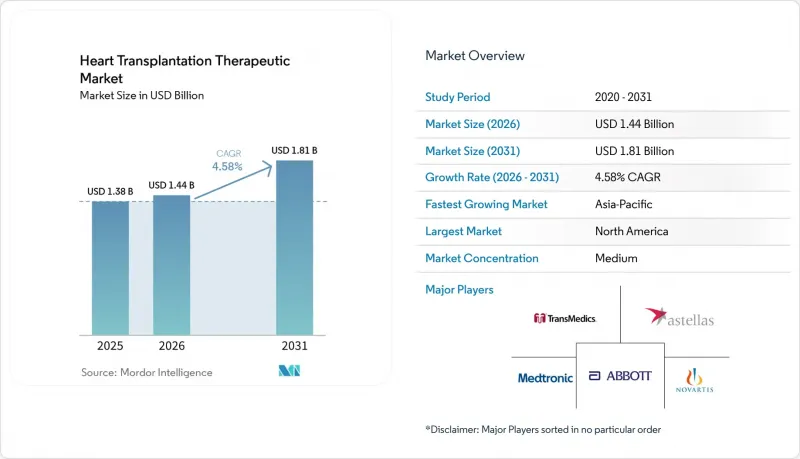
This report is Segmented by Drug Type (Immunosuppressants, Anti-Infectives, and More), Distribution Channel (Hospital, Retail, Online Pharmacies), Therapy Setting, Patient Age (Adult, Pediatric), Indication (Dilated Cardiomyopathy, Ischemic Heart Disease, and More), and Geography (North America, Europe, and More). The Market Forecasts are Provided in Terms of Value (USD).
Global Heart Transplantation Therapeutic Market Trends and Insights
Rising End-Stage Heart Failure Burden
The heart transplantation therapeutic market is driven by the increasing prevalence of advanced heart failure. A 2026 analysis highlighted a rise in age-standardized prevalence and years lived with disability due to cardiovascular disease-related heart failure from 1990 to 2025, with significant increases among individuals aged 20 to 54 and in middle to high Socio Demographic Index countries. Global heart failure prevalence remains high at 64 million individuals, ensuring a broad pool of potential transplant candidates, though only a fraction progresses to surgery. In the U.S., heart transplants increased by 101.1% from 2012 to 2024, reaching 4,599 procedures in 2024, with 424 additional adult transplants between 2023 and 2024. The 2025 World Heart Report also identified obesity-linked cardiomyopathy as a growing contributor to heart failure, emphasizing the need for tailored post-transplant treatment plans.
Expanding Use of Immunosuppressive Maintenance Therapies
The heart transplantation therapeutic market, anchored in tacrolimus-based multi-drug maintenance therapy, is expanding through improved access and treatment refinement. In January 2025, Biocon Pharma received NMPA approval in China for tacrolimus capsules in 0.5 mg, 1 mg, and 5 mg strengths, broadening the generic supply base. Research on tacrolimus intra-patient variability supports closer monitoring and formulations ensuring steadier exposure. A 2025 study linked tacrolimus variability to inferior allograft outcomes, while a 2026 paper identified ABCC2 rs2273697 as a determinant of this variability. These findings promote structured dosing programs at high-complexity centers, balancing price competition in standard agents with value-based differentiation in specialized regimens.
Donor Organ Scarcity
The heart transplantation market continues to face limitations as its growth depends on donor availability rather than clinical demand. In 2024, 10,287 heart transplants were performed globally, yet a significant supply gap remains due to the standard cold ischemia time of 4 to 6 hours. Donation after circulatory death (DCD) donors accounted for 28% of all deceased donors in 2024, a 17% year-over-year increase, but DCD hearts were utilized in only 9 countries. This limited geographic adoption restricts market growth. Additionally, the updated ISHLT candidate evaluation guidance in 2024 emphasizes stricter risk stratification, potentially reducing listings at centers applying the framework rigorously. While United Therapeutics received FDA clearance in May 2026 for the EXPRESS xenotransplantation trial with UHeart, it represents a long-term solution to donor scarcity.
Other drivers and restraints analyzed in the detailed report include:
- Wider Adoption of Ex-Vivo Organ Perfusion and Preservation
- Personalized Immunosuppression Guided by Biomarkers
- Lifelong Immunosuppression Safety Burden
For complete list of drivers and restraints, kindly check the Table Of Contents.
Segment Analysis
In 2025, immunosuppressants dominated the heart transplantation therapeutic market, accounting for 54.60% of the revenue. This dominance underscores the reliance on calcineurin inhibitor-based regimens, the gold standard for heart transplant recipients. Spending heavily leans towards tacrolimus formulations and mycophenolate combinations, both of which necessitate prolonged use and frequent adjustments. Such dynamics ensure the centrality of this category in the market, even amidst only moderate growth in procedures.
Anti-infectives are set to be the fastest-growing segment, with a projected CAGR of 6.90% through 2031. This growth is driven more by heightened prophylaxis protocols than mere increases in patient volume. Research highlights that heart transplant patients, who are donor positive and recipient negative, face a heightened risk of CMV infection after three months on valganciclovir prophylaxis, compared to six months. Such findings advocate for extended antiviral treatment durations, especially during the crucial first year post-transplant.
In 2025, hospital pharmacies secured 61.30% of the revenue, underscoring the heart transplantation therapeutic market's strong ties to tertiary care. Key processes like induction therapy, early tacrolimus titration, and therapeutic drug monitoring are integral to specialist hospital workflows. This positions hospital pharmacies as the primary and most regulated dispensing point for new transplant recipients. Their dominance is further bolstered by the concentration of procedures at major academic transplant centers, which often feature integrated pharmacy teams.
Online pharmacies are projected to expand at a 5.95% CAGR through 2031, marking the highest growth rate in this segment. This trend is driven less by convenience and more by specialized services like mail order handling, home delivery, and coordination for stable patients' monitoring needs. As recipients progress beyond the immediate post-surgery phase, there's a noticeable shift of prescriptions from hospital settings to channels that ensure consistent long-term refills.
Complete Report Scope:
- By Drug Type
- Immunosuppressants
- Anti-Infectives
- Analgesics
- Other Heart Transplant Therapeutics
- By Distribution Channel
- Hospital Pharmacies
- Retail Pharmacies
- Online Pharmacies
- By Therapy Setting
- Pre-Transplant Care
- In-Hospital Post-Transplant Care
- Long-Term Outpatient Maintenance Therapy
- By Patient Age Group
- Adult
- Pediatric
- By Indication
- Dilated Cardiomyopathy
- Ischemic Heart Disease
- Hypertrophic Cardiomyopathy
- Restrictive Cardiomyopathy
- Congenital Heart Disease
- Other Indications
- By Geography
- North America
- United States
- Canada
- Mexico
- Europe
- Germany
- United Kingdom
- France
- Italy
- Spain
- Rest of Europe
- Asia-Pacific
- China
- India
- Japan
- Australia
- South Korea
- Rest of Asia-Pacific
- Middle East and Africa
- GCC
- South Africa
- Rest of Middle East and Africa
- South America
- Brazil
- Argentina
- Rest of South America
- North America
Geography Analysis
In 2025, North America accounted for 40.65% of the heart transplantation therapeutic market revenue, securing its leading position. The U.S. led globally with 4,636 heart transplants performed in 2024. Medicare reimbursements and established specialty pharmacy networks drive high per-patient drug spending post-surgery. Concentration at academic hospitals enhances protocol standardization and supports large-scale monitoring of treatment outcomes. Vanderbilt exemplified this by performing 210 adult and pediatric heart transplants in 2025, reinforcing the role of high-throughput centers in shaping treatment practices.
Europe remains the second-largest market for heart transplantation therapeutics. Eurotransplant member states reported 1,102 heart transplants in the first five months of 2026, up from 1,046 during the same period in 2025. Spain increased cardiac transplant volumes by 12% in 2025 and maintained a high donation rate of 50.7 donors per million inhabitants. Germany and the U.K. contribute significantly to procedure volumes, while stringent manufacturing and pharmacovigilance standards sustain strong demand for branded and regulated formulations.
Asia Pacific is projected to grow at the fastest CAGR of 6.55% through 2031, emerging as the most dynamic regional market. China and India drive growth, supported by expanding institutional capacities, broader access to generic tacrolimus, and favorable policies for transplant and immune regulation therapeutics. Biocon's tacrolimus approval and rollout in China in 2025 demonstrated how access expansion supports institutional procurement growth. Japan, South Korea, and Australia, though smaller in transplant numbers, maintain high treatment expenditures due to national coverage supporting post-surgery immunosuppressive use. Growth in the Middle East, Africa, and South America remains uneven, with countries like Saudi Arabia, the UAE, Brazil, and Argentina improving capabilities but facing challenges such as donor shortages, funding constraints, and limited specialist availability.
- Abbott Laboratories
- Abbvie
- Astellas Pharma
- Biocon
- Boston Scientific
- Bristol-Myers Squibb
- Dr. Reddy's Laboratories
- Roche
- Glenmark Pharmaceuticals
- Intas Pharmaceutical
- Medtronic
- Mylan
- Novartis
- Organox
- Paragonix Technologies
- Pfizer
- Sanofi
- Sun Pharmaceuticals Industries
- Teva Pharmaceutical Industries
- TransMedics Group, Inc.
- Viatris
Additional Benefits:
- The market estimate (ME) sheet in Excel format
- 3 months of analyst support
TABLE OF CONTENTS
1 INTRODUCTION
- 1.1 Study Assumptions and Market Definition
- 1.2 Scope of the Study
2 RESEARCH METHODOLOGY
3 EXECUTIVE SUMMARY
4 MARKET LANDSCAPE
- 4.1 Market Overview
- 4.2 Market Drivers
- 4.2.1 Rising End-Stage Heart Failure Burden
- 4.2.2 Expanding Use of Immunosuppressive Maintenance Therapy
- 4.2.3 Wider Adoption of Ex-Vivo Organ Perfusion And Preservation Systems
- 4.2.4 Personalized Immunosuppression Guided by Biomarkers
- 4.2.5 Donor-Heart Logistics Pressure From Time-to-Transplant Constraints
- 4.2.6 Post-Transplant Infection Prevention Protocol Intensification
- 4.3 Market Restraints
- 4.3.1 Shortage of Suitable Donor Hearts
- 4.3.2 Lifelong Immunosuppression Safety Burden
- 4.3.3 High Total Cost of Transplant Care And Follow-Up
- 4.3.4 Limited Center Capacity and Specialist Availability
- 4.4 Supply/Value Chain Analysis
- 4.5 Regulatory Landscape
- 4.6 Technological Outlook
- 4.7 Porter's Five Forces Analysis
- 4.7.1 Bargaining Power Of Suppliers
- 4.7.2 Bargaining Power Of Buyers
- 4.7.3 Threat Of New Entrants
- 4.7.4 Threat Of Substitutes
- 4.7.5 Competitive Rivalry
5 MARKET SIZE AND GROWTH FORECASTS (VALUE, USD)
- 5.1 By Drug Type
- 5.1.1 Immunosuppressants
- 5.1.2 Anti-Infectives
- 5.1.3 Analgesics
- 5.1.4 Other Heart Transplant Therapeutics
- 5.2 By Distribution Channel
- 5.2.1 Hospital Pharmacies
- 5.2.2 Retail Pharmacies
- 5.2.3 Online Pharmacies
- 5.3 By Therapy Setting
- 5.3.1 Pre-Transplant Care
- 5.3.2 In-Hospital Post-Transplant Care
- 5.3.3 Long-Term Outpatient Maintenance Therapy
- 5.4 By Patient Age Group
- 5.4.1 Adult
- 5.4.2 Pediatric
- 5.5 By Indication
- 5.5.1 Dilated Cardiomyopathy
- 5.5.2 Ischemic Heart Disease
- 5.5.3 Hypertrophic Cardiomyopathy
- 5.5.4 Restrictive Cardiomyopathy
- 5.5.5 Congenital Heart Disease
- 5.5.6 Other Indications
- 5.6 By Geography
- 5.6.1 North America
- 5.6.1.1 United States
- 5.6.1.2 Canada
- 5.6.1.3 Mexico
- 5.6.2 Europe
- 5.6.2.1 Germany
- 5.6.2.2 United Kingdom
- 5.6.2.3 France
- 5.6.2.4 Italy
- 5.6.2.5 Spain
- 5.6.2.6 Rest of Europe
- 5.6.3 Asia-Pacific
- 5.6.3.1 China
- 5.6.3.2 India
- 5.6.3.3 Japan
- 5.6.3.4 Australia
- 5.6.3.5 South Korea
- 5.6.3.6 Rest of Asia-Pacific
- 5.6.4 Middle East and Africa
- 5.6.4.1 GCC
- 5.6.4.2 South Africa
- 5.6.4.3 Rest of Middle East and Africa
- 5.6.5 South America
- 5.6.5.1 Brazil
- 5.6.5.2 Argentina
- 5.6.5.3 Rest of South America
- 5.6.1 North America
6 COMPETITIVE LANDSCAPE
- 6.1 Market Concentration
- 6.2 Market Share Analysis
- 6.3 Company Profiles (includes Global Level Overview, Market Level Overview, Core Segments, Financials as available, Strategic Information, Market Rank/Share, Products and Services, Recent Developments)
- 6.3.1 Abbott Laboratories
- 6.3.2 AbbVie Inc.
- 6.3.3 Astellas Pharma Inc.
- 6.3.4 Biocon Limited
- 6.3.5 Boston Scientific Corporation
- 6.3.6 Bristol Myers Squibb Company
- 6.3.7 Dr. Reddy's Laboratories Limited
- 6.3.8 F. Hoffmann-La Roche Ltd
- 6.3.9 Glenmark Pharmaceuticals Limited
- 6.3.10 Intas Pharmaceuticals Limited
- 6.3.11 Medtronic plc
- 6.3.12 Mylan N.V.
- 6.3.13 Novartis AG
- 6.3.14 OrganOx Limited
- 6.3.15 Paragonix Technologies, Inc.
- 6.3.16 Pfizer Inc.
- 6.3.17 Sanofi S.A.
- 6.3.18 Sun Pharmaceutical Industries Limited
- 6.3.19 Teva Pharmaceutical Industries Limited
- 6.3.20 TransMedics Group, Inc.
- 6.3.21 Viatris Inc.
7 MARKET OPPORTUNITIES AND FUTURE OUTLOOK
- 7.1 White-Space and Unmet-Need Assessment

