PUBLISHER: Mordor Intelligence | PRODUCT CODE: 2073111

PUBLISHER: Mordor Intelligence | PRODUCT CODE: 2073111
India Oleochemicals - Market Share Analysis, Industry Trends & Statistics, Growth Forecasts (2026 - 2031)
According to Mordor Intelligence, the india oleochemicals market size was valued at USD 1.36 billion in 2025 and is estimated to grow from USD 1.41 billion in 2026 to reach USD 1.71 billion by 2031, at a CAGR of 3.89% during the forecast period (2026-2031).
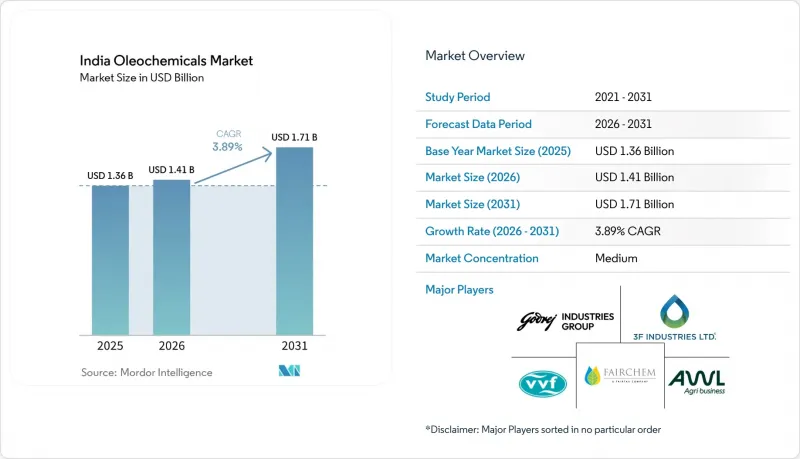
This report is Segmented by Product (Fatty Acid Methyl Esters, Fatty Alcohol, Glycerin, Fatty Acid, and Others), Application (Pharmaceuticals and Personal Care, Soap and Detergents, Food and Beverages, Polymers, and Others), and Feedstock (Palm-Based Oils, Soybean Oil and Derivatives, Castor-Based Oils, and Animal Tallow). The Market Forecasts are Provided in Terms of Value (USD).
India Oleochemicals Market Trends and Insights
Personal-Care Demand Surge
The personal-care upswing channels new volumes into C12-C14 fatty alcohols as formulators replace sulfates to meet clean-label claims. The Bureau of Indian Standards updated IS 4707 in 2025, capping heavy metals and tightening pH ranges, which forces smaller brands to qualify RSPO-compliant inputs. Croda India's Dahej facility, opened in March 2026, supplies EXCiPACT-certified esters that sell at 15-20% premiums, signaling sustained appetite for high-grade inputs. Rising disposable income in tier-2 and tier-3 cities lifts per-capita consumption, while international brands leverage India's cost base to export certified oleochemicals. The India oleochemicals market, therefore, expands not only in volume but in value as compliant grades displace commodity inputs, reinforcing a medium-term CAGR lift of 0.8 percentage points.
Biodiesel and Renewable-Chemicals Mandates
April 2026 marks the operational start of E20 ethanol blending, which diverts fatty acid methyl esters away from surfactant pools into biodiesel. Universal Biofuels already runs an 80-million-gallon-per-year plant at Kakinada and has booked USD 103 million in 2024 deliveries to oil marketing companies, with higher volumes scheduled for 2025-2026. Each 1-percentage-point rise in biodiesel use removes roughly 50,000-60,000 tons of methyl esters, prompting price spreads that encourage fatty alcohol substitution in detergents. The short-term squeeze adds 1.2 percentage points to the India oleochemicals market CAGR, rewarding integrated refiners that can swing between methyl esters and fatty acids.
Palm-Oil Price Volatility
Palm-based oils held 56.41% feedstock share in 2025, yet imports fell to a 7.1 million-ton, 15-year low as Malaysia and Indonesia diverted supply to domestic biodiesel. Soap and detergent makers reliant on palm derivatives saw EBITDA margins compress 200-300 basis points (bps) during 2025-2026 spikes. Substituting soybean oil provides some hedge, but Argentine export policies and South American weather add fresh volatility. The net drag slices 0.3 percentage points from the India oleochemicals market CAGR.
Other drivers and restraints analyzed in the detailed report include:
- Expanding Packaged-Food Processing
- Integrated Domestic Vegetable-Oil Refining
- Cost-Competitive Petrochemical Substitutes
For complete list of drivers and restraints, kindly check the Table Of Contents.
Segment Analysis
Fatty acid methyl esters commanded 34.76% share of India oleochemicals market size in 2025, yet fatty alcohol value will rise faster at a 4.66% CAGR during the forecast period (2026-2031) as detergent makers increase mid-cut loading by 10%. Godrej's INR 750 crore (approximately USD 90 million) expansion doubles fatty alcohol output and quadruples specialty capacity, targeting sulfate-free shampoos priced at 15-20% premiums. VVF's Taloja plant, Asia's largest, strengthens India oleochemicals market share in exports across 90 countries.
Commodity glycerin faces oversupply as Chinese cargoes land at USD 620-680/ton, so Godrej pivots to USP-grade units where price spreads remain strong. Specialty fatty acids such as dimer and isostearic, processed by Fairchem from acid-oil waste, earn 50-100% premiums and insulate margins from palm volatility.
Complete Report Scope:
- By Product
- Fatty Acid Methyl Esters
- Fatty Alcohol
- Glycerin
- Fatty Acid
- Others
- By Application
- Pharmaceuticals and Personal Care
- Soap and Detergents
- Food and Beverages
- Polymers
- Others
- By Feedstock
- Palm-based Oils
- Soybean Oil and Derivatives
- Castor-based Oils
- Animal Tallow
List of Companies Covered in this Report:
- South India Krishna Oil & Fats Pvt. Ltd. (SIKOF)
- 3F Industries LTD
- AAK
- Adani Wilmar Ltd (AWL)
- Croda India Ltd.
- Emery Oleochemicals
- Fairchem Organics Limited
- Fine Organic Industries Limited.
- Godrej Industries Limited
- India Glycols Ltd (IGL)
- Jocil Limited.
- KLK OLEO
- Muez Hest
- Oleon NV
- Pan Oleo
- Patanjali Foods Ltd
- SPIC
- Universal Biofuels Private Limited
- VVF Ltd.
Additional Benefits:
- The market estimate (ME) sheet in Excel format
- 3 months of analyst support
TABLE OF CONTENTS
1 Introduction
- 1.1 Study Assumptions and Market Definition
- 1.2 Scope of the Study
2 Research Methodology
3 Executive Summary
4 Market Landscape
- 4.1 Market Overview
- 4.2 Market Drivers
- 4.2.1 Personal-care demand surge
- 4.2.2 Biodiesel and renewable-chemicals mandates
- 4.2.3 Expanding packaged-food processing
- 4.2.4 Integrated domestic vegetable-oil refining
- 4.2.5 China-plus-one sourcing shift into India
- 4.3 Market Restraints
- 4.3.1 Palm-oil price volatility
- 4.3.2 Cost-competitive petrochemical substitutes
- 4.3.3 Import dependence on high-purity specialty esters
- 4.4 Value Chain Analysis
- 4.5 Porter's Five Forces
- 4.5.1 Threat of New Entrants
- 4.5.2 Bargaining Power of Suppliers
- 4.5.3 Bargaining Power of Buyers
- 4.5.4 Threat of Substitutes
- 4.5.5 Competitive Rivalry
5 Market Size and Growth Forecasts (Value)
- 5.1 By Product
- 5.1.1 Fatty Acid Methyl Esters
- 5.1.2 Fatty Alcohol
- 5.1.3 Glycerin
- 5.1.4 Fatty Acid
- 5.1.5 Others
- 5.2 By Application
- 5.2.1 Pharmaceuticals and Personal Care
- 5.2.2 Soap and Detergents
- 5.2.3 Food and Beverages
- 5.2.4 Polymers
- 5.2.5 Others
- 5.3 By Feedstock
- 5.3.1 Palm-based Oils
- 5.3.2 Soybean Oil and Derivatives
- 5.3.3 Castor-based Oils
- 5.3.4 Animal Tallow
6 Competitive Landscape
- 6.1 Market Concentration
- 6.2 Strategic Moves
- 6.3 Market Share(%)/Ranking Analysis
- 6.4 Company Profiles (includes Global Overview, Market Overview, Core Segments, Financials, Strategic Information, Products and Services, and Recent Developments)
- 6.4.1 South India Krishna Oil & Fats Pvt. Ltd. (SIKOF)
- 6.4.2 3F Industries LTD
- 6.4.3 AAK
- 6.4.4 Adani Wilmar Ltd (AWL)
- 6.4.5 Croda India Ltd.
- 6.4.6 Emery Oleochemicals
- 6.4.7 Fairchem Organics Limited
- 6.4.8 Fine Organic Industries Limited.
- 6.4.9 Godrej Industries Limited
- 6.4.10 India Glycols Ltd (IGL)
- 6.4.11 Jocil Limited.
- 6.4.12 KLK OLEO
- 6.4.13 Muez Hest
- 6.4.14 Oleon NV
- 6.4.15 Pan Oleo
- 6.4.16 Patanjali Foods Ltd
- 6.4.17 SPIC
- 6.4.18 Universal Biofuels Private Limited
- 6.4.19 VVF Ltd.
7 Market Opportunities and Future Outlook
- 7.1 White-Space and Unmet-Need Assessment

