PUBLISHER: Mordor Intelligence | PRODUCT CODE: 2073124

PUBLISHER: Mordor Intelligence | PRODUCT CODE: 2073124
North America Cannabidiol (CBD) - Market Share Analysis, Industry Trends & Statistics, Growth Forecasts (2026 - 2031)
According to Mordor Intelligence, the north america cannabidiol market size is expected to increase from USD 4.67 billion in 2025 to USD 5.36 billion in 2026 and reach USD 10.70 billion by 2031, growing at a CAGR of 14.82% over 2026-2031.
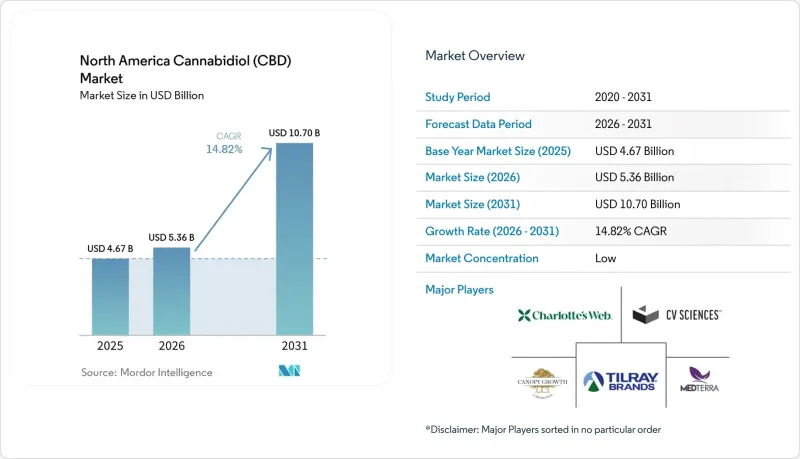
This report is Segmented by Source (Hemp, Marijuana), End Use (Pharmaceuticals, Wellness, F&B, Cosmetics and Skin Care, Pet Care, Others), Product Form (Oils, Capsules, Gummies and Confectionery, Topicals, Others), Distribution Channel (Hospital Pharmacies, Retail Stores, E-Commerce, Others), and Country (United States, Canada, Mexico). Market Forecasts are in Value (USD).
North America Cannabidiol (CBD) Market Trends and Insights
Expanding Clinical Adoption In Pain And Anxiety Management
The North America cannabidiol (CBD) market is gaining support from a clearer clinical use case in anxiety, sleep disturbance, and related care settings. A 2024 multicenter randomized clinical trial reported that nanodispersible CBD reduced GAD-7 anxiety scores by 7.02 points versus placebo, while also improving sleep quality and depression measures. Clinical development is also continuing in academic settings, with the University of Florida trial on CBD for anxiety and sleep disturbance moving through Phase 2 and targeting primary completion by late 2026. Federal policy direction also turned more favorable in late 2025 when the White House instructed agencies to prioritize cannabidiol research and widen physician access pathways. This matters for the North America cannabidiol (CBD) market because brands with stronger evidence, cleaner documentation, and more disciplined manufacturing can move closer to physician recommendation instead of depending only on paid consumer outreach. It also changes brand positioning, since clinical readiness now affects reimbursement access, pharmacy acceptance, and the ability to compete in healthcare-linked channels.
Retail Normalization Of Hemp-Derived CBD Products
The North America cannabidiol (CBD) market is also benefiting from a broader shift toward normalized retail access across major digital and mainstream channels. As large retailers and marketplace operators bring CBD into regular assortment logic, shelf access becomes a quality filter instead of a simple distribution win. Charlotte's Web said its 2025 growth was supported by expanded presence on Walmart.com, Amazon, and Faire, which showed that broad retail integration is now a basic requirement for scale. This shift does not make competition easier, because tighter assortment rules can push weaker products out of the category and give compliant brands more durable visibility. The North America cannabidiol (CBD) market therefore looks more tiered in 2026, with better-tested and better-documented products holding a clearer path to retention in normalized retail environments.
Patchwork State And Federal Compliance Requirements
The North America cannabidiol (CBD) market still faces a serious drag from uneven compliance rules across jurisdictions and channels. Medterra said California Assembly Bill 8 will halt its THC-containing product sales in the state after July 1, 2026, which shows how state-level action can quickly disrupt existing product portfolios. Canada is moving through a different process, with consultation and streamlining steps that point to a more defined product pathway, but that contrast also highlights how uneven the regional framework remains. Larger operators can absorb reformulation work, compliance review, and slower approval timing more easily than smaller brands can. This means the North America cannabidiol (CBD) market may continue to consolidate, not only because demand is rising, but because the cost of staying compliant keeps increasing.
Other drivers and restraints analyzed in the detailed report include:
- Strong Pull From Pet Wellness And Veterinary Adjacent Use Cases
- E-Commerce And Direct-To-Consumer Brand Scaling
- Price Erosion From Hemp Biomass Oversupply And Private Labeling
For complete list of drivers and restraints, kindly check the Table Of Contents.
Segment Analysis
Hemp accounted for 71.31% of the North America cannabidiol (CBD) market share in 2025, which kept it firmly ahead of marijuana-derived CBD on a revenue basis. This lead reflects the scale advantage built around hemp cultivation, extraction capacity, established supply routes, and wider compatibility with mainstream wellness positioning across the region. In the North America cannabidiol (CBD) industry, hemp also fits more easily into broad retail and e-commerce models because it has already been normalized for a larger set of commercial use cases. That installed base gives hemp-derived products a strong presence across oils, gummies, capsules, topicals, and pharmacy-adjacent formats that need consistency and familiar sourcing. It also means the largest share of the North America cannabidiol (CBD) market still rests on suppliers that can manage agricultural inputs, extraction standards, and quality documentation at scale.
Marijuana-derived CBD is projected to grow at a 17.38% CAGR through 2031, which places it ahead of the overall market pace and shows that demand is broadening beyond the largest source category. Part of that growth comes from adult-use cannabis settings where consumers often prefer fuller cannabinoid profiles and perceive those formulations as more potent or more complete. The White House focus on expanding cannabinoid research also gives more visibility to clinically oriented development pathways, which may support higher-value formulations across both source groups over time. The North America cannabidiol (CBD) market therefore has a dual structure by source, with hemp preserving the larger commercial base and marijuana-derived CBD widening the premium growth lane. This balance matters because it keeps scale economics centered in hemp while allowing faster-growth demand pockets to emerge where clinical perception, channel rules, and consumer preference favor differentiated cannabinoid origin.
Wellness and personal use held 32.24% of the market in 2025, which made it the largest end-use category in the North America cannabidiol (CBD) market. This segment remains the volume anchor because it connects CBD with sleep support, stress management, exercise recovery, and familiar daily wellness routines. It is also the easiest category for brands to position across multiple formats, which helps explain why gummies, tinctures, capsules, and topical products all feed into this same demand pool. The broad reach of wellness and personal use gives companies a large consumer entry point, but it also creates more direct price competition and faster imitation. For that reason, brands in the North America cannabidiol (CBD) market often use formulation layering, ingredient pairing, and stronger quality signals to stand out within the largest end-use base.
Pet care is projected to grow at a 16.52% CAGR through 2031, which gives it the strongest growth outlook among end-use segments and shows how quickly the use case is becoming mainstream. Health Canada's consultation process signaled material interest in veterinary CBD pathways, which supports the idea that pet demand is moving closer to formal professional oversight. Pharmaceuticals also carry strategic weight because physician-directed reimbursement pathways can convert part of CBD demand from discretionary spending into budgeted care spending. That shift matters for the North America cannabidiol (CBD) market because clinical channels place more value on documentation, standardization, and formulation discipline than consumer-led channels do. The end-use structure therefore mixes a large and steady wellness base with two value-accretive lanes, one in pet care and one in pharmaceuticals, that can improve pricing quality and channel defensibility.
Complete Report Scope:
- By Source
- Hemp
- Marijuana
- By End Use
- Pharmaceuticals
- Wellness and Personal Use
- Food and Beverages
- Cosmetics and Skin Care
- Pet Care
- Other End Use
- By Product Form
- Oils and Tinctures
- Capsules and Softgels
- Gummies and Confectionery
- Topicals and Skin Care
- Other Product Forms
- By Distribution Channel
- Hospital and Specialty Pharmacies
- Retail Stores
- E-commerce
- Other Distribution Channels
- By Country
- United States
- Canada
- Mexico
List of Companies Covered in this Report:
- Aurora Cannabis Inc.
- cbdMD, Inc.
- Charlotte's Web Holdings, Inc.
- Colorado Botanicals
- Cornbread Hemp
- CV Sciences, Inc.
- Green Roads, LLC
- Holistic Hound
- Jazz Pharmaceuticals plc (GW Pharmaceuticals)
- Joy Organics
- Kazmira LLC
- Lazarus Naturals
- Medical Marijuana
- Medterra CBD
- NuLeaf Naturals
- Pet Releaf
- Tilray Brands, Inc.
Additional Benefits:
- The market estimate (ME) sheet in Excel format
- 3 months of analyst support
TABLE OF CONTENTS
1 Introduction
- 1.1 Study Assumptions & Market Definition
- 1.2 Scope of the Study
2 Research Methodology
3 Executive Summary
4 Market Landscape
- 4.1 Market Overview
- 4.2 Market Drivers
- 4.2.1 Expanding Clinical Adoption in Pain and Anxiety Management
- 4.2.2 Retail Normalization of Hemp-Derived CBD Products
- 4.2.3 Strong Pull from Pet Wellness and Veterinary Adjacent Use Cases
- 4.2.4 Product Innovation in Gummies, Softgels, and Beverages
- 4.2.5 Rising Demand for Third-Party Tested, Traceable CBD Formulations
- 4.2.6 E-Commerce and Direct-to-Consumer Brand Scaling
- 4.3 Market Restraints
- 4.3.1 Patchwork State and Federal Compliance Requirements
- 4.3.2 Ongoing Banking, Payments, and Insurance Frictions for CBD Brands
- 4.3.3 Price Erosion from Hemp Biomass Oversupply and Private Labeling
- 4.3.4 Restrictive Labeling, Claims, and Advertising Enforcement
- 4.4 Supply Chain Analysis
- 4.5 Regulatory Landscape
- 4.6 Technological Outlook
- 4.7 Porter's Five Forces Analysis
- 4.7.1 Threat of New Entrants
- 4.7.2 Bargaining Power of Buyers
- 4.7.3 Bargaining Power of Suppliers
- 4.7.4 Threat of Substitutes
- 4.7.5 Intensity of Competitive Rivalry
5 Market Size & Growth Forecasts (Value, USD)
- 5.1 By Source
- 5.1.1 Hemp
- 5.1.2 Marijuana
- 5.2 By End Use
- 5.2.1 Pharmaceuticals
- 5.2.2 Wellness and Personal Use
- 5.2.3 Food and Beverages
- 5.2.4 Cosmetics and Skin Care
- 5.2.5 Pet Care
- 5.2.6 Other End Use
- 5.3 By Product Form
- 5.3.1 Oils and Tinctures
- 5.3.2 Capsules and Softgels
- 5.3.3 Gummies and Confectionery
- 5.3.4 Topicals and Skin Care
- 5.3.5 Other Product Forms
- 5.4 By Distribution Channel
- 5.4.1 Hospital and Specialty Pharmacies
- 5.4.2 Retail Stores
- 5.4.3 E-commerce
- 5.4.4 Other Distribution Channels
- 5.5 By Country
- 5.5.1 United States
- 5.5.2 Canada
- 5.5.3 Mexico
6 Competitive Landscape
- 6.1 Market Concentration
- 6.2 Market Share Analysis
- 6.3 Company Profiles (includes Global Level Overview, Market Level Overview, Core Segments, Financials as available, Strategic Information, Market Rank/Share, Products and Services, Recent Developments)
- 6.3.1 Aurora Cannabis Inc.
- 6.3.2 cbdMD, Inc.
- 6.3.3 Charlotte's Web Holdings, Inc.
- 6.3.4 Colorado Botanicals
- 6.3.5 Cornbread Hemp
- 6.3.6 CV Sciences, Inc.
- 6.3.7 Green Roads, LLC
- 6.3.8 Holistic Hound
- 6.3.9 Jazz Pharmaceuticals plc (GW Pharmaceuticals)
- 6.3.10 Joy Organics
- 6.3.11 Kazmira LLC
- 6.3.12 Lazarus Naturals
- 6.3.13 Medical Marijuana, Inc.
- 6.3.14 Medterra CBD
- 6.3.15 NuLeaf Naturals, LLC
- 6.3.16 Pet Releaf
- 6.3.17 Tilray Brands, Inc.
7 Market Opportunities & Future Outlook
- 7.1 White-Space and Unmet-Need Assessment

