PUBLISHER: Mordor Intelligence | PRODUCT CODE: 2073189

PUBLISHER: Mordor Intelligence | PRODUCT CODE: 2073189
Food Ingredients - Market Share Analysis, Industry Trends & Statistics, Growth Forecasts (2026 - 2031)
According to Mordor Intelligence, the food ingredients market is anticipated to expand from USD 306.47 billion in 2025 to USD 319.37 billion in 2026, reaching USD 392.50 billion by 2031, with a CAGR of 4.21% over the forecast period of 2026-2031.
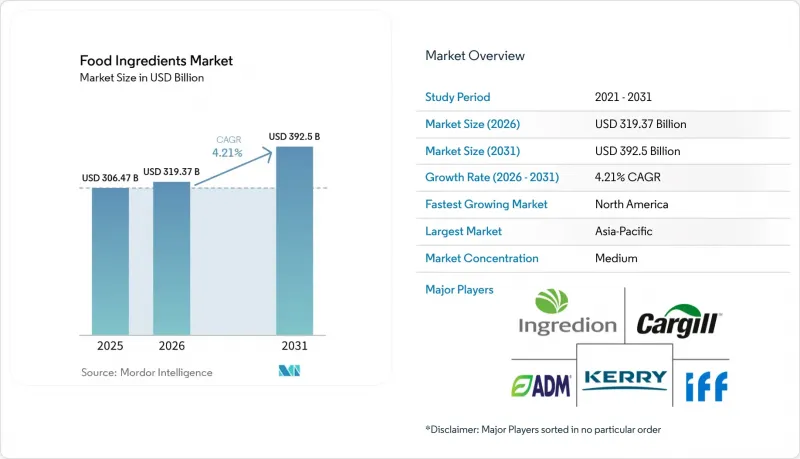
This report is Segmented by Product Type (Specialty Ingredients, Coloring Ingredients, and More), Source (Plant-Based, Animal-Based, and More), Nature (Natural and Synthetic), Form (Dry and Liquid), End Use Application (Beverages, Fats and Oils, and More), and Geography (North America, Europe, Asia-Pacific, South America, and Middle East and Africa). The Market Forecasts are Provided in Terms of Value (USD).
Global Food Ingredients Market Trends and Insights
Increasing consumption of processed, packaged, and convenience foods worldwide
The food ingredients market is experiencing significant growth, driven by the rising demand for processed, packaged, and convenience foods. These products rely heavily on ingredients such as sweeteners, flavors, preservatives, emulsifiers, stabilizers, and nutritional additives to enhance taste, maintain quality, and extend shelf life. According to the 2025 International Food Information Council (IFIC) Food & Health Survey, nearly half of Americans (48%) prioritize convenience when selecting food and beverages, underscoring the growing preference for ready-to-eat and easy-to-prepare options. This trend is not limited to developed markets but is also gaining traction in emerging economies such as China, India, and Indonesia, where rapid urbanization, rising disposable incomes, and hectic lifestyles are driving demand for packaged snacks, instant meals, bakery products, and functional beverages. Consequently, the need for innovative, advanced food ingredient solutions is growing, as manufacturers strive to meet evolving consumer preferences and maintain a competitive edge.
Growing demand for sugar reduction and healthier product reformulation
The growing emphasis on reducing sugar intake and enhancing nutritional profiles is significantly driving the global food ingredients market. As highlighted in the 2025 International Food Information Council (IFIC) Food & Health Survey, 75% of Americans are actively seeking to limit or avoid sugars in their diets, showcasing a heightened consumer focus on health and wellness. In response to this trend, food and beverage manufacturers are increasingly reformulating their product offerings across categories such as beverages, dairy, bakery, and confectionery to lower sugar content while preserving desired taste, texture, and overall quality. Since sugar plays a crucial role in providing sweetness, texture, browning, and preservation, manufacturers are turning to innovative combinations of sweeteners, flavor maskers, texturants, and stabilizers to meet consumer demands. This shift is driving the need for advanced food ingredient solutions, further fueling market growth.
Stringent regulatory requirements and evolving food safety standards
Stringent regulatory requirements and evolving food safety standards are significant challenges restraining the growth of the global food ingredients market. These regulations increase compliance costs and extend product development timelines, creating hurdles for manufacturers. Regulatory authorities in key markets are intensifying their oversight of food additives, ingredient safety, labeling, and post-market monitoring. This necessitates substantial investments in testing, documentation, and approval processes by companies. For instance, the European Commission revised the conditions of use for various food stabilizers and thickeners under its food additive framework in 2026. Similarly, the U.S. Food and Drug Administration (FDA) has maintained a strong focus on ingredient reviews and post-market safety assessments. Such evolving regulatory landscapes can delay product launches, escalate reformulation costs, and pose additional challenges for businesses aiming to commercialize ingredients across multiple international markets.
Other drivers and restraints analyzed in the detailed report include:
- Accelerating innovation in plant-based and alternative protein products
- Technological advancements in fermentation and ingredient processing technologies
- Growing scrutiny of artificial additives and ingredient perceptions
For complete list of drivers and restraints, kindly check the Table Of Contents.
Segment Analysis
In 2025, sweetening ingredients held the largest share of the food ingredients market, accounting for 42.37% of total market revenue. This significant share is attributed to their widespread use across various food and beverage categories, including bakery, confectionery, dairy, beverages, and processed foods. The growing consumer preference for enhanced taste, sugar substitutes, and low-calorie options has fueled the demand for both conventional and alternative sweeteners. The growing focus on health-conscious consumption and the rising popularity of natural sweeteners have further strengthened the segment's market position.
Functional ingredients are projected to be the fastest-growing segment, with an anticipated CAGR of 5.45% during the forecast period of 2026-2031. This growth is primarily driven by the rising consumer inclination toward health, wellness, and preventive nutrition. Manufacturers are increasingly incorporating functional components, such as proteins, fibers, probiotics, prebiotics, and emulsifiers, into their products to meet this demand. These ingredients, which offer benefits beyond basic nutrition, are gaining traction across a wide range of food and beverage applications. The trend toward fortified and functional foods is expected to sustain the expansion of this segment in the coming years.
In 2025, plant-based ingredients led the food ingredients market, accounting for 51.03% of total revenue. This dominance is attributed to the rising consumer preference for natural, sustainable, and clean-label products, particularly in food, beverage, and nutritional applications. The increasing use of plant-derived proteins, fibers, sweeteners, and functional ingredients has further bolstered the segment's growth. The growing awareness of health benefits and the environmental advantages of plant-based diets has significantly influenced consumer choices, solidifying the segment's market position.
Microbial-based ingredients are anticipated to be the fastest-growing source segment, with a projected CAGR of 5.82% through 2031. This growth is primarily driven by advancements in biotechnology and fermentation technologies, which have enabled the production of high-value ingredients such as probiotics, enzymes, organic acids, and specialty proteins. The rising demand for functional foods and precision fermentation solutions, coupled with the need for sustainable ingredient production, is expected to propel the adoption of microbial-based ingredients. These factors are positioning microbial-based ingredients as a key growth area within the food industry.
Complete Report Scope:
- By Product Type
- Sweetening Ingredients
- Natural Sweeteners
- Stevia
- Honey
- Monk Fruit
- Others
- Sugar Substitutes
- Aspartame
- Acesulfame-K
- Sucralose
- Saccharin
- Others
- Sugar Alcohol/Polyols
- Xylitol
- Sorbitol
- Maltitol
- Others
- Industrial/Bulk Sugars
- Sucrose/Cane Sugar
- High-Fructose Corn Syrup (HFCS)
- Others
- Others
- Natural Sweeteners
- Functional Ingredients
- Emulsifiers
- Mono and Diglycerides
- Lecithin
- Polysorbates
- Others
- Stabilizers and Thickeners
- Xanthan Gum
- Gelatin
- Guar Gum
- Pectin
- Others
- Acidulants
- Citric Acid
- Lactic Acid
- Tartaric Acid
- Others
- Enzymes
- Lipases
- Proteases
- Others
- Preservatives
- Sorbates
- Benzoates
- Others
- Antioxidants
- Green Tea Extract
- Tocopherols
- Others
- Texturizers
- Others
- Emulsifiers
- Flavoring Ingredients
- Fruit Flavors
- Flavor Enhancers
- Monosodium Glutamate (MSG)
- Yeast Extract
- Hydrolyzed Vegetable Protein (HVP)
- Others
- Botanical Flavors
- Others
- Coloring Ingredients
- Cartenoids
- Curcumin
- Spirulina Extract
- Beetroot Extract
- Chlorophyll
- Anthocyanins
- Others
- Nutritional Ingredients
- Proteins
- Vitamins
- Minerals
- Omega Fatty Acids
- Omega-3
- Omega-6
- Others
- Amino Acids
- Prebiotics and Probiotics
- Others
- Specialty Ingredients
- Specialty Carbohydrates
- Native Starches
- Modified Starches
- Maltodextrin
- Others
- Functional Lipids
- Others
- Specialty Carbohydrates
- Sweetening Ingredients
- By Source
- Plant-Based
- Animal-Based
- Microbial-Based
- By Nature
- Natural
- Synthetic
- By Form
- Dry
- Powder
- Granules
- Flakes
- Liquid
- Dry
- By End Use Application
- Bakery and Confectionery
- Breads and Rolls
- Cakes and Pastries
- Biscuits and Cookies
- Chocolates
- Others
- Dairy and Dairy Alternatives
- Milk Products
- Yogurt
- Cheese
- Ice Cream
- Others
- Beverages
- Carbonated Soft Drinks
- Juices
- Energy Drinks
- Alcoholic Beverages
- Others
- Snacks and Savory Products
- Chips and Crisps
- Nuts and Seeds
- Extruded Snacks
- Others
- Infant Nutrition
- Infant Formula
- Baby Food
- Meat, Poultry and Seafood Products
- Fats and Oils
- Sauces, Dressings and Condiments
- Dietary Supplements
- Others
- Bakery and Confectionery
- By Geography
- North America
- United States
- Canada
- Mexico
- Rest of North America
- Europe
- Germany
- United Kingdom
- Italy
- France
- Spain
- Poland
- Belgium
- Sweden
- Rest of Europe
- Asia-Pacific
- China
- Japan
- India
- Australia
- Indonesia
- South Korea
- Thailand
- Singapore
- Rest of Asia-Pacific
- South America
- Brazil
- Argentina
- Colombia
- Chile
- Peru
- Rest of South America
- Middle East and Africa
- South Africa
- Saudi Arabia
- United Arab Emirates
- Nigeria
- Egypt
- Morocco
- Turkey
- Rest of Middle East and Africa
- North America
Geography Analysis
Asia-Pacific dominated the food ingredients market in 2025, accounting for 34.65% of total revenue. This dominance is attributed to the region's robust food processing industry, the rapid expansion of the packaged food sector, and the increasing demand for value-added food products. Manufacturers in the region are focusing on incorporating specialty, functional, and health-oriented ingredients to create unique product offerings. Additionally, significant investments in advanced formulation techniques and product innovation are further solidifying Asia-Pacific's leadership in the market. The region's growing population and changing dietary preferences also contribute to its strong market position.
North America is projected to be the fastest-growing regional market, with a 5.32% CAGR through 2031. The growth is primarily driven by rising consumer preferences for clean-label products, healthier food formulations, and functional ingredients that offer added nutritional benefits. Regulatory pressures on food additives and chemical components are pushing manufacturers to explore alternative ingredient solutions that enhance product safety and transparency. Furthermore, the region benefits from a well-established food manufacturing infrastructure and a strong focus on innovation, enabling companies to meet evolving consumer demands effectively. These factors collectively position North America as a key growth driver in the global food ingredients market.
Europe continues to hold a significant share of the food ingredients market, supported by stringent quality standards, reformulation initiatives, and a high demand for premium and organic food products. In South America, the market is witnessing increased demand for ingredient substitution as manufacturers adapt to stricter nutrition-focused regulations. Meanwhile, the Middle East and Africa are emerging as promising growth regions, driven by rising urbanization, growing investments in food processing industries, and an increasing appetite for fortified and nutritionally enhanced food products. These developments are creating lucrative opportunities for ingredient suppliers to expand their presence and cater to the evolving needs of these regions.
- Archer Daniels Midland Company
- Cargill Incorporated
- Kerry Group plc
- International Flavors and Fragrances Inc.
- Ingredion Incorporated
- Tate and Lyle PLC
- DSM-Firmenich AG
- Givaudan SA
- Symrise AG
- Corbion N.V.
- Novonesis A/S
- Roquette Freres
- Bunge Limited
- AAK AB
- Sensient Technologies Corporation
- BASF Nutrition and Health
- Dohler GmbH
- Ajinomoto Co., Inc.
- Kemin Industries, Inc.
- AAK AB
Additional Benefits:
- The market estimate (ME) sheet in Excel format
- 3 months of analyst support
TABLE OF CONTENTS
1 INTRODUCTION
- 1.1 Study Assumptions and Market Definition
- 1.2 Scope of the Study
2 RESEARCH METHODOLOGY
3 EXECUTIVE SUMMARY
4 MARKET LANDSCAPE
- 4.1 Market Overview
- 4.2 Market Drivers
- 4.2.1 Increasing consumption of processed, packaged, and convenience foods worldwide
- 4.2.2 Growing demand for sugar reduction and healthier product reformulation
- 4.2.3 Demand for shelf-life extension and food waste reduction solutions
- 4.2.4 Rising regulatory support for food fortification and nutritional enhancement initiatives
- 4.2.5 Technological advancements in fermentation and ingredient processing technologies
- 4.2.6 Accelerating innovation in plant-based and alternative protein products
- 4.3 Market Restraints
- 4.3.1 Stringent regulatory requirements and evolving food safety standards
- 4.3.2 Technical challenges in sugar, sodium, and fat reduction initiatives
- 4.3.3 High development and reformulation costs associated with clean-label products
- 4.3.4 Growing scrutiny of artificial additives and ingredient perceptions
- 4.4 Supply Chain Analysis
- 4.5 Regulatory Outlook
- 4.6 Porter's Five Forces
- 4.6.1 Threat of New Entrants
- 4.6.2 Bargaining Power of Buyers
- 4.6.3 Bargaining Power of Suppliers
- 4.6.4 Threat of Substitute Products
- 4.6.5 Intensity of Competitive Rivalry
5 MARKET SIZE AND GROWTH FORECASTS (VALUE)
- 5.1 By Product Type
- 5.1.1 Sweetening Ingredients
- 5.1.1.1 Natural Sweeteners
- 5.1.1.1.1 Stevia
- 5.1.1.1.2 Honey
- 5.1.1.1.3 Monk Fruit
- 5.1.1.1.4 Others
- 5.1.1.2 Sugar Substitutes
- 5.1.1.2.1 Aspartame
- 5.1.1.2.2 Acesulfame-K
- 5.1.1.2.3 Sucralose
- 5.1.1.2.4 Saccharin
- 5.1.1.2.5 Others
- 5.1.1.3 Sugar Alcohol/Polyols
- 5.1.1.3.1 Xylitol
- 5.1.1.3.2 Sorbitol
- 5.1.1.3.3 Maltitol
- 5.1.1.3.4 Others
- 5.1.1.4 Industrial/Bulk Sugars
- 5.1.1.4.1 Sucrose/Cane Sugar
- 5.1.1.4.2 High-Fructose Corn Syrup (HFCS)
- 5.1.1.4.3 Others
- 5.1.1.5 Others
- 5.1.1.1 Natural Sweeteners
- 5.1.2 Functional Ingredients
- 5.1.2.1 Emulsifiers
- 5.1.2.1.1 Mono and Diglycerides
- 5.1.2.1.2 Lecithin
- 5.1.2.1.3 Polysorbates
- 5.1.2.1.4 Others
- 5.1.2.2 Stabilizers and Thickeners
- 5.1.2.2.1 Xanthan Gum
- 5.1.2.2.2 Gelatin
- 5.1.2.2.3 Guar Gum
- 5.1.2.2.4 Pectin
- 5.1.2.2.5 Others
- 5.1.2.3 Acidulants
- 5.1.2.3.1 Citric Acid
- 5.1.2.3.2 Lactic Acid
- 5.1.2.3.3 Tartaric Acid
- 5.1.2.3.4 Others
- 5.1.2.4 Enzymes
- 5.1.2.4.1 Lipases
- 5.1.2.4.2 Proteases
- 5.1.2.4.3 Others
- 5.1.2.5 Preservatives
- 5.1.2.5.1 Sorbates
- 5.1.2.5.2 Benzoates
- 5.1.2.5.3 Others
- 5.1.2.6 Antioxidants
- 5.1.2.6.1 Green Tea Extract
- 5.1.2.6.2 Tocopherols
- 5.1.2.6.3 Others
- 5.1.2.7 Texturizers
- 5.1.2.8 Others
- 5.1.2.1 Emulsifiers
- 5.1.3 Flavoring Ingredients
- 5.1.3.1 Fruit Flavors
- 5.1.3.2 Flavor Enhancers
- 5.1.3.2.1 Monosodium Glutamate (MSG)
- 5.1.3.2.2 Yeast Extract
- 5.1.3.2.3 Hydrolyzed Vegetable Protein (HVP)
- 5.1.3.2.4 Others
- 5.1.3.3 Botanical Flavors
- 5.1.3.4 Others
- 5.1.4 Coloring Ingredients
- 5.1.4.1 Cartenoids
- 5.1.4.2 Curcumin
- 5.1.4.3 Spirulina Extract
- 5.1.4.4 Beetroot Extract
- 5.1.4.5 Chlorophyll
- 5.1.4.6 Anthocyanins
- 5.1.4.7 Others
- 5.1.5 Nutritional Ingredients
- 5.1.5.1 Proteins
- 5.1.5.2 Vitamins
- 5.1.5.3 Minerals
- 5.1.5.4 Omega Fatty Acids
- 5.1.5.4.1 Omega-3
- 5.1.5.4.2 Omega-6
- 5.1.5.4.3 Others
- 5.1.5.5 Amino Acids
- 5.1.5.6 Prebiotics and Probiotics
- 5.1.5.7 Others
- 5.1.6 Specialty Ingredients
- 5.1.6.1 Specialty Carbohydrates
- 5.1.6.1.1 Native Starches
- 5.1.6.1.2 Modified Starches
- 5.1.6.1.3 Maltodextrin
- 5.1.6.1.4 Others
- 5.1.6.2 Functional Lipids
- 5.1.6.3 Others
- 5.1.6.1 Specialty Carbohydrates
- 5.1.1 Sweetening Ingredients
- 5.2 By Source
- 5.2.1 Plant-Based
- 5.2.2 Animal-Based
- 5.2.3 Microbial-Based
- 5.3 By Nature
- 5.3.1 Natural
- 5.3.2 Synthetic
- 5.4 By Form
- 5.4.1 Dry
- 5.4.1.1 Powder
- 5.4.1.2 Granules
- 5.4.1.3 Flakes
- 5.4.2 Liquid
- 5.4.1 Dry
- 5.5 By End Use Application
- 5.5.1 Bakery and Confectionery
- 5.5.1.1 Breads and Rolls
- 5.5.1.2 Cakes and Pastries
- 5.5.1.3 Biscuits and Cookies
- 5.5.1.4 Chocolates
- 5.5.1.5 Others
- 5.5.2 Dairy and Dairy Alternatives
- 5.5.2.1 Milk Products
- 5.5.2.2 Yogurt
- 5.5.2.3 Cheese
- 5.5.2.4 Ice Cream
- 5.5.2.5 Others
- 5.5.3 Beverages
- 5.5.3.1 Carbonated Soft Drinks
- 5.5.3.2 Juices
- 5.5.3.3 Energy Drinks
- 5.5.3.4 Alcoholic Beverages
- 5.5.3.5 Others
- 5.5.4 Snacks and Savory Products
- 5.5.4.1 Chips and Crisps
- 5.5.4.2 Nuts and Seeds
- 5.5.4.3 Extruded Snacks
- 5.5.4.4 Others
- 5.5.5 Infant Nutrition
- 5.5.5.1 Infant Formula
- 5.5.5.2 Baby Food
- 5.5.6 Meat, Poultry and Seafood Products
- 5.5.7 Fats and Oils
- 5.5.8 Sauces, Dressings and Condiments
- 5.5.9 Dietary Supplements
- 5.5.10 Others
- 5.5.1 Bakery and Confectionery
- 5.6 By Geography
- 5.6.1 North America
- 5.6.1.1 United States
- 5.6.1.2 Canada
- 5.6.1.3 Mexico
- 5.6.1.4 Rest of North America
- 5.6.2 Europe
- 5.6.2.1 Germany
- 5.6.2.2 United Kingdom
- 5.6.2.3 Italy
- 5.6.2.4 France
- 5.6.2.5 Spain
- 5.6.2.6 Poland
- 5.6.2.7 Belgium
- 5.6.2.8 Sweden
- 5.6.2.9 Rest of Europe
- 5.6.3 Asia-Pacific
- 5.6.3.1 China
- 5.6.3.2 Japan
- 5.6.3.3 India
- 5.6.3.4 Australia
- 5.6.3.5 Indonesia
- 5.6.3.6 South Korea
- 5.6.3.7 Thailand
- 5.6.3.8 Singapore
- 5.6.3.9 Rest of Asia-Pacific
- 5.6.4 South America
- 5.6.4.1 Brazil
- 5.6.4.2 Argentina
- 5.6.4.3 Colombia
- 5.6.4.4 Chile
- 5.6.4.5 Peru
- 5.6.4.6 Rest of South America
- 5.6.5 Middle East and Africa
- 5.6.5.1 South Africa
- 5.6.5.2 Saudi Arabia
- 5.6.5.3 United Arab Emirates
- 5.6.5.4 Nigeria
- 5.6.5.5 Egypt
- 5.6.5.6 Morocco
- 5.6.5.7 Turkey
- 5.6.5.8 Rest of Middle East and Africa
- 5.6.1 North America
6 COMPETITIVE LANDSCAPE
- 6.1 Market Concentration
- 6.2 Strategic Moves
- 6.3 Market Ranking Analysis
- 6.4 Company Profiles (includes Global-level Overview, Market-level Overview, Core Segments, Financials (if available), Strategic Information, Market Rank/Share, Products and Services, Recent Developments)
- 6.4.1 Archer Daniels Midland Company
- 6.4.2 Cargill Incorporated
- 6.4.3 Kerry Group plc
- 6.4.4 International Flavors and Fragrances Inc.
- 6.4.5 Ingredion Incorporated
- 6.4.6 Tate and Lyle PLC
- 6.4.7 DSM-Firmenich AG
- 6.4.8 Givaudan SA
- 6.4.9 Symrise AG
- 6.4.10 Corbion N.V.
- 6.4.11 Novonesis A/S
- 6.4.12 Roquette Freres
- 6.4.13 Bunge Limited
- 6.4.14 AAK AB
- 6.4.15 Sensient Technologies Corporation
- 6.4.16 BASF Nutrition and Health
- 6.4.17 Dohler GmbH
- 6.4.18 Ajinomoto Co., Inc.
- 6.4.19 Kemin Industries, Inc.
- 6.4.20 AAK AB
7 MARKET OPPORTUNITIES AND FUTURE OUTLOOK

