PUBLISHER: Mordor Intelligence | PRODUCT CODE: 2073201

PUBLISHER: Mordor Intelligence | PRODUCT CODE: 2073201
Network Point-of-Care Glucose Testing - Market Share Analysis, Industry Trends & Statistics, Growth Forecasts (2026 - 2031)
According to Mordor Intelligence, the network point-of-Care glucose testing market size is expected to grow from USD 1.48 billion in 2025 to USD 1.55 billion in 2026 and is forecast to reach USD 1.93 billion by 2031 at 4.5% CAGR over 2026-2031.
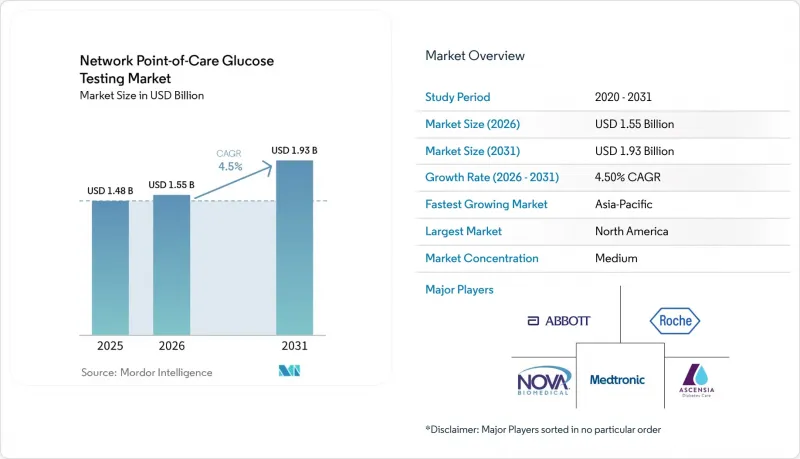
This report is Segmented by Product Type (Accu-Chek Inform II, Statstrip, Hemocue, Barozen H Expert Plus, I-STAT, Caresens Expert Plus), Modality (Handheld/Portable, Wearable, Benchtop), Distribution Channel (Online Retail, Offline Retail, Direct Sales), and Geography (North America, Europe, Asia-Pacific, MEA, South America). The Market Forecasts are Provided in Terms of Value (USD).
Global Network Point-of-Care Glucose Testing Market Trends and Insights
Hospital Network Integration: From Isolated Meters to Glycemic Command Centers
Hospitals are transitioning from standalone bedside testing to integrated glucose systems that directly input results into enterprise records. In April 2025, Abbott integrated FreeStyle Libre data into Epic via the Aura software platform. This move granted over 575,000 U.S. healthcare providers, catering to 280 million patients, seamless access to glucose data within their routine workflow. Once glucose data integrates with nursing documentation, billing, and treatment protocols, hospitals become reluctant to switch devices, even if competitors offer similar performance. Roche announced 24,000 new cobas pulse placements across EMEA by its 2026 Diagnostics Day, with a live U.S. launch in 2026, underscoring buyers' preference for systems that align with broader hospital software environments. Germany's KHZG funding program bolsters this trend, spotlighting connected point-of-care systems that resonate with hospital digitalization goals, catching the eye of procurement teams.
Remote Monitoring in High-Risk Diabetic Patients: Expanding Bedside Testing Beyond the Bedside
Remote glucose monitoring is evolving from a temporary solution to a sustainable care model for high-risk inpatients. In May 2026, Glooko secured FDA 510(k) clearance for EndoTool IV Cloud, marking it as the first cloud-based inpatient insulin dosing platform approved for hospital use. This innovation eliminates the need for on-premise infrastructure, enabling centralized management across facilities. A multicenter study in Diabetes Care highlighted that real-time continuous glucose monitoring, paired with remote nursing oversight, curbed hypoglycemia in insulin-dependent inpatients without adverse effects. This allows hospitals to extend specialist supervision without overburdening bedside staff and emphasizes the growing importance of software platforms in procurement discussions.
Cybersecurity Review Burden: Compliance as a Market Entry Barrier
Connected glucose meters now face stricter compliance requirements before regulatory approval. The FDA's final cybersecurity guidance, issued on June 27, 2025, updated Section 524B expectations, requiring software bills of materials, vulnerability disclosure plans, and detailed cybersecurity risk assessments in premarket submissions. These measures are critical as connectivity failures can erode trust in clinical outcomes. In December 2024, the FDA announced a Class I software correction for Nova Biomedical's StatStrip glucose and glucose/ketone meters due to a software error that risked transmitting incorrect results during simultaneous wireless events. Smaller vendors often struggle with the time and costs needed to meet these demands, making market entry more challenging and favoring larger companies with stronger regulatory capabilities.
Other drivers and restraints analyzed in the detailed report include:
- Expansion of Digital Diabetes Ecosystems: Devices as Entry Points, Not Endpoints
- Reimbursement Support for Connected Glucose Monitoring: Unlocking Volume in Outpatient Transition Zones
- Interoperability Friction: The Hidden Cost of Multi-Vendor Hospital Environments
For complete list of drivers and restraints, kindly check the Table Of Contents.
Segment Analysis
Accu-Chek's Inform II, supported by Roche's navify POC Operations software, dominated the network point-of-care glucose testing market with a 48.40% share in 2025. This stronghold, particularly in European and North American hospitals, is reinforced by Roche's software, which supports over 100 device types and streamlines data management. Buyers now prioritize workflow platforms alongside testing devices, reflecting the industry's shift towards data management and compliance reporting. CareSens Expert Plus, featuring Wi-Fi, Ethernet, USB, and NFC connectivity, is the fastest-growing product, projected to expand at a 7.80% CAGR through 2031.
StatStrip, the only FDA-cleared meter for all critically ill patient sample types, continues to play a pivotal clinical role. Nova Biomedical strengthened this position in March 2025 with its next-generation platform, offering a Linux OS, RFID data entry, and a wider hematocrit range. HemoCue's Glucose 201+ maintains a steady presence in decentralized care, reporting 20 million tests in 2024 across 11,000 U.S. practices. Abbott's i-STAT 1 system remains critical in emergency settings, with FDA-cleared updates in August 2025 ensuring its relevance in multi-analyte testing. The market's leading systems integrate clinical functionality with hospital operations seamlessly.
Complete Report Scope:
- By Product Type
- Accu-Chek Inform II
- StatStrip
- HemoCue
- BAROzen H Expert Plus
- i-STAT
- CareSens Expert Plus
- By Modality
- Handheld/Portable Devices
- Wearable Devices
- Benchtop Devices
- By Distribution Channel
- Online Retail
- Offline Retail
- Direct Sales
- By Geography
- North America
- United States
- Canada
- Mexico
- Europe
- Germany
- United Kingdom
- France
- Italy
- Spain
- Rest of Europe
- Asia-Pacific
- China
- India
- Japan
- Australia
- South Korea
- Rest of Asia-Pacific
- Middle East and Africa
- GCC
- South Africa
- Rest of Middle East and Africa
- South America
- Brazil
- Argentina
- Rest of South America
- North America
Geography Analysis
In 2025, North America accounted for 40.27% of the network point-of-care glucose testing market, making it the largest regional contributor. The region benefits from strong tertiary care infrastructure, high EHR adoption, and reimbursement systems that support connected monitoring. U.S. hospital networks often integrate glucose systems into broader IT and pharmacy workflows, favoring vendors with advanced integration tools. Roche's 2026 launch of cobas pulse in the U.S. highlights the region's significant replacement and upgrade potential. Europe remains the second-largest market, with Germany leading due to KHZG funding, which drives adoption of connected point-of-care systems aligned with hospital digitalization strategies.
Asia-Pacific is projected to grow at a 7.45% CAGR through 2031, the fastest among all regions. Growth is driven by expanding hospital infrastructure, increasing diabetes care needs, and rising interest in connected monitoring in countries like China, India, Japan, and South Korea. Hospitals are increasingly adopting systems that support bedside testing and digital data integration. In 2025, Findex and Abbott Japan linked FreeStyle Libre 2 CGM data with patient guidance and medical data management systems in Japan, showcasing advancements in data connectivity across care settings.
The Middle East, Africa, and South America exhibit uneven growth due to budget constraints, fragmented IT systems, and slower device refresh cycles. However, urban hospital networks in Brazil and well-funded Gulf health systems present opportunities for connected glucose platforms. Multinational vendors play a key role in these regions, as hospitals often require significant implementation support. Market growth in these areas depends heavily on funding stability and digital readiness.
- Abbott Laboratories
- Acon Laboratories
- AgaMatrix, Inc.
- Arkray
- Ascensia Diabetes Care Holdings AG
- Beckton Dickinson
- Bio-Rad Laboratories
- Dexcom
- EKF Diagnostics Holdings plc
- Roche
- Lifescan
- Medtronic
- Nipro
- Nova Biomedical
- PTS Diagnostics
- Siemens Healthineers
- Terumo
- Trividia Health, Inc.
- Ypsomed
Additional Benefits:
- The market estimate (ME) sheet in Excel format
- 3 months of analyst support
TABLE OF CONTENTS
1 INTRODUCTION
- 1.1 Study Assumptions and Market Definition
- 1.2 Scope of the Study
2 RESEARCH METHODOLOGY
3 EXECUTIVE SUMMARY
4 MARKET LANDSCAPE
- 4.1 Market Overview
- 4.2 Market Drivers
- 4.2.1 Hospital Network Integration and Centralized Data Capture
- 4.2.2 Remote Monitoring Demand in High-Risk Diabetes Cohorts
- 4.2.3 Strong Procurement Preference for Workflow Reducing Meters
- 4.2.4 Wider Use of Interoperable Devices in Care Pathways
- 4.2.5 Expansion of Digital Diabetes Ecosystems
- 4.2.6 Reimbursement Support for Connected Glucose Data Workflows
- 4.3 Market Restraints
- 4.3.1 Cybersecurity Review Burden for Connected Medical Devices
- 4.3.2 Interoperability Friction Across Hospital IT and LIS Environments
- 4.3.3 Test Strip and Meter Quality Variability Affecting Trust
- 4.3.4 Budget Pressure on Healthcare Facilities Outside Core Diabetes Units
- 4.4 Supply/Value Chain Analysis
- 4.5 Regulatory Landscape
- 4.6 Technological Outlook
- 4.7 Porter's Five Forces Analysis
- 4.7.1 Bargaining Power of Suppliers
- 4.7.2 Bargaining Power of Buyers
- 4.7.3 Threat of New Entrants
- 4.7.4 Threat of Substitutes
- 4.7.5 Competitive Rivalry
5 MARKET SIZE AND GROWTH FORECASTS (VALUE, USD)
- 5.1 By Product Type
- 5.1.1 Accu-Chek Inform II
- 5.1.2 StatStrip
- 5.1.3 HemoCue
- 5.1.4 BAROzen H Expert Plus
- 5.1.5 i-STAT
- 5.1.6 CareSens Expert Plus
- 5.2 By Modality
- 5.2.1 Handheld/Portable Devices
- 5.2.2 Wearable Devices
- 5.2.3 Benchtop Devices
- 5.3 By Distribution Channel
- 5.3.1 Online Retail
- 5.3.2 Offline Retail
- 5.3.3 Direct Sales
- 5.4 By Geography
- 5.4.1 North America
- 5.4.1.1 United States
- 5.4.1.2 Canada
- 5.4.1.3 Mexico
- 5.4.2 Europe
- 5.4.2.1 Germany
- 5.4.2.2 United Kingdom
- 5.4.2.3 France
- 5.4.2.4 Italy
- 5.4.2.5 Spain
- 5.4.2.6 Rest of Europe
- 5.4.3 Asia-Pacific
- 5.4.3.1 China
- 5.4.3.2 India
- 5.4.3.3 Japan
- 5.4.3.4 Australia
- 5.4.3.5 South Korea
- 5.4.3.6 Rest of Asia-Pacific
- 5.4.4 Middle East and Africa
- 5.4.4.1 GCC
- 5.4.4.2 South Africa
- 5.4.4.3 Rest of Middle East and Africa
- 5.4.5 South America
- 5.4.5.1 Brazil
- 5.4.5.2 Argentina
- 5.4.5.3 Rest of South America
- 5.4.1 North America
6 COMPETITIVE LANDSCAPE
- 6.1 Market Concentration
- 6.2 Market Share Analysis
- 6.3 Company Profiles (includes Global Level Overview, Market Level Overview, Core Segments, Financials as available, Strategic Information, Market Rank/Share, Products and Services, Recent Developments)
- 6.3.1 Abbott Laboratories
- 6.3.2 ACON Laboratories, Inc.
- 6.3.3 AgaMatrix, Inc.
- 6.3.4 ARKRAY, Inc.
- 6.3.5 Ascensia Diabetes Care Holdings AG
- 6.3.6 Becton, Dickinson and Company
- 6.3.7 Bio-Rad Laboratories, Inc.
- 6.3.8 DexCom, Inc.
- 6.3.9 EKF Diagnostics Holdings plc
- 6.3.10 F. Hoffmann-La Roche Ltd.
- 6.3.11 LifeScan, Inc.
- 6.3.12 Medtronic plc
- 6.3.13 Nipro Corporation
- 6.3.14 Nova Biomedical Corporation
- 6.3.15 PTS Diagnostics
- 6.3.16 Siemens Healthineers AG
- 6.3.17 Terumo Corporation
- 6.3.18 Trividia Health, Inc.
- 6.3.19 Ypsomed Holding AG
7 MARKET OPPORTUNITIES AND FUTURE OUTLOOK
- 7.1 White-Space and Unmet-Need Assessment

