
PUBLISHER: Mordor Intelligence | PRODUCT CODE: 2073249

PUBLISHER: Mordor Intelligence | PRODUCT CODE: 2073249
Sleepwear and Loungewear - Market Share Analysis, Industry Trends & Statistics, Growth Forecasts (2026 - 2031)
According to Mordor Intelligence, the sleepwear and loungewear market, valued at USD 34.1 billion in 2025, is projected to reach USD 49.9 billion by 2031, growing at a CAGR of 6.8% from 2026 to 2031.
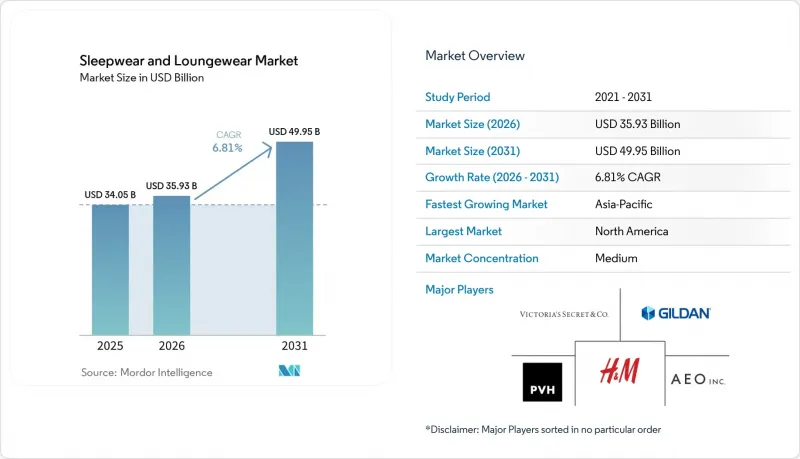
This report is Segmented by Product Type (Sleepwear, Loungewear), Material (Cotton, Silk, Bamboo, Polyester and Blends, Others), End User (Women, Men, Kids, Unisex), Distribution Channel (Supermarkets and Hypermarkets, Specialty Stores, Department Stores, Online Retail, Others), and Geography (North America, Europe, Asia-Pacific, South America, MEA). The Market Forecasts are Provided in Terms of Value (USD).
Global Sleepwear and Loungewear Market Trends and Insights
Remote Work and Telecommuting Lifestyle Shifts
As hybrid work becomes the norm, it's reshaping how consumers approach dressing at home and on less formal workdays, benefiting the sleepwear and loungewear market. A survey conducted in June 2025 by the International Workplace Group revealed that 92% of U.S. hybrid workers value clothing that seamlessly transitions between work and leisure. Furthermore, 31% of respondents emphasized the importance of garments suitable for the office, home, and relaxation, indicating a shift towards a demand for refined comfort over merely functional nightwear. This evolution has carved out a broader daytime loungewear niche, positioned between traditional pajamas and casual wear. This niche is particularly significant for brands that already straddle the line between sleepwear and athleisure. Consequently, the sleepwear and loungewear market is not only seeing an uptick in regular wear cycles but is also expanding its role in wardrobes, moving beyond its previous association with gifting.
Growing Focus on Sleep Wellness and Comfort
The growing connection between sleep quality and wellness is driving the sleepwear and loungewear market. According to a 2025 survey by the American Academy of Sleep Medicine, 55% of U.S. consumers aged 18 to 44 spent between USD 100 and USD 500 on sleep-related products in the previous year. Younger adults were particularly willing to spend over USD 100, showing that premium sleep products are becoming a regular part of their discretionary spending. Additionally, the Global Wellness Institute reported that hospitality operators are enhancing sleep programs with environmental design and coaching, reflecting the rising importance of sleep optimization in consumer culture. This trend boosts the demand for features like moisture control, thermal balance, and skin comfort in sleepwear and loungewear, making premium fabric performance more justifiable at retail.
Supply Chain Disruptions Affecting Timely Delivery
In 2026, the sleepwear and loungewear market grappled with significant supply pressures, largely due to geopolitical disruptions affecting textile and shipping flows. According to the Business and Human Rights Resource Centre, ship transits through the Strait of Hormuz plummeted by 97% post late February 2026. Concurrently, all four major container lines halted their operations in the region. The Centre also highlighted a doubling of bunker fuel costs and a projected 10% to 15% surge in global textile production costs. Notably, polyester-linked supply chains bore the brunt of these increases. This is particularly consequential for the sleepwear and loungewear market, as mass-market loungewear heavily relies on polyester and blended fabrics. Any delivery delays can lead to markdowns, especially if seasonal goods arrive late. Consequently, retailers exhibit diminished confidence in reorders and face tighter margins in price-sensitive product tiers.
Other drivers and restraints analyzed in the detailed report include:
- Sustainable and Eco-Friendly Material Preferences
- Social Media and Digital Platform Influence
- Counterfeit Products Undercutting Authentic Brands
For complete list of drivers and restraints, kindly check the Table Of Contents.
Segment Analysis
In 2025, sleepwear commanded a dominant 56.32% share of the global market value, solidifying its top position in the sleepwear and loungewear sector. This prominence can be attributed to its close ties with gifting cycles, household replenishments, and its appeal across various age groups. The segment's strength lies in its diverse sub-categories, including pajama sets, nightgowns, robes, sleep tops, and bottoms. This variety enables retailers to curate a year-round assortment without being tethered to a singular silhouette. Such depth fosters repeat purchases, especially in women's and children's lines, where holiday collections and family matching themes consistently drive demand peaks. Highlighting the segment's vitality, Victoria's Secret & Co. reported an 8% growth in comparable sales for Q4 of fiscal 2025, singling out sleepwear as a standout category. This underscores how brand allure and social sharing can maintain premium pricing in a saturated apparel market.
Loungewear is set to surge at a robust 8.18% CAGR through 2031, emerging as the fastest-growing segment in the sleepwear and loungewear market. Consumers are increasingly adopting joggers, leggings, hoodies, and soft separates for both home and casual outings. The appeal of loungewear lies in its versatility, straddling the line between relaxation wear and everyday essentials, thus catering to a broader spectrum of weekly clothing needs. HanesBrands recognized this trend, launching 'Hanes Moves' in March 2025, an athleisure line tailored for comfort-driven, all-day wear. As loungewear's popularity surges, it's attracting heightened competition from activewear and fast-fashion brands, intensifying the industry's focus on fabric quality, brand identity, and consistent fit execution.
In 2025, cotton held a 43.33% share of the global market value, reinforcing its key role in the sleepwear and loungewear sectors. Consumers prefer cotton for its breathability and ease of care across both mass and premium price tiers. Its qualities also make it ideal for children's products and family collections, where softness and wash durability are crucial. The USDA reported global cotton mill usage at 118.1 million bales in 2025/26, a five-year high, highlighting strong demand across textile applications. Cotton remains the primary material, even as brands explore specialized performance and sustainability features.
Bamboo is projected to grow at an 7.98% CAGR through 2031, making it the fastest-growing material in the sleepwear and loungewear market. Premium buyers value bamboo for its softness, moisture management, and modern sustainability appeal. As its price premium becomes more acceptable, bamboo is expanding in categories focused on rest and skin comfort. Hanes emphasized this trend with its SuperSoft Originals line, using viscose-from-bamboo fabric to promote enhanced comfort in basics. To maintain bamboo's premium status, brands must ensure clear communication about processing methods and sourcing quality, avoiding its perception as a passing trend.
Complete Report Scope:
- By Product Type
- Sleepwear
- Pajama Sets
- Nightgowns and Sleepshirts
- Robes
- Sleep Tops
- Sleep Bottoms
- Others
- Loungewear
- Hoodies and Sweatshirts
- Joggers and Sweatpants
- Leggings
- Shorts
- Others
- Sleepwear
- By Material
- Cotton
- Silk
- Bamboo
- Polyester and Blended Fabrics
- Other Materials
- By End User
- Women
- Men
- Kids
- Unisex
- By Distribution Channel
- Supermarkets and Hypermarkets
- Specialty Stores
- Department Stores
- Online Retail
- Other Distribution Channels
- By Geography
- North America
- United States
- Canada
- Mexico
- Rest of North America
- Europe
- Germany
- United Kingdom
- Italy
- France
- Spain
- Netherlands
- Poland
- Belgium
- Sweden
- Rest of Europe
- Asia-Pacific
- China
- India
- Japan
- Australia
- Indonesia
- South Korea
- Thailand
- Singapore
- Rest of Asia-Pacific
- South America
- Brazil
- Argentina
- Colombia
- Chile
- Peru
- Rest of South America
- Middle East and Africa
- South Africa
- Saudi Arabia
- United Arab Emirates
- Nigeria
- Egypt
- Morocco
- Turkey
- Rest of Middle East and Africa
- North America
Geography Analysis
In 2025, North America held 35.31% of the global sleepwear and loungewear market, driven by the strong presence of branded comfort apparel in the U.S. and Canada. The region benefits from a solid direct-to-consumer network, high apparel spending, and a concentration of established sleepwear and intimate brands, supporting premium and mid-market sales. The U.S. leads with brand-focused merchandising, extensive digital reach, and frequent seasonal updates, while Canada boosts demand for certified, comfort-driven products in urban retail, favoring premium fabrics and ethical sourcing. Despite slower growth than Asia-Pacific, North America remains the key value hub in the market.
Europe ranked as the second-largest region in 2025, with Germany, the UK, France, Italy, and Spain driving demand. The UK stands out, as Marks & Spencer reported in April 2026 that it sells a bra every two seconds and serves one in three women for underwear and sleepwear, highlighting its dominance in related categories. Europe's regulatory influence pushes brands toward better traceability, consistent certifications, and clear fabric standards. South America and the Middle East & Africa are smaller markets but show growth potential due to younger consumers, rising social visibility, and increasing demand for branded comfort apparel.
Asia-Pacific is the fastest-growing region, with a projected 9.25% CAGR through 2031, driven by urban middle-class growth, rising disposable incomes, and e-commerce adoption. China, India, Indonesia, and Vietnam lead this expansion, embracing comfort-focused dressing. lululemon's December 2025 franchise agreements in India and other markets reflect global brands prioritizing these high-growth regions. Japan and South Korea remain mature, high-value markets favoring technical fabrics and minimalist designs, while Asia-Pacific's manufacturing base keeps it central to the sleepwear and loungewear supply chain.
- Victoria's Secret and Co.
- Hanesbrands Inc.
- Hennes and Mauritz AB
- PVH Corp.
- American Eagle Outfitters Inc.
- Jockey International Inc.
- Ralph Lauren Corporation
- Triumph International Holding GmbH
- Marks and Spencer Group Plc
- Gap Inc.
- lululemon athletica inc.
- Calida Group Digital GmbH
- La Perla Global Management UK Ltd.
- Eberjey, LLC
- Gildan Activewear Inc.
- Skims Body, Inc.
- Zara
- Next Retail Ltd.
- Nordstrom, Inc.
- Under Armour, Inc.
Additional Benefits:
- The market estimate (ME) sheet in Excel format
- 3 months of analyst support
TABLE OF CONTENTS
1 INTRODUCTION
- 1.1 Study Assumptions and Market Definition
- 1.2 Scope of the Study
2 RESEARCH METHODOLOGY
3 EXECUTIVE SUMMARY
4 MARKET LANDSCAPE
- 4.1 Market Overview
- 4.2 Market Drivers
- 4.2.1 Remote work and telecommuting lifestyle shifts
- 4.2.2 Growing focus on sleep wellness and comfort
- 4.2.3 Sustainable and eco-friendly material preferences
- 4.2.4 Fabric innovation and temperature-regulating materials
- 4.2.5 Social media and digital platform influence
- 4.2.6 Demand for inclusive sizing and minimalist aesthetics
- 4.3 Market Restraints
- 4.3.1 Supply chain disruptions affecting timely delivery
- 4.3.2 Competition from alternative apparel categories
- 4.3.3 Consumer price sensitivity in price-sensitive markets
- 4.3.4 Counterfeit products undercutting authentic brands
- 4.4 Consumer Behaviour Analysis
- 4.5 Regulatory Landscape
- 4.6 Technological Outlook
- 4.7 Porter's Five Forces
- 4.7.1 Bargaining Power of Suppliers
- 4.7.2 Bargaining Power of Buyers
- 4.7.3 Threat of New Entrants
- 4.7.4 Threat of Substitutes
- 4.7.5 Competitive Rivalry
5 MARKET SIZE AND GROWTH FORECASTS (VALUE)
- 5.1 By Product Type
- 5.1.1 Sleepwear
- 5.1.1.1 Pajama Sets
- 5.1.1.2 Nightgowns and Sleepshirts
- 5.1.1.3 Robes
- 5.1.1.4 Sleep Tops
- 5.1.1.5 Sleep Bottoms
- 5.1.1.6 Others
- 5.1.2 Loungewear
- 5.1.2.1 Hoodies and Sweatshirts
- 5.1.2.2 Joggers and Sweatpants
- 5.1.2.3 Leggings
- 5.1.2.4 Shorts
- 5.1.2.5 Others
- 5.1.1 Sleepwear
- 5.2 By Material
- 5.2.1 Cotton
- 5.2.2 Silk
- 5.2.3 Bamboo
- 5.2.4 Polyester and Blended Fabrics
- 5.2.5 Other Materials
- 5.3 By End User
- 5.3.1 Women
- 5.3.2 Men
- 5.3.3 Kids
- 5.3.4 Unisex
- 5.4 By Distribution Channel
- 5.4.1 Supermarkets and Hypermarkets
- 5.4.2 Specialty Stores
- 5.4.3 Department Stores
- 5.4.4 Online Retail
- 5.4.5 Other Distribution Channels
- 5.5 By Geography
- 5.5.1 North America
- 5.5.1.1 United States
- 5.5.1.2 Canada
- 5.5.1.3 Mexico
- 5.5.1.4 Rest of North America
- 5.5.2 Europe
- 5.5.2.1 Germany
- 5.5.2.2 United Kingdom
- 5.5.2.3 Italy
- 5.5.2.4 France
- 5.5.2.5 Spain
- 5.5.2.6 Netherlands
- 5.5.2.7 Poland
- 5.5.2.8 Belgium
- 5.5.2.9 Sweden
- 5.5.2.10 Rest of Europe
- 5.5.3 Asia-Pacific
- 5.5.3.1 China
- 5.5.3.2 India
- 5.5.3.3 Japan
- 5.5.3.4 Australia
- 5.5.3.5 Indonesia
- 5.5.3.6 South Korea
- 5.5.3.7 Thailand
- 5.5.3.8 Singapore
- 5.5.3.9 Rest of Asia-Pacific
- 5.5.4 South America
- 5.5.4.1 Brazil
- 5.5.4.2 Argentina
- 5.5.4.3 Colombia
- 5.5.4.4 Chile
- 5.5.4.5 Peru
- 5.5.4.6 Rest of South America
- 5.5.5 Middle East and Africa
- 5.5.5.1 South Africa
- 5.5.5.2 Saudi Arabia
- 5.5.5.3 United Arab Emirates
- 5.5.5.4 Nigeria
- 5.5.5.5 Egypt
- 5.5.5.6 Morocco
- 5.5.5.7 Turkey
- 5.5.5.8 Rest of Middle East and Africa
- 5.5.1 North America
6 COMPETITIVE LANDSCAPE
- 6.1 Market Concentration
- 6.2 Strategic Moves
- 6.3 Market Share Analysis
- 6.4 Company Profiles (includes Global level Overview, Market level overview, Core Segments, Financials (if available), Strategic Information, Market Rank/Share, Products, Recent Developments)
- 6.4.1 Victoria's Secret and Co.
- 6.4.2 Hanesbrands Inc.
- 6.4.3 Hennes and Mauritz AB
- 6.4.4 PVH Corp.
- 6.4.5 American Eagle Outfitters Inc.
- 6.4.6 Jockey International Inc.
- 6.4.7 Ralph Lauren Corporation
- 6.4.8 Triumph International Holding GmbH
- 6.4.9 Marks and Spencer Group Plc
- 6.4.10 Gap Inc.
- 6.4.11 lululemon athletica inc.
- 6.4.12 Calida Group Digital GmbH
- 6.4.13 La Perla Global Management UK Ltd.
- 6.4.14 Eberjey, LLC
- 6.4.15 Gildan Activewear Inc.
- 6.4.16 Skims Body, Inc.
- 6.4.17 Zara
- 6.4.18 Next Retail Ltd.
- 6.4.19 Nordstrom, Inc.
- 6.4.20 Under Armour, Inc.
7 MARKET OPPORTUNITIES AND FUTURE OUTLOOK

