PUBLISHER: Mordor Intelligence | PRODUCT CODE: 2073261

PUBLISHER: Mordor Intelligence | PRODUCT CODE: 2073261
Integrated GPU - Market Share Analysis, Industry Trends & Statistics, Growth Forecasts (2026 - 2031)
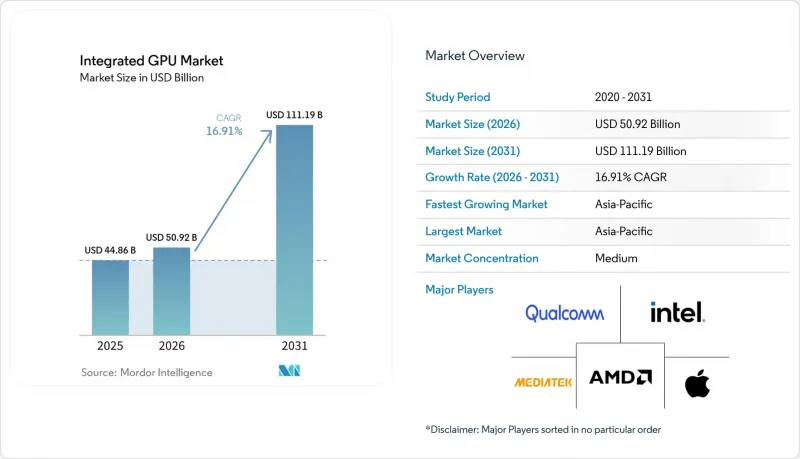
According to Mordor Intelligence, the integrated GPU market size is expected to increase from USD 44.86 billion in 2025 to USD 50.92 billion in 2026 and reach USD 111.19 billion by 2031, growing at a CAGR of 16.91% over 2026-2031.
This report is Segmented by Device Category (Desktop and Laptop Processors, Mobile SoCs, Embedded and Industrial SoCs, and Server and Data Center Processors With Integrated Graphics), Performance Tier (Entry-Level, Mainstream, Performance, and High-Performance), and Geography. The Market Forecasts are Provided in Terms of Value (USD).
Global Integrated GPU Market Trends and Insights
AI PC Refresh Cycle and On-Device AI Adoption
The integrated GPU market is benefiting from the broader move toward AI-capable personal computing, where graphics blocks now support image enhancement, local model execution, and media processing in mainstream systems. Platform vendors are no longer treating the integrated GPU as a secondary feature, because it now works alongside the CPU and NPU in shared workloads that matter to enterprise and consumer buyers. Intel clearly positioned this shift with the Core Ultra Series 3, which combines up to 12 Xe3 GPU cores and a 50 TOPS NPU in a single package on Intel 18A. That design choice supports the integrated GPU market by raising the baseline graphics capability in AI PCs without adding a separate graphics card. The same approach also improves system balance, as lighter AI tasks can be offloaded to the NPU while the integrated GPU continues to handle visual pipelines and sustained graphics activity. This is helping the integrated GPU market gain a stronger role in commercial refresh cycles and premium notebook positioning.
Rising Graphics Integration Across Mobile SoCs
The integrated graphics processing unit (GPU) market continues to draw its largest unit base from mobile SoCs, where graphics blocks are moving beyond frame rendering and into broader compute and AI-assisted imaging functions. MediaTek expanded that performance range with the Dimensity 9500, which integrates the Arm G1-Ultra GPU, adds a new GPU Dynamic Cache Architecture, delivers 33% higher peak performance, and improves power efficiency by 42% from the prior generation. Samsung also raised expectations in premium smartphones with the Exynos 2600, a 2nm GAA chip that pairs the Xclipse 960 GPU with in-house thermal management and higher ray-tracing capability than the prior model. Qualcomm reinforced the same direction in PC-class mobile silicon with the Snapdragon X2 Elite family, where the Adreno X2-90 integrated GPU supports DirectX 12.2 Ultimate, Vulkan 1.4, and higher performance at the same power level. These changes matter to the integrated GPU market because they widen the performance ceiling of SoCs that already ship at very high volume across phones, tablets, and always-connected PCs. They also show that memory handling, cache design, and graphics efficiency have become core product differentiators in the integrated GPU market rather than supporting features.
Performance Gap Versus Discrete GPUs in AAA and Professional Workloads
The integrated GPU market still faces a clear ceiling in workloads that need long-duration rendering, professional content creation, or advanced gaming at high settings. Even with architectural gains, integrated designs still share system memory and thermal limits, while discrete GPUs keep dedicated memory pools and separate power budgets. Intel's current roadmap shows how far integrated graphics have advanced, but even its newest client platforms position strong integrated graphics within broader package designs rather than as full substitutes for professional discrete hardware. This keeps the integrated GPU market from capturing the entire opportunity in creator workstations, high-end desktops, and heavy 3D production environments. Software certification patterns also slow substitution, because professional buyers often continue to specify hardware that has a longer history in specialist rendering and visualization workflows. As a result, the integrated GPU market will continue to expand, but it is likely to remain limited in the most demanding graphics segments over the forecast period.
Other drivers and restraints analyzed in the detailed report include:
- Unified-Memory Designs Enabling Local AI Inference
- Demand for Power-Efficient Thin-and-Light Computing
- Thermal and Shared-Memory Constraints in Sustained Loads
For complete list of drivers and restraints, kindly check the Table Of Contents.
Segment Analysis
Mobile SoCs held a 49.32% share of the integrated GPU market in 2025, keeping the category at the center of global shipment volume. The integrated GPU market draws much of its scale from smartphones and tablets because graphics IP is embedded directly into application processors that ship in very large numbers across consumer price bands. In this part of the integrated GPU industry, vendors compete on gaming response, imaging quality, AI-assisted media features, and power efficiency rather than on raw compute power alone. MediaTek strengthened this category with the Dimensity 9500, which added the Arm G1-Ultra GPU, higher peak graphics performance, better power efficiency, and 120 fps hardware ray tracing in a mainstream commercial SoC. Samsung also reinforced premium mobile graphics with the Exynos 2600, which features the Xclipse 960 GPU and a 2nm GAA process, supporting stronger visual performance in flagship devices.
Server and Data Center Processors with Integrated Graphics are projected to expand at a 17.62% CAGR through 2031, making them the fastest-growing device category in the integrated GPU market. This growth reflects demand for edge AI and compact server platforms where lightweight inference and orchestration can run without a separate add-in card. Desktop and Laptop Processors remain the second-largest device category by value, as client computing continues to absorb large volumes of x86 and Arm-based processors, with improving integrated graphics capabilities. Intel's Core Ultra Series 3 and Core Series 3 show how the integrated GPU market is moving across both premium and value notebook lines with stronger graphics blocks and higher AI readiness. Embedded and Industrial SoCs remain the smallest revenue segment, but they continue to widen the addressable base of the integrated GPU market as visual interfaces, edge vision, and connected control systems adopt more capable SoC designs.
Complete Report Scope:
- By Device Category
- Desktop and Laptop Processors
- Mobile SoCs (Smartphones and Tablets)
- Embedded and Industrial SoCs
- Server and Data Center Processors with Integrated Graphics
- By Performance Tier
- Entry-Level (< USD 50)
- Mainstream (USD 50 - USD 150)
- Performance (USD 150 - USD 300)
- High-Performance (> USD 300)
- By Geography
- North America
- United States
- Canada
- Mexico
- Europe
- Germany
- United Kingdom
- France
- Italy
- Rest of Europe
- Asia-Pacific
- China
- Japan
- South Korea
- India
- Southeast Asia
- Rest of Asia-Pacific
- South America
- Middle East and Africa
- North America
Geography Analysis
Asia-Pacific held 43.93% of the integrated GPU market share in 2025 and is expected to post the fastest regional CAGR of 17.89% through 2031. The region leads the integrated GPU market because it combines SoC manufacturing depth, high-volume electronics assembly, and very great end-device demand across smartphones, notebooks, and consumer electronics. China remains the largest regional demand center due to its scale in device assembly and its push to strengthen domestic semiconductor capabilities. Regional vendors continue to invest in premium integrated graphics capabilities. South Korea adds value through advanced mobile chip development, and Samsung's Exynos 2600 shows how leading vendors in the region continue to invest in premium integrated graphics capability. India and Southeast Asia are also expanding the integrated GPU market through wider 5G adoption, rising smartphone use, and device access programs that bring more GPU-equipped products into everyday computing.
North America represents the second-largest regional revenue base in the integrated GPU market, supported by enterprise PC replacement, premium consumer demand, and wider adoption of AI-ready devices. The January 2026 Section 232 semiconductor tariffs changed procurement economics for imported chips, increasing the appeal of domestic or tariff-exempt supply for some buyers. That policy backdrop favors US-based design and manufacturing strategies, especially when integrated platforms can help reduce bill-of-material complexity. Canada and Mexico contribute mainly through assembly, logistics, and distribution roles within the broader North American supply chain.
Europe continues to develop as both a demand center and a strategic manufacturing investment location for the integrated graphics processing unit (GPU) market. Regional demand is supported by commercial PCs, industrial systems, and automotive electronics that rely on embedded graphics capability. South America remains a smaller but growing part of the integrated GPU market, with demand tied closely to mid-range smartphones and broader mobile data adoption. The Middle East and Africa are also expanding from a smaller base as digital transformation programs, smart city deployments, and connected surveillance systems increase demand for embedded and industrial SoCs with graphics capability. Across both regions, the integrated GPU market is still shaped more by the availability and pricing of imported devices than by local chip production. This leaves demand sensitive to currency movements, trade policy, and pricing effects stemming from supply tightness in major semiconductor manufacturing hubs.
- Intel Corporation
- Advanced Micro Devices, Inc.
- Apple Inc.
- Qualcomm Incorporated
- MediaTek Inc.
- Samsung Electronics Co., Ltd.
- Arm Limited
- Imagination Technologies Group plc
- UNISOC Technologies Co., Ltd.
- NXP Semiconductors N.V.
- Renesas Electronics Corporation
- Texas Instruments Incorporated
- VeriSilicon Holdings Co., Ltd.
- HiSilicon Technologies Co., Ltd.
- Rockchip Electronics Co., Ltd.
- Allwinner Technology Co., Ltd.
- Loongson Technology Corporation Limited
- Shanghai Zhaoxin Semiconductor Co., Ltd.
- Google LLC
- VIA Technologies, Inc.
Additional Benefits:
- The market estimate (ME) sheet in Excel format
- 3 months of analyst support
TABLE OF CONTENTS
1 INTRODUCTION
- 1.1 Study Assumptions and Market Definition
- 1.2 Scope of the Study
2 RESEARCH METHODOLOGY
3 EXECUTIVE SUMMARY
4 MARKET LANDSCAPE
- 4.1 Market Overview
- 4.2 Market Drivers
- 4.2.1 AI PC Refresh Cycle and On-Device AI Adoption
- 4.2.2 Demand for Power-Efficient Thin-and-Light Computing
- 4.2.3 Rising Graphics Integration Across Mobile SoCs
- 4.2.4 Architectural Gains in Mainstream Integrated Graphics
- 4.2.5 Unified-Memory Designs Enabling Local AI Inference
- 4.2.6 Tariff- and Memory-Driven Substitution Away From Entry Discrete GPUs
- 4.3 Market Restraints
- 4.3.1 Performance Gap Versus Discrete GPUs in AAA and Professional Workloads
- 4.3.2 Thermal and Shared-Memory Constraints in Sustained Loads
- 4.3.3 Advanced-Node and LPDDR Supply Allocation Constraints
- 4.3.4 AI PC Spec Inflation Versus Real Memory-Bandwidth Needs
- 4.4 Impact of Macroeconomic Factors on the Market
- 4.5 Industry Value Chain Analysis
- 4.6 Supply Chain Analysis
- 4.7 Regulatory Landscape
- 4.8 Technological Outlook
- 4.9 Porter's Five Forces Analysis
- 4.9.1 Bargaining Power of Suppliers
- 4.9.2 Bargaining Power of Buyers
- 4.9.3 Threat of New Entrants
- 4.9.4 Threat of Substitutes
- 4.9.5 Intensity of Competitive Rivalry
5 MARKET SIZE AND GROWTH FORECASTS (VALUE)
- 5.1 By Device Category
- 5.1.1 Desktop and Laptop Processors
- 5.1.2 Mobile SoCs (Smartphones and Tablets)
- 5.1.3 Embedded and Industrial SoCs
- 5.1.4 Server and Data Center Processors with Integrated Graphics
- 5.2 By Performance Tier
- 5.2.1 Entry-Level (< USD 50)
- 5.2.2 Mainstream (USD 50 - USD 150)
- 5.2.3 Performance (USD 150 - USD 300)
- 5.2.4 High-Performance (> USD 300)
- 5.3 By Geography
- 5.3.1 North America
- 5.3.1.1 United States
- 5.3.1.2 Canada
- 5.3.1.3 Mexico
- 5.3.2 Europe
- 5.3.2.1 Germany
- 5.3.2.2 United Kingdom
- 5.3.2.3 France
- 5.3.2.4 Italy
- 5.3.2.5 Rest of Europe
- 5.3.3 Asia-Pacific
- 5.3.3.1 China
- 5.3.3.2 Japan
- 5.3.3.3 South Korea
- 5.3.3.4 India
- 5.3.3.5 Southeast Asia
- 5.3.3.6 Rest of Asia-Pacific
- 5.3.4 South America
- 5.3.5 Middle East and Africa
- 5.3.1 North America
6 COMPETITIVE LANDSCAPE
- 6.1 Market Concentration
- 6.2 Strategic Moves
- 6.3 Market Share Analysis
- 6.4 Company Profiles (includes Global Level Overview, Market Level Overview, Core Segments, Financials as available, Strategic Information, Market Rank/Share, Products and Services, Recent Developments)
- 6.4.1 Intel Corporation
- 6.4.2 Advanced Micro Devices, Inc.
- 6.4.3 Apple Inc.
- 6.4.4 Qualcomm Incorporated
- 6.4.5 MediaTek Inc.
- 6.4.6 Samsung Electronics Co., Ltd.
- 6.4.7 Arm Limited
- 6.4.8 Imagination Technologies Group plc
- 6.4.9 UNISOC Technologies Co., Ltd.
- 6.4.10 NXP Semiconductors N.V.
- 6.4.11 Renesas Electronics Corporation
- 6.4.12 Texas Instruments Incorporated
- 6.4.13 VeriSilicon Holdings Co., Ltd.
- 6.4.14 HiSilicon Technologies Co., Ltd.
- 6.4.15 Rockchip Electronics Co., Ltd.
- 6.4.16 Allwinner Technology Co., Ltd.
- 6.4.17 Loongson Technology Corporation Limited
- 6.4.18 Shanghai Zhaoxin Semiconductor Co., Ltd.
- 6.4.19 Google LLC
- 6.4.20 VIA Technologies, Inc.
7 MARKET OPPORTUNITIES AND FUTURE OUTLOOK
- 7.1 White-Space and Unmet-Need Assessment

