PUBLISHER: Mordor Intelligence | PRODUCT CODE: 2073286

PUBLISHER: Mordor Intelligence | PRODUCT CODE: 2073286
AI-Powered Payroll Analytics - Market Share Analysis, Industry Trends & Statistics, Growth Forecasts (2026 - 2031)
According to Mordor Intelligence, the AI-Powered payroll analytics market size is expected to grow from USD 1.24 billion in 2025 to USD 1.39 billion in 2026 and is forecast to reach USD 2.86 billion by 2031 at a 15.51% CAGR over 2026-2031.
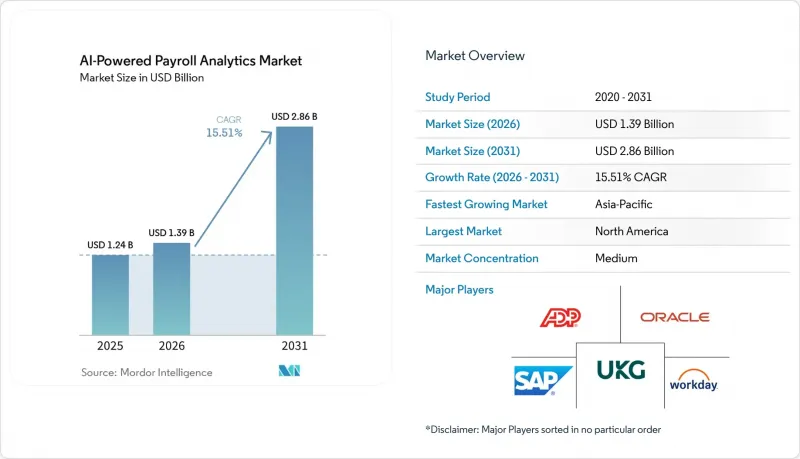
This report is Segmented by Component (Software and Services), Analytics Type (Predictive Payroll Analytics, and More), Deployment Mode (Cloud and On-Premise), Organization Size (Small and Medium Enterprises and Large Enterprises), Industry Vertical (IT and Telecommunications, Retail and E-Commerce, and More), and Geography. The Market Forecasts are Provided in Terms of Value (USD).
Global AI-Powered Payroll Analytics Market Trends and Insights
Rapid Adoption of Cloud-Based Payroll Suites
Elastic compute, API-first architectures, and turnkey AI modules are pushing enterprises to abandon on-premise deployments. Workday added more than 60 Australian payroll customers within two years of launch, and at least half were already live by late 2025.ADP's three-cloud partnership with AWS, Azure, and GCP unlocked monetization of anonymized payroll datasets, powering benchmarking tools that smaller rivals cannot match. Workday's Deployment Agent, available February 2026, is projected to cut implementation timelines by 25%, a value proposition resonating with midsize companies that lack dedicated IT resources. The Australian Payroll Association reported that 23.6% of payroll teams cited poor systems integration as a bottleneck, an inefficiency cloud-native platforms are designed to remove. Collectively, these developments place cloud at the center of the AI-Powered Payroll Analytics market growth narrative.
Increasing Regulatory Complexity in Multi-Country Payroll
The EU Pay Transparency Directive (effective June 6 2026) mandates gender-segmented pay-gap disclosure, while California's SB 464 imposes annual pay-data reporting with escalating fines for inaccuracies. New York City's Int. 982-A and Ontario's Working for Workers Four Act extend similar obligations, compelling employers to embed compliance intelligence into everyday payroll workflows. Enterprises operating across five or more jurisdictions already manage 50-plus statutory changes annually, rendering manual updates untenable. Vendors are responding by shipping AI agents that scan legislative feeds and auto-configure withholding tables, a capability now cited as top-three in RFPs across North America and Europe. Persistent rule churn therefore underpins the long-run trajectory of the AI-Powered Payroll Analytics market.
Data Privacy and Cross-Border Data Transfer Restrictions
California's CPPA rules effective October 2025 require anti-bias testing, cybersecurity audits, and opt-out flows for automated pay decisions, materially increasing compliance budgets for multistate employers. The U.S. Department of Justice Bulk Data Transfer Rule (April 2025) limits offshore administrative access, compelling global vendors to introduce sovereign-cloud regions. Under GDPR, companies lacking approved safeguards face suspension of data flows, spurring demand for customer-managed encryption keys and confidential-computing enclaves. Each additional safeguard adds latency, cost, and legal exposure, tempering adoption velocity in the AI-Powered Payroll Analytics industry.
Other drivers and restraints analyzed in the detailed report include:
- Growing Demand for Real-Time Payroll Insights to Improve Workforce Planning
- AI-Driven Fraud Detection and Payroll Compliance Monitoring
- Shortage of Payroll Data Science Talent
For complete list of drivers and restraints, kindly check the Table Of Contents.
Segment Analysis
Implementation, consulting, and support services accounted for the fastest growth inside the AI-Powered Payroll Analytics market, advancing at 17.78% CAGR as enterprises tackled legacy ERP integration, sovereign-cloud provisioning, and pay-equity reporting. Although software maintained a 65.44% revenue share in 2025, buyers increasingly view code as commodity and outcomes as premium. Vendors that wrap turnkey playbooks around GDPR transfer impact assessments and California CPPA audits capture higher attach rates.
Demand for post-go-live tuning is also accelerating. Quarterly bias audits, model-drift remediation, and legislative rule-engine updates require human oversight that internal teams often lack. Zalaris recommends at least four compliance validation cycles per year to keep AI outputs defensible. Consequently, services revenues are projected to lift their share of the AI-Powered Payroll Analytics market size as organizations treat continuous optimization as essential to safeguard brand and regulatory standing.
Predictive payroll analytics held a 34.11% revenue share in 2025, but fraud and anomaly detection is rising faster, reflecting heightened cyber-security threats and stricter audit obligations. With 70% of enterprises encountering at least one payroll breach in two years, boards now mandate continuous monitoring regimes. Workday's Financial Test Suite adds automated stop-payment controls, underscoring a pivot from identification to prevention.
Convergence is emerging. Suites now bundle cost modeling, pay-equity diagnostics, and anomaly scanning in a unified canvas, simplifying role-based access governance and evidentiary logging. Vendors that can surface variance root causes inside minutes, rather than days, are winning bake-offs, suggesting that fraud analytics will continue enlarging its slice of the AI-Powered Payroll Analytics market share over the forecast horizon.
Complete Report Scope:
- By Component
- Software
- Services
- Implementation Services
- Consulting Services
- Support and Maintenance Services
- By Analytics Type
- Predictive Payroll Analytics
- Automated Compliance and Risk Analytics
- Payroll Fraud and Anomaly Detection
- AI?Optimized Workforce Cost Modeling
- AI?Driven Pay Equity and Compensation Analytics
- Other Analytics Type
- By Deployment Mode
- Cloud
- On-Premise
- By Organization Size
- Small and Medium Enterprises (SMEs)
- Large Enterprises
- By Industry Vertical
- IT and Telecommunications
- BFSI
- Healthcare
- Retail and E-Commerce
- Manufacturing
- Government and Public Sector
- Other Industry Verticals
- By Geography
- North America
- United States
- Canada
- Mexico
- South America
- Brazil
- Argentina
- Rest of South America
- Europe
- Germany
- United Kingdom
- France
- Italy
- Spain
- Rest of Europe
- Asia-Pacific
- China
- India
- Japan
- Australia
- South Korea
- Rest of Asia-Pacific
- Middle East
- Saudi Arabia
- United Arab Emirates
- Turkey
- Rest of Middle East
- Africa
- South Africa
- Nigeria
- Rest of Africa
- North America
Geography Analysis
North America generated 38.14% of global revenue in 2025, sustained by California SB 464, New York City Int. 982-A, and Ontario's Working for Workers Four Act that mandate granular pay-data reporting. Vendor consolidation, exemplified by Paychex's USD 4.1 billion acquisition of Paycor, gave buyers access to platforms serving one in eleven U.S. private-sector workers, reinforcing scale economies that accelerate feature rollout.
Asia-Pacific is the fastest-growing territory at 16.51% CAGR. India's 75% payroll-staff shortage and Australia's 43% coverage gap have driven companies toward automation and anomaly detection.Workday's rapid Australian uptake shows regional appetite for AI-infused compliance alerts, while African start-ups such as PaidHR expand footprints across 49 currencies, illustrating untapped frontier opportunities.
Europe records steady adoption propelled by the EU Pay Transparency Directive effective June 2026. SD Worx's acquisition of Paie and RH Solutions in February 2026 increased its French SME client base by 1,100 accounts, signaling intensified mid-market competition. South America and the Middle East and Africa remain early-stage but are seeing cloud-first entrants plug into volatile currency zones and fragmented tax landscapes, adding long-tail momentum to the AI-Powered Payroll Analytics market.
- Automatic Data Processing, Inc.
- Paychex, Inc.
- Paycom Software, Inc.
- Ceridian HCM Holding Inc.
- Paycor HCM, Inc.
- Intuit Inc.
- Workday, Inc.
- Gusto, Inc.
- Rippling People Center, Inc.
- Zenefits LLC
- BambooHR LLC
- UKG Inc.
- Oracle Corporation
- SAP SE
- Ramco Systems Limited
- Zoho Corporation Private Limited
- Deel, Inc.
- Papaya Global Ltd.
- Neeyamo Enterprise Solutions Private Limited
- Namely Inc.
Additional Benefits:
- The market estimate (ME) sheet in Excel format
- 3 months of analyst support
TABLE OF CONTENTS
1 INTRODUCTION
- 1.1 Study Assumptions and Market Definition
- 1.2 Scope of the Study
2 RESEARCH METHODOLOGY
3 EXECUTIVE SUMMARY
4 MARKET LANDSCAPE
- 4.1 Market Overview
- 4.2 Market Drivers
- 4.2.1 Rapid Adoption of Cloud-Based Payroll Suites
- 4.2.2 Increasing Regulatory Complexity in Multi-Country Payroll
- 4.2.3 Growing Demand for Real-Time Payroll Insights to Improve Workforce Planning
- 4.2.4 AI-Driven Fraud Detection and Payroll Compliance Monitoring
- 4.2.5 Rising Venture Capital Funding Into HR Tech Start-Ups
- 4.2.6 Integration of Payroll Analytics With Financial Wellness Programs
- 4.3 Market Restraints
- 4.3.1 Data Privacy and Cross-Border Data Transfer Restrictions
- 4.3.2 Shortage of Payroll Data Science Talent
- 4.3.3 Legacy Payroll Infrastructure in Large Enterprises
- 4.3.4 High Initial Integration Costs for SMEs
- 4.4 Industry Value Chain Analysis
- 4.5 Regulatory Landscape
- 4.6 Technological Outlook
- 4.7 Impact of Macroeconomic Factors on the Market
- 4.8 Porter's Five Forces Analysis
5 MARKET SIZE AND GROWTH FORECASTS (VALUE)
- 5.1 By Component
- 5.1.1 Software
- 5.1.2 Services
- 5.1.2.1 Implementation Services
- 5.1.2.2 Consulting Services
- 5.1.2.3 Support and Maintenance Services
- 5.2 By Analytics Type
- 5.2.1 Predictive Payroll Analytics
- 5.2.2 Automated Compliance and Risk Analytics
- 5.2.3 Payroll Fraud and Anomaly Detection
- 5.2.4 AI?Optimized Workforce Cost Modeling
- 5.2.5 AI?Driven Pay Equity and Compensation Analytics
- 5.2.6 Other Analytics Type
- 5.3 By Deployment Mode
- 5.3.1 Cloud
- 5.3.2 On-Premise
- 5.4 By Organization Size
- 5.4.1 Small and Medium Enterprises (SMEs)
- 5.4.2 Large Enterprises
- 5.5 By Industry Vertical
- 5.5.1 IT and Telecommunications
- 5.5.2 BFSI
- 5.5.3 Healthcare
- 5.5.4 Retail and E-Commerce
- 5.5.5 Manufacturing
- 5.5.6 Government and Public Sector
- 5.5.7 Other Industry Verticals
- 5.6 By Geography
- 5.6.1 North America
- 5.6.1.1 United States
- 5.6.1.2 Canada
- 5.6.1.3 Mexico
- 5.6.2 South America
- 5.6.2.1 Brazil
- 5.6.2.2 Argentina
- 5.6.2.3 Rest of South America
- 5.6.3 Europe
- 5.6.3.1 Germany
- 5.6.3.2 United Kingdom
- 5.6.3.3 France
- 5.6.3.4 Italy
- 5.6.3.5 Spain
- 5.6.3.6 Rest of Europe
- 5.6.4 Asia-Pacific
- 5.6.4.1 China
- 5.6.4.2 India
- 5.6.4.3 Japan
- 5.6.4.4 Australia
- 5.6.4.5 South Korea
- 5.6.4.6 Rest of Asia-Pacific
- 5.6.5 Middle East
- 5.6.5.1 Saudi Arabia
- 5.6.5.2 United Arab Emirates
- 5.6.5.3 Turkey
- 5.6.5.4 Rest of Middle East
- 5.6.6 Africa
- 5.6.6.1 South Africa
- 5.6.6.2 Nigeria
- 5.6.6.3 Rest of Africa
- 5.6.1 North America
6 COMPETITIVE LANDSCAPE
- 6.1 Market Concentration
- 6.2 Strategic Moves
- 6.3 Market Share Analysis
- 6.4 Company Profiles (includes Global Level Overview, Market Level Overview, Core Segments, Financials as available, Strategic Information, Market Rank/Share, Products and Services, Recent Developments)
- 6.4.1 Automatic Data Processing, Inc.
- 6.4.2 Paychex, Inc.
- 6.4.3 Paycom Software, Inc.
- 6.4.4 Ceridian HCM Holding Inc.
- 6.4.5 Paycor HCM, Inc.
- 6.4.6 Intuit Inc.
- 6.4.7 Workday, Inc.
- 6.4.8 Gusto, Inc.
- 6.4.9 Rippling People Center, Inc.
- 6.4.10 Zenefits LLC
- 6.4.11 BambooHR LLC
- 6.4.12 UKG Inc.
- 6.4.13 Oracle Corporation
- 6.4.14 SAP SE
- 6.4.15 Ramco Systems Limited
- 6.4.16 Zoho Corporation Private Limited
- 6.4.17 Deel, Inc.
- 6.4.18 Papaya Global Ltd.
- 6.4.19 Neeyamo Enterprise Solutions Private Limited
- 6.4.20 Namely Inc.
7 MARKET OPPORTUNITIES AND FUTURE OUTLOOK
- 7.1 White-Space and Unmet-Need Assessment

