PUBLISHER: Mordor Intelligence | PRODUCT CODE: 2073287

PUBLISHER: Mordor Intelligence | PRODUCT CODE: 2073287
3D Animation - Market Share Analysis, Industry Trends & Statistics, Growth Forecasts (2026 - 2031)
According to Mordor Intelligence, the 3D animation market size is expected to grow from USD 26.72 billion in 2025 to USD 31.49 billion in 2026 and is forecast to reach USD 54.36 billion by 2031 at 11.54% CAGR over 2026-2031.
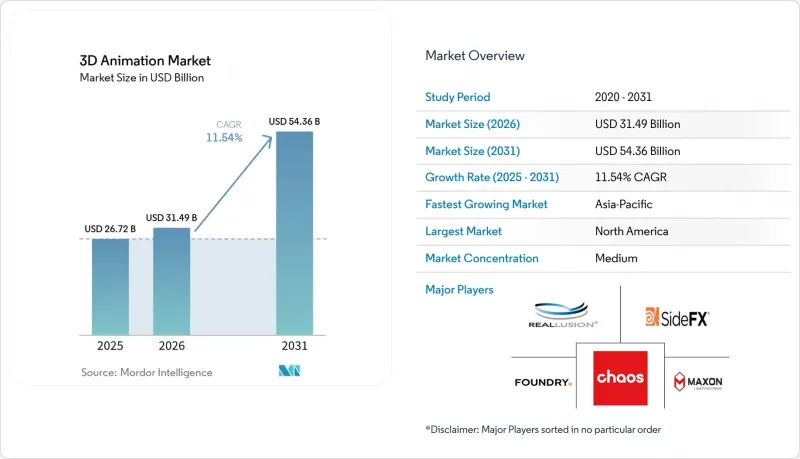
This report is Segmented by Component (Software, and More), Deployment Mode (On-Premise, and Cloud), Technique (3D Modeling, Motion Graphics, and More), End-User Industry (Media and Entertainment, Gaming, Advertising and Marketing, Architecture, Engineering, and Construction, Healthcare and Life Sciences, Education and Training, and More), Geography. The Market Forecasts are Provided in Terms of Value (USD).
Global 3D Animation Market Trends and Insights
Rising VFX Demand Across Streaming and Film
Premium streaming platforms continued to prioritize visual quality as a core driver of subscriber retention, keeping demand for animation and effects work elevated across the 3D animation market. Disney committed USD 24 billion in content investment for fiscal year 2026, showing that large content owners still supported aggressive production pipelines even as cost discipline became more visible. Netflix launched INKubator in May 2026 as an artist-led, GenAI-native animation studio, demonstrating that major platforms were investing directly in internal production systems rather than relying solely on external vendors. Netflix also opened Eyeline Studios in Hyderabad in March 2026, expanding high-end visual effects capacity into a production market that previously sat outside the first tier of global facility networks. Amazon, MGM Studios, and AWS launched Project Nara in April 2026, cutting pilot timelines from 3-6 months to 5 weeks and signaling that infrastructure-backed speed had become part of the creative value proposition in the 3D animation market. As a result, content demand in this market was no longer driven only by volume, because it was increasingly tied to how quickly studios could move from concept to production-ready output.
Expanding Game and Esports Content Pipelines
The esports economy created a steady stream of short-cycle content work, pushing the 3D animation market beyond traditional film and game launch schedules. Broadcast packages, branded sequences, cinematic intros, and real-time effects all required high-quality 3D assets with tighter revision windows than most film productions. The Valorant Champions 2026 activation for Red Bull used bespoke 3D integration assets and real-time visual effects, reflecting the level of polish now expected at large esports events. This pattern favored cloud rendering, modular assets, and AI-assisted content generation because teams needed to iterate quickly across events, sponsors, and formats. The 3D animation market also benefited from the expansion of esports infrastructure in the United States, South Korea, and Saudi Arabia, broadening the regional demand base for professional production services.
High Compute, Licensing, and Talent Costs
The 3D animation market remained expensive to operate at a high quality level, especially for mid-sized studios that could not spread fixed costs across large project slates. Cloud GPU demand rose sharply, and AWS capacity tied to Project Nara alone was projected to account for 15% of total AWS GPU allocation by year-end 2026, pointing to tighter infrastructure availability and margin pressure. Licensing costs added to that pressure, because a professional Cinema 4D subscription costs USD 109 per month or USD 839 per year before studios added rendering, compositing, motion capture, or collaboration tools. Those software costs were only part of the picture, because experienced technical artists and pipeline specialists still commanded premium compensation in major production centers. Many firms in the 3D animation market, therefore, delayed upgrades, mixed paid and open-source tools, or moved selected workloads to external partners to avoid locking in high fixed costs. That response helped control spending, but it also increased compatibility risk and made workflow standardization harder across projects.
Other drivers and restraints analyzed in the detailed report include:
- Wider Use of 3D Animation in Healthcare, Architecture, and Training
- AI Rigging and AI-Assisted Character Pipeline Compression
- Shortage of Production-Ready Technical Artists and Animators
For complete list of drivers and restraints, kindly check the Table Of Contents.
Segment Analysis
Software held the largest share of 63.37% in the 3D animation market in 2025, reflecting studios' long-standing reliance on core authoring, rigging, simulation, rendering, and compositing tools. Autodesk's Maya and Arnold stack remained central to character and production workflows, while Maxon's Maxon One bundle brought Cinema 4D, ZBrush, Redshift, and Red Giant into a single subscription model that reinforced recurring software spend. Hardware occupied a smaller share, but it stayed relevant because GPU upgrades, motion capture devices, and review systems still shaped production performance and real-time capability. Services were the fastest-growing component in the 3D animation market and were projected to expand at a 12.14% CAGR from 2026 to 2031. That growth reflected the need for flexible rendering capacity, pipeline integration, and outsourced content production without large capital commitments.
Studios across the 3D animation industry increasingly treated rendering and pipeline management as variable operating costs rather than fixed infrastructure decisions. Project Nara illustrated this direction by combining production tooling, AI support, and managed compute into a single workflow environment. OpenUSD adoption also supported services demand, because more studios needed integration, migration, and consulting support after the OpenUSD Core Specification 1.0 was ratified in 2025. Training and support services remained smaller, but they stayed relevant where teams had to adapt quickly to new AI features and cross-application workflows. This kept the component mix in the 3D animation market tilted toward software leadership, while services captured a larger share of incremental growth.
On-premises deployment retained a 59.91% share of the 3D animation market in 2025, indicating that major studios still preferred control over their core production environments. Large facilities continued to value predictable frame throughput, stronger security over proprietary assets, and the ability to customize pipelines without depending on shared cloud capacity. That preference was especially strong in feature film and episodic work, where delivery delays could disrupt entire production schedules. Hardware improvements also helped keep internal rendering viable for studios with enough frame volume to justify dedicated infrastructure. In practice, this meant the 3D animation market still relied heavily on on-premises compute for its most intensive workloads.
Cloud was the fastest-growing deployment mode in the 3D animation market, with a CAGR of 11.92%, as smaller studios, ad agencies, and cross-disciplinary teams needed elastic access to compute and collaborative tools. Blackmagic Design's public beta release of Fusion Studio 20.x in December 2025 included architectural improvements that enabled broader cloud compatibility. Rokoko also launched Rokoko Create in April 2026 as a browser-based text-to-animation tool, which showed how vendors were designing lighter access points that did not require heavy local setups. As interoperability improves through OpenUSD and similar standards, cloud adoption in the 3D animation market is likely to face less integration friction than it did in older pipeline models. Independent studios in emerging markets stand to benefit first because cloud access reduces the capital barrier that once limited entry into high-end production.
Complete Report Scope:
- By Component
- Software
- Hardware
- Services
- By Deployment Mode
- On-premise
- Cloud
- By Technique
- 3D Modeling
- Motion Graphics
- 3D Rendering
- Visual Effects
- By End-User Industry
- Media and Entertainment
- Gaming
- Advertising and Marketing
- Architecture, Engineering, and Construction
- Healthcare and Life Sciences
- Education and Training
- Manufacturing and Industrial
- Government and Defense
- By Geography
- North America
- United States
- Canada
- Mexico
- South America
- Brazil
- Argentina
- Rest of South America
- Europe
- Germany
- United Kingdom
- France
- Italy
- Spain
- Rest of Europe
- Asia-Pacific
- China
- Japan
- India
- South Korea
- Australia
- Southeast Asia
- Rest of Asia-Pacific
- Middle East
- Saudi Arabia
- United Arab Emirates
- Rest of Middle East
- Africa
- South Africa
- Nigeria
- Rest of Africa
- North America
Geography Analysis
North America held 39.84% of the 3D animation market share in 2025, which made it the leading regional cluster by revenue. The United States drove much of that position through the concentration of major studios, streaming platforms, AAA game publishers, and software vendors that anchored procurement and R&D. Disney's fiscal 2026 content spending plans and Netflix's broader studio build-out showed that high-end production demand remained concentrated in this region even as some capacity expanded abroad. Canada continued to benefit from tax credits and a mature animation cluster, and Rodeo FX's acquisition of Mikros Animation in March 2025 strengthened its integrated VFX and animation footprint. Mexico remained an emerging outsourcing location in the 3D animation market, but its pipeline maturity still trailed hubs such as Vancouver and Los Angeles.
Asia-Pacific was the fastest-growing region, with a 12.48% CAGR in the 3D animation market, and India and China were the clearest growth engines. Netflix opened Eyeline Studios in Hyderabad in March 2026, spanning 32,000 sq. ft., formally bringing India into Netflix's top-tier VFX network alongside Los Angeles, Vancouver, Seoul, and London. China's animated film box office reached CNY 25 billion (USD 3.47 billion) in 2025, accounting for close to 50% of the country's total theatrical box office, indicating that domestic animation demand had entered a structurally larger phase. South Korea continued to serve as an outsourcing destination for animation and VFX work, while Japan pushed further into integrated production and distribution with U-NEXT Holdings' acquisition of GoHands in May 2026. The 3D animation market in Asia-Pacific also had an industrial layer that was becoming more important, because OpenUSD adoption in manufacturing and digital twin environments suggested another route to future demand.
Strong independent production ecosystems in the United Kingdom, Germany, and France supported Europe's 3D animation market. The United Kingdom benefited from tax incentives for high-end television production, which supported demand for compositing and effects tools. Germany stood out for enterprise use cases, where OpenUSD-based digital twin workflows opened new procurement paths tied to manufacturing and engineering applications. South America, the Middle East, and Africa remained smaller, but the 3D animation market gained support from event-led content demand in Saudi Arabia, creative technology incentives in the UAE, and co-production links between South Africa and European broadcasters.
- Maxon Computer GmbH
- Side Effects Software Inc.
- The Foundry Visionmongers Limited
- Reallusion Inc.
- Stichting Blender Foundation
- Toon Boom Animation Inc.
- Chaos Software EOOD
- DAZ Productions, Inc.
- OTOY Inc.
- Boris FX, Inc.
- Blackmagic Design Pty. Ltd.
- Rokoko Electronics ApS
- Faceware Technologies, Inc.
- Marmoset LLC
- Pilgway LLC
- Nekki Limited
- Vicon Motion Systems Ltd.
- NaturalPoint, Inc. d/b/a OptITrack
- Qualisys AB
- iPi Soft LLC
Additional Benefits:
- The market estimate (ME) sheet in Excel format
- 3 months of analyst support
TABLE OF CONTENTS
1 INTRODUCTION
- 1.1 Study Assumptions and Market Definition
- 1.2 Scope of the Study
2 RESEARCH METHODOLOGY
3 EXECUTIVE SUMMARY
4 MARKET LANDSCAPE
- 4.1 Market Overview
- 4.2 Impact of Macroeconomic Factors on the Market
- 4.3 Market Drivers
- 4.3.1 Rising VFX Demand Across Streaming and Film
- 4.3.2 Expanding Game and Esports Content Pipelines
- 4.3.3 Wider Use of 3D Animation in Healthcare, Architecture, and Training
- 4.3.4 Cloud-Based Tool Access for Small and Mid-Sized Studios
- 4.3.5 OpenUSD-Based Asset Interoperability Across Creation Pipelines
- 4.3.6 AI Rigging and AI-Assisted Character Pipeline Compression
- 4.4 Market Restraints
- 4.4.1 High Compute, Licensing, and Talent Costs
- 4.4.2 Shortage of Production-Ready Technical Artists and Animators
- 4.4.3 Copyright Ambiguity Around AI-Assisted Outputs
- 4.4.4 Software Piracy and Compliance Leakage
- 4.5 Industry Value Chain Analysis
- 4.6 Regulatory Landscape
- 4.7 Technological Outlook
- 4.8 Porter's Five Forces Analysis
- 4.8.1 Bargaining Power of Suppliers
- 4.8.2 Bargaining Power of Buyers
- 4.8.3 Threat of New Entrants
- 4.8.4 Threat of Substitutes
- 4.8.5 Intensity of Competitive Rivalry
5 MARKET SIZE AND GROWTH FORECASTS (VALUE)
- 5.1 By Component
- 5.1.1 Software
- 5.1.2 Hardware
- 5.1.3 Services
- 5.2 By Deployment Mode
- 5.2.1 On-premise
- 5.2.2 Cloud
- 5.3 By Technique
- 5.3.1 3D Modeling
- 5.3.2 Motion Graphics
- 5.3.3 3D Rendering
- 5.3.4 Visual Effects
- 5.4 By End-User Industry
- 5.4.1 Media and Entertainment
- 5.4.2 Gaming
- 5.4.3 Advertising and Marketing
- 5.4.4 Architecture, Engineering, and Construction
- 5.4.5 Healthcare and Life Sciences
- 5.4.6 Education and Training
- 5.4.7 Manufacturing and Industrial
- 5.4.8 Government and Defense
- 5.5 By Geography
- 5.5.1 North America
- 5.5.1.1 United States
- 5.5.1.2 Canada
- 5.5.1.3 Mexico
- 5.5.2 South America
- 5.5.2.1 Brazil
- 5.5.2.2 Argentina
- 5.5.2.3 Rest of South America
- 5.5.3 Europe
- 5.5.3.1 Germany
- 5.5.3.2 United Kingdom
- 5.5.3.3 France
- 5.5.3.4 Italy
- 5.5.3.5 Spain
- 5.5.3.6 Rest of Europe
- 5.5.4 Asia-Pacific
- 5.5.4.1 China
- 5.5.4.2 Japan
- 5.5.4.3 India
- 5.5.4.4 South Korea
- 5.5.4.5 Australia
- 5.5.4.6 Southeast Asia
- 5.5.4.7 Rest of Asia-Pacific
- 5.5.5 Middle East
- 5.5.5.1 Saudi Arabia
- 5.5.5.2 United Arab Emirates
- 5.5.5.3 Rest of Middle East
- 5.5.6 Africa
- 5.5.6.1 South Africa
- 5.5.6.2 Nigeria
- 5.5.6.3 Rest of Africa
- 5.5.1 North America
6 COMPETITIVE LANDSCAPE
- 6.1 Market Concentration
- 6.2 Strategic Moves
- 6.3 Market Share Analysis
- 6.4 Company Profiles (includes Global Level Overview, Market Level Overview, Core Segments, Financials as available, Strategic Information, Market Rank/Share, Products and Services, Recent Developments)
- 6.4.1 Maxon Computer GmbH
- 6.4.2 Side Effects Software Inc.
- 6.4.3 The Foundry Visionmongers Limited
- 6.4.4 Reallusion Inc.
- 6.4.5 Stichting Blender Foundation
- 6.4.6 Toon Boom Animation Inc.
- 6.4.7 Chaos Software EOOD
- 6.4.8 DAZ Productions, Inc.
- 6.4.9 OTOY Inc.
- 6.4.10 Boris FX, Inc.
- 6.4.11 Blackmagic Design Pty. Ltd.
- 6.4.12 Rokoko Electronics ApS
- 6.4.13 Faceware Technologies, Inc.
- 6.4.14 Marmoset LLC
- 6.4.15 Pilgway LLC
- 6.4.16 Nekki Limited
- 6.4.17 Vicon Motion Systems Ltd.
- 6.4.18 NaturalPoint, Inc. d/b/a OptiTrack
- 6.4.19 Qualisys AB
- 6.4.20 iPi Soft LLC
7 MARKET OPPORTUNITIES AND FUTURE OUTLOOK
- 7.1 White-Space and Unmet-Need Assessment

