PUBLISHER: Mordor Intelligence | PRODUCT CODE: 2073302

PUBLISHER: Mordor Intelligence | PRODUCT CODE: 2073302
Pay Equity Analytics Platform - Market Share Analysis, Industry Trends & Statistics, Growth Forecasts (2026 - 2031)
According to Mordor Intelligence, the pay equity analytics platform market size is projected to expand from USD 0.94 billion in 2025 and USD 1.07 billion in 2026 to USD 2.39 billion by 2031, registering a CAGR of 17.46% between 2026 and 2031.
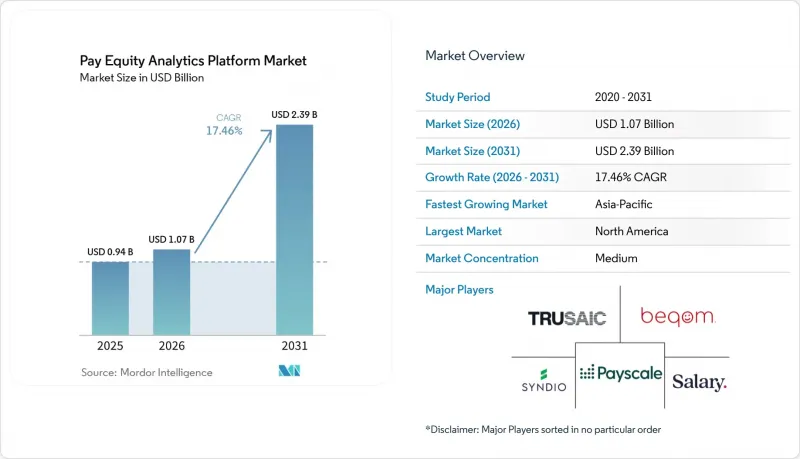
This report is Segmented by Deployment Mode (Cloud-Based, and On-Premises), Organization Size (Large Enterprises, and SMEs), Application (Pay Gap Analytics, Benchmarking and Compensation Analysis, Compliance and Regulatory Reporting, and More), End-User Industry (BFSI, IT and Telecommunications, and More), and Geography. The Market Forecasts are Provided in Terms of Value (USD).
Global Pay Equity Analytics Platform Market Trends and Insights
EU Pay Transparency Directive Creates Immediate Compliance Demand
The June 7, 2026, transposition deadline has become the clearest near-term trigger for the pay equity analytics platform market. The directive requires salary-range transparency for candidates, gives employees access to pay-level information, restricts salary history practices, and bars pay secrecy clauses, which turns compensation data into a regulated operating process rather than a one-time review. Employers with 150 or more employees must publish their first gender pay gap reports by June 7, 2027, and employers with 100 or more employees must follow by 2031. The directive also sets a 5% threshold for unjustified pay gaps, and if the gap is not corrected within 6 months, the employer must carry out a joint pay assessment with worker representatives. That combination is pushing the pay equity analytics platform market toward audit-grade systems capable of classifying workers, tracking remediation windows, and preserving defensible records across multiple jurisdictions. The same rule set is also expanding the buyer base in the pay equity analytics platform market, as mid-sized employers that were previously outside formal reporting cycles are now moving toward compliance.
U.S. State Pay Transparency Laws Drive A Patchwork Compliance Market
State-level rulemaking is creating a second major demand engine for the pay equity analytics platform market. Colorado continues to enforce its Equal Pay for Equal Work Act and reported USD 841,500 in total citation fines, which shows that noncompliance now carries visible financial consequences rather than only reputational risk. Massachusetts now requires salary range disclosure in defined circumstances, and the law applies to employers with 25 or more employees, which lowers the practical entry point for formal pay transparency controls. For employers operating across remote and distributed teams, the issue is less about one statute and more about coordinating several state-specific posting, recordkeeping, and reporting rules at the same time. That is why the pay equity analytics platform market is benefiting from demand for centralized policy logic, reusable job structures, and standardized disclosure workflows. The patchwork model also favors vendors that can update rule libraries quickly and present state-specific outputs through a single reporting layer.
Compensation Data Privacy Exposure Constrains Enterprise Adoption
Data sensitivity remains one of the clearest brakes on the pay equity analytics platform market. These platforms must process compensation, demographic attributes, performance information, and career histories, which means buyers are often evaluating them against the strictest standards used anywhere in the HR stack. Evenpay positions GDPR-compliant EU data residency and security controls as part of its product value, which shows how closely adoption is tied to privacy expectations in regulated markets. PayAnalytics by beqom also emphasizes pay equity and workforce analytics in a framework built for enterprise use, reflecting how certification and governance have become baseline purchase conditions. In the pay equity analytics platform market, this raises the bar for smaller vendors because buyers want clear evidence of data handling discipline before they will connect payroll and employee records. Privacy rules, therefore, slow some deals even while they make specialized platforms more necessary.
Other drivers and restraints analyzed in the detailed report include:
- Continuous Audits And Board-Level Accountability Reshape Procurement Cycles
- Cloud HR Stack Integration Lowers Deployment Friction
- Fragmented HR Data And Weak Job Architectures Slow Time-To-Value
For complete list of drivers and restraints, kindly check the Table Of Contents.
Segment Analysis
Cloud-based deployment accounted for 76.18% share of the pay equity analytics platform market size in 2025, and cloud-based deployment is also forecast to expand at an 18.94% CAGR through 2031. In the pay equity analytics platform market, that lead reflects the practical need to connect payroll, HRIS, ATS, and compensation planning data without relying on repeated file transfers. The cloud model also supports multi-country policy changes more efficiently because vendors can update reporting logic across all clients from one governed environment. This matters more as employers face overlapping rules in Europe and North America and need a system that can absorb frequent legal changes without a fresh IT project each time.
On-premises tools still retain a place in some financial institutions, public bodies, and organizations with strict hosting requirements. Even so, the balance of demand in the pay equity analytics platform market is moving toward hosted environments because faster implementation, centralized controls, and stronger integration paths now outweigh earlier cloud hesitations for many buyers. Payscale's integration expansion in early 2025 underscored how the competitive center of gravity has shifted toward connected deployment rather than isolated analysis. The same pattern is visible in enterprise procurement, where buyers increasingly ask whether a platform can plug into existing HCM workflows on day 1. Within the pay equity analytics platform industry, deployment choice is therefore becoming less about infrastructure preference and more about how quickly a client can move from raw data to defensible decisions.
Large enterprises held 66.42% share in 2025, while SMEs are projected to grow at a 20.87% CAGR through 2031. The pay equity analytics platform market still leans toward large employers because they operate across more legal entities, more geographies, and more compensation structures, which increases both reporting complexity and remediation risk. Syndio reported that its platform governs pay for more than 10 million employees across 100 countries and serves nearly 400 global enterprises, including more than 50% of the Fortune 100. That level of adoption shows why enterprise accounts remain the commercial anchor of the pay equity analytics platform market.
The faster growth, however, is moving into smaller employers that are entering formal disclosure and reporting obligations for the first time. In Europe, the reporting threshold of 100 or more employees broadens the addressable buyer pool materially over the forecast period, and in the United States, several state rules already apply to employers of smaller size. Massachusetts, for example, applies salary range requirements to employers with 25 or more employees in covered situations. Ravio's USD 12 million Series A raise in May 2025 was tied to international expansion and reflects investor interest in tools that can serve growing companies rather than only global enterprises. The pay equity analytics platform market is therefore likely to see simpler packaging, faster setup, and more modular pricing as vendors pursue this emerging mid-market demand pool.
Complete Report Scope:
- By Deployment Mode
- Cloud-based
- On-premises
- By Organization Size
- Large Enterprises
- SMEs
- By Application
- Pay Gap Analytics
- Benchmarking and Compensation Analysis
- Compliance and Regulatory Reporting
- Other Applications
- By End-User Industry
- BFSI
- IT and Telecommunications
- Healthcare and Lifesciences
- Retail and E-commerce
- Industrial Manufacturing
- Government and Public Sector
- Other End-user Industries
- By Geography
- North America
- United States
- Canada
- Mexico
- South America
- Brazil
- Argentina
- Rest of South America
- Europe
- Germany
- United Kingdom
- France
- Italy
- Spain
- Russia
- Rest of Europe
- Asia-Pacific
- China
- Japan
- India
- South Korea
- Australia and New Zealand
- Rest of Asia-Pacific
- Middle East
- Saudi Arabia
- United Arab Emirates
- Turkey
- Rest of Middle East
- Africa
- South Africa
- Egypt
- Nigeria
- Rest of Africa
- North America
Geography Analysis
North America held 44.26% of the pay equity analytics platform market share in 2025, giving it the largest regional position. The region benefits from an unusual mix of legal enforceability, employer awareness, and high software readiness, particularly in the United States and Canada. In the United States, the pay equity analytics platform market is supported by a growing web of state-level salary disclosure and reporting obligations that employers must manage across distributed workforces. Colorado's enforcement record shows the seriousness of this environment, with the state reporting USD 841,500 in total citation fines under the Equal Pay for Equal Work Act.
The pay equity analytics platform market in Europe holds the second-largest regional position, but it is going through the deepest regulatory reset. The European Union's pay transparency rules apply across all 27 member states, giving the region an unusually broad compliance footprint across both private and public employment. The June 2026 transposition deadline, followed by staged reporting obligations for employers with 150 or more employees and then 100 or more employees, creates a multi-year implementation cycle rather than a one-time rush. The 5% unjustified gap threshold also raises the operating stakes because unresolved findings can move employers into a joint pay assessment process.
Asia-Pacific is the fastest-growing regional segment in the pay equity analytics platform market, projected to expand at a 22.41% CAGR through 2031. Growth there is being supported by multinational employers that want consistent reporting frameworks across global operations and by local employers that are starting to formalize pay transparency practices. The current pattern remains more reactive than in North America or Western Europe, which means adoption still tends to accelerate when legal obligations become clearer. That gap leaves room for further expansion as regional employers improve their HR data foundations and seek closer integration between payroll and compensation governance. South America, the Middle East, and Africa remain earlier-stage territories for the pay equity analytics platform market, although local reporting expectations are beginning to create openings for vendors that can localize job structures and compliance workflows. PayAnalytics by beqom has already published guidance for South African employers on annual Employment Equity Act reporting and pending transparency requirements, which points to a developing commercial path in the region.
- Syndio Solutions, Inc.
- Trusaic
- Salary.com, LLC
- Payscale, Inc.
- beqom SA
- Performing Ideas HR AB
- Sysarb AB
- PayGap ApS
- Evenpay Oy
- Claritava GmbH
- Opacity ApS
- Figures SAS
- OpenComp, Inc.
- ThinkWhy LLC
- Compport Private Limited
- HRsoft, Inc.
- Ravio Technologies Ltd.
- Parity Software, LLC
- Decusoft
- Compa Technologies, Inc.
- equidi Pty Ltd
- EDGE Strategy AG
Additional Benefits:
- The market estimate (ME) sheet in Excel format
- 3 months of analyst support
TABLE OF CONTENTS
1 INTRODUCTION
- 1.1 Study Assumptions and Market Definition
- 1.2 Scope of the Study
2 RESEARCH METHODOLOGY
3 EXECUTIVE SUMMARY
4 MARKET LANDSCAPE
- 4.1 Market Overview
- 4.2 Market Drivers
- 4.2.1 EU Pay Transparency Directive Implementation Deadline in 2026
- 4.2.2 Expansion of U.S. State Pay Transparency and Pay Data Reporting Laws
- 4.2.3 Shift Toward Continuous Pay Equity Audits and Board-Level Accountability
- 4.2.4 Cloud HR Stack Integration and Workflow Automation
- 4.2.5 Embedding Fair-Pay Guardrails Into Hiring, Promotion, and Merit Decisions
- 4.2.6 Rising Need for Job Architecture and Work-of-Equal-Value Classification
- 4.3 Market Restraints
- 4.3.1 Sensitive Compensation Data Privacy and Security Exposure
- 4.3.2 Weak Job Architecture and Fragmented HR Data
- 4.3.3 Legal Discoverability Risk From Unremediated Audit Findings
- 4.3.4 Salary Benchmarking Data Licensing and Localization Cost Burden
- 4.4 Industry Value Chain Analysis
- 4.5 Regulatory Landscape
- 4.6 Technological Outlook
- 4.7 Impact of Macroeconomic Factors on the Market
- 4.8 Porter's Five Forces Analysis
- 4.8.1 Threat of New Entrants
- 4.8.2 Bargaining Power of Buyers
- 4.8.3 Bargaining Power of Suppliers
- 4.8.4 Threat of Substitutes
- 4.8.5 Intensity of Competitive Rivalry
5 MARKET SIZE AND GROWTH FORECASTS (VALUE)
- 5.1 By Deployment Mode
- 5.1.1 Cloud-based
- 5.1.2 On-premises
- 5.2 By Organization Size
- 5.2.1 Large Enterprises
- 5.2.2 SMEs
- 5.3 By Application
- 5.3.1 Pay Gap Analytics
- 5.3.2 Benchmarking and Compensation Analysis
- 5.3.3 Compliance and Regulatory Reporting
- 5.3.4 Other Applications
- 5.4 By End-User Industry
- 5.4.1 BFSI
- 5.4.2 IT and Telecommunications
- 5.4.3 Healthcare and Lifesciences
- 5.4.4 Retail and E-commerce
- 5.4.5 Industrial Manufacturing
- 5.4.6 Government and Public Sector
- 5.4.7 Other End-user Industries
- 5.5 By Geography
- 5.5.1 North America
- 5.5.1.1 United States
- 5.5.1.2 Canada
- 5.5.1.3 Mexico
- 5.5.2 South America
- 5.5.2.1 Brazil
- 5.5.2.2 Argentina
- 5.5.2.3 Rest of South America
- 5.5.3 Europe
- 5.5.3.1 Germany
- 5.5.3.2 United Kingdom
- 5.5.3.3 France
- 5.5.3.4 Italy
- 5.5.3.5 Spain
- 5.5.3.6 Russia
- 5.5.3.7 Rest of Europe
- 5.5.4 Asia-Pacific
- 5.5.4.1 China
- 5.5.4.2 Japan
- 5.5.4.3 India
- 5.5.4.4 South Korea
- 5.5.4.5 Australia and New Zealand
- 5.5.4.6 Rest of Asia-Pacific
- 5.5.5 Middle East
- 5.5.5.1 Saudi Arabia
- 5.5.5.2 United Arab Emirates
- 5.5.5.3 Turkey
- 5.5.5.4 Rest of Middle East
- 5.5.6 Africa
- 5.5.6.1 South Africa
- 5.5.6.2 Egypt
- 5.5.6.3 Nigeria
- 5.5.6.4 Rest of Africa
- 5.5.1 North America
6 COMPETITIVE LANDSCAPE
- 6.1 Market Concentration
- 6.2 Strategic Moves
- 6.3 Market Share Analysis
- 6.4 Company Profiles (includes Global Level Overview, Market Level Overview, Core Segments, Financials as available, Strategic Information, Market Rank/Share, Products and Services, Recent Developments)
- 6.4.1 Syndio Solutions, Inc.
- 6.4.2 Trusaic
- 6.4.3 Salary.com, LLC
- 6.4.4 Payscale, Inc.
- 6.4.5 beqom SA
- 6.4.6 Performing Ideas HR AB
- 6.4.7 Sysarb AB
- 6.4.8 PayGap ApS
- 6.4.9 Evenpay Oy
- 6.4.10 Claritava GmbH
- 6.4.11 Opacity ApS
- 6.4.12 Figures SAS
- 6.4.13 OpenComp, Inc.
- 6.4.14 ThinkWhy LLC
- 6.4.15 Compport Private Limited
- 6.4.16 HRsoft, Inc.
- 6.4.17 Ravio Technologies Ltd.
- 6.4.18 Parity Software, LLC
- 6.4.19 Decusoft
- 6.4.20 Compa Technologies, Inc.
- 6.4.21 equidi Pty Ltd
- 6.4.22 EDGE Strategy AG
7 MARKET OPPORTUNITIES AND FUTURE OUTLOOK
- 7.1 White-space and Unmet-Need Assessment

