
PUBLISHER: Mordor Intelligence | PRODUCT CODE: 2073320

PUBLISHER: Mordor Intelligence | PRODUCT CODE: 2073320
Learning Management System (LMS) In Healthcare - Market Share Analysis, Industry Trends & Statistics, Growth Forecasts (2026 - 2031)
According to Mordor Intelligence, the learning management system (LMS) in the Healthcare Market in healthcare reached USD 3.31 billion in 2025 and is forecast to reach USD 6.42 billion by 2031, growing at a CAGR of 11.59% over 2026-2031.
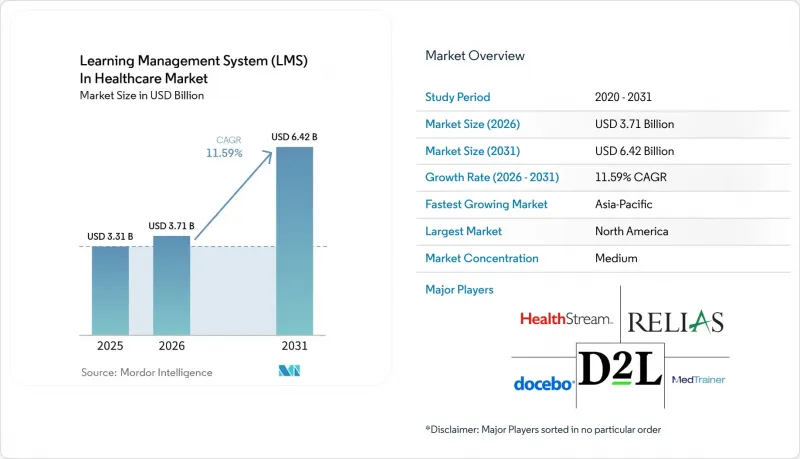
This report is Segmented by Component (Software and Services), Deployment Mode (Cloud-Based, and More), Delivery Mode (Self-Paced and Distance Learning, and More), Application (Compliance Training, Clinical and Care Training, and More), End User (Hospitals and Health Systems, and More), and Geography. The Market Forecasts are Provided in Terms of Value (USD).
Global Learning Management System (LMS) In Healthcare Market Trends and Insights
Regulatory Compliance and Accreditation Tracking
The learning management system market in healthcare continues to draw steady demand from accreditation-linked training mandates that health systems cannot defer without increasing operating risk. Documented, role-specific competency validation has become embedded in routine workforce management, turning the LMS from a convenience tool into a compliance system tied to inspections, renewals, and internal audit readiness. This matters even more in large provider networks, where policy acknowledgment, competency sign-off, and retraining records need to be searchable across facilities, units, and job categories within a single evidentiary trail. The result is a strong switching-cost effect: once reporting architecture, audit logs, and accreditation evidence are aligned on a single platform, procurement teams become more cautious about vendor changes. The learning management system in the healthcare market also benefits as continuing education requirements expand across specialties, since the number of training events that must be recorded can rise even without a corresponding increase in headcount.
Workforce Shortages and Continuous Clinical Upskilling
The learning management system in the healthcare market is also being supported by staffing shortages that are forcing providers to rely on faster, more scalable training models. The American Hospital Association projected a shortfall of 64,000 nurses by 2030 and said health care is expected to account for 24% of all new U.S. jobs this decade, meaning every new role created will increase demand for onboarding and continuing education. The American Medical Group Association reported that total clinic staffing in primary care and medical specialties declined by 5% to 7% between 2022 and 2024, even as patient visits rose 2.3% in 2024, making classroom-only delivery harder to sustain in busy clinical settings. The same pressure is visible in frontline support roles, where high turnover expands the annual cycle of onboarding-linked training, and in pharmacy operations, where the Pharmacy Technician Certification Board found employer-based training programs rose 6.3% in 2025 across its survey base of 17,112 respondents. As care teams diversify and role scopes become more specialized, the learning management system in the healthcare market benefits from the need to standardize training across jurisdictions, credentials, and care pathways without relying on additional in-person administrative staff.
Data Privacy and Cybersecurity Requirements
The learning management system in the healthcare market faces a significant brake due to the security burden imposed by systems that store staff training records, compliance evidence, and user-level identifiers. A 2026 survey published in Applied Sciences noted that U.S. health care breaches peaked in 2024 with 276 million records exposed, and that incidents in the sector averaged 279 days to identify and contain in 2025. This environment heightens buyer scrutiny of encryption, access controls, audit trails, testing procedures, and vendor documentation before contracts move forward. The cost of validating these controls can materially increase deployment expenses for smaller hospitals and federally qualified health centers, making the mid-market more price-sensitive than top-tier health systems. The learning management system market in healthcare, therefore, grows faster when vendors can centrally package security compliance and reduce the burden of local oversight for customers with limited internal cyber resources.
Other drivers and restraints analyzed in the detailed report include:
- AI-Enabled Personalized Learning and Skills Analytics
- Cloud-Based and Hybrid Training Delivery Adoption
- Integration Complexity With EHR, HRIS, And Credentialing Systems
For complete list of drivers and restraints, kindly check the Table Of Contents.
Segment Analysis
Solutions captured 70.12% of the 2025 component split, making them the largest revenue stream in the healthcare learning management system market. Buyers favored integrated platforms because they combine content libraries, workflow automation, reporting, and user management in a single interface, rather than spreading accountability across multiple tools. That setup reduces audit friction because training completion, policy acknowledgment, and competency sign-off can be reviewed through a single evidence trail. It also supports enterprise standardization, which is important for health systems that need the same training logic across hospitals, clinics, and post-acute settings.
Services are the faster-growing component, with a 12.23% CAGR projected through 2031, reflecting a clear shift in buyer behavior within the learning management system in the healthcare industry. Many customers have moved past basic platform deployment and now want outside help with implementation, regulatory updates, content maintenance, and multi-site administration. MedTrainer said it released more than 250 new healthcare-specific courses and more than 130 software enhancements during 2025, while also expanding its engineering team by 25%, demonstrating how vendors are building recurring service layers on top of the software base. As use cases broaden into skills gap analysis, AI retraining, and distributed credentialing, services become a practical way for providers to keep the learning environment current without hiring large internal LMS teams.
Cloud-based deployment held a 65.23% share in 2025 and remains the leading configuration in the healthcare learning management system market. The main reason is operational, because cloud infrastructure lets role-based assignments, content updates, and reporting changes move across all sites without local system administration at each facility. It also supports faster onboarding for new locations and newly acquired provider groups that need to fit into an existing compliance framework. For buyers with large workforces and lean IT teams, these benefits make cloud the most efficient model for maintaining training continuity at scale.
Cloud is also the fastest-growing deployment mode, with a 12.46% CAGR through 2031, while hybrid demand remains relevant in more tightly regulated environments. The European Health Data Space regulation strengthened the case for platforms that can support digital interoperability together with jurisdiction-aware governance controls. Hybrid deployment remains a key option for large academic medical centers and integrated delivery networks that want on-premises control for selected records while still leveraging cloud elasticity for content delivery and analytics. On-premises systems continue to be used in high-security or resource-constrained environments, but the learning management system market in healthcare is clearly moving toward hosted architectures that offer compliance parity with lower maintenance overhead.
Complete Report Scope:
- By Component
- Solutions
- Services
- By Deployment Mode
- Cloud-Based
- On-Premises
- Hybrid
- By Delivery Mode
- Self-Paced and Distance Learning
- Instructor-Led Training
- Blended Learning
- By Application
- Compliance Training
- Clinical and Care Training
- CME and Certification Training
- Product and Commercial Training
- Patient Safety Training
- EHR/Clinical Systems Training
- Infection Control Training
- Cybersecurity and Data Privacy Training
- Telehealth Training
- Workforce Credentialing and Competency Management
- By End User
- Hospitals and Health Systems
- Clinics and Ambulatory Care Providers
- Pharmaceutical Companies
- Medical Device Companies
- Academic Medical Institutions
- Long-Term Care Facilities
- Home Healthcare Providers
- By Geography
- North America
- United States
- Canada
- Mexico
- South America
- Brazil
- Argentina
- Chile
- Rest of South America
- Europe
- Germany
- United Kingdom
- France
- Italy
- Spain
- Russia
- Rest of Europe
- Asia-Pacific
- China
- Japan
- India
- South Korea
- Australia
- Singapore
- Rest of Asia-Pacific
- Middle East
- Saudi Arabia
- United Arab Emirates
- Rest of Middle East
- Africa
- South Africa
- Nigeria
- Rest of Africa
- North America
Geography Analysis
North America held 36.58% of the healthcare learning management system market share in 2025, making it the largest regional market. The United States remained the dominant national market because CMS participation rules, accreditation standards, and privacy obligations make documented training an operational requirement rather than an optional software upgrade. This environment supports a stable demand for platforms that can manage onboarding, competency validation, policy acknowledgment, and recurring compliance at enterprise scale. Canada also showed active institutional adoption, and the University of Toronto Temerty Faculty of Medicine selected a cloud-based learner management platform in 2025 to support MD and postgraduate education aligned with the Competence by Design framework. Mexico remains a smaller opportunity in the region, but private hospital groups are gradually formalizing workforce development and competency documentation as payer and quality expectations rise.
Europe remains an important part of the learning management system in the healthcare market because it combines dense hospital networks with expanding digital health governance. The European Health Data Space regulation, adopted in 2025, created a stronger framework for cross-border health data management, which adds training needs for staff who handle digital records, system access, and compliance processes. The United Kingdom, Germany, and France remain the main national demand centers, while Spain, Italy, and Eastern Europe are moving forward from a smaller base as record digitization and workforce governance become more structured. This keeps Europe positioned as a market where vendors need both regional data awareness and the ability to adapt training structures to varied health system models.
Asia-Pacific is the fastest-growing region in the learning management system market for healthcare, with a 13.41% CAGR projected through 2031. Growth is being driven by state-led health system expansion in China and India, by scaling private hospital networks across Southeast Asia, and by a broader recognition that workforce quality assurance requires digital training infrastructure. The World Health Organization said in 2025 that only 30% of member states have well-functioning regulatory systems at Maturity Levels 3 or 4, and it launched a learning catalog to help upskill regulatory workforces, reflecting a wider need for structured training capacity across several developing health systems. A 2026 study in Frontiers in Medicine also showed strong engagement with AI-enabled clinical learning among Chinese medical students, with 45.6% participating in sessions of 15 to 30 minutes and 63.4% preferring mobile app delivery, pointing to mobile-first design expectations across the region. Australia and Singapore remain smaller but advanced digital health markets, while South America, the Middle East, and Africa continue to present earlier-stage opportunities led by Brazil, Saudi Arabia, and the UAE.
- HealthStream, Inc.
- Relias LLC
- MedTrainer, Inc.
- Docebo S.p.A.
- D2L Corporation
- Absorb Software Inc.
- Cornerstone OnDemand, Inc.
- Epignosis LLC
- LearnUpon Limited
- iSpring Solutions, Inc.
- SkyPrep Inc.
- Kallidus Limited
- TOVUTI, Inc.
- Medbridge Inc.
- ACTO Technologies Inc.
- Knowledge Factor, Inc. dba Amplifire
- CareAcademy.co, Inc.
- The World Continuing Education Alliance Ltd
- Biomedical Research Alliance of New York LLC
- Thought Industries, Inc.
Additional Benefits:
- The market estimate (ME) sheet in Excel format
- 3 months of analyst support
TABLE OF CONTENTS
1 INTRODUCTION
- 1.1 Study Assumptions and Market Definition
- 1.2 Scope of the Study
2 RESEARCH METHODOLOGY
3 EXECUTIVE SUMMARY
4 MARKET LANDSCAPE
- 4.1 Market Overview
- 4.2 Market Drivers
- 4.2.1 Regulatory Compliance and Accreditation Tracking
- 4.2.2 Workforce Shortages and Continuous Clinical Upskilling
- 4.2.3 Cloud-Based and Hybrid Training Delivery Adoption
- 4.2.4 AI-Enabled Personalized Learning and Skills Analytics
- 4.2.5 Retraining Demand From Ambient AI and Digital Workflow Adoption
- 4.2.6 Cross-Site Auditability Needs After Cyber and Patient-Safety Incidents
- 4.3 Market Restraints
- 4.3.1 Data Privacy and Cybersecurity Requirements
- 4.3.2 Integration Complexity With EHR, HRIS, and Credentialing Systems
- 4.3.3 Content Governance Bottlenecks in Fast-Changing Clinical Protocols
- 4.3.4 Shift-Based Care Models Reduce Rich-Format Training Completion
- 4.4 Impact of Macroeconomic Factors on the Market
- 4.5 Industry Value Chain Analysis
- 4.6 Regulatory Landscape
- 4.7 Technological Outlook
- 4.8 Porter's Five Forces Analysis
- 4.8.1 Threat of New Entrants
- 4.8.2 Bargaining Power of Suppliers
- 4.8.3 Bargaining Power of Buyers
- 4.8.4 Threat of Substitutes
- 4.8.5 Intensity of Competitive Rivalry
5 MARKET SIZE AND GROWTH FORECASTS (VALUE)
- 5.1 By Component
- 5.1.1 Solutions
- 5.1.2 Services
- 5.2 By Deployment Mode
- 5.2.1 Cloud-Based
- 5.2.2 On-Premises
- 5.2.3 Hybrid
- 5.3 By Delivery Mode
- 5.3.1 Self-Paced and Distance Learning
- 5.3.2 Instructor-Led Training
- 5.3.3 Blended Learning
- 5.4 By Application
- 5.4.1 Compliance Training
- 5.4.2 Clinical and Care Training
- 5.4.3 CME and Certification Training
- 5.4.4 Product and Commercial Training
- 5.4.5 Patient Safety Training
- 5.4.6 EHR/Clinical Systems Training
- 5.4.7 Infection Control Training
- 5.4.8 Cybersecurity and Data Privacy Training
- 5.4.9 Telehealth Training
- 5.4.10 Workforce Credentialing and Competency Management
- 5.5 By End User
- 5.5.1 Hospitals and Health Systems
- 5.5.2 Clinics and Ambulatory Care Providers
- 5.5.3 Pharmaceutical Companies
- 5.5.4 Medical Device Companies
- 5.5.5 Academic Medical Institutions
- 5.5.6 Long-Term Care Facilities
- 5.5.7 Home Healthcare Providers
- 5.6 By Geography
- 5.6.1 North America
- 5.6.1.1 United States
- 5.6.1.2 Canada
- 5.6.1.3 Mexico
- 5.6.2 South America
- 5.6.2.1 Brazil
- 5.6.2.2 Argentina
- 5.6.2.3 Chile
- 5.6.2.4 Rest of South America
- 5.6.3 Europe
- 5.6.3.1 Germany
- 5.6.3.2 United Kingdom
- 5.6.3.3 France
- 5.6.3.4 Italy
- 5.6.3.5 Spain
- 5.6.3.6 Russia
- 5.6.3.7 Rest of Europe
- 5.6.4 Asia-Pacific
- 5.6.4.1 China
- 5.6.4.2 Japan
- 5.6.4.3 India
- 5.6.4.4 South Korea
- 5.6.4.5 Australia
- 5.6.4.6 Singapore
- 5.6.4.7 Rest of Asia-Pacific
- 5.6.5 Middle East
- 5.6.5.1 Saudi Arabia
- 5.6.5.2 United Arab Emirates
- 5.6.5.3 Rest of Middle East
- 5.6.6 Africa
- 5.6.6.1 South Africa
- 5.6.6.2 Nigeria
- 5.6.6.3 Rest of Africa
- 5.6.1 North America
6 COMPETITIVE LANDSCAPE
- 6.1 Market Concentration
- 6.2 Strategic Moves
- 6.3 Market Share Analysis
- 6.4 Company Profiles (includes Global Level Overview, Market Level Overview, Core Segments, Financials as available, Strategic Information, Market Rank/Share, Products and Services, Recent Developments).
- 6.4.1 HealthStream, Inc.
- 6.4.2 Relias LLC
- 6.4.3 MedTrainer, Inc.
- 6.4.4 Docebo S.p.A.
- 6.4.5 D2L Corporation
- 6.4.6 Absorb Software Inc.
- 6.4.7 Cornerstone OnDemand, Inc.
- 6.4.8 Epignosis LLC
- 6.4.9 LearnUpon Limited
- 6.4.10 iSpring Solutions, Inc.
- 6.4.11 SkyPrep Inc.
- 6.4.12 Kallidus Limited
- 6.4.13 TOVUTI, Inc.
- 6.4.14 Medbridge Inc.
- 6.4.15 ACTO Technologies Inc.
- 6.4.16 Knowledge Factor, Inc. dba Amplifire
- 6.4.17 CareAcademy.co, Inc.
- 6.4.18 The World Continuing Education Alliance Ltd
- 6.4.19 Biomedical Research Alliance of New York LLC
- 6.4.20 Thought Industries, Inc.
7 MARKET OPPORTUNITIES AND FUTURE OUTLOOK
- 7.1 White-Space and Unmet-Need Assessment

