PUBLISHER: Mordor Intelligence | PRODUCT CODE: 2073325

PUBLISHER: Mordor Intelligence | PRODUCT CODE: 2073325
Art & Craft Tools - Market Share Analysis, Industry Trends & Statistics, Growth Forecasts (2026 - 2031)
According to Mordor Intelligence, the art and craft tools market, valued at USD 3.98 billion in 2025, is projected to grow to USD 4.23 billion in 2026 and reach USD 5.96 billion by 2031, with a 7.11% CAGR from 2026 to 2031.
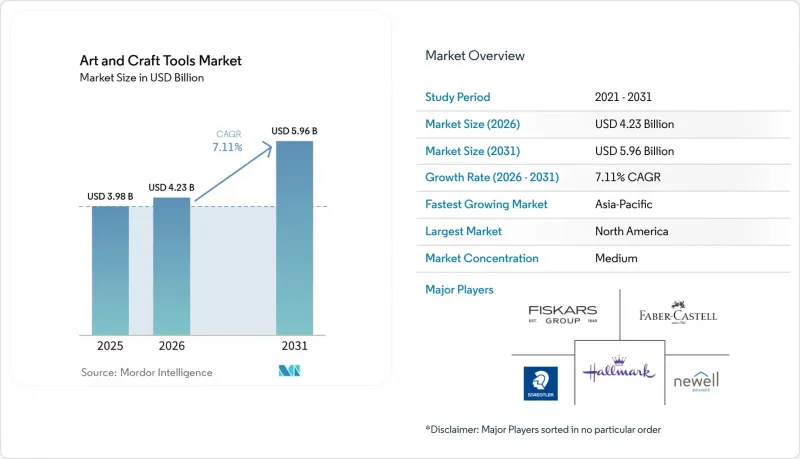
This report is Segmented by Product Type (Drawing & Painting Tools, Cutting Tools, Paper Crafts & Decorative Items, Others), Application (Household, Educational Institutions, Commercial Art Studios, Others), Material (Plastic, Wood, and More), Distribution Channel (Supermarkets & Hypermarkets, and More), and Geography (North America, Europe, and More). Market Forecasts are Provided in Terms of Value (USD).
Global Art & Craft Tools Market Trends and Insights
Rising Use of Art Therapy in Schools, Clinics, and Wellness Programs
As art therapy increasingly integrates into organized school and clinical programs, the demand for art and craft tools is solidifying. In February 2025, the Medical University of South Carolina highlighted its "Arts in Healing" initiative, providing structured art therapy to over 80 students in Florence public schools. This underscores a shift towards education-linked procurement. A systematic analysis in Frontiers in Psychology in 2025 noted a significant evolution from 2020 to 2024, emphasizing the growing intersections of art therapy with psychology, digital health, and education across various regions. With the formalization of these programs, there's a trend towards bulk procurement, standardized tool lists, and defined safety criteria. This shift positions suppliers with certified products and dependable B2B distribution channels more favorably than brands reliant on consumer impulse sales in the art and craft tools market.
Sustainability and Eco-Friendly Product Preferences
Across the art and craft tools market, sustainability is reshaping sourcing, formulation, and shelf positioning, particularly in premium and regulated channels. Faber-Castell, leveraging a direct sourcing advantage, manages over 10,000 hectares of FSC-certified forest in Brazil, ensuring a steady supply of certified pencil wood. STAEDTLER showcases the synergy of material efficiency and certification by producing select pencils from PEFC-certified upcycled wood chips, a byproduct of industrial sawing and planing. This trend is bolstered by stringent material disclosure and chemical compliance standards in Europe and the U.S. Consequently, the art and craft tools market is increasingly allocating premium shelf space to major suppliers capable of financing certification, testing, and large-scale reformulation efforts.
Competition from Digital Art Tools and Software
Digital software is increasingly replacing traditional tools in professional illustration and design. For instance, Adobe's integration of Firefly 3.0 into Photoshop and Illustrator has streamlined image creation, diminishing the reliance on premium drawing and rendering tools. However, this shift isn't felt equally across the art and craft tools market. Sectors like therapy, education, and tactile hobbies still prioritize hands-on interaction with materials. A 2025 review in Frontiers in Psychology highlighted that the benefits of art therapy are tied to this physical engagement, making direct substitution challenging. As a result, while demand may wane in professional drawing tiers, the broader market isn't facing a collapse.
Other drivers and restraints analyzed in the detailed report include:
- Expansion of E-Commerce Platforms Improving Product Accessibility
- Rising Popularity of DIY Culture and Home-Based Crafting
- Volatility in Raw Material Prices, Particularly Plastics and Wood
For complete list of drivers and restraints, kindly check the Table Of Contents.
Segment Analysis
In 2025, Drawing and Painting Tools held a 39.43% share of the art and craft tools market. This segment's dominance stems from its wide range of products, including pencils, markers, paints, brushes, and surfaces, catering to users from schoolchildren to professionals. Most beginners in creative activities start with basic drawing, coloring, or painting, highlighting this segment's importance. Its layered product structure adds value, with commodity lines driving volume and premium artist materials boosting margins. In 2025, STAEDTLER enhanced this segment by launching its Artist Series, featuring Mars Lumograph colour aquarell pencils, designed with professional artists for lightfastness and watercolor use.
From 2026 to 2031, Paper Crafts and Decorative Items are expected to grow at a 7.96% CAGR, making them the fastest-growing segment in the art and craft tools market. Their growth is driven by home decor trends, gifting seasons, and creative activities in North America and Europe. The segment's low entry barriers attract new users, while specialty papers, metallic finishes, and embossed materials encourage experienced users to upgrade. Additionally, the category thrives on social media, where its visual transformations are engaging and easy for beginners to replicate.
In 2025, households held a 45.21% share of the art and craft tools market, highlighting crafting's popularity among families, hobbyists, and adults seeking leisure activities. This significant segment supports the market and includes children's value packs and premium adult kits. Purchases are influenced by seasonality, trends, gifting, and crafting's role as a calming home activity. To target this adult audience, Crayola launched its "All Grown Up" line in June 2026, featuring alcohol-based markers and artist-designed coloring books.
Commercial Art Studios are projected to grow at a CAGR of 8.01% from 2026 to 2031, making them the fastest-growing segment in the art and craft tools market. This category includes craft class venues, creative studios, and experience-focused retail formats, which purchase tools more frequently and at higher quality than households. Educational institutions also drive demand as art-based experiential learning grows. In March 2026, Crayola announced a partnership with Luxor Writing Instruments to improve access to experiential learning for India's 436 million children across 1.5 million schools. This shift shows the industry increasingly serves organized educational budgets alongside household spending.
Complete Report Scope:
- By Product Type
- Drawing and Painting Tools
- Drawing Tools
- Pencils
- Pens and Markers
- Erasers
- Others
- Painting Tools
- Brushes
- Paints
- Painting Surfaces
- Others
- Cutting Tools
- Scissors
- Knives and Blades
- Punching and Shaping Tools
- Others
- Paper Crafts and Decorative Items
- Others
- Drawing and Painting Tools
- By Application
- Household
- Educational Institutions
- Commercial Art Studios
- Others
- By Material
- Plastic
- Wood
- Metal
- Composite Materials
- By Distribution Channel
- Supermarkets and Hypermarkets
- Specialty Stores
- Online Stores
- Convenience Stores
- Other Distribution Channels
- By Geography
- North America
- United States
- Canada
- Mexico
- Rest of North America
- Europe
- Germany
- United Kingdom
- Italy
- France
- Spain
- Netherlands
- Poland
- Belgium
- Sweden
- Rest of Europe
- Asia-Pacific
- China
- India
- Japan
- Australia
- Indonesia
- South Korea
- Thailand
- Singapore
- Rest of Asia-Pacific
- South America
- Brazil
- Argentina
- Colombia
- Chile
- Peru
- Rest of South America
- Middle East and Africa
- South Africa
- Saudi Arabia
- United Arab Emirates
- Nigeria
- Egypt
- Morocco
- Turkey
- Rest of Middle East and Africa
- North America
Geography Analysis
In 2025, North America commanded a dominant 42.33% share of the art and craft tools market. This region's stronghold is bolstered by widespread household engagement in crafting, a well-established network of specialty retailers, and organized procurement efforts by schools and wellness programs. Notably, the U.S. market showcases robust demand spanning children's activity products, adult recreational tools, and studio-led creative endeavors. However, despite this healthy demand, the region grapples with input cost pressures stemming from 2025 trade measures impacting imported materials across the board.
Europe stands as the second major player in the art and craft tools arena, buoyed by a rich tradition in arts education and a robust base of established manufacturers. Here, regulatory standards emphasizing material safety and chemical compliance play a pivotal role, influencing market access. Such regulations inherently favor suppliers like Faber-Castell, STAEDTLER, Fiskars, and BIC, who not only adhere to these compliance systems but also enjoy established brand trust. While South America and the Middle East & Africa currently occupy smaller market shares, both regions present significant growth potential, driven by burgeoning youth populations, increased education spending, and an expanding distribution network.
Asia-Pacific is on track to achieve a 9.11% CAGR through 2031, positioning it as the fastest-growing region in the art and craft tools market. This growth trajectory is underpinned by an expanding middle class, broader product accessibility, and school-driven policy demands. A testament to this potential is Crayola's March 2026 collaboration with Luxor Writing Instruments, aimed at producing and distributing co-branded products tailored for India's 436 million children. This partnership, further emphasizing experiential learning across 1.5 million schools, transcends a mere distribution agreement. While China continues to be a pivotal manufacturing hub for mid-market products, it's also evolving into a discerning consumer market for premium tools. Both international and regional brands are carving a niche among adult hobbyists and art students. Suppliers adept at balancing affordability, quality, and localized distribution stand poised to reap the most significant rewards in this growth phase.
- Hallmark Cards, Inc. (Crayola)
- Newell Brands Inc.
- Fiskars Group
- Faber-Castell AG
- STAEDTLER Mars GmbH and Co. KG
- Kokuyo Camlin Ltd.
- Societe BIC S.A.
- Pentel Co., Ltd.
- PILOT Corporation
- Shanghai MandG Stationery Inc.
- ACCO Brands Corporation
- Michaels Stores, Inc.
- Pelikan International Corporation Berhad
- Westcott (Acme United Corporation)
- Sakura Color Products Corporation
- General Pencil Co., Inc.
- Jo-Ann Stores, LLC
- FILA Group LLC
- Plaid Enterprises Inc.
- Arteza LLC
Additional Benefits:
- The market estimate (ME) sheet in Excel format
- 3 months of analyst support
TABLE OF CONTENTS
1 INTRODUCTION
- 1.1 Study Assumptions and Market Definition
- 1.2 Scope of the Study
2 RESEARCH METHODOLOGY
3 EXECUTIVE SUMMARY
4 MARKET LANDSCAPE
- 4.1 Market Overview
- 4.2 Market Drivers
- 4.2.1 Rising use of art therapy in schools, clinics, and wellness programs
- 4.2.2 Sustainability and eco-friendly product preferences
- 4.2.3 Expansion of e-commerce platforms improving product accessibility
- 4.2.4 Rising popularity of DIY culture and home-based crafting
- 4.2.5 Innovation in ergonomics, safety, and material quality
- 4.2.6 Social media platforms amplifying creative trends and tutorials
- 4.3 Market Restraints
- 4.3.1 Competition from digital art tools and software
- 4.3.2 Regulatory and safety standards shaping viability and access
- 4.3.3 Environmental concerns related to manufacturing and disposal
- 4.3.4 Volatility in raw material prices, particularly plastics and wood
- 4.4 Value Chain Analysis
- 4.5 Regulatory Landscape
- 4.6 Technological Outlook
- 4.7 Porter's Five Forces
- 4.7.1 Bargaining Power of Suppliers
- 4.7.2 Bargaining Power of Buyers
- 4.7.3 Threat of New Entrants
- 4.7.4 Threat of Substitutes
- 4.7.5 Competitive Rivalry
5 MARKET SIZE AND GROWTH FORECASTS (VALUE)
- 5.1 By Product Type
- 5.1.1 Drawing and Painting Tools
- 5.1.1.1 Drawing Tools
- 5.1.1.2 Pencils
- 5.1.1.3 Pens and Markers
- 5.1.1.4 Erasers
- 5.1.1.5 Others
- 5.1.1.6 Painting Tools
- 5.1.1.7 Brushes
- 5.1.1.8 Paints
- 5.1.1.9 Painting Surfaces
- 5.1.1.10 Others
- 5.1.2 Cutting Tools
- 5.1.2.1 Scissors
- 5.1.2.2 Knives and Blades
- 5.1.2.3 Punching and Shaping Tools
- 5.1.2.4 Others
- 5.1.3 Paper Crafts and Decorative Items
- 5.1.4 Others
- 5.1.1 Drawing and Painting Tools
- 5.2 By Application
- 5.2.1 Household
- 5.2.2 Educational Institutions
- 5.2.3 Commercial Art Studios
- 5.2.4 Others
- 5.3 By Material
- 5.3.1 Plastic
- 5.3.2 Wood
- 5.3.3 Metal
- 5.3.4 Composite Materials
- 5.4 By Distribution Channel
- 5.4.1 Supermarkets and Hypermarkets
- 5.4.2 Specialty Stores
- 5.4.3 Online Stores
- 5.4.4 Convenience Stores
- 5.4.5 Other Distribution Channels
- 5.5 By Geography
- 5.5.1 North America
- 5.5.1.1 United States
- 5.5.1.2 Canada
- 5.5.1.3 Mexico
- 5.5.1.4 Rest of North America
- 5.5.2 Europe
- 5.5.2.1 Germany
- 5.5.2.2 United Kingdom
- 5.5.2.3 Italy
- 5.5.2.4 France
- 5.5.2.5 Spain
- 5.5.2.6 Netherlands
- 5.5.2.7 Poland
- 5.5.2.8 Belgium
- 5.5.2.9 Sweden
- 5.5.2.10 Rest of Europe
- 5.5.3 Asia-Pacific
- 5.5.3.1 China
- 5.5.3.2 India
- 5.5.3.3 Japan
- 5.5.3.4 Australia
- 5.5.3.5 Indonesia
- 5.5.3.6 South Korea
- 5.5.3.7 Thailand
- 5.5.3.8 Singapore
- 5.5.3.9 Rest of Asia-Pacific
- 5.5.4 South America
- 5.5.4.1 Brazil
- 5.5.4.2 Argentina
- 5.5.4.3 Colombia
- 5.5.4.4 Chile
- 5.5.4.5 Peru
- 5.5.4.6 Rest of South America
- 5.5.5 Middle East and Africa
- 5.5.5.1 South Africa
- 5.5.5.2 Saudi Arabia
- 5.5.5.3 United Arab Emirates
- 5.5.5.4 Nigeria
- 5.5.5.5 Egypt
- 5.5.5.6 Morocco
- 5.5.5.7 Turkey
- 5.5.5.8 Rest of Middle East and Africa
- 5.5.1 North America
6 COMPETITIVE LANDSCAPE
- 6.1 Market Concentration
- 6.2 Strategic Moves
- 6.3 Market Share Analysis
- 6.4 Company Profiles (includes Global level Overview, Market level overview, Core Segments, Financials (if available), Strategic Information, Products, Recent Developments)
- 6.4.1 Hallmark Cards, Inc. (Crayola)
- 6.4.2 Newell Brands Inc.
- 6.4.3 Fiskars Group
- 6.4.4 Faber-Castell AG
- 6.4.5 STAEDTLER Mars GmbH and Co. KG
- 6.4.6 Kokuyo Camlin Ltd.
- 6.4.7 Societe BIC S.A.
- 6.4.8 Pentel Co., Ltd.
- 6.4.9 PILOT Corporation
- 6.4.10 Shanghai MandG Stationery Inc.
- 6.4.11 ACCO Brands Corporation
- 6.4.12 Michaels Stores, Inc.
- 6.4.13 Pelikan International Corporation Berhad
- 6.4.14 Westcott (Acme United Corporation)
- 6.4.15 Sakura Color Products Corporation
- 6.4.16 General Pencil Co., Inc.
- 6.4.17 Jo-Ann Stores, LLC
- 6.4.18 FILA Group LLC
- 6.4.19 Plaid Enterprises Inc.
- 6.4.20 Arteza LLC
7 MARKET OPPORTUNITIES AND FUTURE OUTLOOK

