PUBLISHER: Mordor Intelligence | PRODUCT CODE: 2073336

PUBLISHER: Mordor Intelligence | PRODUCT CODE: 2073336
Herbal Tea - Market Share Analysis, Industry Trends & Statistics, Growth Forecasts (2026 - 2031)
According to Mordor Intelligence, the herbal tea market size is expected to increase from USD 5.72 billion in 2025 to USD 5.98 billion in 2026 and reach USD 8.07 billion by 2031, growing at a CAGR of 6.2% over 2026-2031.
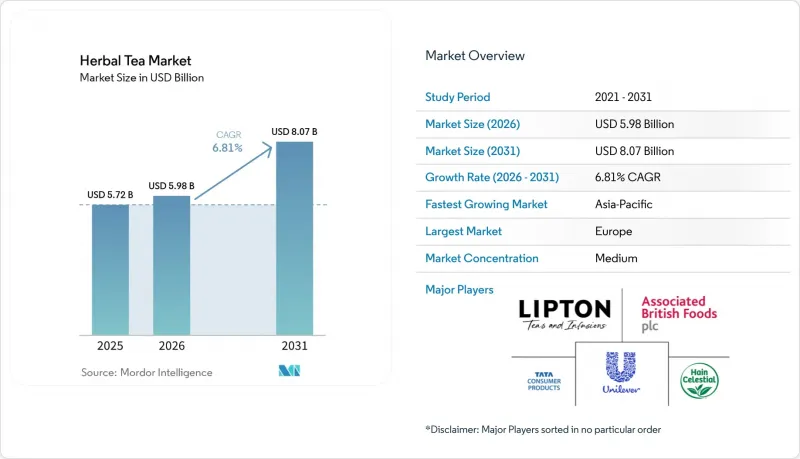
This report is Segmented by Product Type (Chamomile Tea, Peppermint Tea, Ginger Tea, Hibiscus Tea, Turmeric Tea, Rooibos Tea, and Other Herbal Teas), Category (Conventional and Organic), Distribution Channel (Foodservice and Retail), and Geography (North America, Europe, Asia-Pacific, South America, and Middle East and Africa). The Market Forecasts are Provided in Terms of Value (USD).
Global Herbal Tea Market Trends and Insights
Rising demand for caffeine-free wellness beverages
Driven by a focus on sleep disruption, stress management, and digestive health, consumers are increasingly turning to herbal teas. This shift has led to a demand profile that prioritizes outcomes over price, distinguishing it from traditional tea categories. The World Tea News 2025 State of the Tea Industry Survey revealed that 26.3% of industry respondents pinpointed consumer health and wellness interests as the top influencer on tea sales, marking it as the study's leading driver. This evolving consumer behavior has notable distribution implications: those seeking herbal teas for wellness are more inclined to experiment with premium and specialty variants, reducing the price sensitivity that often limits mass-market growth. Brands tailoring their product formulations to address specific needs, be it sleep, immunity, or digestion, are witnessing significantly higher repeat purchase rates compared to those offering generic herbal blends. In its November 2025 expansion into the herbal category, Lipton Teas and Infusions highlighted that formulations like mint for digestion and chamomile for relaxation outperformed generic blends in consumer panel tests.
Growth of clean-label and organic tea purchasing
Certified organic herbal teas are witnessing a surge in demand, outpacing the broader beverage category. Projections indicate that from 2026 to 2031, organic herbal tea will grow at an 8.11% CAGR, marking a premium of roughly 2 percentage points over the overall market rate. The Organic Trade Association's 2026 Market Report highlighted that U.S. organic beverage sales hit USD 10.2 billion in 2025, boasting a growth rate of 7.2%, more than thrice that of the total beverage market. Data from Oekolandbau revealed that in 2024, organic tea's share of Germany's total tea volume climbed by 2.2 percentage points to 17.7%. This is notable when juxtaposed with the overall German organic food market's share of a mere 6.5%. Such a trend, where tea consumers lean more towards organic purchases than the general food market, underscores a structural pricing advantage for producers of certified-organic herbal teas. For brands aiming at the premium tier in European and North American retail channels, adhering to the EU Organic Regulation 2018/848 and obtaining the USDA National Organic Program (NOP) certification are essential baseline requirements.
Seasonal herb supply volatility
The herbal tea industry grapples with procurement risks tied to its reliance on geographically concentrated agricultural sources. This dependence not only jeopardizes margin stability but also threatens product availability. Chamomile, commanding a dominant 32.71% share in 2025, predominantly hails from Egypt and Argentina. The U.S., with an import reliance of 85-95%, finds its manufacturers vulnerable to crop yield fluctuations. These fluctuations are often driven by temperature spikes, droughts, and unpredictable rainfall during crucial harvest windows. Meanwhile, ginger, the industry's fastest-growing segment, is set to witness a CAGR of 7.46% from 2026 to 2031. Yet, it too contends with supply disruptions. For instance, the 2025 ginger season in Peru wrapped up ahead of schedule, tightening global supplies just as demand surged. This scenario allowed China and Thailand to capitalize on the constrained market. Furthermore, the herbal botanical supply chain grapples with quality adulteration challenges. Under procurement pressures, the risk of adulteration escalates, leading to verification costs. These costs pose a significant burden for smaller brands. In contrast, producers boasting vertically integrated sourcing or long-term agricultural contracts are fortifying their supply chain resilience, turning it into a competitive advantage. However, asset-light brands find themselves navigating challenges related to margins and product availability.
Other drivers and restraints analyzed in the detailed report include:
- Premiumization through functional botanical blends
- Shift away from sugary and carbonated drinks
- Tight regulatory scrutiny on botanical health claims
For complete list of drivers and restraints, kindly check the Table Of Contents.
Segment Analysis
In 2025, chamomile tea led the herbal tea market with a 32.71% share, solidifying its role as the category's cornerstone. Widely recognized, chamomile tea has consistent consumer demand for relaxation and sleep-support benefits across mass retail and specialty outlets. Ginger tea is the fastest-growing product, with a projected 7.46% CAGR from 2026 to 2031, driven by clinical recognition of its digestive and nausea relief benefits, along with its appeal in ready-to-drink (RTD) and foodservice menus. Peppermint tea, a digestion-focused staple, is particularly strong in Europe. The Deutscher Tee and Krautertee Verband's Tea Report 2025 highlighted peppermint and mint blends as the top single-variety herbal category in Germany, holding a 7.5% volume share. Hibiscus tea is gaining popularity in iced and RTD formats for its antioxidants and visual appeal, while rooibos maintains a niche but loyal consumer base in Europe, where its South African origin adds brand value. Turmeric tea, combining anti-inflammatory wellness and Ayurvedic heritage, is set for rapid growth as its benefits gain mainstream recognition.
The "Other Herbal Teas" segment, including blends with adaptogens, mushrooms, and multi-botanical formulations, drives innovation in the category. Teapigs' May 2026 launch of four new herbal blends on Amazon, including its first Reishi mushroom-infused tea, highlights the category's expansion. This growth is expected to accelerate as functional food-as-medicine gains consumer acceptance. Cross-category blends, such as ginger with turmeric, chamomile with lavender, and hibiscus with rosehip, enhance perceived value and support premium pricing. Contract manufacturers are fueling this innovation. For example, Caraway Tea Company's April 2026 entry into adaptogen and mushroom-based blends reflects rising demand for scientifically curated multi-botanical formulations.
Complete Report Scope:
- Product Type
- Chamomile Tea
- Peppermint Tea
- Ginger Tea
- Hibiscus Tea
- Turmeric Tea
- Rooibos Tea
- Other Herbal Teas
- Category
- Conventional
- Organic
- Distribution Channel
- Foodservice
- Retail
- Supermarkets/Hypermarkets
- Convenience Stores
- Specialty Stores
- Online Retail Stores
- Other Distribution Channels
- Geography
- North America
- United States
- Canada
- Mexico
- Rest of North America
- Europe
- United Kingdom
- Germany
- France
- Italy
- Spain
- Sweden
- Belgium
- Poland
- Netherlands
- Rest of Europe
- Asia-Pacific
- China
- Japan
- India
- Thailand
- Singapore
- Indonesia
- South Korea
- Australia
- Rest of Asia-Pacific
- South America
- Brazil
- Argentina
- Colombia
- Peru
- Chile
- Rest of South America
- Middle East and Africa
- United Arab Emirates
- South Africa
- Saudi Arabia
- Nigeria
- Egypt
- Morocco
- Turkey
- Rest of Middle East and Africa
- North America
Geography Analysis
In 2025, Europe is set to command a 36.40% share of the global herbal tea market, with Germany, the UK, France, and the Netherlands leading the charge. In these nations, herbal infusions are deeply embedded in the culture as daily wellness rituals. Germany stands out: in 2024, the country consumed 39,398 tonnes of herbal and fruit infusions, accounting for 67.7% of Germany's total tea market, surpassing the global average, as highlighted in the Tea Report 2025 by Deutscher Tee and Krautertee Verband. In 2025, Germany's organic food and beverage market hit EUR 18.23 billion (~USD 19.7 billion), marking a 6.7% growth. Organic tea's growth outpaced overall organic food penetration, according to Oekolandbau.de. The UK market is shaped by Twinings and Pukka Herbs, leading in mass and premium channels. Eastern European nations like Poland and Sweden present expansion opportunities for mid-tier brands. Sweden's specialty tea shop culture and Belgium's premium food retail scene remain largely untapped. The German Tea Report 2025 noted that in 2024, innovative herbal and fruit tea blends and cold brew formats emerged as top performers, reflecting a shift in consumer preferences towards novel formats over traditional loose-leaf and tea bags.
North America, with the U.S. at the helm, is a market of strategic importance. Health-conscious consumers aged 25-45 are driving the growth of specialty and organic herbal teas. The OTA's 2026 Organic Market Report revealed that U.S. organic beverage sales grew by 7.2% in 2025, reaching USD 10.2 billion. Herbal tea benefited from the prevailing "food as medicine" trend. Canada showcases strong engagement with premium herbal wellness brands. Traditional Medicinals, a leading organic tea company in Canada, launched its Organic Stress Soother Tension Relief Tea in January 2026, underscoring the country's priority status. Mexico and other parts of North America are in the early stages of adoption, with growth driven by modern retail formats and rising health awareness among urban middle-class consumers.
Asia-Pacific is on a rapid ascent, projected to grow at a 7.98% CAGR from 2026 to 2031. China leads the region, where age-old herbal medicine practices meet a modern pivot: consumers increasingly favor sugar-free RTD teas over sugary carbonated drinks. This shift is evident in the 2025 observation of the Chinese beverage market's move towards sugar-free teas, functional drinks, and premium bottled water. India is also witnessing rapid growth. VAHDAM India reported a 31% year-on-year revenue growth in FY26, reaching INR 350 crore (~USD 42 million), underscoring the potential of premium herbal and botanical teas rooted in Ayurvedic traditions. Japan, South Korea, Thailand, and Indonesia each have unique demand profiles shaped by local herbal customs, with RTD formats gaining traction in convenience and modern trade channels. South America, the Middle East, and Africa are emerging players. Brazil's growing urban middle class and the Gulf Cooperation Council's premium food retail segment, aligned with wellness trends, stand out as prime targets for brands with the right distribution channels.
- Associated British Foods plc
- Apeejay Surrendra Group
- Bigelow Tea Company
- Celestial Seasonings
- Dilmah Ceylon Tea Company PLC
- The Hain Celestial Group, Inc.
- Harney and Sons Fine Teas
- LIPTON Teas and Infusions
- Mountain Rose Herbs, Inc.
- Numi, Inc.
- Organic India Pvt. Ltd.
- Pukka Herbs Limited
- R. Twining and Company Limited
- Rishi Tea and Botanicals
- Tata Consumer Products Limited
- Traditional Medicinals, Inc.
- Unilever PLC
- VAHDAM India Private Limited
- Yogi Tea
- Twinings North America, Inc.
Additional Benefits:
- The market estimate (ME) sheet in Excel format
- 3 months of analyst support
TABLE OF CONTENTS
1 INTRODUCTION
- 1.1 Study Assumptions and Market Definition
- 1.2 Scope of the Study
2 RESEARCH METHODOLOGY
3 EXECUTIVE SUMMARY
4 MARKET LANDSCAPE
- 4.1 Market Overview
- 4.2 Market Drivers
- 4.2.1 Rising Demand For Caffeine-Free Wellness Beverages
- 4.2.2 Growth Of Clean-Label and Organic Tea Purchasing
- 4.2.3 Expanding E-Commerce and Direct-to-Consumer Distribution
- 4.2.4 Premiumization Through Functional Botanical Blends
- 4.2.5 Shift Away from Sugary and Carbonated Drinks
- 4.2.6 RTD and Convenience Format Innovation
- 4.3 Market Restraints
- 4.3.1 Seasonal Herb Supply Volatility
- 4.3.2 Competition from Other Functional Beverages
- 4.3.3 Tight Regulatory Scrutiny On Botanical Health Claims
- 4.3.4 Quality Inconsistency in Multi-Origin Herbal Inputs
- 4.4 Value Chain Analysis
- 4.5 Regulatory Landscape
- 4.6 Technological Outlook
- 4.7 Porter's Five Forces
- 4.7.1 Threat of New Entrants
- 4.7.2 Bargaining Power of Buyers
- 4.7.3 Bargaining Power of Suppliers
- 4.7.4 Threat of Substitutes
- 4.7.5 Intensity of Competitive Rivalry
5 MARKET SIZE AND GROWTH FORECASTS (VALUE)
- 5.1 Product Type
- 5.1.1 Chamomile Tea
- 5.1.2 Peppermint Tea
- 5.1.3 Ginger Tea
- 5.1.4 Hibiscus Tea
- 5.1.5 Turmeric Tea
- 5.1.6 Rooibos Tea
- 5.1.7 Other Herbal Teas
- 5.2 Category
- 5.2.1 Conventional
- 5.2.2 Organic
- 5.3 Distribution Channel
- 5.3.1 Foodservice
- 5.3.2 Retail
- 5.3.2.1 Supermarkets/Hypermarkets
- 5.3.2.2 Convenience Stores
- 5.3.2.3 Specialty Stores
- 5.3.2.4 Online Retail Stores
- 5.3.2.5 Other Distribution Channels
- 5.4 Geography
- 5.4.1 North America
- 5.4.1.1 United States
- 5.4.1.2 Canada
- 5.4.1.3 Mexico
- 5.4.1.4 Rest of North America
- 5.4.2 Europe
- 5.4.2.1 United Kingdom
- 5.4.2.2 Germany
- 5.4.2.3 France
- 5.4.2.4 Italy
- 5.4.2.5 Spain
- 5.4.2.6 Sweden
- 5.4.2.7 Belgium
- 5.4.2.8 Poland
- 5.4.2.9 Netherlands
- 5.4.2.10 Rest of Europe
- 5.4.3 Asia-Pacific
- 5.4.3.1 China
- 5.4.3.2 Japan
- 5.4.3.3 India
- 5.4.3.4 Thailand
- 5.4.3.5 Singapore
- 5.4.3.6 Indonesia
- 5.4.3.7 South Korea
- 5.4.3.8 Australia
- 5.4.3.9 Rest of Asia-Pacific
- 5.4.4 South America
- 5.4.4.1 Brazil
- 5.4.4.2 Argentina
- 5.4.4.3 Colombia
- 5.4.4.4 Peru
- 5.4.4.5 Chile
- 5.4.4.6 Rest of South America
- 5.4.5 Middle East and Africa
- 5.4.5.1 United Arab Emirates
- 5.4.5.2 South Africa
- 5.4.5.3 Saudi Arabia
- 5.4.5.4 Nigeria
- 5.4.5.5 Egypt
- 5.4.5.6 Morocco
- 5.4.5.7 Turkey
- 5.4.5.8 Rest of Middle East and Africa
- 5.4.1 North America
6 COMPETITIVE LANDSCAPE
- 6.1 Market Concentration
- 6.2 Strategic Moves
- 6.3 Market Ranking Analysis
- 6.4 Company Profiles
- 6.4.1 Associated British Foods plc
- 6.4.2 Apeejay Surrendra Group
- 6.4.3 Bigelow Tea Company
- 6.4.4 Celestial Seasonings
- 6.4.5 Dilmah Ceylon Tea Company PLC
- 6.4.6 The Hain Celestial Group, Inc.
- 6.4.7 Harney and Sons Fine Teas
- 6.4.8 LIPTON Teas and Infusions
- 6.4.9 Mountain Rose Herbs, Inc.
- 6.4.10 Numi, Inc.
- 6.4.11 Organic India Pvt. Ltd.
- 6.4.12 Pukka Herbs Limited
- 6.4.13 R. Twining and Company Limited
- 6.4.14 Rishi Tea and Botanicals
- 6.4.15 Tata Consumer Products Limited
- 6.4.16 Traditional Medicinals, Inc.
- 6.4.17 Unilever PLC
- 6.4.18 VAHDAM India Private Limited
- 6.4.19 Yogi Tea
- 6.4.20 Twinings North America, Inc.
7 MARKET OPPORTUNITIES AND FUTURE OUTLOOK

