PUBLISHER: Mordor Intelligence | PRODUCT CODE: 2073341

PUBLISHER: Mordor Intelligence | PRODUCT CODE: 2073341
North America Luxury Apparel - Market Share Analysis, Industry Trends & Statistics, Growth Forecasts (2026 - 2031)
According to Mordor Intelligence, the north america luxury apparel market size is projected to expand from USD 38.52 billion in 2025 and USD 39.98 billion in 2026 to USD 51.63 billion by 2031, registering a CAGR of 5.3% between 2026 and 2031.
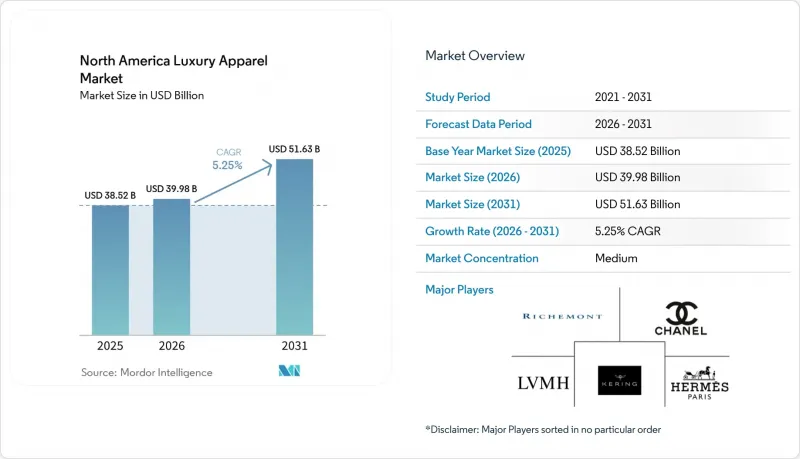
This report is Segmented by Product Type (Trousers, Jeans, T-Shirts/Shirts, Jackets/Sweatshirts/Hoodies, and More), End Purpose (Athleisure and Fashion and Casual), End User (Men, Women, and Kids/Children), Distribution Channel (Specialty Stores, Online Retail, and Other), and Geography (United States, Canada, Mexico, Rest of North America). The Market Forecasts are Provided in Terms of Value (USD).
North America Luxury Apparel Market Trends and Insights
Ultra-high-net-worth consumers anchoring market resilience
In 2024-2025, while global luxury faced spending pullbacks, the North American luxury apparel market found stability, thanks to the ultra-high-net-worth (UHNW) consumer segment. In Q1 2026, Hermes' Americas division boasted a +17.2% growth in constant currencies. Demand was "balanced across all metiers" in the U.S., Canada, and South America, highlighting a resilience not seen in the broader market, thanks to the unwavering engagement of top-tier consumers. Brunello Cucinelli reported a 20.3% revenue surge in constant currencies for Q1 2026, with the strongest demand for its premium-priced items. This trend suggests that for this elite group, higher prices are seen as a feature, not a deterrent. Notably, a surge in wealth from the tech sector, especially the AI boom in U.S. coastal cities, is birthing a new wave of UHNW buyers. These individuals view luxury apparel not just as a display of wealth, but as a distinct cultural marker. J.P. Morgan highlighted in September 2025 that the robust performance of equity markets and resultant wealth creation were pivotal in bolstering North American luxury spending. As brands adjust their Very Important Client (VIC) programs to tap into this influx of tech-driven wealth, the trend of luxury spending becoming increasingly concentrated among the highest income brackets is poised to amplify through 2031.
Luxury e-commerce and omnichannel expansion reshaping distribution
In 2024, online luxury sales in North America experienced a significant surge, with a notable majority of Americans turning to the internet for their premium goods purchases. This shift has redefined the approach for premium clothing brands, elevating digital platforms from a mere supplementary channel to a primary avenue for customer acquisition. However, there's a growing nuance: as luxury brands seek tighter control over their brand experience, traditional pure-digital strategies are beginning to wane in effectiveness. LuxExperience, the parent company of Mytheresa, NET-A-PORTER, and MR PORTER, reported a commendable 9% net sales growth for the entirety of FY2025. Their Adjusted EBITDA saw an impressive 73% uptick, a testament to their strategy of focusing marketing efforts on high-value clientele instead of broadening their aspirational customer base. Ralph Lauren witnessed a 21% surge in its North American digital commerce for Q4 FY2026. Additionally, in 2025, a striking 77% of REVOLVE's customer orders were made via mobile devices. The crux of the emerging strategy lies in striking a balance: while brands aim for digital expansion, they must also uphold the exclusivity that luxury embodies. A misstep, such as diluting curated digital experiences with discounting tactics, could jeopardize their in-store pricing integrity. According to BCG's insights, the future competitive edge may well lie in AI-driven client advisors, adept at mirroring the premium in-store service, but in a digital realm.
Counterfeit proliferation eroding brand equity and consumer trust
Counterfeit apparel and accessories pose a significant threat to the North American luxury apparel market, undermining brand equity and diverting consumer spending away from legitimate channels. In FY2025, U.S. Customs and Border Protection seized nearly 79 million counterfeit items, with a potential street value exceeding USD 7.3 billion, and clothing ranked among the top categories, as reported by UPI. A 2025 OECD report highlighted that the global counterfeit trade is valued at approximately USD 467 billion annually, accounting for over 2% of worldwide imports. A notable shift occurred in August 2025, when the U.S. closed its de minimis loophole, a move that previously let shipments valued under USD 800 slip past customs scrutiny. This change is expected to boost interdiction rates but may also drive counterfeiters to adopt more sophisticated distribution methods. According to BCG's 2025 consumer survey, 70% of luxury buyers prioritize Digital Product Passport authentication, indicating that brands embracing blockchain traceability and QR-code authentication could leverage this concern, setting themselves apart from unverified rivals. Consequently, this trend creates a cycle of compliance and technology investments, favoring larger, well-capitalized brands over their emerging or mid-market counterparts.
Other drivers and restraints analyzed in the detailed report include:
- Growing preference for casualization blurring the luxury-sportswear boundary
- Rise of customization and personalization as a conversion lever
- Inventory risk from short fashion-trend cycles straining operational models
For complete list of drivers and restraints, kindly check the Table Of Contents.
Segment Analysis
In 2025, T-Shirts and Shirts captured 45.71% of North America's luxury apparel market, solidifying their role as the leading symbols of luxury's casualization. This dominance isn't merely about volume or pricing; it's indicative of a broader shift in values. Affluent consumers, spanning various age groups, are increasingly channeling their luxury apparel budgets towards elevated basics. They're opting for premium cottons, exclusive prints, and capsule-collection tees from renowned houses like Loro Piana and Brunello Cucinelli, moving away from traditional, occasion-driven formal attire. Jackets, Sweatshirts, and Hoodies are set to be the fastest-growing product type through 2031, with a projected 6.96% CAGR. Brands like Moncler are at the forefront, leveraging the performance-luxury nexus. Their technically advanced outerwear is being marketed as long-term wardrobe investments, not just seasonal buys, evident from Moncler's 7% growth in the Americas segment in Q1 2026.
Mid-tier in the product hierarchy are Trousers, Jeans, Shorts, Skirts, Innerwear, and Dresses and Gowns, each appealing to distinct consumer segments. While Jeans are often viewed as a mass-market commodity, in the luxury realm, limited-edition denim from heritage houses commands premium prices between USD 500 and 2,000+, primarily sold through exclusive boutique channels. Dresses and Gowns, though challenged by the trend towards casualization, still hold significance for occasion-wear and among older affluent buyers. Burberry's move to assert dominance in Outerwear and Scarves, both witnessing double-digit growth in H2 FY2026, underscores the potential of a targeted product strategy within the expansive apparel category, even in a stabilizing market. Additionally, compliance mandates, like the PFAS bans in New York and California set for January 2025, are reshaping product designs, necessitating changes in technical fabric treatments for Jackets and Innerwear.
The Fashion and Casual segment accounted for the largest share of the North America luxury apparel market in 2025, driven by consumers' preference for versatile, everyday luxury clothing that balances style, comfort, and brand prestige. The continued relaxation of workplace dress codes and growing demand for premium casualwear have strengthened sales of luxury shirts, knitwear, outerwear, and denim. Reflecting this trend, Burberry reported double-digit growth in its Outerwear and Scarves categories in FY2026, while luxury brands such as Gucci and Louis Vuitton expanded casual ready-to-wear collections during 2025-2026. According to the National Retail Federation (NRF), consumers increasingly prioritize apparel suitable for multiple occasions, supporting sustained demand for fashion-oriented luxury casualwear.
Athleisure is projected to be the fastest-growing segment, registering a 7.01% CAGR between 2026 and 2031, fueled by the convergence of luxury fashion, wellness, and active lifestyles. Consumers increasingly seek premium apparel that offers both performance functionality and luxury aesthetics, encouraging brands to introduce elevated sportswear collections. Industry organizations such as the Sports & Fitness Industry Association (SFIA) continue to report strong participation in fitness and recreational activities across North America, supporting demand for premium activewear. During 2025 and 2026, luxury houses including Dior, Louis Vuitton, and Prada expanded luxury sneakers, performance-inspired apparel, and athleisure-focused collections, reflecting the growing appeal of high-end activewear among affluent consumers.
Complete Report Scope:
- Product Type
- Trousers
- Jeans
- T-Shirts and Shirts
- Shorts and Skirts
- Jackets, Sweatshirts and Hoodies
- Innerwear
- Dresses and Gowns
- Other Product Types
- End Purpose
- Athleisure
- Fashion and Casual
- End User
- Men
- Women
- Kids/Children
- Distribution Channel
- Specialty Stores
- Online Retail Stores
- Other Distribution Channels
- Geography
- United States
- Canada
- Mexico
- Rest of North America
List of Companies Covered in this Report:
- LVMH Moet Hennessy Louis Vuitton SE
- Kering SA
- Hermes International S.A.
- Chanel S.A.
- Compagnie Financiere Richemont SA
- Prada S.p.A.
- Burberry Group plc
- Ralph Lauren Corporation
- Tapestry, Inc.
- Capri Holdings Limited
- Giorgio Armani S.p.A.
- Moncler S.p.A.
- Salvatore Ferragamo S.p.A.
- Dolce and Gabbana S.r.l.
- Valentino S.p.A.
- Brunello Cucinelli S.p.A.
- Fendi
- Versace
- Christian Dior SE
- Michael Kors Holdings Limited
Additional Benefits:
- The market estimate (ME) sheet in Excel format
- 3 months of analyst support
TABLE OF CONTENTS
1 INTRODUCTION
- 1.1 Study Assumptions and Market Definition
- 1.2 Scope of the Study
2 RESEARCH METHODOLOGY
3 EXECUTIVE SUMMARY
4 MARKET LANDSCAPE
- 4.1 Market Overview
- 4.2 Market Drivers
- 4.2.1 Ultra-High-Net-Worth Consumer Density and Premium Wardrobe Spending
- 4.2.2 Luxury E-Commerce and Omnichannel Conversion
- 4.2.3 Shift Toward Sustainable and Conscious Luxury
- 4.2.4 Growing Preference for Casualization and "Quiet Luxury"
- 4.2.5 Rise of Customization and Personalization
- 4.2.6 Increased Focus on Inclusivity and Gender-Fluid Fashion
- 4.3 Market Restraints
- 4.3.1 Proliferation of Counterfeit Goods and Super-Fakes
- 4.3.2 Inventory Risk From Short Fashion Cycles and Size Complexity
- 4.3.3 Compliance Cost From Sustainability, Labor, and Product-Traceability Rules
- 4.3.4 Strict Scrutiny Over Sustainability and "Greenwashing"
- 4.4 Value Chain Analysis
- 4.5 Regulatory Landscape
- 4.6 Technological Outlook
- 4.7 Porter's Five Forces
- 4.7.1 Threat of New Entrants
- 4.7.2 Bargaining Power of Buyers
- 4.7.3 Bargaining Power of Suppliers
- 4.7.4 Threat of Substitutes
- 4.7.5 Intensity of Competitive Rivalry
5 MARKET SIZE AND GROWTH FORECASTS (VALUE)
- 5.1 Product Type
- 5.1.1 Trousers
- 5.1.2 Jeans
- 5.1.3 T-Shirts and Shirts
- 5.1.4 Shorts and Skirts
- 5.1.5 Jackets, Sweatshirts and Hoodies
- 5.1.6 Innerwear
- 5.1.7 Dresses and Gowns
- 5.1.8 Other Product Types
- 5.2 End Purpose
- 5.2.1 Athleisure
- 5.2.2 Fashion and Casual
- 5.3 End User
- 5.3.1 Men
- 5.3.2 Women
- 5.3.3 Kids/Children
- 5.4 Distribution Channel
- 5.4.1 Specialty Stores
- 5.4.2 Online Retail Stores
- 5.4.3 Other Distribution Channels
- 5.5 Geography
- 5.5.1 United States
- 5.5.2 Canada
- 5.5.3 Mexico
- 5.5.4 Rest of North America
6 COMPETITIVE LANDSCAPE
- 6.1 Market Concentration
- 6.2 Strategic Moves
- 6.3 Market Ranking Analysis
- 6.4 Company Profiles
- 6.4.1 LVMH Moet Hennessy Louis Vuitton SE
- 6.4.2 Kering SA
- 6.4.3 Hermes International S.A.
- 6.4.4 Chanel S.A.
- 6.4.5 Compagnie Financiere Richemont SA
- 6.4.6 Prada S.p.A.
- 6.4.7 Burberry Group plc
- 6.4.8 Ralph Lauren Corporation
- 6.4.9 Tapestry, Inc.
- 6.4.10 Capri Holdings Limited
- 6.4.11 Giorgio Armani S.p.A.
- 6.4.12 Moncler S.p.A.
- 6.4.13 Salvatore Ferragamo S.p.A.
- 6.4.14 Dolce and Gabbana S.r.l.
- 6.4.15 Valentino S.p.A.
- 6.4.16 Brunello Cucinelli S.p.A.
- 6.4.17 Fendi
- 6.4.18 Versace
- 6.4.19 Christian Dior SE
- 6.4.20 Michael Kors Holdings Limited
7 MARKET OPPORTUNITIES AND FUTURE OUTLOOK

