PUBLISHER: Mordor Intelligence | PRODUCT CODE: 2073342

PUBLISHER: Mordor Intelligence | PRODUCT CODE: 2073342
Natural Skin Care Products - Market Share Analysis, Industry Trends & Statistics, Growth Forecasts (2026 - 2031)
According to Mordor Intelligence, the natural skin care products market size is projected to expand from USD 45.5 billion in 2025 and USD 48 billion in 2026 to USD 66.6 billion by 2031, registering a CAGR of 6.8% between 2026 and 2031.
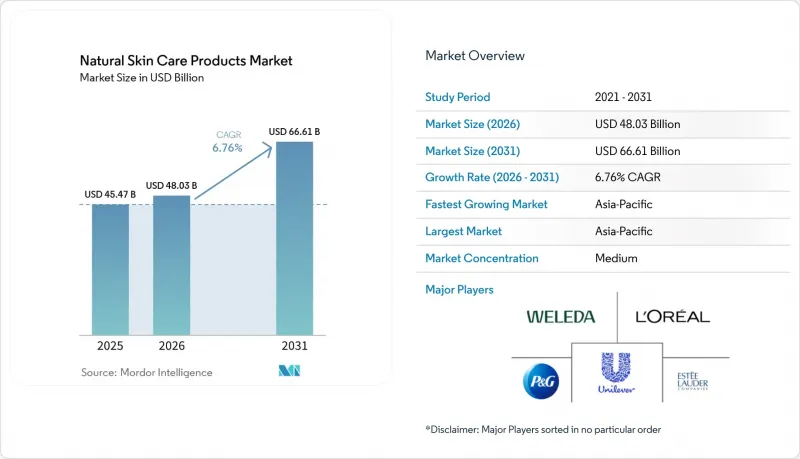
This report is Segmented by Product Type (Facial Care Products, Body Care Products, and Lip Care Products), Category (Mass and Luxury/Premium), End User (Men and Women), Distribution Channel (Health and Beauty Stores, and More), and Geography (North America, Europe, Asia-Pacific, South America, and Middle East and Africa). The Market Forecasts are Provided in Terms of Value (USD).
Global Natural Skin Care Products Market Trends and Insights
Rising consumer demand for chemical-free skin care
Millennials and Gen Z, now the dominant forces in global beauty spending, have transitioned from casually avoiding certain synthetic compounds to making it a primary filter in their purchases. These compounds include parabens, phthalates, formaldehyde-releasing preservatives, and synthetic fragrances. However, not all natural product categories enjoy the same level of demand. For instance, formulations that credibly tout a "chemical-free" label and back it with clinical mechanisms, like a ceramide-rich botanical serum referencing peer-reviewed skin barrier science, see significantly higher repeat purchase rates than those that merely list ingredients. In 2025, NATRUE highlighted the rapid ascent of men's natural skincare as one of the industry's fastest-growing sub-segments. This trend is self-perpetuating: as brands become more transparent, consumers engage in comparison shopping. This heightened scrutiny on synthetic alternatives complicates matters for conventional brands, making it challenging to retain customers who've transitioned to verified-natural products. Moreover, brands that secure dermatologist endorsements and present published clinical evidence are carving out robust competitive advantages, especially in the lucrative facial care market.
Premiumization of natural and organic skin care routines
As the organic and luxury skincare categories converge, a new premium-natural segment emerges, where certification integrity increasingly dictates pricing power, overshadowing traditional brand heritage. Weleda AG's 2025 annual results underscore this trend: the company celebrated a record turnover with a 9.2% sales growth, buoyed by the October 2025 debut of its premium face care line, Cell Longevity, and the Booster Drops serum range, which clinched the title of the year's top skincare launch in Germany. Notably, Weleda also highlighted a significant leap in its sustainability efforts: recycled primary packaging in its natural cosmetics surged to 77% in 2025, up from 65% the previous year. This shift underscores that in the premium-natural segment, sustainability is now a baseline expectation rather than a distinguishing feature. Continuing this trajectory, Weleda made waves in the UV protection arena with its UV Glow Fluid launch in Q1 2026, mirroring the robust growth of 2025. This momentum suggests that the push towards premiumization in the natural category is not a fleeting trend but a sustained movement. Meanwhile, brands attempting to carve a niche in the luxury skincare realm, yet lacking verifiable supply chain traceability and endorsements from third-party certifiers like NATRUE, COSMOS, or USDA Organic, find themselves grappling with regulatory challenges and consumer doubts, jeopardizing their desired pricing premiums.
Higher stability and shelf-life constraints versus conventional formulations
Natural preservation systems like rosemary extract, vitamin E, and fermented actives face formulation challenges due to their inherent instability compared to parabens or phenoxyethanol. This instability is particularly pronounced in water-based formulations, such as toners and hydrating serums. Under ambient storage, these natural products risk microbial contamination, potentially shortening their shelf life to 12-18 months, while conventionally preserved items can last 24-36 months. As a result, natural skincare brands grapple with tough choices: accept the higher risk of a shorter shelf life, invest in more complex waterless or anhydrous formulations, or pivot to biotechnology-derived preservatives, each with its own certification and supply chain challenges. The financial stakes are heightened by MoCRA's recall framework. According to draft guidance from December 18, 2025, brands are primarily liable for adulteration, meaning a widespread stability failure could have dire regulatory and reputational repercussions. Meanwhile, established players with robust research and development teams are pulling ahead of indie brands, hinting at mounting consolidation pressures in the water-based natural product segment.
Other drivers and restraints analyzed in the detailed report include:
- Expansion of clean beauty retail and e-commerce channels
- Microbiome-friendly and sensitive-skin positioning
- Supply volatility in botanicals and natural actives
For complete list of drivers and restraints, kindly check the Table Of Contents.
Segment Analysis
In 2025, Facial Care Products dominated the revenue landscape, commanding a significant 85.21% share. This dominance underscores the pivotal role facial skincare plays in shaping a brand's scientific credibility and pricing strategy. Within the Facial Care realm, not all sub-categories exhibit the same dynamism. Cleansers and moisturizers cater to a high-volume, moderately premium audience. In contrast, serums and essences, where consumers are willing to pay a premium per milliliter, emerge as the forefront of ingredient innovation. Weleda, a brand with a century-old legacy, made headlines in April 2026 by unveiling its first face serums in over a hundred years. The Serum Booster Drops collection, featuring six variants focused on hydration, vitamin C, anti-aging, and radiance, underscores the brand's strategic pivot towards premium-natural positioning. Meanwhile, toners and face masks serve as crucial discovery tools, facilitating trials for emerging natural brands, especially via online retail platforms.
Body Care Products, which include body lotions, foot and hand creams, and other formats, currently hold a smaller market share. However, they're witnessing growth as consumers increasingly adopt natural formulation standards beyond just facial products. Lip Care Products are buzzing with innovation. In February 2026, Burt's Bees ventured into the lip oil segment, harnessing jojoba, sweet almond, and meadowfoam seed oils. This move not only underscores the brand's commitment to its natural heritage but also its adaptability to trend-driven formats, now available at major retailers like Target, Amazon, Walmart, and CVS Pharmacy. Looking ahead, the Facial Care Products segment is projected to grow at a robust 7.31% CAGR through 2031, outpacing the overall market's 6.76% growth rate. This trend highlights the industry's continued investment in clinically validated botanical actives, especially as the serum and essence sub-categories reach maturity.
In 2025, the Mass category dominated, capturing 53.54% of total category revenue, underscoring its pivotal role as the go-to choice for consumers seeking easily accessible natural skincare through widespread retail channels. The natural skincare landscape showcases two distinct growth trajectories: mass formats, buoyed by price accessibility, and the Luxury/Premium tier, where the allure lies in certification credibility and ingredient traceability, ensuring robust pricing power. L'Occitane en Provence's April 2026 comeback of its Amande Sublime collection, now boasting 97% natural-origin ingredients, fully biodegradable components, and a refillable format, underscores how legacy brands are bolstering their natural credentials to fend off competition from purer-positioned indie rivals.
Projected to expand at an 8.12% CAGR until 2031, the Luxury/Premium segment is set to outpace both the Mass category and the broader market. While consumers loyal to natural formulations are eager to invest more for verified organic certifications and heightened bioactive concentrations, their expectations are climbing. Under EU Regulation No 655/2013, claims of "natural" in cosmetics must be substantiated, elevating the compliance bar for all premium-tier brands in Europe. Meanwhile, in markets like the United States, the United Kingdom, Germany, and Japan, brands lacking COSMOS or NATRUE certification are grappling to maintain premium pricing as consumer awareness sharpens.
Complete Report Scope:
- Product Type
- Facial Care Products
- Cleansers
- Moisturizers and creams
- Serums and Essence
- Toners
- Face Masks
- Other Facial Care Products
- Body Care Products
- Body Lotion
- Foot and Hand Cream
- Other Body Care Products
- Lip Care Products
- Facial Care Products
- Category
- Mass
- Luxury/Premium
- End User
- Men
- Women
- Distribution Channel
- Supermarkets/Hypermarkets
- Health and Beauty Stores
- Online Retail Stores
- Other Channels
- Geography
- North America
- United States
- Canada
- Mexico
- Rest of North America
- Europe
- United Kingdom
- Germany
- France
- Italy
- Spain
- Sweden
- Belgium
- Poland
- Netherlands
- Rest of Europe
- Asia-Pacific
- China
- Japan
- India
- Thailand
- Singapore
- Indonesia
- South Korea
- Australia
- Rest of Asia-Pacific
- South America
- Brazil
- Argentina
- Colombia
- Peru
- Chile
- Rest of South America
- Middle East and Africa
- United Arab Emirates
- South Africa
- Saudi Arabia
- Nigeria
- Egypt
- Morocco
- Turkey
- Rest of Middle East and Africa
- North America
Geography Analysis
In 2025, Asia-Pacific commanded a dominant 37.4% share of the global revenue, solidifying its position as the leading market for natural skin care products. Forecasts predict Asia-Pacific will not only maintain its status as the largest regional market but also emerge as the fastest-growing, with an anticipated CAGR of 7.8% through 2031. China, bolstered by a growing demand for ingredient transparency and the emergence of digital-first local brands like Winona and Proya, stands as the region's primary revenue driver. Meanwhile, India is carving out a niche as the fastest-growing national market, both in Asia-Pacific and on the global stage. UEBT attributes this growth to India's pivotal role as a vertically integrated botanical sourcing hub, especially for Ayurvedic formulations. Reinforcing this perspective, The Estee Lauder Companies, in March 2026, took a significant step by acquiring full ownership of Forest Essentials, a prestigious natural skincare brand rooted in integrated Ayurvedic sourcing.
South Korea is reshaping the credibility landscape of the natural skin care products market. On August 1, 2025, the Ministry of Food and Drug Safety abolished its government certification system for natural and organic cosmetics. This pivotal shift placed the onus of disclosure squarely on brands. As a result, many companies are gravitating towards globally recognized standards like COSMOS and NATRUE, especially when marketing in Korea or using it as a benchmark for exports. Meanwhile, as consumer awareness deepens, smaller markets in the Asia-Pacific, such as Thailand, Singapore, Indonesia, and Australia, are also making strides. Indonesia, in 2026, introduced an added layer of compliance with mandatory halal certification for cosmetics, a move that resonates with the rising demand for cleaner ingredient profiles.
North America and Europe continue to wield significant influence over the regulatory and pricing dynamics of the natural skin care products market. Europe, in particular, holds a pivotal role: Germany, France, and the UK account for a substantial portion of the certified-organic demand. Germany's pharmacy-centric skincare culture further bolsters brands that meld botanical traditions with clinical credibility. The EU has tightened its grip on ingredient controls. Notably, in April 2026, Commission Regulation (EU) 2026/909 imposed new restrictions on certain cosmetic substances, amplifying the reformulation challenges for products reliant on synthetic fragrance systems. While South America, the Middle East, and Africa are still in the nascent stages, they hold significance in the market. Brazil, with Natura's Amazonian sourcing model, leads the charge in South America. In the Middle East, the UAE and Saudi Arabia blend luxury demand with preferences for halal formulations. Meanwhile, Africa's rich botanical offerings, from shea butter to baobab extract, present a long-term sourcing opportunity, allowing brands to fortify their local procurement capabilities.
- The Procter & Gamble Company
- The Estee Lauder Companies Inc.
- Unilever PLC
- The Clorox Company
- L'Oreal S.A.
- L'Occitane International S.A.
- Weleda AG
- WALA Heilmittel GmbH
- The Body Shop International Limited
- Tata Harper Skincare, LLC
- Herbivore Botanicals, Inc.
- True Botanicals, Inc.
- Juice Beauty, Inc.
- Pai Skincare Ltd.
- Neal's Yard Remedies Limited
- Burt's Bees, Inc.
- Origins Natural Resources, Inc.
- Aveda Corporation
- KORA Organics Pty Ltd.
- Dr. Bronner's Magic Soaps, Inc.
Additional Benefits:
- The market estimate (ME) sheet in Excel format
- 3 months of analyst support
TABLE OF CONTENTS
1 INTRODUCTION
- 1.1 Study Assumptions and Market Definition
- 1.2 Scope of the Study
2 RESEARCH METHODOLOGY
3 EXECUTIVE SUMMARY
4 MARKET LANDSCAPE
- 4.1 Market Overview
- 4.2 Market Drivers
- 4.2.1 Rising Consumer Demand for Chemical-Free Skin Care
- 4.2.2 Expansion of Clean Beauty Retail and E-Commerce Channels
- 4.2.3 Premiumization of Natural and Organic Skin Care Routines
- 4.2.4 Ingredient Transparency and Label-Trust Requirements
- 4.2.5 Microbiome-Friendly and Sensitive-Skin Positioning
- 4.2.6 Regulatory Push Against Undisclosed Synthetic Additives
- 4.3 Market Restraints
- 4.3.1 Higher Stability and Shelf-Life Constraints Versus Conventional Formulations
- 4.3.2 Ingredient Traceability and Certification Costs
- 4.3.3 Counterfeit, Greenwashing, and Brand-Trust Risk
- 4.3.4 Supply Volatility in Botanicals and Natural Actives
- 4.4 Value Chain Analysis
- 4.5 Regulatory Landscape
- 4.6 Technological Outlook
- 4.7 Porter's Five Forces
- 4.7.1 Threat of New Entrants
- 4.7.2 Bargaining Power of Buyers
- 4.7.3 Bargaining Power of Suppliers
- 4.7.4 Threat of Substitutes
- 4.7.5 Intensity of Competitive Rivalry
5 MARKET SIZE AND GROWTH FORECASTS (VALUE)
- 5.1 Product Type
- 5.1.1 Facial Care Products
- 5.1.1.1 Cleansers
- 5.1.1.2 Moisturizers and creams
- 5.1.1.3 Serums and Essence
- 5.1.1.4 Toners
- 5.1.1.5 Face Masks
- 5.1.1.6 Other Facial Care Products
- 5.1.2 Body Care Products
- 5.1.2.1 Body Lotion
- 5.1.2.2 Foot and Hand Cream
- 5.1.2.3 Other Body Care Products
- 5.1.3 Lip Care Products
- 5.1.1 Facial Care Products
- 5.2 Category
- 5.2.1 Mass
- 5.2.2 Luxury/Premium
- 5.3 End User
- 5.3.1 Men
- 5.3.2 Women
- 5.4 Distribution Channel
- 5.4.1 Supermarkets/Hypermarkets
- 5.4.2 Health and Beauty Stores
- 5.4.3 Online Retail Stores
- 5.4.4 Other Channels
- 5.5 Geography
- 5.5.1 North America
- 5.5.1.1 United States
- 5.5.1.2 Canada
- 5.5.1.3 Mexico
- 5.5.1.4 Rest of North America
- 5.5.2 Europe
- 5.5.2.1 United Kingdom
- 5.5.2.2 Germany
- 5.5.2.3 France
- 5.5.2.4 Italy
- 5.5.2.5 Spain
- 5.5.2.6 Sweden
- 5.5.2.7 Belgium
- 5.5.2.8 Poland
- 5.5.2.9 Netherlands
- 5.5.2.10 Rest of Europe
- 5.5.3 Asia-Pacific
- 5.5.3.1 China
- 5.5.3.2 Japan
- 5.5.3.3 India
- 5.5.3.4 Thailand
- 5.5.3.5 Singapore
- 5.5.3.6 Indonesia
- 5.5.3.7 South Korea
- 5.5.3.8 Australia
- 5.5.3.9 Rest of Asia-Pacific
- 5.5.4 South America
- 5.5.4.1 Brazil
- 5.5.4.2 Argentina
- 5.5.4.3 Colombia
- 5.5.4.4 Peru
- 5.5.4.5 Chile
- 5.5.4.6 Rest of South America
- 5.5.5 Middle East and Africa
- 5.5.5.1 United Arab Emirates
- 5.5.5.2 South Africa
- 5.5.5.3 Saudi Arabia
- 5.5.5.4 Nigeria
- 5.5.5.5 Egypt
- 5.5.5.6 Morocco
- 5.5.5.7 Turkey
- 5.5.5.8 Rest of Middle East and Africa
- 5.5.1 North America
6 COMPETITIVE LANDSCAPE
- 6.1 Market Concentration
- 6.2 Strategic Moves
- 6.3 Market Ranking Analysis
- 6.4 Company Profiles
- 6.4.1 The Procter & Gamble Company
- 6.4.2 The Estee Lauder Companies Inc.
- 6.4.3 Unilever PLC
- 6.4.4 The Clorox Company
- 6.4.5 L'Oreal S.A.
- 6.4.6 L'Occitane International S.A.
- 6.4.7 Weleda AG
- 6.4.8 WALA Heilmittel GmbH
- 6.4.9 The Body Shop International Limited
- 6.4.10 Tata Harper Skincare, LLC
- 6.4.11 Herbivore Botanicals, Inc.
- 6.4.12 True Botanicals, Inc.
- 6.4.13 Juice Beauty, Inc.
- 6.4.14 Pai Skincare Ltd.
- 6.4.15 Neal's Yard Remedies Limited
- 6.4.16 Burt's Bees, Inc.
- 6.4.17 Origins Natural Resources, Inc.
- 6.4.18 Aveda Corporation
- 6.4.19 KORA Organics Pty Ltd.
- 6.4.20 Dr. Bronner's Magic Soaps, Inc.
7 MARKET OPPORTUNITIES AND FUTURE OUTLOOK

