
PUBLISHER: Mordor Intelligence | PRODUCT CODE: 2073374

PUBLISHER: Mordor Intelligence | PRODUCT CODE: 2073374
Payday Lending - Market Share Analysis, Industry Trends & Statistics, Growth Forecasts (2026 - 2031)
According to Mordor Intelligence, the payday lending market size was valued at USD 41.12 billion in 2025 and estimated to grow from USD 43.02 billion in 2026 to reach USD 53.89 billion by 2031, at a CAGR of 4.61% during the forecast period (2026-2031).
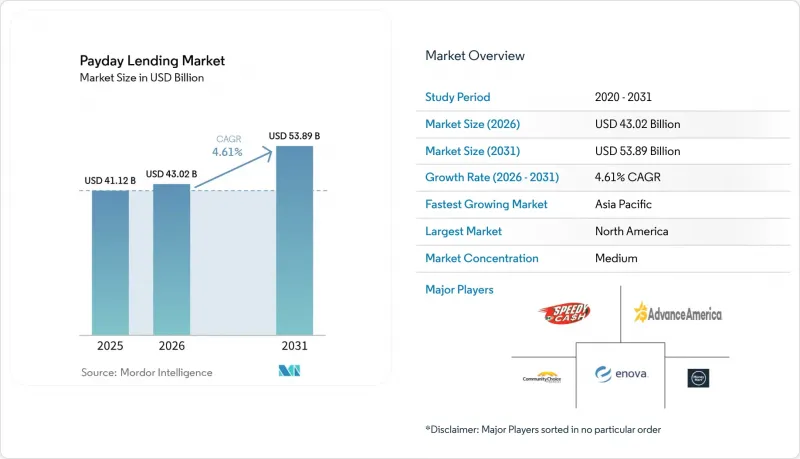
This report is Segmented by Loan Type (Storefront Payday Loans, Online Payday Loans, and Hybrid / Omni-Channel Payday Loans), Age Group (18 - 24, 25 - 34, and More), Marital Status (Married, Single, and Others), Distribution Channel (Direct-Lender Websites, Marketplace / Broker Platforms, and Mobile Apps), and Geography. The Market Forecasts are Provided in Terms of Value (USD).
Global Payday Lending Market Trends and Insights
Shift to Online and Mobile Lending Platforms
Mobile and web channels are re-shaping how credit is originated, funded and serviced. Consumers favor application turnaround measured in minutes, and lenders that embed biometrics and real-time payroll data can cut operating expense by up to 50% while lowering fraud losses. These efficiencies let providers offer slightly lower fees without eroding margins, even as regulators scrutinize algorithmic bias .
Volatile Household Incomes Driving Small-Ticket Credit Demand
Gig-economy workers and part-time employees frequently encounter mid-month liquidity gaps. The Federal Reserve logged USD 1.4 billion in outstanding small-dollar loans at end-2023, with a median balance of USD 507 and 70% of borrowers classified sub-prime. Extreme weather events are adding a climate-risk lens to underwriting because repayment rates dip when utilities and medical bills spike.
Tighter APR Caps and Rate-Glide-Path Legislation
Canada's January 2025 reforms cut payday loan fees to 14% of the principal and reduced the criminal interest ceiling to 35% APR, prompting providers to recalibrate revenue models. Forty-five U.S. states also enforce caps, many targeting 36% APR, putting pressure on high-cost operators to pivot toward installment or earned-wage products.
Other drivers and restraints analyzed in the detailed report include:
- Deregulation in Select U.S. States Raising Loan-Size Caps
- Open-Banking-Based Alternative-Data Underwriting
- Rising Preference for BNPL and Overdraft-Free Wage Products
For complete list of drivers and restraints, kindly check the Table Of Contents.
Segment Analysis
Online advances accounted for 57.60% of the payday lending market in 2025 as convenience, privacy and 24-hour disbursement win over storefront traffic. Hybrid channels are set to post a 12.05% CAGR because lenders pair chat-bots with branch pick-up options for users who value face-to-face verification. Regulators view omnichannel models as easier to supervise than cash-only outlets, potentially supporting sustainable scale.
Storefront loans still attract older or rural borrowers but face escalating rent and compliance overhead. Chain consolidation saw Illinois outlet numbers shrink during 2021-2024 as operators exited low-margin zip codes. Nevertheless, strategic clustering persists in lower-income districts where bank branch density is low.
Borrowers aged 25-34 held 29.55% of the payday lending market in 2025, reflecting student-loan loads and starter-salary cash flow gaps. The 18-24 cohort is on an 11.1% CAGR path, propelled by thin credit files that block card access. Lenders, therefore, emphasize in-app education modules to curb default and regulator concern over youth debt traps.
Middle-aged segments use payday credit episodically for medical or car-repair bills, whereas the 55+ bracket shows modest uptake linked to retirement-income shortfalls. FDIC surveys confirm that 34% of 18-34-year-olds used high-cost products within five years, underscoring sustained growth prospects for age-tailored offerings .
Complete Report Scope:
- By Loan Type
- Storefront Payday Loans
- Online Payday Loans
- Hybrid / Omni-channel Payday Loans
- By Age Group
- 18 - 24
- 25 - 34
- 35 - 44
- 45 - 54
- 55 +
- By Marital Status
- Single
- Married
- Others
- By Distribution Channel
- Direct-lender Websites
- Marketplace / Broker Platforms
- Mobile Apps
- Physical Stores
- Others
- By Geography
- North America
- United States
- Canada
- Mexico
- South America
- Brazil
- Argentina
- Rest of South America
- Europe
- Germany
- United Kingdom
- France
- Italy
- Spain
- Russia
- Rest of Europe
- Asia-Pacific
- China
- Japan
- India
- South Korea
- Australia and New Zealand
- Rest of Asia-Pacific
- Middle East and Africa
- Middle East
- Saudi Arabia
- United Arab Emirates
- Turkey
- Rest of Middle East
- Africa
- South Africa
- Nigeria
- Egypt
- Rest of Africa
- Middle East
- North America
Geography Analysis
North America controlled 41.60% of the payday lending market in 2025 amid a patchwork of state rules ranging from Texas's 662% permissible APR to outright bans in 18 jurisdictions. The CFPB's current enforcement posture gives small banks breathing room to test sub-prime credit offerings, yet impending federal elections could reverse that stance, injecting policy risk into lender forecasts.
Asia-Pacific is the fastest-growing region at 9.95% CAGR to 2031. India's Unified Payments Interface and China's super-app ecosystems allow instant cash-flow verification, enabling risk-based pricing at scale. Regulatory sandboxes in Indonesia and the Philippines further accelerate fintech penetration, presenting outsized upside for cross-border digital lenders.
Europe paints a mixed picture. The UK's crackdown trimmed the local operator count by more than 80% between 2019 and 2024, leading to a market where price caps and redress schemes dominate strategic dialogue. Meanwhile, Eastern European economies display double-digit growth because traditional bank credit remains under-served. The EU's 2023 Consumer Credit Directive extends strict creditworthiness tests to small-value loans, signaling future compliance cost escalations across the bloc.
- Enova International, Inc.
- Speedy Cash
- Advance America, Cash Advance Centers, Inc. (Grupo Elektra)
- MoneyMart Financial Services (DFC Global Corp.)
- Community Choice Financial, Inc.
- Check Into Cash, Inc.
- ACE Cash Express, Inc. (Populus Financial)
- Elevate Credit, Inc.
- OppFi Inc.
- Cash Converters International Ltd.
- TMX Finance LLC
- Moneytree Inc.
- World Acceptance Corp.
- Speedy Finance Pty Ltd.
- Cashfloat (UK Credit Ltd.)
- Creditstar Group AS
- Provident SPV Ltd. (Vanquis Banking Group)
- Mr Lender Ltd.
- goeasy Ltd. (easyfinancial)
- Advance Financial 24/7 (AFS Tennessee Inc.)
Additional Benefits:
- The market estimate (ME) sheet in Excel format
- 3 months of analyst support
TABLE OF CONTENTS
1 INTRODUCTION
- 1.1 Market Definition and Study Assumptions
- 1.2 Scope of the Study
2 RESEARCH METHODOLOGY
3 EXECUTIVE SUMMARY
4 MARKET LANDSCAPE
- 4.1 Market Overview
- 4.2 Market Drivers
- 4.2.1 Shift to online and mobile lending platforms
- 4.2.2 Volatile household incomes driving small-ticket credit demand
- 4.2.3 Deregulation in select U.S. states raising loan-size caps
- 4.2.4 Open-banking based alternative-data underwriting
- 4.2.5 Employer-integrated earned-wage-access partnerships
- 4.2.6 Expansion of hybrid/omni-channel service models
- 4.3 Market Restraints
- 4.3.1 Tighter APR caps and rate-glide-path legislation
- 4.3.2 Rising preference for BNPL and overdraft-free wage products
- 4.3.3 Heightened algorithmic-bias scrutiny by regulators
- 4.3.4 ESG-driven divestment from high-cost lenders
- 4.4 Value / Supply-Chain Analysis
- 4.5 Evaluation of Critical Regulatory Framework
- 4.6 Impact Assessment of Key Stakeholders
- 4.7 Technological Outlook
- 4.8 Porter's Five Forces Analysis
- 4.8.1 Bargaining Power of Suppliers
- 4.8.2 Bargaining Power of Consumers
- 4.8.3 Threat of New Entrants
- 4.8.4 Threat of Substitutes
- 4.8.5 Intensity of Competitive Rivalry
- 4.9 Impact of Macro-economic Factors
5 MARKET SIZE AND GROWTH FORECASTS (VALUE)
- 5.1 By Loan Type
- 5.1.1 Storefront Payday Loans
- 5.1.2 Online Payday Loans
- 5.1.3 Hybrid / Omni-channel Payday Loans
- 5.2 By Age Group
- 5.2.1 18 - 24
- 5.2.2 25 - 34
- 5.2.3 35 - 44
- 5.2.4 45 - 54
- 5.2.5 55 +
- 5.3 By Marital Status
- 5.3.1 Single
- 5.3.2 Married
- 5.3.3 Others
- 5.4 By Distribution Channel
- 5.4.1 Direct-lender Websites
- 5.4.2 Marketplace / Broker Platforms
- 5.4.3 Mobile Apps
- 5.4.4 Physical Stores
- 5.4.5 Others
- 5.5 By Geography
- 5.5.1 North America
- 5.5.1.1 United States
- 5.5.1.2 Canada
- 5.5.1.3 Mexico
- 5.5.2 South America
- 5.5.2.1 Brazil
- 5.5.2.2 Argentina
- 5.5.2.3 Rest of South America
- 5.5.3 Europe
- 5.5.3.1 Germany
- 5.5.3.2 United Kingdom
- 5.5.3.3 France
- 5.5.3.4 Italy
- 5.5.3.5 Spain
- 5.5.3.6 Russia
- 5.5.3.7 Rest of Europe
- 5.5.4 Asia-Pacific
- 5.5.4.1 China
- 5.5.4.2 Japan
- 5.5.4.3 India
- 5.5.4.4 South Korea
- 5.5.4.5 Australia and New Zealand
- 5.5.4.6 Rest of Asia-Pacific
- 5.5.5 Middle East and Africa
- 5.5.5.1 Middle East
- 5.5.5.1.1 Saudi Arabia
- 5.5.5.1.2 United Arab Emirates
- 5.5.5.1.3 Turkey
- 5.5.5.1.4 Rest of Middle East
- 5.5.5.2 Africa
- 5.5.5.2.1 South Africa
- 5.5.5.2.2 Nigeria
- 5.5.5.2.3 Egypt
- 5.5.5.2.4 Rest of Africa
- 5.5.5.1 Middle East
- 5.5.1 North America
6 COMPETITIVE LANDSCAPE
- 6.1 Market Concentration
- 6.2 Strategic Moves
- 6.3 Market Share Analysis
- 6.4 Company Profiles (includes Global level Overview, Market level overview, Core Segments, Financials as available, Strategic Information, Market Rank/Share for key companies, Products and Services, and Recent Developments)
- 6.4.1 Enova International, Inc.
- 6.4.2 Speedy Cash
- 6.4.3 Advance America, Cash Advance Centers, Inc. (Grupo Elektra)
- 6.4.4 MoneyMart Financial Services (DFC Global Corp.)
- 6.4.5 Community Choice Financial, Inc.
- 6.4.6 Check Into Cash, Inc.
- 6.4.7 ACE Cash Express, Inc. (Populus Financial)
- 6.4.8 Elevate Credit, Inc.
- 6.4.9 OppFi Inc.
- 6.4.10 Cash Converters International Ltd.
- 6.4.11 TMX Finance LLC
- 6.4.12 Moneytree Inc.
- 6.4.13 World Acceptance Corp.
- 6.4.14 Speedy Finance Pty Ltd.
- 6.4.15 Cashfloat (UK Credit Ltd.)
- 6.4.16 Creditstar Group AS
- 6.4.17 Provident SPV Ltd. (Vanquis Banking Group)
- 6.4.18 Mr Lender Ltd.
- 6.4.19 goeasy Ltd. (easyfinancial)
- 6.4.20 Advance Financial 24/7 (AFS Tennessee Inc.)
7 MARKET OPPORTUNITIES AND FUTURE TRENDS
- 7.1 White-space and Unmet-need Assessment

