PUBLISHER: Mordor Intelligence | PRODUCT CODE: 2073383

PUBLISHER: Mordor Intelligence | PRODUCT CODE: 2073383
Video Advertising - Market Share Analysis, Industry Trends & Statistics, Growth Forecasts (2026 - 2031)
According to Mordor Intelligence, the video advertising market size is expected to grow from USD 82.68 billion in 2025 to USD 90.88 billion in 2026 and is forecast to reach USD 145.97 billion by 2031 at 9.92% CAGR over 2026-2031.
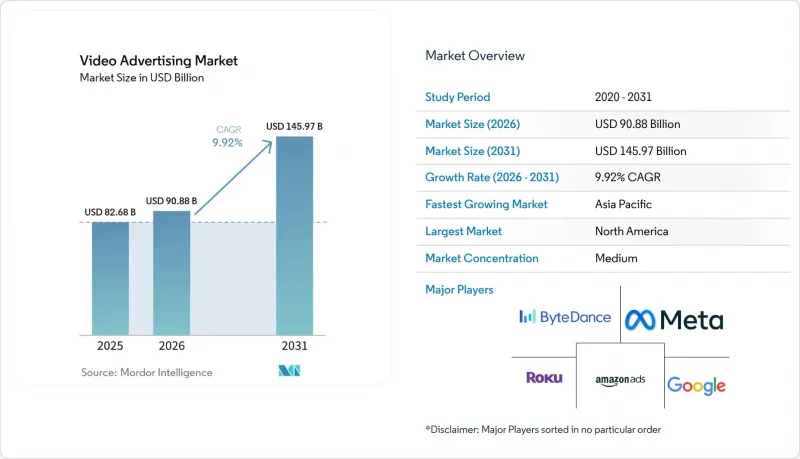
This report Segments the Industry Into by Device (Mobile, Desktop and Laptop, and More), Ad Format (In-Stream, Out-Stream / In-Feed, and More), End-User Industry (Retail and E-Commerce, Media and Entertainment, and More), Pricing Model (Cost Per Mille (CPM), Cost Per View (CPV), Cost Per Click (CPC), and More), and Geography. The Market Forecasts are Provided in Terms of Value (USD).
Global Video Advertising Market Trends and Insights
Surging Connected-TV Household Penetration
CTV has reached a mainstream scale, with US households averaging 7.5 hours of connected-device viewing per day. Netflix alone has crossed 40 million monthly active ad-supported users within 18 months of launching its lower-priced tier, and ad-tier sign-ups now account for more than 55% of new customers in enabled markets. Automotive brands see tangible influence; 61% of prospective car buyers say CTV ads shaped their vehicle choice. Live sports streaming is further raising CPMs because real-time events sustain viewer attention and create appointment viewing that advertisers value.
Programmatic and AI-Driven Audience Targeting Efficiency
Machine-learning platforms ingest real-time signals to personalise creative, producing up to 6X click-through rates versus traditional targeting. Amazon's generative-AI video suite lets brands auto-create product demos with dynamic text, music, and voice overlays, cutting production costs and turnaround times. As third-party cookies fade, contextual engines that rely on page semantics rather than personal identifiers are expected to capture USD 250 billion in global spend.
Escalating CPMs Amid Premium Inventory Scarcity
Meta disclosed near-40% CPM inflation year-over-year, and YouTube rates climbed 36% as brand dollars chase finite high-attention slots. Technology advertisers now pay USD 6.40 per thousand impressions, double the travel category's USD 3.20. Brands deploy AI supply-path optimisation to bypass duplicated auctions, yet scarcity persists as streaming services limit ad loads to preserve user experience, keeping demand ahead of supply.
Other drivers and restraints analyzed in the detailed report include:
- 5G-Enabled High-Quality Mobile Video Deliverability
- Shoppable Video Ads Integrating Instant Checkout
- Ad-Blocking and Data-Privacy Regulations Shrinking Reach
For complete list of drivers and restraints, kindly check the Table Of Contents.
Segment Analysis
Mobile generated the largest slice of the video advertising market size at USD 55.87 billion in 2025, equal to 67.58% share, and is tracking a 10.18% CAGR through 2031. Fifth-generation networks allow full-HD playback without buffering, and 57% of consumers state that 5G availability boosts their willingness to stream ads on smartphones big3media. Connected-TV follows as the prime incremental channel since large-screen environments boast 97% ad-completion rates.
Advertisers now weave sequential storytelling across phone, CTV and digital-out-of-home touchpoints, with auto dealers observing uplift when CTV awareness flights are retargeted on mobile within 48 hours. Programmatic advertisement buying hubs are bundling identity graphs so impressions delivered on any screen are frequency-capped at the household level. Laptop and desktop inventory declines annually yet remains vital for B2B demand-generation campaigns and long-form demos that perform better on larger monitors.
In-stream spots retained 43.92% revenue share in 2025 because viewers are primed to watch during mid-roll breaks in professionally produced content. Shoppable and interactive formats, however, are scaling at a 13.44% CAGR as brands exploit overlays, QR codes and instant-checkout widgets to shorten the purchase funnel. Videos under 90 seconds sustain 50% viewer retention, essential for social-feed environments where audiences swipe within seconds.
Out-stream placements integrated into news feeds trade at lower CPMs but contribute incremental unduplicated reach. Live-stream commerce campaigns are emerging as premium units: Paramount+ inserted real-time polls and product carousels during its Super Bowl broadcast, lifting engagement by 73 seconds on average compared with standard pre-roll. Rich-media signals enhance measurement because viewer taps, swipes and cart adds create deterministic intent data that feeds performance-based bidding loops.
Complete Report Scope:
- By Device
- Mobile
- Desktop and Laptop
- Connected TV / OTT
- Digital-Out-of-Home (DOOH) Screens
- By Ad Format
- In-stream
- Out-stream / In-feed
- Short-form Vertical / Stories / Reels
- Shoppable and Interactive Video
- Rich-media Live-stream
- By End-User Industry
- Retail and E-commerce
- Media and Entertainment
- IT and Telecom
- Automotive
- Financial Services
- Consumer Goods and Electronics
- Healthcare and Pharma
- Other Industries
- By Pricing Model
- Cost per Mille (CPM)
- Cost per View (CPV)
- Cost per Click (CPC)
- Cost per Action (CPA)
- Hybrid / Programmatic Guaranteed
- By Geography
- North America
- United States
- Canada
- Mexico
- South America
- Brazil
- Argentina
- Chile
- Peru
- Rest of South America
- Europe
- Germany
- United Kingdom
- France
- Italy
- Spain
- Rest of Europe
- Asia-Pacific
- China
- Japan
- South Korea
- India
- Australia
- New Zealand
- Rest of Asia-Pacific
- Middle East and Africa
- Middle East
- United Arab Emirates
- Saudi Arabia
- Turkey
- Rest of Middle East
- Africa
- South Africa
- Nigeria
- Egypt
- Rest of Africa
- Middle East
- North America
Geography Analysis
North America accounted for 36.12% of 2025 revenue, underpinned by mature streaming ecosystems and ad-tech infrastructure. Growth is moderating as inventory supply reaches a plateau; however, higher CPMs and premium formats sustain dollar expansion. US-based retail media networks, such as Amazon, Walmart, and Kroger, are funneling first-party shopping data into programmatic pipes, thereby tightening the loop between exposure and sale while insulating the video advertising market from cookie deprecation.
Asia-Pacific is the clear growth engine, advancing at a 7.42% CAGR through 2031. China commands more than 50% of Asia-Pacific spend, fuelled by Alibaba's and Tencent's commerce-plus-content ecosystems. India is the fastest climber: national digital video revenue is on track to surpass broadcast TV by 2027 as smartphone penetration surpasses 80%. Southeast Asian markets benefit from cross-border ecommerce and cheap mobile data, spawning new inventory inside super-apps.
Europe is contending with strict GDPR and Digital Services Act rules that limit behavioral targeting, which pushes spend toward contextual and publisher-first-party solutions. Latin America shows accelerating potential; Mercado Libre's ad unit enjoys 70-80% EBIT margins, and total regional digital ad revenue could triple by 2028. The Middle East and Africa remain nascent but attractive on a long-horizon basis, as governments fund 5G rollouts and local content studios scale, opening up fresh supply for global brands.
- Meta Platforms, Inc.
- Google LLC
- Amazon.com, Inc.
- Roku, Inc.
- ByteDance Ltd.
- Magnite, Inc.
- Conversant, LLC
- Levitate Media LLC
- Legacy Pro Co, LLC
- Viant Technology Inc.
- ExoClick S.L.
- Innovid Corp.
- PubMatic, Inc.
- The Trade Desk, Inc.
- Nexxen International Ltd.
- Hulu, LLC
- Digital Turbine Media, Inc.
- Snap Inc.
- Yahoo Inc.
- Vungle, Inc.
Additional Benefits:
- The market estimate (ME) sheet in Excel format
- 3 months of analyst support
TABLE OF CONTENTS
1 INTRODUCTION
- 1.1 Study Assumptions and Market Definition
- 1.2 Scope of the Study
2 RESEARCH METHODOLOGY
3 EXECUTIVE SUMMARY
4 MARKET LANDSCAPE
- 4.1 Market Overview
- 4.2 Market Drivers
- 4.2.1 Surging connected-TV (CTV) household penetration
- 4.2.2 Programmatic and AI-driven audience targeting efficiency
- 4.2.3 5G-enabled high-quality mobile video deliverability
- 4.2.4 Shoppable video ads integrating instant checkout
- 4.2.5 Gen-Z demand for short-form vertical video
- 4.2.6 Privacy-friendly contextual ad engines
- 4.3 Market Restraints
- 4.3.1 Escalating CPMs amid premium inventory scarcity
- 4.3.2 Ad-blocking and data-privacy regulations shrinking reach
- 4.3.3 Fragmented CTV measurement hindering attribution
- 4.3.4 Growing scrutiny of digital-ad carbon footprints
- 4.4 Impact of Macroeconomic Factors on the Market
- 4.5 Regulatory or Technological Outlook
- 4.6 Porter's Five Forces
- 4.6.1 Threat of New Entrants
- 4.6.2 Bargaining Power of Buyers
- 4.6.3 Bargaining Power of Suppliers
- 4.6.4 Threat of Substitutes
- 4.6.5 Competitive Rivalry
- 4.7 Industry Ecosystem Analysis
- 4.8 Key Use Cases and Case Studies
- 4.9 Assessment of Macroeconomic Trends
- 4.10 Investment Analysis
5 MARKET SIZE AND GROWTH FORECAST (VALUE)
- 5.1 By Device
- 5.1.1 Mobile
- 5.1.2 Desktop and Laptop
- 5.1.3 Connected TV / OTT
- 5.1.4 Digital-Out-of-Home (DOOH) Screens
- 5.2 By Ad Format
- 5.2.1 In-stream
- 5.2.2 Out-stream / In-feed
- 5.2.3 Short-form Vertical / Stories / Reels
- 5.2.4 Shoppable and Interactive Video
- 5.2.5 Rich-media Live-stream
- 5.3 By End-User Industry
- 5.3.1 Retail and E-commerce
- 5.3.2 Media and Entertainment
- 5.3.3 IT and Telecom
- 5.3.4 Automotive
- 5.3.5 Financial Services
- 5.3.6 Consumer Goods and Electronics
- 5.3.7 Healthcare and Pharma
- 5.3.8 Other Industries
- 5.4 By Pricing Model
- 5.4.1 Cost per Mille (CPM)
- 5.4.2 Cost per View (CPV)
- 5.4.3 Cost per Click (CPC)
- 5.4.4 Cost per Action (CPA)
- 5.4.5 Hybrid / Programmatic Guaranteed
- 5.5 By Geography
- 5.5.1 North America
- 5.5.1.1 United States
- 5.5.1.2 Canada
- 5.5.1.3 Mexico
- 5.5.2 South America
- 5.5.2.1 Brazil
- 5.5.2.2 Argentina
- 5.5.2.3 Chile
- 5.5.2.4 Peru
- 5.5.2.5 Rest of South America
- 5.5.3 Europe
- 5.5.3.1 Germany
- 5.5.3.2 United Kingdom
- 5.5.3.3 France
- 5.5.3.4 Italy
- 5.5.3.5 Spain
- 5.5.3.6 Rest of Europe
- 5.5.4 Asia-Pacific
- 5.5.4.1 China
- 5.5.4.2 Japan
- 5.5.4.3 South Korea
- 5.5.4.4 India
- 5.5.4.5 Australia
- 5.5.4.6 New Zealand
- 5.5.4.7 Rest of Asia-Pacific
- 5.5.5 Middle East and Africa
- 5.5.5.1 Middle East
- 5.5.5.1.1 United Arab Emirates
- 5.5.5.1.2 Saudi Arabia
- 5.5.5.1.3 Turkey
- 5.5.5.1.4 Rest of Middle East
- 5.5.5.2 Africa
- 5.5.5.2.1 South Africa
- 5.5.5.2.2 Nigeria
- 5.5.5.2.3 Egypt
- 5.5.5.2.4 Rest of Africa
- 5.5.5.1 Middle East
- 5.5.1 North America
6 COMPETITIVE LANDSCAPE
- 6.1 Market Concentration
- 6.2 Strategic Moves
- 6.3 Market Share Analysis
- 6.4 Company Profiles (includes Global level Overview, Market level overview, Core Segments, Financials as available, Strategic Information, Market Rank/Share for key companies, Products and Services, and Recent Developments)
- 6.4.1 Meta Platforms, Inc.
- 6.4.2 Google LLC
- 6.4.3 Amazon.com, Inc.
- 6.4.4 Roku, Inc.
- 6.4.5 ByteDance Ltd.
- 6.4.6 Magnite, Inc.
- 6.4.7 Conversant, LLC
- 6.4.8 Levitate Media LLC
- 6.4.9 Legacy Pro Co, LLC
- 6.4.10 Viant Technology Inc.
- 6.4.11 ExoClick S.L.
- 6.4.12 Innovid Corp.
- 6.4.13 PubMatic, Inc.
- 6.4.14 The Trade Desk, Inc.
- 6.4.15 Nexxen International Ltd.
- 6.4.16 Hulu, LLC
- 6.4.17 Digital Turbine Media, Inc.
- 6.4.18 Snap Inc.
- 6.4.19 Yahoo Inc.
- 6.4.20 Vungle, Inc.
7 MARKET OPPORTUNITIES AND FUTURE OUTLOOK
- 7.1 White-space and Unmet-need Assessment

