PUBLISHER: Mordor Intelligence | PRODUCT CODE: 2073385

PUBLISHER: Mordor Intelligence | PRODUCT CODE: 2073385
Artificial Intelligence Supply Chain - Market Share Analysis, Industry Trends & Statistics, Growth Forecasts (2026 - 2031)
According to Mordor Intelligence, the artificial intelligence supply chain market size is expected to grow from USD 7.67 billion in 2025 to USD 10.29 billion in 2026 and is forecast to reach USD 44.7 billion by 2031 at 34.12% CAGR over 2026-2031.
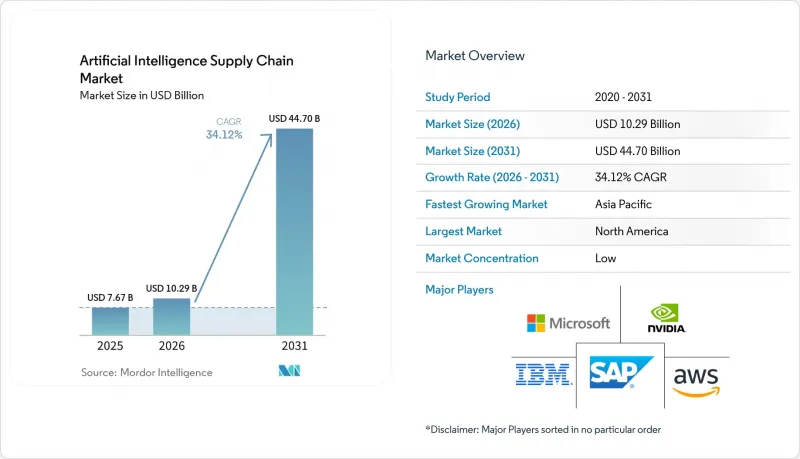
This report Segments the Industry Into by Offering (Hardware, Software, and Services), Technology (Machine Learning, Computer Vision, and More), Application (Supply-Chain Planning and SandOP, Warehouse and Inventory Management, and More), End-User Industry (Manufacturing, Automotive, and More), and Geography. The Market Forecasts are Provided in Terms of Value (USD).
Global Artificial Intelligence Supply Chain Market Trends and Insights
Lower operating costs and error reduction
Enterprises deploying AI for predictive maintenance, dynamic routing, and intelligent allocation report 15-20% cost savings and near-perfect order accuracy, gains that free capital for additional AI projects. Automotive manufacturers using computer vision have cut defect rates by 30%, reinforcing a financial case that accelerates platform rollouts across discrete and process industries. Scaling benefits compound over multiple facilities, positioning AI as an essential lever for margin protection during economic volatility.
Enhanced warehouse throughput via autonomous mobile robots
Productivity jumps of 25-50% and incident reductions up to 60% demonstrate robotic systems' immediate ROI, while emerging humanoid designs promise task-agnostic flexibility without large facility retrofits. Uptake is strongest in high labor-cost regions, with projections that most UK fulfillment centers will add robots by 2030. These gains shorten payback periods and support the growing e-commerce demand surge.
Shortage and concentration of AI accelerator GPUs
Lead times for top-tier GPUs have reached double digits in weeks, with list prices nearing USD 40,000, prompting enterprises to ration compute and adopt more efficient architectures. Supply risk is magnified by geographic clustering of substrate manufacturing, compelling firms to pre-order capacity years ahead and rethink AI workload placement strategies.
Other drivers and restraints analyzed in the detailed report include:
- Surge in Gen-AI copilots for demand forecasting
- Agentic AI for end-to-end self-orchestration
- Expanding AI-specific cyber and model-poisoning threats at the edge
For complete list of drivers and restraints, kindly check the Table Of Contents.
Segment Analysis
Software platforms held 47.02% artificial intelligence supply chain market share in 2025, reflecting enterprises' preference for integrated suites that span planning, execution, and analytics. Yet services revenue is increasing at 18.92% CAGR as organizations outsource implementation, model training, and continuous optimization to specialized partners. Implementation and managed-service providers benefit from skills shortages and the complexity of multi-vendor ecosystems.
Hardware remains the smallest slice but exerts outsized influence due to the ongoing GPU bottleneck. Scarcity has sparked interest in alternative accelerators such as TPUs and FPGAs, which in turn drives demand for code-porting and model-compression services. Firms that can integrate heterogeneous compute stacks without sacrificing performance are capturing share across the artificial intelligence supply chain market.
Machine learning retained 37.30% share in 2025, cementing its status as the default analytic engine for demand prediction and replenishment. Natural language processing accelerates procurement automation by translating contract text into structured insights, while computer vision expands from quality inspection to robotic navigation.
Context-aware computing, however, is scaling fastest at 22.15% CAGR as IoT telemetry feeds real-time optimization engines. These systems adjust decisions based on ambient temperature, equipment health, and traffic patterns, delivering near-instant course corrections. The artificial intelligence supply chain market size linked to context-aware solutions is projected to climb sharply as sensor prices decline and edge-AI frameworks mature.
Complete Report Scope:
- By Offering
- Hardware
- AI accelerator chips (GPU, TPU, ASIC)
- Edge devices and sensors
- Robotics and AMRs
- Software
- AI supply-chain platforms
- Predictive analytics suites
- Services
- Implementation and integration
- Managed and support services
- Hardware
- By Technology
- Machine Learning
- Computer Vision
- Natural Language Processing
- Context-Aware Computing
- Other AI Techniques (Graph, GANs)
- By Application
- Supply-chain planning and SandOP
- Warehouse and inventory management
- Transportation / fleet routing
- Risk and disruption management
- Virtual assistants and chatbots
- Procurement and sourcing optimisation
- By End-User Industry
- Manufacturing
- Automotive
- Food and Beverages
- Healthcare and Life-Sciences
- Retail and E-commerce
- Aerospace and Defence
- Consumer-Packaged Goods
- Other Industries (Energy, Chemicals)
- By Geography
- North America
- United States
- Canada
- Mexico
- South America
- Brazil
- Argentina
- Rest of South America
- Europe
- United Kingdom
- Germany
- France
- Italy
- Spain
- Nordics
- Rest of Europe
- Middle East and Africa
- GCC
- Israel
- South Africa
- Rest of Middle East and Africa
- Asia-Pacific
- China
- India
- Japan
- South Korea
- ASEAN
- Australia
- New Zealand
- Rest of Asia-Pacific
- North America
Geography Analysis
North America captured the highest artificial intelligence supply chain market share at 41.25% in 2025, buoyed by robust venture funding and the presence of technology giants that bundle AI, cloud, and edge services into turnkey offerings. Strategic acquisitions such as Blue Yonder's USD 839 million purchase of One Network Enterprises illustrate a platform-consolidation wave driven by customer demand for end-to-end solutions. Regional enterprises also benefit from early regulatory clarity, supporting faster pilots and scaleouts.
Asia-Pacific is the fastest growing region with an 17.9% CAGR through 2031. National programs in China, Japan, and South Korea subsidize AI infrastructure, while manufacturing powerhouses deploy agentic AI to counter labor shortages. Governments are additionally funding semiconductor self-sufficiency projects to reduce exposure to overseas GPU supply risks, an incentive that accelerates domestic AI adoption.
Europe maintains a steady growth path as sustainability and trustworthy-AI regulations spur demand for transparent, auditable AI workflows. Enterprises invest in AI to track Scope 3 emissions, optimize reverse logistics, and comply with the EU Artificial Intelligence Act. Elsewhere, early-stage deployments in Latin America and Africa focus on basic visibility and demand-planning use cases, often delivered via cloud-based subscription models that lower entry barriers.
- Amazon Web Services, Inc.
- Microsoft Corporation
- IBM Corporation
- SAP SE
- NVIDIA Corporation
- Intel Corporation
- Oracle Corporation
- Alibaba Group Holding Limited
- Deutsche Post DHL Group
- Logility, Inc.
- Blue Yonder Group, Inc.
- Kinaxis Inc.
- C3.ai, Inc.
- Google LLC (Google Cloud)
- Palantir Technologies Inc.
- Zebra Technologies Corporation
- Llamasoft (a Coupa company)
- Salesforce, Inc.
- Accenture plc (supply-chain AI services)
- Snowflake Inc.
Additional Benefits:
- The market estimate (ME) sheet in Excel format
- 3 months of analyst support
TABLE OF CONTENTS
1 INTRODUCTION
- 1.1 Study Assumptions and Market Definition
- 1.2 Scope of the Study
2 RESEARCH METHODOLOGY
3 EXECUTIVE SUMMARY
4 MARKET LANDSCAPE
- 4.1 Market Overview
- 4.2 Market Drivers
- 4.2.1 Lower operating costs and error reduction
- 4.2.2 Enhanced warehouse throughput via autonomous mobile robots
- 4.2.3 Surge in Gen-AI copilots for demand forecasting
- 4.2.4 Agentic AI for end-to-end self-orchestration of supply chains
- 4.2.5 Synthetic data improving supply-planning accuracy
- 4.2.6 Industry-cloud platforms bundling AI and IoT for quick deployment
- 4.3 Market Restraints
- 4.3.1 Shortage and concentration of AI accelerator GPUs
- 4.3.2 Fragmented, poor-quality legacy data silos
- 4.3.3 Expanding AI-specific cyber and model-poisoning threats at the edge
- 4.3.4 Emerging global and state-level trustworthy-AI regulations
- 4.4 Evaluation of Critical Regulatory Framework
- 4.5 Technological Outlook
- 4.6 Porter's Five Forces
- 4.6.1 Bargaining Power of Suppliers
- 4.6.2 Bargaining Power of Buyers
- 4.6.3 Threat of New Entrants
- 4.6.4 Threat of Substitutes
- 4.6.5 Competitive Rivalry
- 4.7 Impact Assessment of Key Stakeholders
- 4.8 Key Use Cases and Case Studies
- 4.9 Impact on Macroeconomic Factors of the Market
- 4.10 Investment Analysis
5 MARKET SIZE AND GROWTH FORECAST (VALUE)
- 5.1 By Offering
- 5.1.1 Hardware
- 5.1.1.1 AI accelerator chips (GPU, TPU, ASIC)
- 5.1.1.2 Edge devices and sensors
- 5.1.1.3 Robotics and AMRs
- 5.1.2 Software
- 5.1.2.1 AI supply-chain platforms
- 5.1.2.2 Predictive analytics suites
- 5.1.3 Services
- 5.1.3.1 Implementation and integration
- 5.1.3.2 Managed and support services
- 5.1.1 Hardware
- 5.2 By Technology
- 5.2.1 Machine Learning
- 5.2.2 Computer Vision
- 5.2.3 Natural Language Processing
- 5.2.4 Context-Aware Computing
- 5.2.5 Other AI Techniques (Graph, GANs)
- 5.3 By Application
- 5.3.1 Supply-chain planning and SandOP
- 5.3.2 Warehouse and inventory management
- 5.3.3 Transportation / fleet routing
- 5.3.4 Risk and disruption management
- 5.3.5 Virtual assistants and chatbots
- 5.3.6 Procurement and sourcing optimisation
- 5.4 By End-User Industry
- 5.4.1 Manufacturing
- 5.4.2 Automotive
- 5.4.3 Food and Beverages
- 5.4.4 Healthcare and Life-Sciences
- 5.4.5 Retail and E-commerce
- 5.4.6 Aerospace and Defence
- 5.4.7 Consumer-Packaged Goods
- 5.4.8 Other Industries (Energy, Chemicals)
- 5.5 By Geography
- 5.5.1 North America
- 5.5.1.1 United States
- 5.5.1.2 Canada
- 5.5.1.3 Mexico
- 5.5.2 South America
- 5.5.2.1 Brazil
- 5.5.2.2 Argentina
- 5.5.2.3 Rest of South America
- 5.5.3 Europe
- 5.5.3.1 United Kingdom
- 5.5.3.2 Germany
- 5.5.3.3 France
- 5.5.3.4 Italy
- 5.5.3.5 Spain
- 5.5.3.6 Nordics
- 5.5.3.7 Rest of Europe
- 5.5.4 Middle East and Africa
- 5.5.4.1 GCC
- 5.5.4.2 Israel
- 5.5.4.3 South Africa
- 5.5.4.4 Rest of Middle East and Africa
- 5.5.5 Asia-Pacific
- 5.5.5.1 China
- 5.5.5.2 India
- 5.5.5.3 Japan
- 5.5.5.4 South Korea
- 5.5.5.5 ASEAN
- 5.5.5.6 Australia
- 5.5.5.7 New Zealand
- 5.5.5.8 Rest of Asia-Pacific
- 5.5.1 North America
6 COMPETITIVE LANDSCAPE
- 6.1 Market Concentration
- 6.2 Strategic Moves
- 6.3 Market Share Analysis
- 6.4 Company Profiles (includes Global level Overview, Market level overview, Core Segments, Financials as available, Strategic Information, Market Rank/Share for key companies, Products and Services, and Recent Developments)
- 6.4.1 Amazon Web Services, Inc.
- 6.4.2 Microsoft Corporation
- 6.4.3 IBM Corporation
- 6.4.4 SAP SE
- 6.4.5 NVIDIA Corporation
- 6.4.6 Intel Corporation
- 6.4.7 Oracle Corporation
- 6.4.8 Alibaba Group Holding Limited
- 6.4.9 Deutsche Post DHL Group
- 6.4.10 Logility, Inc.
- 6.4.11 Blue Yonder Group, Inc.
- 6.4.12 Kinaxis Inc.
- 6.4.13 C3.ai, Inc.
- 6.4.14 Google LLC (Google Cloud)
- 6.4.15 Palantir Technologies Inc.
- 6.4.16 Zebra Technologies Corporation
- 6.4.17 Llamasoft (a Coupa company)
- 6.4.18 Salesforce, Inc.
- 6.4.19 Accenture plc (supply-chain AI services)
- 6.4.20 Snowflake Inc.
7 MARKET OPPORTUNITIES AND FUTURE OUTLOOK
- 7.1 White-space and Unmet-need Assessment

