
PUBLISHER: Mordor Intelligence | PRODUCT CODE: 2073479

PUBLISHER: Mordor Intelligence | PRODUCT CODE: 2073479
Low Profile Additives - Market Share Analysis, Industry Trends & Statistics, Growth Forecasts (2026 - 2031)
According to Mordor Intelligence, low profile additives market size in 2026 is estimated at USD 0.84 billion, growing from 2025 value of USD 0.79 billion with 2031 projections showing USD 1.17 billion, growing at 6.78% CAGR over 2026-2031.
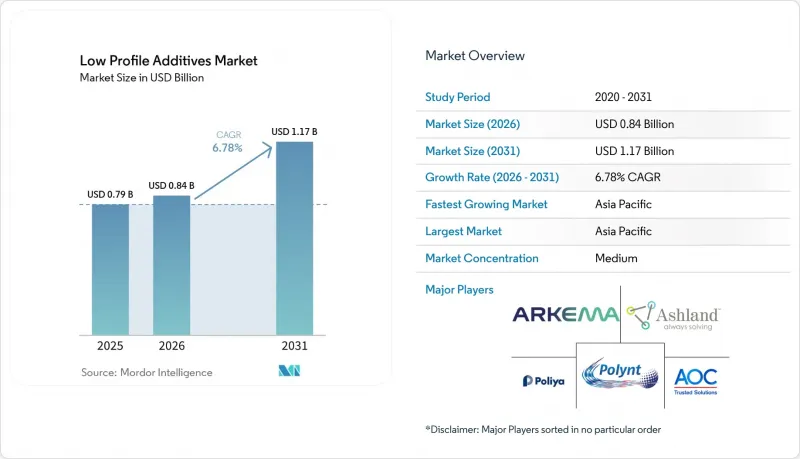
This report is Segmented by Product Type (Polystyrene-Based, Polyvinyl Acetate-Based, and More), Application (Injection and Compression Molding, Pultrusion, and More), End-User Industry (Automotive and Transportation, Building and Construction, and More), and Geography (Asia-Pacific, North America, Europe, South America, Middle East and Africa). The Market Forecasts are Provided in Terms of Value (USD).
Global Low Profile Additives Market Trends and Insights
Increase in Demand for High-performance SMC Formulations from Automotive Industry
Automakers are scaling SMC to mold battery enclosures, body panels, and structural inserts that need flawless Class A finishes. Low profile additives limit volumetric shrinkage, securing dimensional stability under thermal cycling. Dow's polyurethane-carbon fiber spar cap demonstrates cure efficiencies exceeding 90%, exemplifying how next-generation additives support high-speed presses. Larger vehicle platforms and thick-section parts further raise shrinkage control requirements, making advanced low profile additives indispensable across Asia-Pacific's fast-growing electric vehicle hubs.
Accelerated EV Lightweighting Mandates
The European Union's CO2 rules and China's New Energy Vehicle quotas spur rapid fiber-reinforced plastic adoption. Low profile additives underpin these composites by preventing sink marks and waviness even in multi-material assemblies. University of Virginia research shows weight savings of 31% in graphene-modified cement composites, a proxy for similar mass-reduction prospects in auto structures. Rising battery range expectations will continue to pull lightweight composites, sustaining additive demand.
High Polymerization Shrinkage of Unsaturated Polyester Resin with Crosslinking Styrene Monomer
UPR-styrene systems inherently contract during cure, generating voids and print-through that low profile additives must counteract. Suppliers experiment with reactive diluents and modified crosslinkers to curb shrinkage, but such tweaks add cost and cycle-time complexity. Automotive Class A finishes set a high bar, pressuring formulators to keep innovating even in fast-moving, high-volume lines.
Other drivers and restraints analyzed in the detailed report include:
- Replacement of Steel Rebar with Fiber-reinforced Plastics
- Growing Emphasis on Bio-based LPAs from Lignin & Castor Oil
- Competition from Thermoplastic Composites
For complete list of drivers and restraints, kindly check the Table Of Contents.
Segment Analysis
Polystyrene-based grades retained 38.62% low profile additives market share in 2025 through proven cost-performance balance in automotive SMC. The low profile additives market size for "Other" product types-largely bio-based-should rise swiftly, expanding at 8.74% CAGR to 2031 as OEMs chase carbon reduction credits.
Polyvinyl acetate and PMMA variants occupy niches that demand impact strength or optical clarity, while high-density polyethylene grades suit budget-sensitive parts. Polyester-based offerings, both pure and PU-modified, tackle corrosive or high-temperature environments. BASF's biomass-balance EPS underscores how incumbent suppliers blend sustainability with incumbent processes.
Complete Report Scope:
- By Product Type
- Polystyrene-based
- Polyvinyl Acetate-based
- PMMA-based
- High Density Polyethylene (HDPE)
- Polyester-based
- Pure Saturated Polyester
- PU-modified Saturated Polyester
- Other Product Types (EVA, SAN, Bio-based)
- By Application
- Injection and Compression Molding (SMC/BMC)
- Pultrusion
- Resin Transfer Molding (RTM)
- Hand Lay-Up
- Spray-Up
- By End-User Industry
- Automotive and Transportation
- Building and Construction
- Electrical and Electronics
- Industrial Machinery
- Others (Consumer Goods, Marine)
- By Geography
- Asia-Pacific
- China
- India
- Japan
- South Korea
- ASEAN Countries
- Rest of Asia-Pacific
- North America
- United States
- Canada
- Mexico
- Europe
- Germany
- United Kingdom
- France
- Italy
- Spain
- NORDIC Countries
- Rest of Europe
- South America
- Brazil
- Argentina
- Rest of South America
- Middle East and Africa
- Saudi Arabia
- South Africa
- Rest of Middle East and Africa
- Asia-Pacific
Geography Analysis
Asia-Pacific dominated the low profile additives market with 44.12% share in 2025 and an 7.55% CAGR outlook to 2031. China's electric vehicle surge and state-backed infrastructure rollouts underpin composite adoption, while local suppliers scale thermoset capacity. India's automotive expansion and South Korea's electronics exports add tailwinds. BASF's Nanjing site enlargement underscores strategic focus on regional production.
North America ranked second, buoyed by EV platform launches, aerospace rebuilds, and wind-repowering campaigns. The United States houses advanced resin labs and pultrusion lines, while Mexico's proximity to OEM plants fuels part localization. Dow's wind-blade resin programs highlight regional technical prowess.
Europe follows, characterized by strict sustainability requirements that hasten bio-based low profile additives uptake. Germany's premium auto brands adopt composites for body-in-white elements, and Nordic nations channel renewables investments into large turbine blades. Evonik's lignin programs and BYK's VOC-free surfactants typify the innovation thrust.
- ALTANA AG
- AOC
- Arkema
- Ashland
- Clariant
- Composites One
- Evonik Industries AG
- INEOS
- Link Composites Pvt. Ltd.
- Mechemco
- Mitsubishi Chemical Group Corporation.
- Monachem
- Poliya
- Polynt S.p.A
- Scott Bader Company Ltd
- Swancor
- Synthomer Plc
- Wacker Chemie AG
Additional Benefits:
- The market estimate (ME) sheet in Excel format
- 3 months of analyst support
TABLE OF CONTENTS
1 Introduction
- 1.1 Study Assumptions & Market Definition
- 1.2 Scope of the Study
2 Research Methodology
3 Executive Summary
4 Market Landscape
- 4.1 Market Overview
- 4.2 Market Drivers
- 4.2.1 Increase in Demand for High-performance SMC (Sheet Molding Compound) Formulations from Automotive Industry.
- 4.2.2 Accelerated EV lightweighting mandates
- 4.2.3 Replacement of Steel Rebar (Reinforcing Bar Employed to Strengthen Concrete Structures)
- 4.2.4 Emerging Applications in Fiber-reinforced Plastics (FRP)
- 4.2.5 Growing emphasis on Bio-based LPAs from lignin & castor oil
- 4.3 Market Restraints
- 4.3.1 High Polymerization Shrinkage of Unsaturated Polyester Resin with the Crosslinking Styrene Monomer
- 4.3.2 Competition from thermoplastic composites
- 4.3.3 Limited repairability of thermoset parts
- 4.4 Value Chain Analysis
- 4.5 Porter's Five Forces Analysis
- 4.5.1 Bargaining Power of Suppliers
- 4.5.2 Bargaining Power of Consumers
- 4.5.3 Threat of New Entrants
- 4.5.4 Threat of Substitute Products
- 4.5.5 Degree of Competition
5 Market Size & Growth Forecasts (Value)
- 5.1 By Product Type
- 5.1.1 Polystyrene-based
- 5.1.2 Polyvinyl Acetate-based
- 5.1.3 PMMA-based
- 5.1.4 High Density Polyethylene (HDPE)
- 5.1.5 Polyester-based
- 5.1.5.1 Pure Saturated Polyester
- 5.1.5.2 PU-modified Saturated Polyester
- 5.1.6 Other Product Types (EVA, SAN, Bio-based)
- 5.2 By Application
- 5.2.1 Injection and Compression Molding (SMC/BMC)
- 5.2.2 Pultrusion
- 5.2.3 Resin Transfer Molding (RTM)
- 5.2.4 Hand Lay-Up
- 5.2.5 Spray-Up
- 5.3 By End-User Industry
- 5.3.1 Automotive and Transportation
- 5.3.2 Building and Construction
- 5.3.3 Electrical and Electronics
- 5.3.4 Industrial Machinery
- 5.3.5 Others (Consumer Goods, Marine)
- 5.4 By Geography
- 5.4.1 Asia-Pacific
- 5.4.1.1 China
- 5.4.1.2 India
- 5.4.1.3 Japan
- 5.4.1.4 South Korea
- 5.4.1.5 ASEAN Countries
- 5.4.1.6 Rest of Asia-Pacific
- 5.4.2 North America
- 5.4.2.1 United States
- 5.4.2.2 Canada
- 5.4.2.3 Mexico
- 5.4.3 Europe
- 5.4.3.1 Germany
- 5.4.3.2 United Kingdom
- 5.4.3.3 France
- 5.4.3.4 Italy
- 5.4.3.5 Spain
- 5.4.3.6 NORDIC Countries
- 5.4.3.7 Rest of Europe
- 5.4.4 South America
- 5.4.4.1 Brazil
- 5.4.4.2 Argentina
- 5.4.4.3 Rest of South America
- 5.4.5 Middle East and Africa
- 5.4.5.1 Saudi Arabia
- 5.4.5.2 South Africa
- 5.4.5.3 Rest of Middle East and Africa
- 5.4.1 Asia-Pacific
6 Competitive Landscape
- 6.1 Market Concentration
- 6.2 Strategic Moves
- 6.3 Market Share(%)/Ranking Analysis
- 6.4 Company Profiles (includes Global level Overview, Market level overview, Core Segments, Financials as available, Strategic Information, Market Rank/Share, Products & Services, Recent Developments)
- 6.4.1 ALTANA AG
- 6.4.2 AOC
- 6.4.3 Arkema
- 6.4.4 Ashland
- 6.4.5 Clariant
- 6.4.6 Composites One
- 6.4.7 Evonik Industries AG
- 6.4.8 INEOS
- 6.4.9 Link Composites Pvt. Ltd.
- 6.4.10 Mechemco
- 6.4.11 Mitsubishi Chemical Group Corporation.
- 6.4.12 Monachem
- 6.4.13 Poliya
- 6.4.14 Polynt S.p.A
- 6.4.15 Scott Bader Company Ltd
- 6.4.16 Swancor
- 6.4.17 Synthomer Plc
- 6.4.18 Wacker Chemie AG
7 Market Opportunities & Future Outlook
- 7.1 White-space & Unmet-Need Assessment

