PUBLISHER: Mordor Intelligence | PRODUCT CODE: 2073480

PUBLISHER: Mordor Intelligence | PRODUCT CODE: 2073480
Solar Water Heater - Market Share Analysis, Industry Trends & Statistics, Growth Forecasts (2026 - 2031)
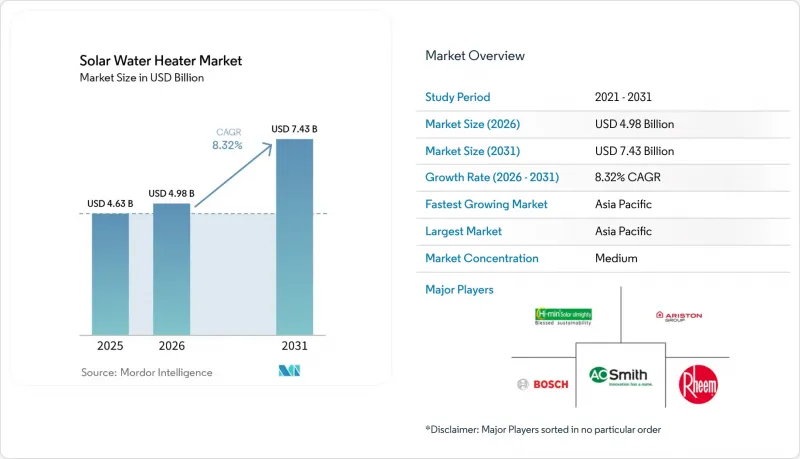
According to Mordor Intelligence, the solar water heater market size was valued at USD 4.63 billion in 2025 and is estimated to grow from USD 4.98 billion in 2026 to reach USD 7.43 billion by 2031, at a CAGR of 8.32% during the forecast period (2026-2031).
This report is Segmented by Thermal Collector Type [Glazed (Evacuated Tube and Flat Plate) and Unglazed], System Type (Active/Pumped, and Passive/Thermosiphon), End User (Residential, Commercial, and Industrial), and Geography (North America, Europe, Asia-Pacific, South America, and Middle East and Africa). The Market Sizes and Forecasts are Provided in Terms of Value (USD).
Global Solar Water Heater Market Trends and Insights
Mainstream Policy-Driven Rooftop Mandates
China's Fourteenth Five-Year Plan extended solar-thermal obligations to 87 additional tier-2 and tier-3 municipalities, compelling new residential buildings below 12 stories to pre-install rooftop systems. India raised capital subsidies to 30% for evacuated-tube units in 2025, aiming for 10 million m2 of added collector area by 2027. Spain's revised Building Technical Code now requires solar thermal to provide half of the domestic hot-water demand in all new homes, solidifying hybrid adoption over pure electric heaters. These rules reduce payback periods to fewer than three years in high-insolation zones, yet uneven incentives in several U.S. states still hinder contractor uptake despite federal tax relief.
Declining Collector Costs in China & India
Evacuated-tube prices have fallen 22% since 2023, reaching below USD 45 per square meter in export-grade batches as vertically integrated Chinese plants scale glass-melting and coating lines. India's Production-Linked Incentive program attracted USD 180 million of fresh factory investment in 2024, trimming delivery lead times for domestic installers. Flat-plate prices track similar cost deflation through aluminum-extrusion automation and polymer glazing, while selective-coating advances narrow the winter efficiency gap between technologies. Affordable hardware is expanding access in Brazil, where residential solar-thermal uptake rose 34% year-on-year in 2025 as unsubsidized systems undercut electric shower-heads over a seven-year lifecycle. Quality variance persists: third-party audits in 2025 found 18% of low-cost evacuated tubes failed ISO 9806 benchmarks, prompting tighter customs inspection in key destinations.
High Up-Front Capex vs. Electric Heaters
A 300-liter residential solar array costs USD 1,200-1,800 installed versus USD 400-600 for a resistance tank, stretching paybacks to 8-10 years in U.S. states with low-power tariffs. Only 12% of American installers offered on-bill financing in 2025, hampering uptake relative to photovoltaic loans. European hybrids exceed EUR 5,000, and a 2025 German survey showed 61% of households underestimated lifecycle savings by more than 30%. Leasing models are emerging; Spain's zero-down subscription launched in 2025, but tax clarity on asset ownership remains unsettled.
Other drivers and restraints analyzed in the detailed report include:
- Heat-Pump/Solar Hybrid Retrofits in Europe
- Industrial Low-Temperature Process-Heat Demand
- Competition From Heat-Pump Water Heaters
For complete list of drivers and restraints, kindly check the Table Of Contents.
Segment Analysis
In 2025, glazed evacuated-tube and flat-plate collectors captured 91.8% of revenue, and the segment is tracking toward an 8.8% CAGR to 2031 as policymakers demand year-round thermal efficiency. Evacuated tubes dominate China and India, where sub-10 °C winters prevail; their vacuum jackets keep annual efficiencies above 60% even with 20 °C ambient deltas. Flat plates find favor in Mediterranean and tropical climates where lower hardware costs and simpler mounts outweigh modest winter losses. The solar water heater market size for glazed collectors is projected to rise alongside selective-coating innovations that push absorptance beyond 0.95, closing the performance gap.
Technological convergence is accelerating: polymer glazing cuts flat-plate weight by 35% and shipping damage by 18% at the expense of shorter UV warranties, while heat-pipe evacuated tubes speed installation by 22%. Compliance with ISO 9806 and Solar Keymark is now mandatory for EU rebates, forcing low-cost exporters to upgrade quality controls. Unglazed polypropylene mats retain a small pool-heating niche but face saturation as cover-sheet solutions deliver passive gains at comparable cost.
Complete Report Scope:
- By Thermal Collector Type
- Glazed (Evacuated Tube, and Flat Plate)
- Unglazed
- By System Type
- Active (Pumped)
- Passive (Thermosiphon)
- By End User
- Residential
- Commercial
- Industrial
- By Geography
- North America
- United States
- Canada
- Mexico
- Europe
- Germany
- United Kingdom
- France
- Italy
- Spain
- NORDIC Countries
- Russia
- Rest of Europe
- Asia-Pacific
- China
- India
- Japan
- South Korea
- ASEAN Countries
- Australia and New Zealand
- Rest of Asia-Pacific
- South America
- Brazil
- Argentina
- Colombia
- Rest of South America
- Middle East and Africa
- Saudi Arabia
- United Arab Emirates
- South Africa
- Egypt
- Rest of Middle East and Africa
- North America
Geography Analysis
Asia-Pacific retained 43.9% of 2025 revenue and is projected to expand at 9.1% CAGR through 2031, supported by China's 18.5 million m2 annual collector additions and India's 30% capital subsidies for evacuated tubes. Export-grade tube prices below USD 45 per m2 allowed Chinese makers to penetrate 87 countries, while India aims for 10 million m2 of new capacity by 2027, lifting rural installations by 28% year-on-year in 2025. Japan's mature but stable base of 47,000 annual installs is increasingly hybridized with CO2 heat pumps where grid power tops JPY 30 per kWh.
Europe's momentum stems from retrofit regulations and hybrid innovation. Germany clocked 112,000 installs in 2025 as Building Performance Directive targets pushed 78% of systems into solar-heat-pump combinations. Spain's 2026 mandate for 50% solar contribution in new homes will add roughly 180,000 annual systems in Mediterranean zones with insolation above 1,800 kWh/m2. Denmark's district-heating hybrid field tied 5,000 m2 of flat plates to a 10,000-m3 seasonal store, achieving 35% solar fraction in 2025.
North America, South America, and the Middle East form high-growth niches. California's Title 24 code drove 18,000 multifamily pre-heat installations in 2025. Mexico's CONAVI subsidies propelled a 22% residential jump, while Brazil's hospital projects attained three-year paybacks and LEED Gold status. Saudi Arabia earmarked USD 120 million in 2025 for industrial solar-thermal rollouts under Vision 2030, bringing 70-90 °C process heat to petrochemical parks. South African aggregators monetize residential installations via voluntary carbon credits, keeping unsubsidized paybacks under four years even without grid-feed tariffs.
- Himin Solar Energy Group
- Rheem Manufacturing Co.
- A. O. Smith Corp.
- Ariston Thermo SpA
- V-Guard Industries Ltd
- Chromagen Ltd
- Bosch Thermotechnology
- SunEarth Inc.
- Solahart Industries
- Greenonetec AG
- Jiangsu Sunpower Solar Tech.
- Zhejiang JiaDeLe Solar Co.
- KODSAN Company
- Alternate Energy Technologies LLC
- Solav Energy
- Supreme Solar Systems
- Racold Thermo (India)
- Rinnai Corp.
- Kingspan Thermomax
- Viessmann Group
Additional Benefits:
- The market estimate (ME) sheet in Excel format
- 3 months of analyst support
TABLE OF CONTENTS
1 Introduction
- 1.1 Study Assumptions & Market Definition
- 1.2 Scope of the Study
2 Research Methodology
3 Executive Summary
4 Market Landscape
- 4.1 Market Overview
- 4.2 Market Drivers
- 4.2.1 Mainstream policy-driven rooftop mandates
- 4.2.2 Declining collector costs in China & India
- 4.2.3 Heat-pump/solar hybrid retrofits in Europe
- 4.2.4 Industrial low-temperature process-heat demand
- 4.2.5 Carbon-credit monetisation of SWH installations
- 4.2.6 Corporate ESG procurement for Scope-1 heat
- 4.3 Market Restraints
- 4.3.1 High up-front capex vs. electric heaters
- 4.3.2 Competition from heat-pump water heaters
- 4.3.3 Supply-chain glass-tube fragility
- 4.3.4 Policy uncertainty for solar thermal vs. PV
- 4.4 Supply-Chain Analysis
- 4.5 Regulatory Landscape
- 4.6 Technological Outlook
- 4.7 Porter's Five Forces
- 4.7.1 Bargaining Power of Suppliers
- 4.7.2 Bargaining Power of Buyers
- 4.7.3 Threat of New Entrants
- 4.7.4 Threat of Substitutes
- 4.7.5 Intensity of Competitive Rivalry
5 Market Size & Growth Forecasts
- 5.1 By Thermal Collector Type
- 5.1.1 Glazed (Evacuated Tube, and Flat Plate)
- 5.1.2 Unglazed
- 5.2 By System Type
- 5.2.1 Active (Pumped)
- 5.2.2 Passive (Thermosiphon)
- 5.3 By End User
- 5.3.1 Residential
- 5.3.2 Commercial
- 5.3.3 Industrial
- 5.4 By Geography
- 5.4.1 North America
- 5.4.1.1 United States
- 5.4.1.2 Canada
- 5.4.1.3 Mexico
- 5.4.2 Europe
- 5.4.2.1 Germany
- 5.4.2.2 United Kingdom
- 5.4.2.3 France
- 5.4.2.4 Italy
- 5.4.2.5 Spain
- 5.4.2.6 NORDIC Countries
- 5.4.2.7 Russia
- 5.4.2.8 Rest of Europe
- 5.4.3 Asia-Pacific
- 5.4.3.1 China
- 5.4.3.2 India
- 5.4.3.3 Japan
- 5.4.3.4 South Korea
- 5.4.3.5 ASEAN Countries
- 5.4.3.6 Australia and New Zealand
- 5.4.3.7 Rest of Asia-Pacific
- 5.4.4 South America
- 5.4.4.1 Brazil
- 5.4.4.2 Argentina
- 5.4.4.3 Colombia
- 5.4.4.4 Rest of South America
- 5.4.5 Middle East and Africa
- 5.4.5.1 Saudi Arabia
- 5.4.5.2 United Arab Emirates
- 5.4.5.3 South Africa
- 5.4.5.4 Egypt
- 5.4.5.5 Rest of Middle East and Africa
- 5.4.1 North America
6 Competitive Landscape
- 6.1 Market Concentration
- 6.2 Strategic Moves (M&A, Partnerships, PPAs)
- 6.3 Market Share Analysis (Market Rank/Share for key companies)
- 6.4 Company Profiles (includes Global level Overview, Market level overview, Core Segments, Financials as available, Strategic Information, Products & Services, and Recent Developments)
- 6.4.1 Himin Solar Energy Group
- 6.4.2 Rheem Manufacturing Co.
- 6.4.3 A. O. Smith Corp.
- 6.4.4 Ariston Thermo SpA
- 6.4.5 V-Guard Industries Ltd
- 6.4.6 Chromagen Ltd
- 6.4.7 Bosch Thermotechnology
- 6.4.8 SunEarth Inc.
- 6.4.9 Solahart Industries
- 6.4.10 Greenonetec AG
- 6.4.11 Jiangsu Sunpower Solar Tech.
- 6.4.12 Zhejiang JiaDeLe Solar Co.
- 6.4.13 KODSAN Company
- 6.4.14 Alternate Energy Technologies LLC
- 6.4.15 Solav Energy
- 6.4.16 Supreme Solar Systems
- 6.4.17 Racold Thermo (India)
- 6.4.18 Rinnai Corp.
- 6.4.19 Kingspan Thermomax
- 6.4.20 Viessmann Group
7 Market Opportunities & Future Outlook
- 7.1 White-space & Unmet-Need Assessment

