PUBLISHER: Mordor Intelligence | PRODUCT CODE: 2073484

PUBLISHER: Mordor Intelligence | PRODUCT CODE: 2073484
Web Analytics - Market Share Analysis, Industry Trends & Statistics, Growth Forecasts (2026 - 2031)
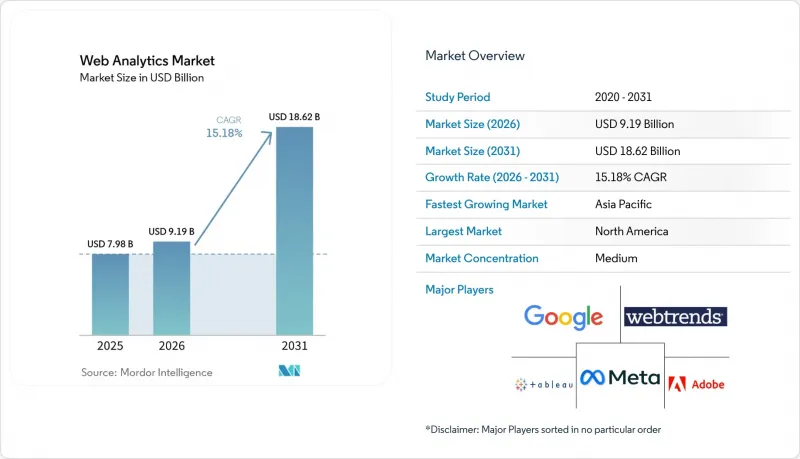
According to Mordor Intelligence, the web analytics market size is expected to grow from USD 7.98 billion in 2025 to USD 9.19 billion in 2026 and is forecast to reach USD 18.62 billion by 2031 at 15.18% CAGR over 2026-2031.
This report is Segmented by Application ( Mobile Analytics, Content Marketing, Social Media Management, and More), Offering (Solutions, and Services), Deployment Model (Cloud-Based, and On-Premises), Organization Size (Large Enterprises, and Small and Medium Enterprises), End-User Vertical (Retail and E-Commerce, Manufacturing, and More), and Geography. The Market Forecasts are Provided in Terms of Value (USD).
Global Web Analytics Market Trends and Insights
Explosion of E-commerce Transaction Volumes
Online retail volumes have soared, pushing analytics requirements beyond page views toward event-level capture of every product interaction and checkout micro-step. Retailers now deploy elastic cloud data pipelines that ingest millions of events per minute and return sub-second personalization responses. Granular data feeds empower sophisticated attribution models that link marketing touchpoints to lifetime value, a capability mid-market merchants previously lacked. As a result, Software-as-a-Service platforms that auto-scale during holiday peaks command increased share of new deployments. Real-time revenue dashboards using web analytics market data have become board-level KPIs for merchandising and supply-chain teams alike.
Rapid Adoption of Mobile and App-Based Analytics
Mobile analytics has shifted from crash logs to unified journey orchestration that stitches in-app events with web sessions. Brands trigger personalized browser offers the moment app users abandon carts, dissolving channel silos. Identity resolution across device IDs and cookies relies on consented first-party data, prompting investment in Customer Data Platforms that reconcile profiles while honoring platform privacy rules. Asia Pacific's mobile-first economies showcase highest conversion uplifts, validating omnichannel budgeting models now rolling into North America and Europe. Enterprises prioritize SDK flexibility that lets them embed privacy prompts tailored to regional regulation without code rewrites.
Stringent Data Protection and Privacy Regulations
Regulators fine companies for misconfigured consent banners and illegal data transfers, turning compliance lapses into material risk. Enterprises respond by deploying server-side gateways that strip personal identifiers before analytics ingestion, yet architecture complexity inflates project timelines and services spend. Smaller firms gravitate toward turnkey privacy-centric vendors, while multinationals create internal privacy engineering teams. The uneven maturity widens performance gaps, with compliant first-party data strategies emerging as competitive moats in the web analytics market.
Other drivers and restraints analyzed in the detailed report include:
- Shift Toward Data-Driven Marketing Automation
- Rising Investment in Customer Experience Optimization
- Cookie Deprecation Reducing Third-Party Tracking Capabilities
For complete list of drivers and restraints, kindly check the Table Of Contents.
Segment Analysis
Online Marketing and Marketing Automation accounted for 40.65% of 2025 revenue, underscoring its role as the baseline use case for the web analytics market. The segment benefits from direct budget linkage to revenue outcomes, driving enterprise retention rates. Customer Journey Mapping, on the other hand, posts the highest 15.95% CAGR as brands seek multi-touch attribution that lowers acquisition costs. This transition elevates demand for path analysis, session replay, and identity stitching.
The shift also unlocks upsell for AI-driven experimentation tools that personalize flows across devices. Customer Data Platforms integrate email, social, and call-center events, feeding unified dashboards consumed by growth and retention teams. As privacy rules tighten, vendors differentiate by embedding consent status flags into every journey visualization, an approach resonating with compliance-heavy sectors.
Solutions represented 63.85% of 2025 spending, anchored by licensing of data collection, visualization, and predictive modules. However, services display a 16.05% CAGR as enterprises engage consultants for server-side tagging, schema design, and consent workflow engineering. Advanced projects pair data scientists with privacy attorneys to validate model features before deployment, a multidisciplinary demand driving premium bill rates.
Managed services appeal to mid-market firms lacking internal skills, bundling infrastructure, monitoring, and regulatory updates into fixed monthly fees. Training engagements spike as marketing teams upskill on AI-assisted insight generation. Collectively, these trends elevate partner ecosystems as core components of vendor go-to-market strategies.
Complete Report Scope:
- By Application
- Online Marketing and Marketing Automation
- Mobile Analytics
- Content Marketing
- Social Media Management
- Email Marketing
- Multichannel Campaign Analysis
- Personalization and A/B Testing
- Customer Journey Mapping and Other Applications
- By Offering
- Solutions
- Services
- By Deployment Model
- Cloud-Based
- On-Premises
- By Organization Size
- Large Enterprises
- Small and Medium Enterprises
- By End-User Vertical
- Retail and E-commerce
- Manufacturing
- Information Technology and Telecom
- Banking Financial Services and Insurance
- Healthcare and Life Sciences
- Transportation and Logistics
- Media and Entertainment and Other End-User Verticals
- By Geography
- North America
- United States
- Canada
- Mexico
- South America
- Brazil
- Argentina
- Rest of South America
- Europe
- Germany
- United Kingdom
- France
- Italy
- Spain
- Rest of Europe
- Asia Pacific
- China
- Japan
- India
- South Korea
- Australia and New Zealand
- Rest of Asia Pacific
- Middle East
- United Arab Emirates
- Saudi Arabia
- Turkey
- Rest of Middle East
- Africa
- South Africa
- Egypt
- Nigeria
- Rest of Africa
- North America
Geography Analysis
North America generated 37.75% of 2025 revenue, supported by mature ad ecosystems, high cloud adoption, and a deep bench of analytics talent. Enterprises exploit integrated suites that synchronize analytics with CRM, commerce, and workflow tools. Compliance investment remains high as enforcement around California's CPRA intensifies, prompting upgrades to consent governance modules.
Europe experiences mid-teen growth as GDPR scrutiny pushes organizations toward first-party data strategies. Server-side tagging gains traction, and analytics spending shifts from marketing to privacy and IT budgets. Countries such as Germany and France favor domestic data centers, steering demand to vendors that offer local hosting options sanctioned for cross-border transfers. The web analytics market size for EU-hosted deployments is set to rise steadily through 2030.
Asia Pacific is the fastest-growing territory, clocking a 15.70% CAGR. Mobile-first economies in Southeast Asia and India spur adoption of lightweight SDKs that capture app events despite bandwidth constraints. Social commerce integration fuels path-to-purchase analysis, and regional super-app ecosystems require analytics engines capable of handling embedded payments, ride-sharing, and messaging in one funnel. Government digital-nation initiatives across Indonesia and Thailand further uplift adoption among public-sector portals.
The Middle East and Africa sees emerging momentum as broadband penetration widens. Investments cluster in Gulf Cooperation Council states, where financial services and travel operators modernize engagement tracking. South America posts steady gains, led by Brazil's e-commerce boom and Argentina's fintech expansion, fostering demand for cost-effective cloud analytics that circumvent legacy infrastructure.
- Google LLC
- Adobe Inc.
- Microsoft Corporation
- Meta Platforms Inc.
- Webtrends Inc.
- Yahoo Inc.
- comScore Inc.
- Splunk Inc.
- MicroStrategy Incorporated
- Tableau Software LLC
- SAS Institute Inc.
- Teradata Corporation
- Applied Technologies Internet SA
- Hootsuite Inc.
- SimilarWeb Ltd.
- Mixpanel Inc.
- InnoCraft Ltd. (Matomo)
- Contentsquare SAS
- Hotjar Ltd.
- Piwik PRO SA
Additional Benefits:
- The market estimate (ME) sheet in Excel format
- 3 months of analyst support
TABLE OF CONTENTS
1 INTRODUCTION
- 1.1 Study Assumptions and Market Definition
- 1.2 Scope of the Study
2 RESEARCH METHODOLOGY
3 EXECUTIVE SUMMARY
4 MARKET LANDSCAPE
- 4.1 Market Overview
- 4.2 Market Drivers
- 4.2.1 Explosion of E-commerce Transaction Volumes
- 4.2.2 Rapid Adoption of Mobile and App-Based Analytics
- 4.2.3 Shift Toward Data-Driven Marketing Automation
- 4.2.4 Rising Investment in Customer Experience Optimization
- 4.2.5 Emergence of Server-Side Tagging to Preserve First-Party Data
- 4.2.6 Integration of Privacy-Preserving Differential Privacy Techniques
- 4.3 Market Restraints
- 4.3.1 Stringent Data Protection and Privacy Regulations
- 4.3.2 Cookie Deprecation Reducing Third-Party Tracking Capabilities
- 4.3.3 Growing Popularity of Walled-Garden Ecosystems Limiting Cross-Domain Tracking
- 4.3.4 Shortage of Skilled Digital Analytics Professionals
- 4.4 Industry Ecosystem Analysis
- 4.5 Regulatory Landscape
- 4.6 Technological Outlook
- 4.7 Porter's Five Forces Analysis
- 4.7.1 Bargaining Power of Buyers
- 4.7.2 Bargaining Power of Suppliers
- 4.7.3 Threat of New Entrants
- 4.7.4 Threat of Substitute Products
- 4.7.5 Intensity of Competitive Rivalry
- 4.8 Impact of Macroeconomic Factors
5 MARKET SIZE AND GROWTH FORECASTS (VALUE)
- 5.1 By Application
- 5.1.1 Online Marketing and Marketing Automation
- 5.1.2 Mobile Analytics
- 5.1.3 Content Marketing
- 5.1.4 Social Media Management
- 5.1.5 Email Marketing
- 5.1.6 Multichannel Campaign Analysis
- 5.1.7 Personalization and A/B Testing
- 5.1.8 Customer Journey Mapping and Other Applications
- 5.2 By Offering
- 5.2.1 Solutions
- 5.2.2 Services
- 5.3 By Deployment Model
- 5.3.1 Cloud-Based
- 5.3.2 On-Premises
- 5.4 By Organization Size
- 5.4.1 Large Enterprises
- 5.4.2 Small and Medium Enterprises
- 5.5 By End-User Vertical
- 5.5.1 Retail and E-commerce
- 5.5.2 Manufacturing
- 5.5.3 Information Technology and Telecom
- 5.5.4 Banking Financial Services and Insurance
- 5.5.5 Healthcare and Life Sciences
- 5.5.6 Transportation and Logistics
- 5.5.7 Media and Entertainment and Other End-User Verticals
- 5.6 By Geography
- 5.6.1 North America
- 5.6.1.1 United States
- 5.6.1.2 Canada
- 5.6.1.3 Mexico
- 5.6.2 South America
- 5.6.2.1 Brazil
- 5.6.2.2 Argentina
- 5.6.2.3 Rest of South America
- 5.6.3 Europe
- 5.6.3.1 Germany
- 5.6.3.2 United Kingdom
- 5.6.3.3 France
- 5.6.3.4 Italy
- 5.6.3.5 Spain
- 5.6.3.6 Rest of Europe
- 5.6.4 Asia Pacific
- 5.6.4.1 China
- 5.6.4.2 Japan
- 5.6.4.3 India
- 5.6.4.4 South Korea
- 5.6.4.5 Australia and New Zealand
- 5.6.4.6 Rest of Asia Pacific
- 5.6.5 Middle East
- 5.6.5.1 United Arab Emirates
- 5.6.5.2 Saudi Arabia
- 5.6.5.3 Turkey
- 5.6.5.4 Rest of Middle East
- 5.6.6 Africa
- 5.6.6.1 South Africa
- 5.6.6.2 Egypt
- 5.6.6.3 Nigeria
- 5.6.6.4 Rest of Africa
- 5.6.1 North America
6 COMPETITIVE LANDSCAPE
- 6.1 Market Concentration
- 6.2 Strategic Moves
- 6.3 Market Share Analysis
- 6.4 Company Profiles (includes Global level Overview, Market level overview, Core Segments, Financials as available, Strategic Information, Market Rank/Share for key companies, Products and Services, and Recent Developments)
- 6.4.1 Google LLC
- 6.4.2 Adobe Inc.
- 6.4.3 Microsoft Corporation
- 6.4.4 Meta Platforms Inc.
- 6.4.5 Webtrends Inc.
- 6.4.6 Yahoo Inc.
- 6.4.7 comScore Inc.
- 6.4.8 Splunk Inc.
- 6.4.9 MicroStrategy Incorporated
- 6.4.10 Tableau Software LLC
- 6.4.11 SAS Institute Inc.
- 6.4.12 Teradata Corporation
- 6.4.13 Applied Technologies Internet SA
- 6.4.14 Hootsuite Inc.
- 6.4.15 SimilarWeb Ltd.
- 6.4.16 Mixpanel Inc.
- 6.4.17 InnoCraft Ltd. (Matomo)
- 6.4.18 Contentsquare SAS
- 6.4.19 Hotjar Ltd.
- 6.4.20 Piwik PRO SA
7 MARKET OPPORTUNITIES AND FUTURE OUTLOOK
- 7.1 White-Space and Unmet-Need Assessment

