PUBLISHER: Mordor Intelligence | PRODUCT CODE: 2073505

PUBLISHER: Mordor Intelligence | PRODUCT CODE: 2073505
Calcium Carbide - Market Share Analysis, Industry Trends & Statistics, Growth Forecasts (2026 - 2031)
According to Mordor Intelligence, the calcium carbide market size is estimated at 34.89 million tons in 2026, and is expected to reach 42.23 million tons by 2031, at a CAGR of 3.89% during the forecast period (2026-2031).
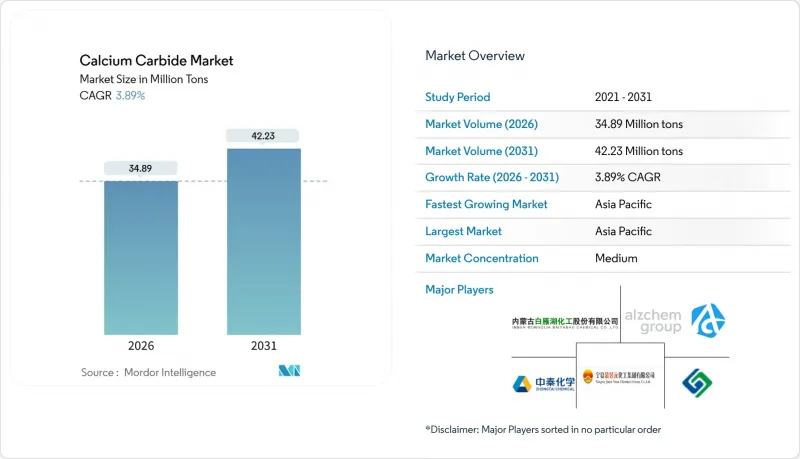
This report is Segmented by Product Grade (CaC2 Content More Than 90%, Cac2 Content 80-90%, and More), Application (Acetylene Gas, Calcium Cyanamide, Reducing and Dehydrating Agent, and More), End-User Industry (Chemicals, Metallurgy, Food, and Others), and Geography (Asia-Pacific, North America, Europe, South America, and Middle East and Africa). Market Forecasts are Provided in Terms of Volume (tons).
Global Calcium Carbide Market Trends and Insights
Favorable Demand From Global Steel Industry
Global crude steel output hit 1,884.6 million tons in 2024, providing a stable baseline for desulfurization agents and oxy-acetylene cutting gases. India's finished-steel production of 139.153 million tons in 2024 created derivative demand for domestic carbide, especially as the country imported 58.12 million tons of coking coal, raising feedstock costs for coke-intensive industries. China's shift toward emissions-intensity targets by 2025 will penalize inefficient furnaces and consolidate supply among plants able to finance energy-saving retrofits.
Rising On-Site Metal Fabrication Demand
Acetylene's 3,100°C flame keeps it irreplaceable for pipeline repair and shipyard fabrication in regions where electric arc systems are impractical. Safety mandates under OSHA and the US EPA raise compliance costs, encouraging large industrial users with ISO 45001 certification to lock in long-term supply contracts, while small workshops migrate to propane or HHO, fragmenting demand.
Health And Safety Hazards Of CaC2 Handling
Calcium carbide's violent reaction with moisture, liberating flammable acetylene gas and heat, creates acute risks in storage, transport, and end-use settings, prompting the European Union's REACH framework to classify it as H260 (releases flammable gas on contact with water) and Skin Corr. 1B. The U.S. Department of Transportation classifies CaC2 as UN 1402, Class 4.3 (dangerous when wet), requiring specialized packaging, moisture-proof containers, and hazmat-certified carriers, which raises logistics costs by an estimated 15-20% versus non-hazardous chemicals.
Other drivers and restraints analyzed in the detailed report include:
- Expanding Downstream Chemical Synthesis
- Growing Utilization in Agriculture
- Stringent Environmental Regulations On Carbide Furnaces
For complete list of drivers and restraints, kindly check the Table Of Contents.
Segment Analysis
High-purity grades in which CaC2 content is more than 90% secured 60.29% of the 2025 volume, and their 4.12% CAGR underpins the largest share of the calcium carbide market size because acetylene-to-VCM producers demand low-impurity feedstock to protect catalysts. Biochar substitution and process-control upgrades enable compliant plants to maintain more than 90% CaC2 content, supporting premium pricing. Lower purity grades face shrinking outlets after India's 2024 ripening ban and tighter food-contact rules.
Process simulations show that producing 220.7 tons of VCM needs 85.3 tons of high-purity CaC2, so any impurity spike directly erodes plant margins. As MIIT's February 2024 guidance pushes coal-to-chemicals toward cleaner feedstocks, integrated producers with ISO 9001 quality systems are well placed to capture long-term contracts, while legacy furnaces without retrofit capital face exit barriers.
Complete Report Scope:
- By Product Grade
- CaC2 Content More Than 90%
- CaC2 Content 80-90%
- CaC2 Content Less Than 80%
- By Application
- Acetylene Gas
- Calcium Cyanamide
- Reducing and Dehydrating Agent
- Desulfurizing and Deoxidizing Agent
- Others (Ripening, PVC and Acetylene Black, Lamps, etc.)
- By End-user Industry
- Chemicals
- Metallurgy
- Food
- Others (Agriculture, Mining, Welding)
- By Geography
- Asia-Pacific
- China
- India
- Japan
- South Korea
- ASEAN Countries
- Rest of Asia-Pacific
- North America
- United States
- Canada
- Mexico
- Europe
- Germany
- United Kingdom
- France
- Italy
- Nordic Countries
- Rest of Europe
- South America
- Brazil
- Argentina
- Rest of South America
- Middle East and Africa
- Saudi Arabia
- South Africa
- Rest of Middle East and Africa
- Asia-Pacific
Geography Analysis
Asia-Pacific held 95.31% of the 2025 volume and is expected to post a 3.91% CAGR through 2031 as China's Coal Triangle pivots toward low-carbon upgrades totaling CNY 437.3 billion by 2030. India's chemical expansion, backed by port-linked clusters and production-linked incentives, creates a second growth pole for the calcium carbide market. Japan and South Korea cater to electronics-grade acetylene black, while ASEAN's USD 226 billion 2024 FDI inflows foreshadow rising specialty-chemical demand, albeit with feedstock cost pressure as industrial energy use climbs to 16 exajoules by 2050.
North America and Europe grow slowly because REACH and OSHA compliance add cost layers absent in the Asia-Pacific. The EU's CBAM will further reshape trade when carbon tariffs on carbide begin in 2026. South America relies on imports for agriculture and mining, while the Middle East and Africa remain nascent due to limited lime and coke integration outside South Africa and Saudi Arabia.
- Alzchem Group AG
- American Elements
- DCM Shriram
- Denka Company Limited
- Donau Chemie AG
- Ghani Global Group
- Inner Mongolia Baiyanhu Chemical Co. Ltd
- Merck
- NEW OCEAN GROUP CO., LIMITED
- Ningxia Jinyuyuan Chemical Group Co., Ltd.
- Ningxia Yinglite Chemical Co., Ltd.
- NIPPON STEEL Chemical & Material Co., Ltd.
- Opta Group LP
- Shizuishan Pengsheng Chemical Co., Ltd.
- Xiahuayuan Xuguang Chemical Co., Ltd.
- Xinjiang Tianye (Group) Co., Ltd.
- Xinjiang Zhongtai Chemical Co., Ltd.
Additional Benefits:
- The market estimate (ME) sheet in Excel format
- 3 months of analyst support
TABLE OF CONTENTS
1 Introduction
- 1.1 Study Assumptions and Market Definition
- 1.2 Scope of the Study
2 Research Methodology
3 Executive Summary
4 Market Landscape
- 4.1 Market Overview
- 4.2 Market Drivers
- 4.2.1 Favourable demand from global steel industry
- 4.2.2 Rising on-site metal fabrication (acetylene) demand
- 4.2.3 Expanding downstream chemical synthesis (PVC, solvents)
- 4.2.4 Growing utilisation in agriculture (soil remediation)
- 4.2.5 Surge in "green" CaC2 production via renewable power
- 4.3 Market Restraints
- 4.3.1 Health & safety hazards of CaC2 handling
- 4.3.2 Stringent environmental regulations on carbide furnaces
- 4.3.3 Availability of alternate welding & cutting gases
- 4.4 Value Chain Analysis
- 4.5 Regulatory Outlook
- 4.6 Porter's Five Forces
- 4.6.1 Bargaining Power of Suppliers
- 4.6.2 Bargaining Power of Buyers
- 4.6.3 Threat of New Entrants
- 4.6.4 Threat of Substitutes
- 4.6.5 Competitive Rivalry
5 Market Size and Growth Forecasts (Volume)
- 5.1 By Product Grade
- 5.1.1 CaC2 Content More Than 90%
- 5.1.2 CaC2 Content 80-90%
- 5.1.3 CaC2 Content Less Than 80%
- 5.2 By Application
- 5.2.1 Acetylene Gas
- 5.2.2 Calcium Cyanamide
- 5.2.3 Reducing and Dehydrating Agent
- 5.2.4 Desulfurizing and Deoxidizing Agent
- 5.2.5 Others (Ripening, PVC and Acetylene Black, Lamps, etc.)
- 5.3 By End-user Industry
- 5.3.1 Chemicals
- 5.3.2 Metallurgy
- 5.3.3 Food
- 5.3.4 Others (Agriculture, Mining, Welding)
- 5.4 By Geography
- 5.4.1 Asia-Pacific
- 5.4.1.1 China
- 5.4.1.2 India
- 5.4.1.3 Japan
- 5.4.1.4 South Korea
- 5.4.1.5 ASEAN Countries
- 5.4.1.6 Rest of Asia-Pacific
- 5.4.2 North America
- 5.4.2.1 United States
- 5.4.2.2 Canada
- 5.4.2.3 Mexico
- 5.4.3 Europe
- 5.4.3.1 Germany
- 5.4.3.2 United Kingdom
- 5.4.3.3 France
- 5.4.3.4 Italy
- 5.4.3.5 Nordic Countries
- 5.4.3.6 Rest of Europe
- 5.4.4 South America
- 5.4.4.1 Brazil
- 5.4.4.2 Argentina
- 5.4.4.3 Rest of South America
- 5.4.5 Middle East and Africa
- 5.4.5.1 Saudi Arabia
- 5.4.5.2 South Africa
- 5.4.5.3 Rest of Middle East and Africa
- 5.4.1 Asia-Pacific
6 Competitive Landscape
- 6.1 Market Concentration
- 6.2 Strategic Moves
- 6.3 Market Share (%)/Ranking Analysis
- 6.4 Company Profiles (includes Global-level Overview, Market-level Overview, Core Segments, Financials as available, Strategic Information, Products and Services, and Recent Developments)
- 6.4.1 Alzchem Group AG
- 6.4.2 American Elements
- 6.4.3 DCM Shriram
- 6.4.4 Denka Company Limited
- 6.4.5 Donau Chemie AG
- 6.4.6 Ghani Global Group
- 6.4.7 Inner Mongolia Baiyanhu Chemical Co. Ltd
- 6.4.8 Merck
- 6.4.9 NEW OCEAN GROUP CO., LIMITED
- 6.4.10 Ningxia Jinyuyuan Chemical Group Co., Ltd.
- 6.4.11 Ningxia Yinglite Chemical Co., Ltd.
- 6.4.12 NIPPON STEEL Chemical & Material Co., Ltd.
- 6.4.13 Opta Group LP
- 6.4.14 Shizuishan Pengsheng Chemical Co., Ltd.
- 6.4.15 Xiahuayuan Xuguang Chemical Co., Ltd.
- 6.4.16 Xinjiang Tianye (Group) Co., Ltd.
- 6.4.17 Xinjiang Zhongtai Chemical Co., Ltd.
7 Market Opportunities and Future Outlook
- 7.1 White-space and Unmet-Need Assessment

