
PUBLISHER: Mordor Intelligence | PRODUCT CODE: 2073515

PUBLISHER: Mordor Intelligence | PRODUCT CODE: 2073515
MEMS For Mobile Devices - Market Share Analysis, Industry Trends & Statistics, Growth Forecasts (2026 - 2031)
According to Mordor Intelligence, the MEMS for mobile devices market size is projected to expand from USD 10.21 billion in 2025 and USD 10.97 billion in 2026 to USD 15.61 billion by 2031, registering a CAGR of 7.31% between 2026 to 2031.
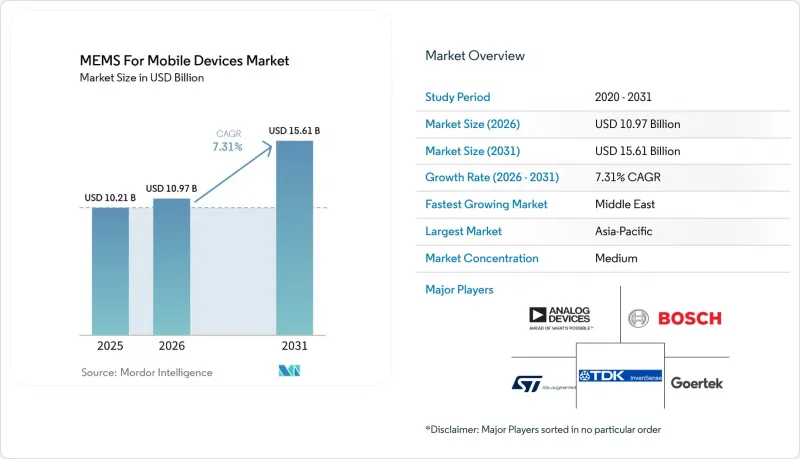
This report is Segmented by Type of Sensor (Fingerprint, Accelerometer, Gyroscope, Pressure, BAW, Microphones, and More), Mobile Device Type (Smartphones, Tablets, Wearables, Gaming, and More), Fabrication Technology (Surface, Bulk, SOI, CMOS-MEMS, and More), Integration Method (SiP, Soc, 3D-Stacked, Discrete, and More), and Geography. The Market Forecasts are Provided in Terms of Value (USD).
Global MEMS For Mobile Devices Market Trends and Insights
Growing Adoption of 5G and Ultra-Wideband Connectivity
Millimeter-wave radios need BAW filters with insertion loss below 1.5 dB and temperature coefficients under 25 ppm/°C, thresholds that piezoelectric thin-film resonators meet at high volume. Qualcomm's Snapdragon 8 Elite integrates ultra-wideband co-processors that trim power by 40%, enabling centimeter-level indoor positioning for augmented-reality services. These architectures depend on MEMS timing references providing phase-noise floors below -160 dBc/Hz at a 1 MHz offset, a metric unattainable by similarly sized quartz parts. Europe's recent spectrum auctions in the 3.4-3.8 GHz range triggered handset replacement cycles because legacy 4G filters cannot contain adjacent-channel interference in dense cells. The convergence of 5G and ultra-wideband is also enabling cross-platform applications, such as smartphone-driven keyless entry systems for vehicles. The MEMS for mobile devices market, therefore, benefits directly from every new mid-band or millimeter-wave launch worldwide.
Rising Integration of MEMS in Foldable and Rollable Displays
Flexible form factors endure more than 100,000 bends at radii below 5 mm, forcing sensor placement inside the display stack instead of on rigid boards. Samsung's Sensor OLED embeds organic photodiodes beneath each pixel to collect fingerprint and heart-rate data, pushing screen-to-body ratios beyond 95%. BOE shipped its first rollable OLED panels with integrated pressure sensors in Q3 2024, allowing interfaces that differentiate taps from palm contact. Such designs demand polyimide-compatible MEMS processes operating below 250 °C and favor thin-film piezoelectric materials over silicon-on-insulator, widening the material toolkit used in the MEMS for mobile devices market. Panel makers are capturing value that once flowed to discrete sensor vendors, compelling traditional suppliers to specialize in ultrathin die bonding and laser lift-off services.
Yield Losses from Wafer-Level Packaging Defects
Wafer-level encapsulation lowers unit cost but introduces cavity leaks, particle contamination, and stress-induced cracks that are hard to screen prior to test; field returns can exceed 500 ppm in high-volume mobile programs. ECTC 2024 papers attribute 60% of failures to microcracks created during through-silicon-via reveal steps. Bosch reported scrapping 8% of gyroscope wafers for hermeticity issues, cutting 2025 gross margin by 300 bps. New metrology tools detect subsurface voids but add USD 2-5 million per line and slow inspection by 30%. Although fan-out packages reduce stress, adoption still covers <10% of MEMS volume, prolonging the drag on the MEMS for mobile devices market.
Other drivers and restraints analyzed in the detailed report include:
- Demand for Low-Power Always-On Sensors in AI Edge Processing
- Standardization of Acoustic Zoom and Spatial Audio in Smartphones
- Limited Availability of Qualified MEMS Design Engineers
For complete list of drivers and restraints, kindly check the Table Of Contents.
Segment Analysis
Fingerprint units accounted for 35.21% of 2025 income, securing the largest MEMS for mobile devices market share thanks to second-generation ultrasonic solutions that authenticate through wet fingers in 0.3 seconds. The bulk acoustic wave category, although smaller, is advancing at 9.32% annually because each 5G flagship now embeds up to 60 filters spanning 600 MHz to 41 GHz. Accelerometers and gyroscopes together supplied roughly one-quarter of shipments, underpinned by gaming, optical-image stabilization, and indoor navigation. Pressure sensors contributed close to 8%, while MEMS microphones captured 18% as spatial-audio and noise-cancellation became standard in premium devices. Environmental sensing, magnetometers, humidity, gas detectors. made up the remainder and is climbing in pollution-sensitive regions.
Bulk acoustic wave resonators are crossing into precision timing, where their high Q supports oscillators with phase noise below -160 dBc/Hz, displacing quartz in Wi-Fi 7 routers. Fingerprint vendors are experimenting with blood-flow detection that may add continuous heart-rate tracking without extra optics, signaling further overlap among sensing modalities. Such cross-pollination amplifies shipment growth prospects and sustains pricing discipline inside the MEMS for mobile devices market.
Smartphones absorbed 66.41% of 2025 unit demand, reflecting their unrivaled scale. Wearables, however, are forecast to post a 7.52% CAGR, buoyed by FDA-cleared health functions and by smartwatches that now sample motion at 256 Hz for atrial-fibrillation screening. Tablets represented 12% of volume as stylus-pressure sensing broadened creative use cases. Mobile gaming devices comprised roughly 5%, and other gadgets, e-readers, AR glasses filled the balance.
Goertek's sub-200 µA always-on voice pickup straddles smart-glasses and earbud categories, illustrating how miniaturization unlocks design freedom across applications. Tablets continue to adopt force sensors offering 4,096 pressure levels, while gaming handhelds specify gyroscopes rated to 4,000 °/s. As smartphones import wearable-grade health metrics and wearables inherit cellular connectivity, platform boundaries blur, amplifying cross-category leverage within the MEMS for mobile devices market.
Complete Report Scope:
- By Type of Sensor
- Fingerprint Sensor
- Accelerometer
- Gyroscope
- Pressure Sensor
- Bulk Acoustic Wave (BAW) Sensor
- Microphones
- Other Types of Sensors
- By Mobile Device Type
- Smartphones
- Tablets
- Wearable Devices
- Mobile Gaming Devices
- Other Mobile Device Types
- By Fabrication Technology
- Surface Micromachining
- Bulk Micromachining
- High Aspect Ratio SOI
- CMOS-MEMS Integration
- Other Fabrication Technologies
- By Integration Method
- System-in-Package (SiP)
- System-on-Chip (SoC)
- Hybrids and 3D-Stacked
- Discrete MEMS
- Other Integration Methods
- By Geography
- North America
- United States
- Canada
- Mexico
- South America
- Brazil
- Argentina
- Rest of South America
- Europe
- Germany
- United Kingdom
- France
- Italy
- Spain
- Rest of Europe
- Asia-Pacific
- China
- Japan
- South Korea
- India
- Australia
- New Zealand
- Rest of Asia-Pacific
- Middle East and Africa
- Middle East
- United Arab Emirates
- Saudi Arabia
- Turkey
- Rest of Middle East
- Africa
- South Africa
- Nigeria
- Kenya
- Rest of Africa
- Middle East
- North America
Geography Analysis
Asia-Pacific captured 46.82% of 2025 revenue, driven by China's thin-film deposition scale, South Korea's CMOS-MEMS co-integration, and Taiwan's foundries that anchor global fabless supply. Beijing's USD 3 billion subsidy aims to lift domestic MEMS wafer capacity 40% by 2027, and Japan's Murata plus TDK delivered over 30% of global MEMS microphone volume by exploiting ceramic-packaging prowess. Samsung Electro-Mechanics is piloting fan-out wafer-level packaging at thicknesses below 0.6 mm, while India's Tata Electronics is building a 300 mm fab that will allocate one-fifth of capacity to MEMS from Q4 2026, reinforcing regional self-sufficiency.
North America produced roughly 24% of 2025 revenue. The United States leads fabless design, and the FDA's string of wearable clearances validates medical MEMS use cases. Canada earmarked CAD 50 million to train 500 MEMS engineers, and Mexico's emerging packaging nodes serve automotive and industrial customers. Europe held 18%; Infineon and Bosch dominate local production, and the AI Act cements on-device processing as a continental norm. The MEMS for mobile devices market therefore sees regulatory pull in the West and volume pull in Asia.
The Middle East, while only mid-single digit today, is growing 8.36% annually as Gulf sovereign funds finance assembly lines that localize supply. Turkey courts test and packaging investment to act as a Europe-Asia bridge. Africa and South America collectively remain below 10% but score double-digit growth tied to rising smartphone penetration: Brazilian and Nigerian assemblers integrate multi-sensor arrays to differentiate camera stabilization and biometric security. Regional diversification thus tempers geopolitical supply-chain risks and enlarges the aggregate MEMS for mobile devices market size.
- STMicroelectronics N.V.
- Bosch Sensortec GmbH
- TDK Corporation (InvenSense)
- Goertek Inc.
- Analog Devices Inc.
- Knowles Corporation
- Murata Manufacturing Co., Ltd.
- AAC Technologies Holdings Inc.
- MEMSIC Inc.
- BSE Co., Ltd.
- Alps Alpine Co., Ltd.
- Infineon Technologies AG
- Qorvo, Inc.
- Qualcomm Technologies, Inc.
- Cirrus Logic, Inc.
- Omron Corporation
- ROHM Co., Ltd.
- SITime Corporation
- TE Connectivity Ltd.
- Robert Bosch GmbH
Additional Benefits:
- The market estimate (ME) sheet in Excel format
- 3 months of analyst support
TABLE OF CONTENTS
1 INTRODUCTION
- 1.1 Study Assumptions and Market Definition
- 1.2 Scope of the Study
2 RESEARCH METHODOLOGY
3 EXECUTIVE SUMMARY
4 MARKET LANDSCAPE
- 4.1 Market Overview
- 4.2 Market Drivers
- 4.2.1 Growing Adoption of 5G and Ultra-Wideband Connectivity
- 4.2.2 Rising Integration of MEMS in Foldable and Rollable Displays
- 4.2.3 Demand for Low-Power Always-On Sensors in AI Edge Processing
- 4.2.4 Standardization of Acoustic Zoom and Spatial Audio in Smartphones
- 4.2.5 Surge in Mobile Health and Environmental Sensing Applications
- 4.2.6 Expansion of CMOS-Compatible MEMS Foundry Ecosystem
- 4.3 Market Restraints
- 4.3.1 Yield Losses from Wafer-Level Packaging Defects
- 4.3.2 Limited Availability of Qualified MEMS Design Engineers
- 4.3.3 IP Fragmentation Across Motion, Pressure and Acoustic MEMS
- 4.3.4 Supply-Chain Concentration in Specialty Piezoelectric Materials
- 4.4 Industry Value Chain Analysis
- 4.5 Regulatory Landscape
- 4.6 Technological Outlook
- 4.7 Porter's Five Forces Analysis
- 4.7.1 Bargaining Power of Buyers
- 4.7.2 Bargaining Power of Suppliers
- 4.7.3 Threat of New Entrants
- 4.7.4 Threat of Substitutes
- 4.7.5 Competitive Rivalry
5 MARKET SIZE AND GROWTH FORECASTS (VALUE)
- 5.1 By Type of Sensor
- 5.1.1 Fingerprint Sensor
- 5.1.2 Accelerometer
- 5.1.3 Gyroscope
- 5.1.4 Pressure Sensor
- 5.1.5 Bulk Acoustic Wave (BAW) Sensor
- 5.1.6 Microphones
- 5.1.7 Other Types of Sensors
- 5.2 By Mobile Device Type
- 5.2.1 Smartphones
- 5.2.2 Tablets
- 5.2.3 Wearable Devices
- 5.2.4 Mobile Gaming Devices
- 5.2.5 Other Mobile Device Types
- 5.3 By Fabrication Technology
- 5.3.1 Surface Micromachining
- 5.3.2 Bulk Micromachining
- 5.3.3 High Aspect Ratio SOI
- 5.3.4 CMOS-MEMS Integration
- 5.3.5 Other Fabrication Technologies
- 5.4 By Integration Method
- 5.4.1 System-in-Package (SiP)
- 5.4.2 System-on-Chip (SoC)
- 5.4.3 Hybrids and 3D-Stacked
- 5.4.4 Discrete MEMS
- 5.4.5 Other Integration Methods
- 5.5 By Geography
- 5.5.1 North America
- 5.5.1.1 United States
- 5.5.1.2 Canada
- 5.5.1.3 Mexico
- 5.5.2 South America
- 5.5.2.1 Brazil
- 5.5.2.2 Argentina
- 5.5.2.3 Rest of South America
- 5.5.3 Europe
- 5.5.3.1 Germany
- 5.5.3.2 United Kingdom
- 5.5.3.3 France
- 5.5.3.4 Italy
- 5.5.3.5 Spain
- 5.5.3.6 Rest of Europe
- 5.5.4 Asia-Pacific
- 5.5.4.1 China
- 5.5.4.2 Japan
- 5.5.4.3 South Korea
- 5.5.4.4 India
- 5.5.4.5 Australia
- 5.5.4.6 New Zealand
- 5.5.4.7 Rest of Asia-Pacific
- 5.5.5 Middle East and Africa
- 5.5.5.1 Middle East
- 5.5.5.1.1 United Arab Emirates
- 5.5.5.1.2 Saudi Arabia
- 5.5.5.1.3 Turkey
- 5.5.5.1.4 Rest of Middle East
- 5.5.5.2 Africa
- 5.5.5.2.1 South Africa
- 5.5.5.2.2 Nigeria
- 5.5.5.2.3 Kenya
- 5.5.5.2.4 Rest of Africa
- 5.5.5.1 Middle East
- 5.5.1 North America
6 COMPETITIVE LANDSCAPE
- 6.1 Market Concentration
- 6.2 Strategic Moves
- 6.3 Market Share Analysis
- 6.4 Company Profiles (includes Global Level Overview, Market Level Overview, Core Segments, Financials as available, Strategic Information, Market Rank/Share, Products and Services, Recent Developments)
- 6.4.1 STMicroelectronics N.V.
- 6.4.2 Bosch Sensortec GmbH
- 6.4.3 TDK Corporation (InvenSense)
- 6.4.4 Goertek Inc.
- 6.4.5 Analog Devices Inc.
- 6.4.6 Knowles Corporation
- 6.4.7 Murata Manufacturing Co., Ltd.
- 6.4.8 AAC Technologies Holdings Inc.
- 6.4.9 MEMSIC Inc.
- 6.4.10 BSE Co., Ltd.
- 6.4.11 Alps Alpine Co., Ltd.
- 6.4.12 Infineon Technologies AG
- 6.4.13 Qorvo, Inc.
- 6.4.14 Qualcomm Technologies, Inc.
- 6.4.15 Cirrus Logic, Inc.
- 6.4.16 Omron Corporation
- 6.4.17 ROHM Co., Ltd.
- 6.4.18 SiTime Corporation
- 6.4.19 TE Connectivity Ltd.
- 6.4.20 Robert Bosch GmbH
7 MARKET OPPORTUNITIES AND FUTURE OUTLOOK
- 7.1 White-Space and Unmet-Need Assessment

