PUBLISHER: Mordor Intelligence | PRODUCT CODE: 2073531

PUBLISHER: Mordor Intelligence | PRODUCT CODE: 2073531
Luxury Watch - Market Share Analysis, Industry Trends & Statistics, Growth Forecasts (2026 - 2031)
According to Mordor Intelligence, the luxury watch market size was valued at USD 79.87 billion in 2025 and estimated to grow from USD 84.77 billion in 2026 to reach USD 114.19 billion by 2031, at a CAGR of 6.14% during the forecast period (2026-2031).
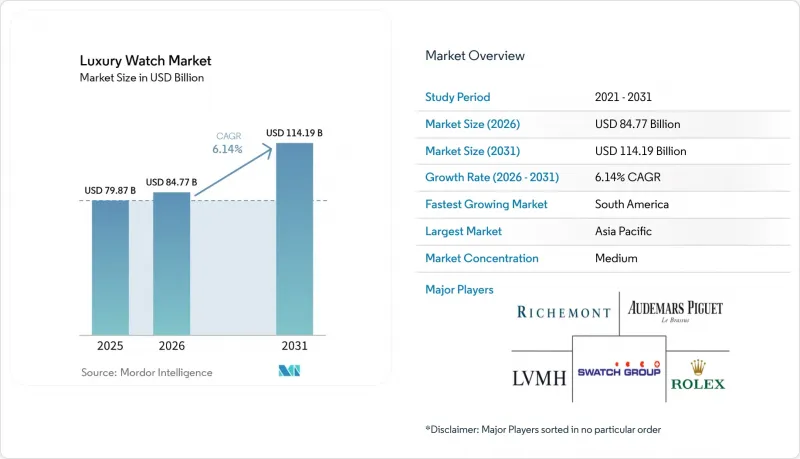
This report is Segmented by Product Type (Quartz/Mechanical Watch and Digital Watch), End User (Women, Men, and Unisex), Distribution Channel (Offline Stores and Online Stores), and Geography (North America, Europe, Asia-Pacific, South America, and the Middle East and Africa). The Market Forecasts are Provided in Terms of Value (USD).
Global Luxury Watch Market Trends and Insights
Increasing demand for collectible and investment-grade pieces
The demand for luxury watches like Rolex, Patek Philippe, and Audemars Piguet as high-value collectibles and alternative investments is heavily driven by the concentration of high-net-worth individuals (HNWIs) and wealth in key global markets, particularly the United States. The country leads globally with 22.7 million individuals having a net worth of over USD 1 million, far surpassing any other nation, as reported by the World Population Review in 2025. Both brands and the secondary market are formalizing vintage trading and certified pre-owned programs, offering benefits such as two-year warranties that provide buyers with confidence and help maintain higher valuations. Record-breaking auction sales, like the CHF 31 million Patek Philippe Grandmaster Chime, set price benchmarks for rare and complex watches, establishing them as alternative investment assets. Investments by specialist funds and family offices in rare watch collections, along with advancements in authentication technology that reduce misinformation, are making luxury watches appealing.
Influence of social media and celebrity endorsement
The impact of social media and celebrity endorsements is a key factor driving the growth of the global luxury watch market. According to the World Bank, 71% of the global population was using the internet in 2024, making platforms like Instagram, TikTok, and YouTube highly influential. These platforms transform celebrity appearances and influencer posts into immediate demand signals, influencing consumer preferences and driving resale activity. For example, when Rafael Nadal wore the Richard Mille RM 27-05, it led to a sharp rise in online searches and inquiries in the secondary market within hours. This trend has led luxury watch brands to actively partner with influencers to enhance their market presence. They are introducing exclusive limited-edition watches and producing engaging digital content to showcase the intricate craftsmanship and advanced technical features of their products. These efforts aim to attract a wider audience and strengthen their brand image in the competitive luxury watch market.
Proliferation of counterfeit Products
Proliferation of counterfeit products is a major restraint on the luxury watch market as high-quality replicas produced using Computer Numerical Control (CNC) machining and 3D printing increasingly blur the line between genuine and fake timepieces, especially across online and peer-to-peer resale channels where verification is weaker, forcing brands to invest more in digital certificates, micro-engraving, and hologram rehauts to protect authenticity. The scale of this challenge is reflected in recent enforcement actions, with United States Customs seizing more than USD 186 million worth of counterfeit luxury jewelry and watches in Louisville in July 2025, followed by another 2025 seizure of over 50 fake luxury watches with a real value exceeding USD 6 million at Cincinnati/Northern Kentucky Airport, underscoring how widespread illicit trade continues to undermine consumer confidence and legitimate luxury watch sales.
Other drivers and restraints analyzed in the detailed report include:
- Product innovation in terms of raw material and design
- Growing interest in vintage and pre-owned luxury watches
- Rising smartwatch adoption challenges traditional timepiece sales
For complete list of drivers and restraints, kindly check the Table Of Contents.
Segment Analysis
Quartz and mechanical watches remain the dominant segments in the luxury watch market as of 2025, holding 63.58% of the total market share. These watches are highly valued for their traditional craftsmanship, timeless designs, and the emotional connection they create with buyers. Many consumers, especially collectors and high-net-worth individuals, view these timepieces as symbols of status and sophistication. Their ability to retain or even increase in value over time makes them a preferred choice for those seeking both luxury and investment potential. This enduring appeal ensures that traditional watches remain the cornerstone of the luxury watch market.
Meanwhile, digital and hybrid luxury watches are steadily gaining popularity, driven by the growing demand for smart features combined with stylish designs. This segment is projected to grow at a CAGR of 6.45% through 2031, as more consumers seek watches that offer functionalities like fitness tracking, connectivity, and convenience for daily use. Hybrid models, which blend classic aesthetics with modern technology, are particularly appealing to younger buyers who value both tradition and innovation. These watches cater to a wide range of needs, from lifestyle to wellness, making them a versatile choice. This trend highlights how technological advancements are influencing the luxury watch market while complementing the enduring charm of traditional craftsmanship.
Complete Report Scope:
- By Product Type
- Quartz/Mechanical Watch
- Digital Watch
- By End User
- Men
- Women
- Unisex
- By Distribution Channel
- Offline Stores
- Online Stores
- By Geography
- North America
- United States
- Canada
- Mexico
- Rest of North America
- South America
- Brazil
- Colombia
- Chile
- Peru
- Argentina
- Rest of South America
- Europe
- United Kingdom
- Germany
- France
- Italy
- Spain
- Poland
- Belgium
- Sweden
- Rest of Europe
- Asia-Pacific
- China
- Japan
- India
- Australia
- Indonesia
- South Korea
- Thailand
- Singapore
- Rest of Asia-Pacific
- Middle East and Africa
- South Africa
- Saudi Arabia
- United Arab Emirates
- Nigeria
- Egypt
- Morocco
- Turkey
- Rest of Middle East and Africa
- North America
Geography Analysis
The Asia Pacific region remains the largest market for luxury watches in 2025, accounting for 41.58% of global revenue. This dominance is driven by rising wealth, a growing community of collectors, and strong cross-border shopping activity. Major markets, including China, Japan, Singapore, Hong Kong, and India, are key contributors to this growth. Factors such as increasing tourism, currency fluctuations, and evolving consumer preferences further drive demand for luxury timepieces. The region remains the primary growth engine for the global luxury watch industry, driven by its robust economic and consumer dynamics.
South America is rapidly becoming the fastest-growing market for luxury watches, with sales projected to grow at a 7.85% CAGR during the forecast period. An expanding affluent population, improved access to credit, and the growing presence of luxury brands in urban centers fuel the region's growth. Countries such as Brazil, Chile, and Colombia are experiencing a surge in interest in high-end watches. The expansion of luxury boutiques and a rising appreciation for premium goods are further driving this trend. South America presents significant opportunities for global watch brands to tap into untapped demand and expand their market presence.
Europe, North America, and the Middle East and Africa remain critical regions for luxury watch sales, even as growth slows in these mature markets. These areas benefit from strong tourism, established retail networks, and a high concentration of wealthy consumers. Cities such as Geneva, Paris, Milan, London, Dubai, and Riyadh serve as major hubs for luxury watch transactions. While these regions provide stability and consistent high-value sales, they complement the faster growth seen in emerging markets like Asia Pacific and South America, ensuring a balanced global market performance.
- Rolex SA
- Compagnie Financiere Richemont S.A.
- The Swatch Group Ltd
- LVMH Moet Hennessy Louis Vuitton SE
- Patek Philippe SA
- Audemars Piguet Holding SA
- Kering S.A
- Seiko Group Corporation
- Breitling SA
- Richard Mille SA
- Chopard Group
- H. Moser & Cie
- F. P. Journe Invenit et Fecit
- Ming Watch
- De Bethune SA
- Armin Strom AG
- Laurent Ferrier SA
- Ressence NV
- Czapek & Cie SA
- Greubel Forsey SA
Additional Benefits:
- The market estimate (ME) sheet in Excel format
- 3 months of analyst support
TABLE OF CONTENTS
1 INTRODUCTION
- 1.1 Study Assumptions and Market Definition
- 1.2 Scope of the Study
2 RESEARCH METHODOLOGY
3 EXECUTIVE SUMMARY
4 MARKET LANDSCAPE
- 4.1 Market Overview
- 4.2 Market Drivers
- 4.2.1 Strong demand for luxury accessories from millenial consumers
- 4.2.2 Influence of social media and celebrity endorsement
- 4.2.3 Increasing demand for collectible and investment-grade pieces
- 4.2.4 Product innovation in terms of raw material and design
- 4.2.5 Rising consumer awareness about watch craftsmanship and heritage
- 4.2.6 Growing interest in vintage and pre-owned luxury watches
- 4.3 Market Restraints
- 4.3.1 Proliferation of counterfeit Products
- 4.3.2 Lesser demand from price sensitive consumers
- 4.3.3 High import tariffs increase retail prices globally
- 4.3.4 Rising smartwatch adoption challenges traditional timepiece sales
- 4.4 Value Chain Analysis
- 4.5 Consumer Behaviour Analysis
- 4.6 Regulatory Outlook
- 4.7 Porter's Five Forces
- 4.7.1 Threat of New Entrants
- 4.7.2 Bargaining Power of Buyers
- 4.7.3 Bargaining Power of Suppliers
- 4.7.4 Threat of Substitute Products
- 4.7.5 Intensity of Competitive Rivalry
5 MARKET SIZE AND GROWTH FORECASTS (VALUE)
- 5.1 By Product Type
- 5.1.1 Quartz/Mechanical Watch
- 5.1.2 Digital Watch
- 5.2 By End User
- 5.2.1 Men
- 5.2.2 Women
- 5.2.3 Unisex
- 5.3 By Distribution Channel
- 5.3.1 Offline Stores
- 5.3.2 Online Stores
- 5.4 By Geography
- 5.4.1 North America
- 5.4.1.1 United States
- 5.4.1.2 Canada
- 5.4.1.3 Mexico
- 5.4.1.4 Rest of North America
- 5.4.2 South America
- 5.4.2.1 Brazil
- 5.4.2.2 Colombia
- 5.4.2.3 Chile
- 5.4.2.4 Peru
- 5.4.2.5 Argentina
- 5.4.2.6 Rest of South America
- 5.4.3 Europe
- 5.4.3.1 United Kingdom
- 5.4.3.2 Germany
- 5.4.3.3 France
- 5.4.3.4 Italy
- 5.4.3.5 Spain
- 5.4.3.6 Poland
- 5.4.3.7 Belgium
- 5.4.3.8 Sweden
- 5.4.3.9 Rest of Europe
- 5.4.4 Asia-Pacific
- 5.4.4.1 China
- 5.4.4.2 Japan
- 5.4.4.3 India
- 5.4.4.4 Australia
- 5.4.4.5 Indonesia
- 5.4.4.6 South Korea
- 5.4.4.7 Thailand
- 5.4.4.8 Singapore
- 5.4.4.9 Rest of Asia-Pacific
- 5.4.5 Middle East and Africa
- 5.4.5.1 South Africa
- 5.4.5.2 Saudi Arabia
- 5.4.5.3 United Arab Emirates
- 5.4.5.4 Nigeria
- 5.4.5.5 Egypt
- 5.4.5.6 Morocco
- 5.4.5.7 Turkey
- 5.4.5.8 Rest of Middle East and Africa
- 5.4.1 North America
6 COMPETITIVE LANDSCAPE
- 6.1 Market Concentration
- 6.2 Strategic Moves
- 6.3 Market Share Analysis
- 6.4 Company Profiles (includes Global-level Overview, Market-level Overview, Core Segments, Financials (if available), Strategic Information, Market Rank/Share, Products and Services, Recent Developments)
- 6.4.1 Rolex SA
- 6.4.2 Compagnie Financiere Richemont S.A.
- 6.4.3 The Swatch Group Ltd
- 6.4.4 LVMH Moet Hennessy Louis Vuitton SE
- 6.4.5 Patek Philippe SA
- 6.4.6 Audemars Piguet Holding SA
- 6.4.7 Kering S.A
- 6.4.8 Seiko Group Corporation
- 6.4.9 Breitling SA
- 6.4.10 Richard Mille SA
- 6.4.11 Chopard Group
- 6.4.12 H. Moser & Cie
- 6.4.13 F. P. Journe Invenit et Fecit
- 6.4.14 Ming Watch
- 6.4.15 De Bethune SA
- 6.4.16 Armin Strom AG
- 6.4.17 Laurent Ferrier SA
- 6.4.18 Ressence NV
- 6.4.19 Czapek & Cie SA
- 6.4.20 Greubel Forsey SA
7 MARKET OPPORTUNITIES AND FUTURE OUTLOOK

