PUBLISHER: Mordor Intelligence | PRODUCT CODE: 2073534

PUBLISHER: Mordor Intelligence | PRODUCT CODE: 2073534
Language Services - Market Share Analysis, Industry Trends & Statistics, Growth Forecasts (2026 - 2031)
According to Mordor Intelligence, the language services market size is projected to be USD 71.84 billion in 2025, USD 75.53 billion in 2026, and reach USD 96.97 billion by 2031, growing at a CAGR of 5.12% from 2026 to 2031.
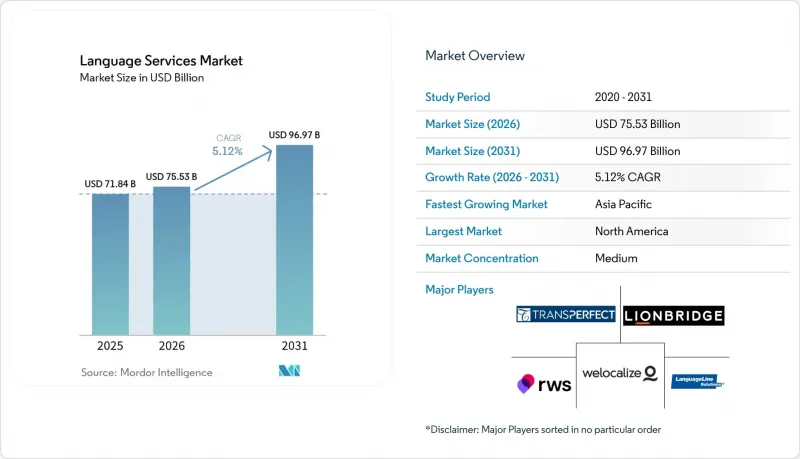
This report is Segmented by Service Type (Translation, Localisation, Interpreting, and More), End-User Vertical (Life Sciences, Media and Entertainment, Legal Finance and Patents, E-Commerce and Retail, IT and Telecom, and More), Delivery Mode (On-Site, Remote, and More), Technology (Human-Only, Pure MT, and More), and Geography. The Market Forecasts are Provided in Terms of Value (USD).
Global Language Services Market Trends and Insights
Corporate Globalization Wave Intensifies Demand
Enterprises pursuing cross-border revenue embed localization experts into design and product teams, reframing translation as a growth lever rather than a cost center. Native-language checkout flows, customer support portals, and compliance documentation reduce abandonment and expedite market entry, especially across the fragmented Southeast Asian e-commerce landscape. Success stories on TransPerfect's GlobalLink platform show clients such as AIG cutting content turnaround by 20% and saving USD 250,000 annually through workflow automation. The outcome is a structural shift in premium localization demand that sustains the language services market's trajectory even as macroeconomic cycles fluctuate. Vendors with global linguist networks and ISO-aligned security protocols secure multi-year master agreements, which anchor predictable cash flow.
Explosive Multilingual Digital-Content Creation
Streaming giants, game publishers, and social-media platforms now launch titles and episodes in dozens of languages simultaneously, overwhelming purely human capacity. Hybrid workflows that blend AI dubbing and linguist post-production cut release times by up to 70% and costs by 50%, as demonstrated by Deepdub's 80-language projects. Synthesia's synthetic-voice platform spans 130+ languages and holds ISO 42001 certification, signaling enterprise-grade reliability. This velocity decouples output from head-count, expanding feasible coverage to long-tail language pairs and enlarging the overall language services market. However, generic volumes face margin pressure, so agencies differentiate through domain expertise, cultural transcreation, and proprietary AI engines.
Open-Source Machine Translation Commoditizes Basic Content
Freely available neural models such as Meta's NLLB-200 and Google Translate now reach near-human parity on common language pairs, enabling firms to translate manuals or reviews in-house. This erodes pricing power on commodity text and forces agencies to reposition as managed-service partners that fine-tune open engines, integrate MT into content stacks, and certify output quality. Although higher-value regulated and creative projects remain insulated, margin compression on basic content trims overall growth in the language services market.
Other drivers and restraints analyzed in the detailed report include:
- Stricter Life-Science Compliance Triggers Premium Regulated-Content Services
- Generative AI Boosts Throughput And Margin Expansion
- Talent Scarcity For Niche Domain Linguists
For complete list of drivers and restraints, kindly check the Table Of Contents.
Segment Analysis
Translation Services contributed 42.52% of 2025 revenue, cementing its role as the foundational engine of the language services market. Clients rely on it for legal contracts, product documentation, and compliance filings, and providers have embedded automated QA, desktop publishing, and terminology management to preserve layout and brand tone. Yet growth momentum is shifting toward AI-Enabled Localization, which is advancing at a 6.16% CAGR by delivering adaptive output that updates alongside agile product releases.
Localization workflows now bundle cultural adaptation, UI testing, and multimedia engineering, making them indispensable for software, gaming, and e-commerce launches. Interpreting Services are splitting into on-demand remote channels and high-touch simultaneous sessions for conferences and courts, while subtitling and captioning volumes surge on the back of streaming and corporate training. Premium transcreation reimagines creative assets for target cultures, commanding higher fees and reinforcing provider differentiation. Integrated offerings that weave machine translation, human post-editing, and cultural consulting under unified governance continue to expand total language services market size.
Life Sciences captured 18.36% of 2025 spending, underpinned by multilingual labeling, pharmacovigilance reports, and clinical-trial materials required by the FDA and EMA. The need for audit trails and terminological precision supports premium pricing and predictable demand, insulating revenue during economic downturns.
E-Commerce and Retail is forecast to grow at a 7.32% CAGR because cross-border marketplaces must localize product descriptions, payment flows, and customer-support scripts in near real time. As regional payment regulations proliferate, accurate translation becomes essential to checkout compliance and conversion uplift, enlarging the language services market share tied to retail. Media and Entertainment, Legal Finance and Patents, and IT and Telecom add diversified volume streams, while Government projects such as Acolad's EU regulation contract illustrate scale opportunities in public-sector translation.
Complete Report Scope:
- By Service Type
- Translation services
- Localisation services
- Interpreting services
- Subtitling and captioning
- Desktop publishing (DTP)
- Transcreation
- Other Service Types
- By End-User Vertical
- Life sciences
- Media and entertainment
- Legal, finance and patents
- E-commerce and retail
- IT and telecom
- Government and public sector
- Manufacturing and industrial
- Other End-User Verticals
- By Service Delivery Mode
- On-site
- Remote
- Over-the-Phone Interpreting (OPI)
- Video Remote Interpreting (VRI)
- Hybrid
- By Technology
- Human-only
- Pure machine translation
- Post-edited machine translation (PEMT)
- AI-enabled localisation
- Other Technologies
- By Geography
- North America
- United States
- Canada
- Mexico
- South America
- Brazil
- Argentina
- Rest of South America
- Europe
- Germany
- United Kingdom
- France
- Italy
- Spain
- Russia
- Rest of Europe
- Asia Pacific
- China
- Japan
- South Korea
- India
- Australia
- New Zealand
- Rest of Asia Pacific
- Middle East
- United Arab Emirates
- Saudi Arabia
- Turkey
- Rest of Middle East
- Africa
- South Africa
- Nigeria
- Kenya
- Rest of Africa
- North America
Geography Analysis
North America generated 37.26% of 2025 revenue, powered by pharmaceutical filings, cross-border e-discovery, and software globalization. United States buyers pay premium rates for certified linguists, lifting average invoice values inside the language services market. Canada's federal bilingualism drives English-French demand, while Mexico's near-shoring boom boosts English-Spanish technical documentation.
Asia Pacific posts the fastest expansion at a 7.36% CAGR. Voice-assistant rollouts covering 30+ Indian languages, plus Japanese and Korean state subsidies for cultural exports, add high-volume audio and subtitle work. China's e-commerce giants localize catalog listings and chat-bots into Southeast Asian vernaculars, lifting regional language services market size. Australia and New Zealand act as quality-assurance hubs that support 24-hour global delivery.
Europe remains a stalwart demand center because EU regulations mandate multilingual packaging, clinical-trial dossiers, and public-sector communications across 24 official languages. Germany, France, and the United Kingdom concentrate specialist linguists in automotive, chemical, and luxury fields, preserving the continent's high-value share of the language services market. The Middle East and Africa and South America contribute incremental upside as Saudi Vision 2030, Brazilian retail liberalization, and South African public-health initiatives unlock Arabic, Portuguese, and African-language projects.
- TransPerfect Global Inc.
- RWS Holdings plc
- Lionbridge Technologies Inc.
- LanguageLine Solutions
- Welocalize Inc.
- Acolad Group
- Keywords Studios plc
- Semantix AB
- Summa Linguae Technologies
- United Language Group
- Straker Translations Ltd.
- Appen Ltd.
- Pactera EDGE
- Honyaku Center Inc.
- PGLS
- Atlas Language Services Inc.
- Globe Language Services Inc.
- Iyuno-SDI Group
- Smartling Inc.
- LILT Inc.
Additional Benefits:
- The market estimate (ME) sheet in Excel format
- 3 months of analyst support
TABLE OF CONTENTS
1 INTRODUCTION
- 1.1 Study Assumptions and Market Definition
- 1.2 Scope of the Study
2 RESEARCH METHODOLOGY
3 EXECUTIVE SUMMARY
4 MARKET LANDSCAPE
- 4.1 Market Overview
- 4.2 Market Drivers
- 4.2.1 Corporate Globalisation Wave Intensifies Demand
- 4.2.2 Explosive Multilingual Digital-Content Creation
- 4.2.3 Stricter Life-Science Compliance Triggers Premium Regulated-Content Services
- 4.2.4 Generative Ai Boosts Throughput And Margin Expansion
- 4.2.5 Hyper-Personalised Multilingual Cx Mandates Real-Time Micro-Localisation
- 4.2.6 Rise Of Voice Assistants In Emerging Markets Unlocks Mass Audio Localisation
- 4.3 Market Restraints
- 4.3.1 Open-Source Machine Translation Commoditises Basic Content
- 4.3.2 Talent Scarcity For Niche Domain Linguists
- 4.3.3 Stringent Data-Sovereignty Laws Restrict Cross-Border Linguistic Datasets
- 4.3.4 Rising Client-Side Integration Costs Create Vendor-Switching Friction
- 4.4 Industry Value Chain Analysis
- 4.5 Regulatory Landscape
- 4.6 Technological Outlook
- 4.7 Cloud-based TMS and CAT platforms
- 4.8 Neural and large-language-model machine translation
- 4.9 Media-localisation technology, synthetic dubbing, SDH
- 4.10 Cyber-secure language workbenches
- 4.11 Porter's Five Forces Analysis
- 4.11.1 Bargaining power of suppliers
- 4.11.2 Bargaining power of buyers
- 4.11.3 Threat of new entrants
- 4.11.4 Threat of substitutes
- 4.11.5 Intensity of competitive rivalry
- 4.12 Investment and Funding Analysis
- 4.13 Impact of Macroeconomic Factors on the Market
5 MARKET SIZE AND GROWTH FORECASTS (VALUE)
- 5.1 By Service Type
- 5.1.1 Translation services
- 5.1.2 Localisation services
- 5.1.3 Interpreting services
- 5.1.4 Subtitling and captioning
- 5.1.5 Desktop publishing (DTP)
- 5.1.6 Transcreation
- 5.1.7 Other Service Types
- 5.2 By End-User Vertical
- 5.2.1 Life sciences
- 5.2.2 Media and entertainment
- 5.2.3 Legal, finance and patents
- 5.2.4 E-commerce and retail
- 5.2.5 IT and telecom
- 5.2.6 Government and public sector
- 5.2.7 Manufacturing and industrial
- 5.2.8 Other End-User Verticals
- 5.3 By Service Delivery Mode
- 5.3.1 On-site
- 5.3.2 Remote
- 5.3.2.1 Over-the-Phone Interpreting (OPI)
- 5.3.2.2 Video Remote Interpreting (VRI)
- 5.3.3 Hybrid
- 5.4 By Technology
- 5.4.1 Human-only
- 5.4.2 Pure machine translation
- 5.4.3 Post-edited machine translation (PEMT)
- 5.4.4 AI-enabled localisation
- 5.4.5 Other Technologies
- 5.5 By Geography
- 5.5.1 North America
- 5.5.1.1 United States
- 5.5.1.2 Canada
- 5.5.1.3 Mexico
- 5.5.2 South America
- 5.5.2.1 Brazil
- 5.5.2.2 Argentina
- 5.5.2.3 Rest of South America
- 5.5.3 Europe
- 5.5.3.1 Germany
- 5.5.3.2 United Kingdom
- 5.5.3.3 France
- 5.5.3.4 Italy
- 5.5.3.5 Spain
- 5.5.3.6 Russia
- 5.5.3.7 Rest of Europe
- 5.5.4 Asia Pacific
- 5.5.4.1 China
- 5.5.4.2 Japan
- 5.5.4.3 South Korea
- 5.5.4.4 India
- 5.5.4.5 Australia
- 5.5.4.6 New Zealand
- 5.5.4.7 Rest of Asia Pacific
- 5.5.5 Middle East
- 5.5.5.1 United Arab Emirates
- 5.5.5.2 Saudi Arabia
- 5.5.5.3 Turkey
- 5.5.5.4 Rest of Middle East
- 5.5.6 Africa
- 5.5.6.1 South Africa
- 5.5.6.2 Nigeria
- 5.5.6.3 Kenya
- 5.5.6.4 Rest of Africa
- 5.5.1 North America
6 COMPETITIVE LANDSCAPE
- 6.1 Market Concentration
- 6.2 Strategic Moves
- 6.3 Market Share Analysis
- 6.4 Company Profiles (includes global-level overview, market-level overview, core segments, financials as available, strategic information, market rank or share for key companies, products and services, and recent developments)
- 6.4.1 TransPerfect Global Inc.
- 6.4.2 RWS Holdings plc
- 6.4.3 Lionbridge Technologies Inc.
- 6.4.4 LanguageLine Solutions
- 6.4.5 Welocalize Inc.
- 6.4.6 Acolad Group
- 6.4.7 Keywords Studios plc
- 6.4.8 Semantix AB
- 6.4.9 Summa Linguae Technologies
- 6.4.10 United Language Group
- 6.4.11 Straker Translations Ltd.
- 6.4.12 Appen Ltd.
- 6.4.13 Pactera EDGE
- 6.4.14 Honyaku Center Inc.
- 6.4.15 PGLS
- 6.4.16 Atlas Language Services Inc.
- 6.4.17 Globe Language Services Inc.
- 6.4.18 Iyuno-SDI Group
- 6.4.19 Smartling Inc.
- 6.4.20 LILT Inc.
7 MARKET OPPORTUNITIES AND FUTURE OUTLOOK
- 7.1 White-Space and Unmet-Need Assessment

