PUBLISHER: Mordor Intelligence | PRODUCT CODE: 2073542

PUBLISHER: Mordor Intelligence | PRODUCT CODE: 2073542
Robotic Vision - Market Share Analysis, Industry Trends & Statistics, Growth Forecasts (2026 - 2031)
According to Mordor Intelligence, the global robotic vision market size reached USD 3.56 billion in 2026 and is forecast to climb to USD 5.56 billion by 2031, advancing at a 9.33% CAGR.
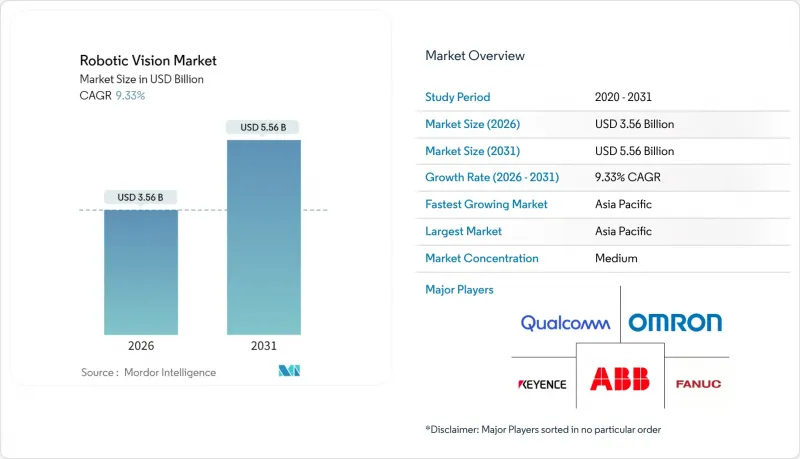
This report is Segmented by Technology (2D Vision Systems, 3D Vision Systems, Multispectral/Infrared Vision, and More), Component (Hardware, Software, and Services), Robot Type (Industrial Robots, Aerial Drones, and More), Application (Material Handling, Pick and Place, and More), End-User Industry (Automotive, Agriculture, and More), and Geography. The Market Forecasts are Provided in Terms of Value (USD).
Global Robotic Vision Market Trends and Insights
Accelerating adoption of AI-embedded 3D vision for complex assembly
AI-embedded 3D Vision lets robots interpret depth, pose, and surface texture in real time, enabling adaptive placement of battery cells, circuit boards, and molded plastics. Automotive plants in Germany and the United States cut battery-module scrap rates by up to 50% after switching from fixed jigs to 3D vision-guided placement. Electronics makers in China and South Korea improved solder-joint detection on curved substrates, overcoming 2D cameras. Commodity edge processors such as Intel Movidius and Qualcomm RB5 now execute neural inference at under 5 watts, eliminating heat constraints inside lightweight cobots. As component prices fall, 3D systems that once cost 2 to 3 times more than 2D alternatives now carry only a 50% premium, speeding replacement cycles. The advance aligns with zero-defect mandates that tie supplier bonuses to ppm defect targets.
Government incentives for automation amid labor shortages
Advanced economies face shrinking labor pools as participation rates remain below pre-pandemic levels. The United Kingdom awarded GBP 250 million (USD 312 million) in grants to factories integrating vision-equipped cobots, thereby trimming payback periods to under 2 years. Japan's tax credit covering 30% of vision-system outlays favored food-processing and drug-manufacturing SMEs. Germany co-funded EUR 500 million (USD 565 million) in vision deployments for Mittelstand firms, prioritizing projects that replace repetitive manual tasks. These programs accelerate project approvals, incentivize transparent AI algorithms, and channel subsidies to vendors offering explainable vision models.
High integration costs with legacy brown-field production lines
Plants built before 2010 seldom feature network bandwidth, power routing, or physical layouts suitable for camera clusters and edge servers. A 2025 survey showed that 65% of North American automotive suppliers face vision integration costs above USD 500,000 per line, with electrical and safety upgrades accounting for nearly half. European factories often run legacy PLCs that lack the headroom to ingest high-resolution image streams, forcing parallel control architectures that inflate budgets. Custom brackets for cameras and lighting add weeks to commissioning, while tight margins push many suppliers to defer projects until full line replacements.
Other drivers and restraints analyzed in the detailed report include:
- Rapid scale-up of vision-enabled cobots in Tier-2 hubs
- Edge-AI chips slashing latency below 10 ms
- Shortage of vision-system integration talent
For complete list of drivers and restraints, kindly check the Table Of Contents.
Segment Analysis
2D systems accounted for 56.73% of the robotic vision market share in 2025, supported by low camera costs and mature barcode and presence-detection software. The surge of electric-vehicle battery and semiconductor inspection is lifting 3D depth sensing, which is set to grow at a 10.32% CAGR through 2031. Automotive lines merging CAD-driven inspections with point-cloud comparison raised defect-detection rates to 99.9%. Time-of-flight sensor pricing fell sharply after 2024, bringing the total cost of 3D cells to just 1.5 times that of a 2D alternative. Multispectral and infrared options are gaining traction in pharma and food safety, where they detect contaminants invisible to RGB. Hybrid architectures that record high-resolution 2D images while streaming 3D point clouds now handle pick, inspect, and place in a single scan, cutting cycle time by 20%.
The diffusion of AI-powered analytics further narrows the performance gap. Systems overlaying neural networks on traditional filters learn new defect classes without manual reprogramming, minimizing downtime. Logistics providers integrate 3D Vision into autonomous mobile robots to automatically measure pallet dimensions and detect overhang, slashing loading errors by 60%. As the price premium narrows and AI toolchains simplify, 3D Vision will penetrate mid-tier factories across China, India, and Eastern Europe, locking in a durable growth runway for the robotic vision market.
Hardware generated 66.89% of 2025 revenue, anchored by cameras, optics, and processors. Area-scan sensors dominate 2D, while structured-light and time-of-flight devices power 3D bin-picking. Edge modules such as NVIDIA Jetson carry 20-25% of hardware spend. Yet software is on track for a 9.92% CAGR to 2031 as vision-as-a-service bundles subscription licenses, synthetic-data model training, and remote calibration. Vendors like Cognex converted perpetual licenses to annual plans, slashing entry cost by 60% and guaranteeing continuous updates. Middleware that abstracts hardware idiosyncrasies lets integrators swap sensors without rewriting code, easing vendor lock-in pain.
Services trail closely, covering system design, operator training, and AI model maintenance. As small factories lack resident data scientists, fully managed packages are gaining market share, particularly in North America, where labor rates justify outsourcing. Over the forecast window, software and services combined are set to capture incremental points of market share in the robotic vision market each year, signaling a strategic pivot from hardware margins to recurring revenue.
Complete Report Scope:
- By Technology
- 2D Vision Systems
- 3D Vision Systems
- AI-Powered Vision
- Multispectral / Infrared Vision
- Hybrid Vision Architectures
- By Component
- Hardware
- Cameras
- Sensors
- Processors and Edge Modules
- Optics and Lighting
- Communication Modules
- Software
- Image-Processing Algorithms
- AI/ML Models
- Vision Middleware
- Calibration and Simulation Tools
- Services
- Integration and Engineering
- Training and Support
- Maintenance and Upgrades
- Vision-as-a-Service
- Hardware
- By Robot Type
- Industrial Robots
- Collaborative Robots (Cobots)
- Mobile Robots (AMR/AGV)
- Humanoid Robots
- Aerial Drones
- By Application
- Material Handling
- Assembly and Disassembly
- Inspection and Quality Assurance
- Guidance and Navigation
- Packaging and Palletizing
- Pick and Place
- Welding and Soldering
- Surface Finishing and Painting
- Adaptive Tasks and Emerging Use Cases
- By End-User Industry
- Automotive
- Electronics and Semiconductor
- Food and Beverage
- Pharmaceutical and Healthcare
- Aerospace and Defense
- Logistics and Warehousing
- E-commerce and Retail
- Agriculture
- Energy and Utilities
- By Geography
- North America
- United States
- Canada
- Mexico
- Europe
- Germany
- United Kingdom
- France
- Russia
- Rest of Europe
- Asia-Pacific
- China
- Japan
- India
- South Korea
- Australia
- Rest of Asia-Pacific
- Middle East and Africa
- Middle East
- Saudi Arabia
- United Arab Emirates
- Rest of Middle East
- Africa
- South Africa
- Egypt
- Rest of Africa
- Middle East
- South America
- Brazil
- Argentina
- Rest of South America
- North America
Geography Analysis
Asia-Pacific retained 47.91% of 2025 revenue and is on course for a 10.37% CAGR to 2031, buoyed by China's Made in China 2025 targets and South Korea's semiconductor capital outlays. Japan's aging workforce pushes cobot adoption in food and pharma factories, while India's USD 2 billion incentive steers electronics makers toward vision-driven automation. Australia's mining firms deploy vision-guided autonomous trucks and drills, cutting operator exposure to hazards.
North America trails but benefits from the Inflation Reduction Act tax credits that fund vision-enabled battery plants. U.S. logistics hubs in Kentucky and Texas are retrofitting distribution centers with camera-equipped AMRs to handle holiday peak orders. Canada's aerospace corridor in Quebec invests in 3D Vision for composite inspection, aiming to achieve defect rates below 0.05 ppm.
Europe faces brownfield integration hurdles yet remains pivotal. Germany's automotive Tier-1s spent EUR 1.5 billion (USD 1.7 billion) on battery inspection lines across 2024-2025. The United Kingdom offsets post-Brexit labor shortages with lights-out vision-guided machining in aerospace and pharma. Central European nations such as Poland and the Czech Republic lure near-shoring contracts by bundling automation rebates with low energy tariffs.
Middle East and Africa, Latin America, and smaller regions grow from modest bases. Mexico's USD 20 billion near-shoring windfall channeled funds to vision-ready wiring harness plants. Brazil's ag-equipment makers integrate Vision into autonomous harvesters, slashing operator costs nearly in half. Saudi Arabia's Vision 2030 earmarks USD 500 million for food and petrochemical automation, with Vision a prerequisite for subsidy approval. South Africa trials vision-guided ore sorters that uplift grade while curbing safety incidents.
- Cognex Corporation
- Keyence Corporation
- FANUC Corporation
- ABB Ltd.
- Omron Corporation
- Sick AG
- Teledyne DALSA Inc.
- Hexagon AB
- Basler AG
- Yaskawa Electric Corporation
- KUKA AG
- Denso Wave Incorporated
- Universal Robots A/S
- LMI Technologies Inc.
- Intel Corporation
- Qualcomm Technologies Inc.
- Nikon Metrology NV
- Matrox Imaging
- ISRA Vision AG
Additional Benefits:
- The market estimate (ME) sheet in Excel format
- 3 months of analyst support
TABLE OF CONTENTS
1 INTRODUCTION
- 1.1 Study Assumptions and Market Definition
- 1.2 Scope of the Study
2 RESEARCH METHODOLOGY
3 EXECUTIVE SUMMARY
4 MARKET LANDSCAPE
- 4.1 Market Overview
- 4.2 Market Drivers
- 4.2.1 Accelerating Adoption of AI-Embedded 3D Vision for Complex Assembly
- 4.2.2 Government Incentives for Automation Amid Labor Shortages
- 4.2.3 Rapid Scale-Up of Vision-Enabled Cobots in Tier-2 Manufacturing Hubs
- 4.2.4 Edge-AI Chips Slashing Latency Below 10 ms Enabling Precision Tasks
- 4.2.5 Post-2025 ESG Mandates Pushing Zero-Defect Manufacturing
- 4.2.6 Vision-as-a-Service Subscription Models Lower Upfront Costs
- 4.3 Market Restraints
- 4.3.1 High Integration Costs With Legacy Brown-Field Production Lines
- 4.3.2 Shortage of Vision-System Integration Talent Outside Major Tech Clusters
- 4.3.3 Fragmented Sensor and Software Standards Hindering Interoperability
- 4.3.4 Rising Cyber-Security Compliance Costs for Vision-Rich Factories
- 4.4 Industry Value Chain Analysis
- 4.5 Regulatory Landscape
- 4.6 Technological Outlook
- 4.7 Impact of Macroeconomic Factors on the Market
- 4.8 Porter's Five Forces Analysis
- 4.8.1 Threat of New Entrants
- 4.8.2 Bargaining Power of Buyers
- 4.8.3 Bargaining Power of Suppliers
- 4.8.4 Threat of Substitute Products
- 4.8.5 Intensity of Competitive Rivalry
5 MARKET SIZE AND GROWTH FORECASTS (VALUE)
- 5.1 By Technology
- 5.1.1 2D Vision Systems
- 5.1.2 3D Vision Systems
- 5.1.3 AI-Powered Vision
- 5.1.4 Multispectral / Infrared Vision
- 5.1.5 Hybrid Vision Architectures
- 5.2 By Component
- 5.2.1 Hardware
- 5.2.1.1 Cameras
- 5.2.1.2 Sensors
- 5.2.1.3 Processors and Edge Modules
- 5.2.1.4 Optics and Lighting
- 5.2.1.5 Communication Modules
- 5.2.2 Software
- 5.2.2.1 Image-Processing Algorithms
- 5.2.2.2 AI/ML Models
- 5.2.2.3 Vision Middleware
- 5.2.2.4 Calibration and Simulation Tools
- 5.2.3 Services
- 5.2.3.1 Integration and Engineering
- 5.2.3.2 Training and Support
- 5.2.3.3 Maintenance and Upgrades
- 5.2.3.4 Vision-as-a-Service
- 5.2.1 Hardware
- 5.3 By Robot Type
- 5.3.1 Industrial Robots
- 5.3.2 Collaborative Robots (Cobots)
- 5.3.3 Mobile Robots (AMR/AGV)
- 5.3.4 Humanoid Robots
- 5.3.5 Aerial Drones
- 5.4 By Application
- 5.4.1 Material Handling
- 5.4.2 Assembly and Disassembly
- 5.4.3 Inspection and Quality Assurance
- 5.4.4 Guidance and Navigation
- 5.4.5 Packaging and Palletizing
- 5.4.6 Pick and Place
- 5.4.7 Welding and Soldering
- 5.4.8 Surface Finishing and Painting
- 5.4.9 Adaptive Tasks and Emerging Use Cases
- 5.5 By End-User Industry
- 5.5.1 Automotive
- 5.5.2 Electronics and Semiconductor
- 5.5.3 Food and Beverage
- 5.5.4 Pharmaceutical and Healthcare
- 5.5.5 Aerospace and Defense
- 5.5.6 Logistics and Warehousing
- 5.5.7 E-commerce and Retail
- 5.5.8 Agriculture
- 5.5.9 Energy and Utilities
- 5.6 By Geography
- 5.6.1 North America
- 5.6.1.1 United States
- 5.6.1.2 Canada
- 5.6.1.3 Mexico
- 5.6.2 Europe
- 5.6.2.1 Germany
- 5.6.2.2 United Kingdom
- 5.6.2.3 France
- 5.6.2.4 Russia
- 5.6.2.5 Rest of Europe
- 5.6.3 Asia-Pacific
- 5.6.3.1 China
- 5.6.3.2 Japan
- 5.6.3.3 India
- 5.6.3.4 South Korea
- 5.6.3.5 Australia
- 5.6.3.6 Rest of Asia-Pacific
- 5.6.4 Middle East and Africa
- 5.6.4.1 Middle East
- 5.6.4.1.1 Saudi Arabia
- 5.6.4.1.2 United Arab Emirates
- 5.6.4.1.3 Rest of Middle East
- 5.6.4.2 Africa
- 5.6.4.2.1 South Africa
- 5.6.4.2.2 Egypt
- 5.6.4.2.3 Rest of Africa
- 5.6.4.1 Middle East
- 5.6.5 South America
- 5.6.5.1 Brazil
- 5.6.5.2 Argentina
- 5.6.5.3 Rest of South America
- 5.6.1 North America
6 COMPETITIVE LANDSCAPE
- 6.1 Market Concentration
- 6.2 Strategic Moves
- 6.3 Market Share Analysis
- 6.4 Company Profiles (includes Global Level Overview, Market Level Overview, Core Segments, Financials as available, Strategic Information, Market Rank/Share for key companies, Products and Services, and Recent Developments)
- 6.4.1 Cognex Corporation
- 6.4.2 Keyence Corporation
- 6.4.3 FANUC Corporation
- 6.4.4 ABB Ltd.
- 6.4.5 Omron Corporation
- 6.4.6 Sick AG
- 6.4.7 Teledyne DALSA Inc.
- 6.4.8 Hexagon AB
- 6.4.9 Basler AG
- 6.4.10 Yaskawa Electric Corporation
- 6.4.11 KUKA AG
- 6.4.12 Denso Wave Incorporated
- 6.4.13 Universal Robots A/S
- 6.4.14 LMI Technologies Inc.
- 6.4.15 Intel Corporation
- 6.4.16 Qualcomm Technologies Inc.
- 6.4.17 Nikon Metrology NV
- 6.4.18 Matrox Imaging
- 6.4.19 ISRA Vision AG
7 MARKET OPPORTUNITIES AND FUTURE OUTLOOK
- 7.1 White-Space and Unmet-Need Assessment

