PUBLISHER: Mordor Intelligence | PRODUCT CODE: 2073544

PUBLISHER: Mordor Intelligence | PRODUCT CODE: 2073544
Inflatable Boat - Market Share Analysis, Industry Trends & Statistics, Growth Forecasts (2026 - 2031)
According to Mordor Intelligence, the inflatable boat market size is expected to grow from USD 1.05 billion in 2025 to USD 1.12 billion in 2026 and is forecast to reach USD 1.52 billion by 2031 at 6.31% CAGR over 2026-2031.
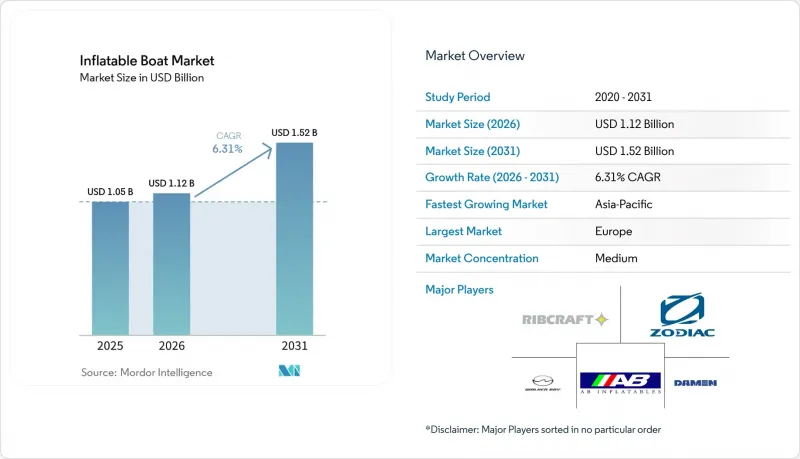
This report is Segmented by Boat Type (Rigid Inflatable Boats and Soft-Sided Inflatable Boats), Material (Hypalon and More), Size (Small Up To 9 Ft and More), Application (Recreational Boating and More), End User (Individual Consumers and More), and Geography. The Market Forecasts are Provided in Terms of Both Value (USD) and Volume (Units).
Global Inflatable Boat Market Trends and Insights
Diversification of Outboard-Engine Compatible Models
Manufacturers re-engineered transoms and fuel systems so that one hull can accept two-stroke, four-stroke, hybrid, or fully electric units without significant refit costs. Mercury Marine's Avator 75e and 110e electric outboards give recreational buyers a zero-emission option that slots directly onto existing brackets . Honda's BF350 V8 adds variable valve timing for a better fuel economy, making premium horsepower more accessible to rescue agencies seeking a more extended patrol range . Broader propulsion choice reduces ownership barriers, supports fleet electrification mandates, and elevates residual values for the inflatable boat market. RIB builders benefit disproportionately because rigid keels can absorb higher torque from large electric units, driving faster adoption in military and commercial fleets.
Growth in Coastal Recreational Tourism
The National Marine Manufacturers Association estimates the United States recreational marine economy grew exponentially in the past few years, some of which were inflatables . Rising disposable income in Southeast Asia and marina expansion projects in Indonesia, Vietnam, and the Philippines extend similar tailwinds. Peer-to-peer charter platforms lengthen utilization hours and lower per-trip costs for casual users, effectively enlarging the addressable pool for the inflatable boat market. Charter operators cite lower insurance premiums-up to one-fifth below fiberglass craft-bolsters profit margins despite recent marina policy hikes. Tourism authorities co-market eco-friendly water sports, indirectly nudging demand toward quieter electric-powered inflatables.
Vulnerability to Puncture Damage in Commercial Operations
Marine insurers have noted a rise in claims for inflatable hulls operating near coral reefs, debris, or fish-processing equipment. This increase has led to significant premium surcharges for charter fleets. Commercial skippers, aware of the downtime from patch repairs, sometimes choose aluminum hulls, even if it means dealing with a heavier displacement. In response, fabric makers have introduced triple-weave coatings and sacrificial keel guards. However, each added layer of protection comes with increased cost and weight. Asian shrimp trawlers, while experimenting with hybrid fiberglass-inflatable collars, have seen a reduction in punctures. Yet, this innovation compromises their ability to store the equipment compactly. Until the industry sees advancements like automated repair tapes or self-healing polymers, certain niches in the inflatable boat market will remain cautious about full-scale adoption.
Other drivers and restraints analyzed in the detailed report include:
- Advancements in Lightweight Drop-Stitch Fabric Technology
- Rising Adoption of Inflatable RIBs for Autonomous Surface Vessels
- Stringent Environmental Regulations on PVC Plasticizers
For complete list of drivers and restraints, kindly check the Table Of Contents.
Segment Analysis
Soft-Sided Inflatable Boats generated a massive amount in 2025, equaling 62.64% of the inflatable boat market size, and are projected to post the leading 6.68% CAGR through 2031. Their rigid keels allow higher horsepower ratings, making them the hull of choice for coast-guard interception, fire rescue, and luxury yacht tender duties where speed and seakeeping trump portability. Zodiac's X10CC signals consumer appetite shifting toward premium day-boats in the boat rental segment that straddle the boundary between inflatable versatility and rigid-hull comfort.
Soft-sided categories still dominate in volume due to sub-USD 10,000 entry points and rooftop-rack portability that attract first-time owners and campsite renters. Manufacturers ' share by upgrading deck stiffness with drop-stitch floors and plug-and-play seating. The inflation-deflation convenience remains unmatched for seasonal users who store boats in garages. Once buyers cross a power and payload threshold, switching costs toward RIBs diminish, nudging the overall inflatable boat market toward the higher-margin performance end.
PVC retained 56.34% of the inflatable boat market share in 2025 as mass-producers in China, Poland, and Vietnam continue to leverage cost grading and automated heat-welding. Yet the segment's growth lags the 6.49% Hypalon trajectory, reflecting commercial and military buyers' rising durability, fuel-spill resistance, and UV exposure requirements. Italian customs, for instance, stipulate CSM rubber tubes on patrol RIBs that operate multiple hours annually under Mediterranean sun.
Environmental pressures are driving a significant shift. The EU's restrictions on phthalates and California's upcoming listings of Plastics Priority Products are nudging mid-tier brands to opt for alternatives like Hypalon or thermoplastic polyester. This shift comes even with a notable increase in bill-of-materials costs. Premium buyers justify this price hike, noting that these alternatives offer considerably longer service intervals and a higher resale value. As a result, gains from Hypalon in the inflatable boat market are being viewed as a long-term trend rather than a fleeting phase.
Complete Report Scope:
- By Boat Type
- Rigid Inflatable Boats (RIBs)
- Soft-Sided Inflatable Boats
- By Material
- Hypalon
- PVC (Polyvinyl Chloride)
- Rubber
- By Size
- Small (up to 9 ft)
- Medium (10 - 15 ft)
- Large (above 15 ft)
- By Application
- Recreational Boating
- Military & Rescue
- Commercial Use
- By End User
- Individual Consumers
- Commercial Operators
- Government Agencies
- By Geography
- North America
- United States
- Canada
- Rest of North America
- South America
- Brazil
- Argentina
- Rest of South America
- Europe
- Germany
- United Kingdom
- France
- Italy
- Spain
- Rest of Europe
- Asia Pacific
- China
- India
- Japan
- South Korea
- Rest of Asia Pacific
- Middle East and Africa
- United Arab Emirates
- Saudi Arabia
- South Africa
- Turkey
- Rest of Middle East and Africa
- North America
Geography Analysis
In 2024, Europe commanded a significant share of the global revenue, bolstered by the Recreational Craft Directive and standardized EN ISO 6185 norms, which facilitate smoother cross-border trade and certification. Countries like Italy, Spain, and Greece, with their dense marinas and vibrant charter ecosystems, continue to thrive, ensuring a steady turnover for both leisure and professional fleets. Meanwhile, defense budgets in France, Germany, and Nordic nations are increasingly allocating funds for multi-role RIBs. These vessels, versatile enough to serve as firefighting units or for migrant support, are boosting after-sales contracts for local shipyards. Furthermore, as sustainability policies tighten, with upcoming restrictions on PVC additives, regional suppliers are pivoting towards eco-friendly composites. This shift not only underscores a commitment to sustainability but also positions tech leaders in the inflatable boat market as frontrunners.
Asia-Pacific is set to lead with robust growth through 2030, driven by the expansion of coastal economic zones, a surge in island tourism, and a push for naval modernization. In China, clusters in Shandong, Guangdong, and Fujian are reaping the benefits of scale synergies. Local governments are further sweetening the deal, subsidizing industrial parks that host everything from tube fabricators to engine OEMs. In India, the unveiling of Sagarmala port upgrades and a focus on disaster-response capabilities hint at upcoming RIB tenders. Across ASEAN nations, as marina numbers swell and import tariffs diminish, European luxury brands find a warm welcome in showrooms across Jakarta, Penang, and Phuket. With rising disposable incomes, first-time boat ownership is becoming a reality for many. Middle-class families are increasingly viewing compact inflatables as affordable leisure options, further embedding the inflatable boat market in the region.
North America witnesses steady growth, buoyed by record participation numbers from the NMMA and a robust base of adult boaters. Agencies like the U.S. Coast Guard, the Department of Homeland Security, and local fire departments engage in predictable, multi-year procurement cycles, ensuring consistent demand even amidst broader economic slowdowns. In South America, Brazil stands out with promising signs. The nation is on track to significantly boost its annual production over the years, marking notable growth. This growth hints at potential diversification across the broader Latin landscape. Meanwhile, the Middle East and Africa see selective advancements, particularly in Gulf marinas and the tourism corridors of Africa's Great Lakes. Yet, challenges like regulatory ambiguities and currency fluctuations temper the rapid expansion of the inflatable boat market in these regions.
- Zodiac Nautic
- BRIG Inflatable Boats
- AB Inflatables
- Highfield Boats
- ASIS Boats
- Mercury Marine
- Williams Jet Tenders
- Achilles Inflatable Crafts
- Avon Marine
- Ribcraft USA LLC
- Wesco Marine
- Walker's Bay
- Zodiac Milpro
- Survitec Group Limited
- Baird Maritime
- Inmar Marine Group
- Gemini Marine
- Vanguard Marine
- Bombardier Recreational Products (Sea-Doo)
- Suzuki Marine
- Honda Marine
- Baltik Boats
- Damen Shipyard
- Qraft Inflatables
Additional Benefits:
- The market estimate (ME) sheet in Excel format
- 3 months of analyst support
TABLE OF CONTENTS
1 Introduction
- 1.1 Study Assumptions & Market Definition
- 1.2 Scope of the Study
2 Research Methodology
3 Executive Summary
4 Market Landscape
- 4.1 Market Overview
- 4.2 Market Drivers
- 4.2.1 Diversification Of Outboard-Engine Compatible Models
- 4.2.2 Growth In Coastal Recreational Tourism
- 4.2.3 Advancements In Lightweight Drop-Stitch Fabric Technology
- 4.2.4 Rising Adoption Of Inflatable Ribs For Autonomous Surface Vessels
- 4.2.5 Increased Defense Spending On Fast Rescue Craft
- 4.2.6 Surge In Peer-To-Peer Boat-Rental Platforms
- 4.3 Market Restraints
- 4.3.1 Vulnerability To Puncture Damage In Commercial Operations
- 4.3.2 Stringent Environmental Regulations On PVC Plasticizers
- 4.3.3 Supply-Chain Disruptions For Synthetic Rubber Polymers
- 4.3.4 Insurance Premium Hikes For Inflatable Charter Fleets
- 4.4 Value / Supply-Chain Analysis
- 4.5 Regulatory Landscape
- 4.6 Technological Outlook
- 4.7 Porter's Five Forces
- 4.7.1 Bargaining Power of Buyers
- 4.7.2 Bargaining Power of Suppliers
- 4.7.3 Threat of New Entrants
- 4.7.4 Threat of Substitutes
- 4.7.5 Competitive Rivalry
5 Market Size & Growth Forecasts (Value (USD) and Volume (Units))
- 5.1 By Boat Type
- 5.1.1 Rigid Inflatable Boats (RIBs)
- 5.1.2 Soft-Sided Inflatable Boats
- 5.2 By Material
- 5.2.1 Hypalon
- 5.2.2 PVC (Polyvinyl Chloride)
- 5.2.3 Rubber
- 5.3 By Size
- 5.3.1 Small (up to 9 ft)
- 5.3.2 Medium (10 - 15 ft)
- 5.3.3 Large (above 15 ft)
- 5.4 By Application
- 5.4.1 Recreational Boating
- 5.4.2 Military & Rescue
- 5.4.3 Commercial Use
- 5.5 By End User
- 5.5.1 Individual Consumers
- 5.5.2 Commercial Operators
- 5.5.3 Government Agencies
- 5.6 By Geography
- 5.6.1 North America
- 5.6.1.1 United States
- 5.6.1.2 Canada
- 5.6.1.3 Rest of North America
- 5.6.2 South America
- 5.6.2.1 Brazil
- 5.6.2.2 Argentina
- 5.6.2.3 Rest of South America
- 5.6.3 Europe
- 5.6.3.1 Germany
- 5.6.3.2 United Kingdom
- 5.6.3.3 France
- 5.6.3.4 Italy
- 5.6.3.5 Spain
- 5.6.3.6 Rest of Europe
- 5.6.4 Asia Pacific
- 5.6.4.1 China
- 5.6.4.2 India
- 5.6.4.3 Japan
- 5.6.4.4 South Korea
- 5.6.4.5 Rest of Asia Pacific
- 5.6.5 Middle East and Africa
- 5.6.5.1 United Arab Emirates
- 5.6.5.2 Saudi Arabia
- 5.6.5.3 South Africa
- 5.6.5.4 Turkey
- 5.6.5.5 Rest of Middle East and Africa
- 5.6.1 North America
6 Competitive Landscape
- 6.1 Market Concentration
- 6.2 Strategic Moves
- 6.3 Market Share Analysis
- 6.4 Company Profiles (includes Global Level Overview, Market Level Overview, Core Segments, Financials as Available, Strategic Information, Market Rank/Share for Key Companies, Products and Services, SWOT Analysis, and Recent Developments)
- 6.4.1 Zodiac Nautic
- 6.4.2 BRIG Inflatable Boats
- 6.4.3 AB Inflatables
- 6.4.4 Highfield Boats
- 6.4.5 ASIS Boats
- 6.4.6 Mercury Marine
- 6.4.7 Williams Jet Tenders
- 6.4.8 Achilles Inflatable Crafts
- 6.4.9 Avon Marine
- 6.4.10 Ribcraft USA LLC
- 6.4.11 Wesco Marine
- 6.4.12 Walker's Bay
- 6.4.13 Zodiac Milpro
- 6.4.14 Survitec Group Limited
- 6.4.15 Baird Maritime
- 6.4.16 Inmar Marine Group
- 6.4.17 Gemini Marine
- 6.4.18 Vanguard Marine
- 6.4.19 Bombardier Recreational Products (Sea-Doo)
- 6.4.20 Suzuki Marine
- 6.4.21 Honda Marine
- 6.4.22 Baltik Boats
- 6.4.23 Damen Shipyard
- 6.4.24 Qraft Inflatables
7 Market Opportunities & Future Outlook
- 7.1 White-space & Unmet-Need Assessment

