PUBLISHER: Mordor Intelligence | PRODUCT CODE: 2073556

PUBLISHER: Mordor Intelligence | PRODUCT CODE: 2073556
North America Industrial Centrifuge - Market Share Analysis, Industry Trends & Statistics, Growth Forecasts (2026 - 2031)
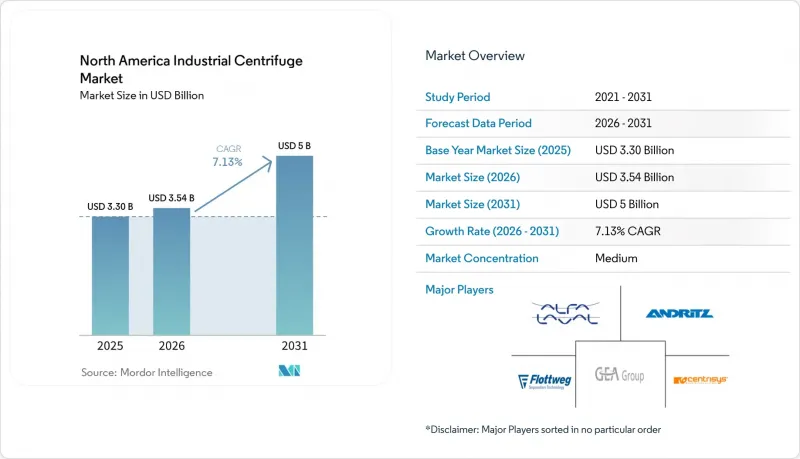
According to Mordor Intelligence, the north america industrial centrifuge market size was valued at USD 3.30 billion in 2025 and is estimated to grow from USD 3.54 billion in 2026 to reach USD 5 billion by 2031, at a CAGR of 7.13% during the forecast period (2026-2031).
This report Segments the Industry Into Type (Sedimentation, Filtering), Design (Horizontal, Vertical), Operation Mode (Batch, Continuous), Industry (Food and Beverages, Pharmaceutical and Biotech, Water and Wastewater Treatment, Chemical, Metals and Mining, Power Generation, and More), and Geography (United States, Canada, Mexico). The Market Forecasts are Provided in Terms of Value (USD).
North America Industrial Centrifuge Market Trends and Insights
Biopharma Capacity Expansion in the U.S. & Canada Is Reshaping Centrifuge Procurement Patterns
North America's biopharmaceutical sector is going through a large domestic manufacturing build-out, and that is sustaining demand for high-speed disc-stack separators and continuous decanters used in cell harvest, clarification, and protein separation. UCB selected Gwinnett County, Georgia, for a new 460,000-square-foot biologics campus in March 2026, adding another procurement center for pharmaceutical-grade centrifuges in the U.S. Southeast. New biologics sites of this kind are being planned for long operating lives and large commercial volumes, which raises the need for reliable separation equipment that can perform at scale. A major shift is that many of these facilities are being designed around continuous biomanufacturing from the outset, and that design choice favors high-speed separators over batch filtration alternatives. Once those layouts are approved, centrifuge demand tends to stay tied to the production line for the life of the plant. This makes biopharma one of the clearest long-cycle demand anchors for the North America industrial centrifuge market.
Regulatory Push for Wastewater-Sludge Reduction Creates Durable Infrastructure Demand
Tighter oversight of biosolids handling is supporting demand for decanter centrifuges across municipal and industrial wastewater systems. The U.S. Environmental Protection Agency finalized Method 1633 in January 2024 for monitoring 40 PFAS analytes in sewage sludge and later moved to incorporate it into 40 CFR Part 136 through a Methods Update Rule signed in December 2024. This process is pushing plant operators to show stronger dewatering performance because cake dryness affects PFAS concentration in sludge that is sent for land application. The compliance burden also sits alongside 40 CFR Part 503, the NPDES program, and related state biosolids rules, which shape permitting and performance verification for centrifuge-based dewatering trains. Better dry solids content also reduces transport and disposal costs, which strengthens the investment case for equipment upgrades even before stricter federal rules are fully implemented. This keeps wastewater infrastructure as a steady demand source for the North America industrial centrifuge market.
High CAPEX and Long Pay-Back Periods Constrain Adoption Velocity Across Mid-Market Operators
High installed cost remains the clearest barrier to faster adoption across mid-market operators. Premium pharmaceutical disc-stack separators and large municipal sludge decanters often require payback periods that stretch beyond 5 years, which is difficult for operators with constrained capital budgets. The issue is strongest in municipal wastewater, where rate-case approvals and bond financing can delay procurement by 18 to 36 months even when the operating and compliance need is clear. Interest rate pressure from the earlier part of the decade also raised the cost of capital used in project appraisal, which made replacement programs harder to approve. Because of this, some operators continue to extend the life of older equipment instead of renewing fleets on a faster schedule. This remains a practical brake on growth for the North America industrial centrifuge market.
Other drivers and restraints analyzed in the detailed report include:
- Food & Beverage Processors Shifting to Continuous Clarification Drives High-Speed Separator Upgrades
- Energy-Efficiency Mandates Under DOE 50001 Framework Are Accelerating Centrifuge Retrofits
- Competition from Membrane-Based Separation Erodes Centrifuge Addressable Market in Select Applications
For complete list of drivers and restraints, kindly check the Table Of Contents.
Segment Analysis
Sedimentation centrifuges accounted for 62.2% of the North America industrial centrifuge market share in 2025, supported by the entrenched use of decanter and disc-stack systems in wastewater treatment, dairy processing, and biopharma clarification. Decanters retain the widest footprint within this group because they handle high-solids municipal sludge duty cycles with steady mechanical reliability. Disc-stack units remain the premium choice in pharmaceutical and beverage clarification, where tighter particle separation and in-place cleaning are required. Hydrocyclone and clarifier or thickener systems continue to serve primary dewatering stages in mining and pulp and paper operations, where throughput often matters more than final dryness. Energy audits tied to continuous improvement programs are also bringing older sedimentation systems into replacement discussions at industrial sites.
Filtering centrifuges are projected to grow at 8.1% CAGR through 2031, making them the fastest-expanding type in the North America industrial centrifuge market. Growth is being driven by battery-active-material separation and fine-chemical crystallization, where buyers need cleaner dry solids and tighter process control. Research published in RSC Advances in January 2026 by Oak Ridge National Laboratory and the University of Tennessee showed that heavy liquid centrifugal separation achieved more than 95% efficiency in lithium-ion battery black mass recovery. That result gives technical support to the filtering route in high-purity resource recovery applications. Pusher and peeler centrifuges are therefore receiving more procurement attention in specialty chemicals and API manufacturing, where cake purity and low residual moisture are core process requirements.
Horizontal centrifuges held 69.3% of the North America industrial centrifuge market size in 2025, reflecting their strength in continuous high-throughput duties such as sewage sludge dewatering, edible oil processing, and mining tailings management. Their lead is reinforced by a mature service and aftermarket network, which improves parts access and technician familiarity across operator groups. This installed-base advantage keeps ownership costs more predictable for plants that run continuously. It also helps explain why horizontal systems remain the default choice in large-volume and solids-heavy duties across the region. Alfa Laval reported more than 4,200 patents in its separation portfolio in its 2025 annual report, which shows the depth of product development around the designs most used in food and water processing applications.
Vertical centrifuges are forecast to expand at 7.5% CAGR over 2026-2031, outpacing horizontal units in the North America industrial centrifuge market. Demand is centered in pharmaceutical and biotech facilities, where vertical bowl geometries fit cleanroom layouts more easily and support CIP validation in GMP-regulated settings. Their form factor also suits controlled production environments where floor planning and contamination management carry more weight. Another emerging use case is direct lithium extraction, where precise liquid-liquid separation at ambient temperature can support saleable lithium carbonate equivalent without conventional thermal processing. This keeps vertical designs tied to both advanced bioprocessing and selected clean-energy mineral flows.
Complete Report Scope:
- By Type
- Sedimentation
- Clarifier/Thickener
- Decanter
- Disc-stack
- Hydrocyclone
- Other Sedimentation
- Filtering
- Basket
- Scroll-screen
- Peeler
- Pusher
- Other Filtering
- Sedimentation
- By Design
- Horizontal
- Vertical
- By Operation Mode
- Batch
- Continuous
- By Industry
- Food and Beverages
- Pharmaceutical and Biotech
- Water and Wastewater Treatment
- Chemical
- Metals and Mining
- Power Generation
- Pulp and Paper
- Other Industries
- By Country
- United States
- Canada
- Mexico
List of Companies Covered in this Report:
- Alfa Laval AB
- Andritz AG
- GEA Group AG
- Flottweg SE
- Centrisys Corp.
- Ferrum AG
- SPX Flow Inc.
- HAUS Centrifuge Technologies
- Hiller GmbH
- B&P Littleford
- Mitsubishi Kakoki Kaisha
- Pieralisi Group
- FLSmidth & Co.
- US Centrifuge Systems
- Tomoe Engineering
- GN Separation
- Trucent Inc.
- Multotec Pty Ltd
- Separation Equipment Co.
- Centrifuges Unlimited Inc.
Additional Benefits:
- The market estimate (ME) sheet in Excel format
- 3 months of analyst support
TABLE OF CONTENTS
1 Introduction
- 1.1 Study Assumptions & Market Definition
- 1.2 Scope of the Study
2 Research Methodology
3 Executive Summary
4 Market Landscape
- 4.1 Market Overview
- 4.2 Market Drivers
- 4.2.1 Regulatory push for wastewater-sludge reduction
- 4.2.2 Biopharma capacity expansion in the U.S. & Canada
- 4.2.3 Food & beverage processors shifting to continuous clarification
- 4.2.4 Energy-efficiency mandates (DOE 50001) driving retrofits
- 4.2.5 IRA-funded clean-hydrogen hubs needing brine centrifuges
- 4.2.6 Battery-recycling "black-mass" separation demand
- 4.3 Market Restraints
- 4.3.1 High CAPEX & long pay-back periods
- 4.3.2 Competition from membrane-based separation
- 4.3.3 Skilled centrifuge-maintenance talent shortage
- 4.3.4 Bearings supply-chain delays lengthen lead-times
- 4.4 Supply-Chain Analysis
- 4.5 Regulatory Landscape
- 4.6 Technological Outlook
- 4.7 Porter's Five Forces
- 4.7.1 Bargaining Power of Suppliers
- 4.7.2 Bargaining Power of Buyers
- 4.7.3 Threat of New Entrants
- 4.7.4 Threat of Substitutes
- 4.7.5 Intensity of Rivalry
5 Market Size & Growth Forecasts (Value)
- 5.1 By Type
- 5.1.1 Sedimentation
- 5.1.1.1 Clarifier/Thickener
- 5.1.1.2 Decanter
- 5.1.1.3 Disc-stack
- 5.1.1.4 Hydrocyclone
- 5.1.1.5 Other Sedimentation
- 5.1.2 Filtering
- 5.1.2.1 Basket
- 5.1.2.2 Scroll-screen
- 5.1.2.3 Peeler
- 5.1.2.4 Pusher
- 5.1.2.5 Other Filtering
- 5.1.1 Sedimentation
- 5.2 By Design
- 5.2.1 Horizontal
- 5.2.2 Vertical
- 5.3 By Operation Mode
- 5.3.1 Batch
- 5.3.2 Continuous
- 5.4 By Industry
- 5.4.1 Food and Beverages
- 5.4.2 Pharmaceutical and Biotech
- 5.4.3 Water and Wastewater Treatment
- 5.4.4 Chemical
- 5.4.5 Metals and Mining
- 5.4.6 Power Generation
- 5.4.7 Pulp and Paper
- 5.4.8 Other Industries
- 5.5 By Country
- 5.5.1 United States
- 5.5.2 Canada
- 5.5.3 Mexico
6 Competitive Landscape
- 6.1 Market Concentration
- 6.2 Strategic Moves (M&A, JVs, Funding)
- 6.3 Market Share Analysis
- 6.4 Company Profiles (includes Global- & Market-level Overview, Core Segments, Financials, Strategic Info, Products & Services, Recent Developments)
- 6.4.1 Alfa Laval AB
- 6.4.2 Andritz AG
- 6.4.3 GEA Group AG
- 6.4.4 Flottweg SE
- 6.4.5 Centrisys Corp.
- 6.4.6 Ferrum AG
- 6.4.7 SPX Flow Inc.
- 6.4.8 HAUS Centrifuge Technologies
- 6.4.9 Hiller GmbH
- 6.4.10 B&P Littleford
- 6.4.11 Mitsubishi Kakoki Kaisha
- 6.4.12 Pieralisi Group
- 6.4.13 FLSmidth & Co.
- 6.4.14 US Centrifuge Systems
- 6.4.15 Tomoe Engineering
- 6.4.16 GN Separation
- 6.4.17 Trucent Inc.
- 6.4.18 Multotec Pty Ltd
- 6.4.19 Separation Equipment Co.
- 6.4.20 Centrifuges Unlimited Inc.
7 Market Opportunities & Future Outlook
- 7.1 White-space & Unmet-need Assessment

