PUBLISHER: Mordor Intelligence | PRODUCT CODE: 2073561

PUBLISHER: Mordor Intelligence | PRODUCT CODE: 2073561
Vendor Risk Management - Market Share Analysis, Industry Trends & Statistics, Growth Forecasts (2026 - 2031)
According to Mordor Intelligence, the vendor risk management market size was valued at USD 13.47 billion in 2025 and estimated to grow from USD 15.08 billion in 2026 to reach USD 26.44 billion by 2031, at a CAGR of 11.89% during the forecast period (2026-2031).
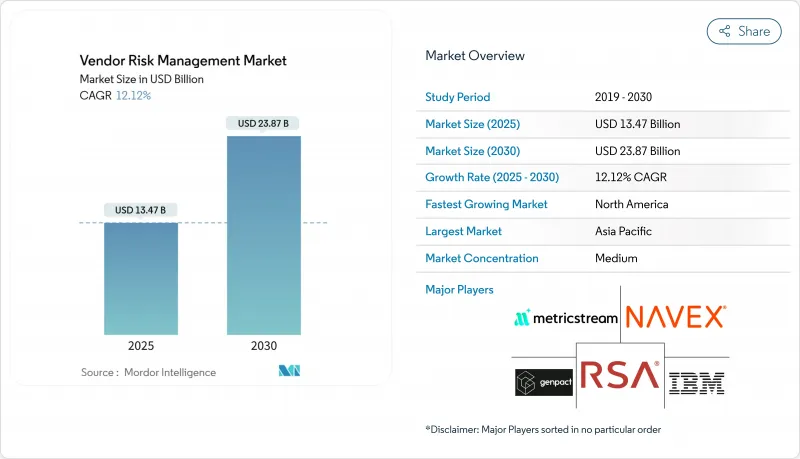
This report Segments the Industry by Type (Solutions, Services), Deployment Type (On-Premises, Cloud), Organization Size (Small and Medium-Sized Enterprises, Large Enterprises), Industry Vertical (Banking, Financial Services, and Insurance, Telecom and IT, Manufacturing, Government, Healthcare, and More), and Geography. The Market Forecasts are Provided in Terms of Value (USD).
Global Vendor Risk Management Market Trends and Insights
Escalating Supply-Chain Cyber-Attacks Triggering Enterprise-Wide Third-Party Risk Programs
Supply-chain cyber incidents surged by 431% between 2021 and 2023, elevating third-party risk to a strategic board priority. Manufacturing, healthcare, and finance now routinely integrate continuous monitoring, incident response playbooks, and collaborative procurement-security workflows. The UK Cyber Security Breaches Survey 2025 notes that 43% of firms endured a breach in the past year, and 85% involved phishing campaigns exploiting trusted vendors . Board-level visibility into supplier controls, attack-surface analytics, and real-time alerts is accelerating platform upgrades and favouring providers with AI-driven detection engines.
Proliferation of ESG Due-Diligence Mandates in EU CSRD
The Corporate Sustainability Reporting Directive broadened mandatory ESG disclosure to roughly 50,000 companies from January 2024, obliging risk teams to map and monitor environmental and human-rights exposure across supply chains. Firms must integrate greenhouse-gas, labour, and diversity metrics into vendor selection and continuously screen for adverse impacts. Coupled with the forthcoming Corporate Sustainability Due Diligence Directive, the rules prioritise traceability and remediation, spurring investments in platforms that unify financial, cyber, and ESG risk signals. Early adopters in automotive, retail, and pharmaceuticals are piloting shared assessment exchanges to streamline evidence collection.
Fragmented Vendor Data Taxonomies Hindering Interoperability Across Enterprise Systems
Inconsistent metadata standards block seamless data exchange between procurement, contract, and ERP platforms. A Nature study underscores that ill-matched structures slow integration and limit analytics quality. Siloed formats force manual reconciliations, prolong implementation cycles, and dilute the value of predictive scoring. Global industry consortia are working on common ontologies, yet divergent privacy rules and legacy architectures mean progress will be gradual.
Other drivers and restraints analyzed in the detailed report include:
- Accelerated Cloud Adoption Complicating Vendor Footprints Among APAC Digital-Native Firms
- Banking Regulators' Heightened Scrutiny of Outsourcing Risk Fueling BFSI Spend
- High Total Cost of Ownership for Integrated GRC Suites Among Mid-Market Organizations
For complete list of drivers and restraints, kindly check the Table Of Contents.
Segment Analysis
Solutions accounted for 71.30% of vendor risk management market revenue in 2025 as firms prioritised core infrastructures such as vendor information management and compliance modules. The vendor risk management market size for solutions is projected to widen steadily, although organisations now demand AI-assisted document parsing and automated evidence gathering to cut analyst workloads. Services, spanning implementation, advisory, and managed operations, are gaining ground at 14.12% CAGR as buyers seek expertise to navigate sprawling regulations and integrate risk data streams.
Service uptake is strongest in healthcare and manufacturing, where in-house teams face resource gaps. Advisory partners assist with control mapping against CSRD, DORA, and sector-specific norms, while managed-service providers deliver continuous vendor surveillance. The shift indicates that talent shortages and heightened board expectations are pushing organisations toward hybrid delivery models blending software with expert support.
Cloud delivery captured 64.40% of the vendor risk management market in 2025. Benefiting from rapid rollout, elastic scaling, and browser access, the vendor risk management market share for cloud platforms is projected to rise further as multinationals consolidate tools onto single stacks that serve global teams. Hybrid approaches persist where data-sovereignty obligations limit full migration, yet even highly regulated banks and insurers now use cloud for low-risk data processing and analytics.
On-premises installations remain important for defence, public-sector, and critical-infrastructure clients. However, cloud platform vendors are addressing concerns through dedicated hosting zones, encryption key management, and audit-ready logging. Growing confidence in shared-responsibility frameworks and improved contractual terms is reducing barriers, enabling organizations to phase critical workflows into secure cloud environments.
Complete Report Scope:
- By Type
- Solutions
- Vendor Information Management
- Quality Assurance Management
- Financial Control
- Compliance Management
- Audit Management
- Contract Management and Others
- Services
- Professional Services
- Managed Services
- Solutions
- By Deployment Type
- On-Premises
- Cloud
- By Organization Size
- Small and Medium-Sized Enterprises
- Large Enterprises
- By Industry Vertical
- Banking, Financial Services and Insurance (BFSI)
- IT and Telecom
- Manufacturing
- Government
- Healthcare
- Others (Energy and Utilities, and Retail and Consumer Goods)
- By Risk Domain
- Cybersecurity Risk
- Financial Risk
- Operational Risk
- Compliance Risk
- ESG / Sustainability Risk
- By Geography
- North America
- United States
- Canada
- Mexico
- South America
- Brazil
- Argentina
- Chile
- Peru
- Rest of South America
- Europe
- Germany
- United Kingdom
- France
- Italy
- Spain
- Rest of Europe
- Asia-Pacific
- China
- Japan
- South Korea
- India
- Australia
- New Zealand
- Rest of Asia-Pacific
- Middle East and Africa
- Middle East
- United Arab Emirates
- Saudi Arabia
- Turkey
- Rest of Middle East
- Africa
- South Africa
- Nigeria
- Egypt
- Rest of Africa
- Middle East
- North America
Geography Analysis
North America generated 34.60% of 2025 revenue, supported by rigorous privacy law enforcement and mature financial and healthcare ecosystems. The SEC's revised Regulation S-P obliges financial services firms to document vendor oversight and incident workflows, spurring technology upgrades. Healthcare providers contend with a 287% surge in breaches routed through business associates, prompting greater allocation to continuous scanning and contract hygiene.
Asia-Pacific is the fastest-growing region at 13.86% CAGR. Rapid cloud adoption, new data-protection statutes, and heightened enforcement in markets such as Singapore and India push enterprises to formalise supplier oversight. Regional security spending is projected to reach USD 52 billion by 2027, and multinational corporations often pilot unified vendor risk management programmes in their APAC subsidiaries to harmonise global standards.
Europe's trajectory is shaped by CSRD and the 2025 introduction of DORA. Large firms must map environmental and human-rights impacts across extended supply chains, while banks are required to update critical-service contracts under new resilience rules. Data-transfer constraints under GDPR and upcoming AI governance laws further raise the compliance bar, increasing demand for centralised repositories, automated evidence workflows and auditable decision trails.
- RSA Security LLC
- Genpact Limited
- Lockpath (NAVEX)
- MetricStream Inc.
- IBM Corporation
- Resolver Inc.
- SAI Global Pty Ltd
- Rapid Ratings International Inc.
- Quantivate LLC
- Optiv Security Inc.
- ServiceNow Inc.
- OneTrust LLC
- Riskonnect Inc.
- Prevalent Inc.
- LogicGate Inc.
- Aravo Solutions Inc.
- Coupa Software Inc.
- Diligent Corporation
- SAP SE
- ProcessUnity Inc.
- BitSight Technologies Inc.
- KPMG International
- Deloitte Touche Tohmatsu Ltd.
- PwC Ltd.
Additional Benefits:
- The market estimate (ME) sheet in Excel format
- 3 months of analyst support
TABLE OF CONTENTS
1 INTRODUCTION
- 1.1 Study Assumptions and Market Definition
- 1.2 Scope of the Study
2 RESEARCH METHODOLOGY
3 EXECUTIVE SUMMARY
4 MARKET LANDSCAPE
- 4.1 Market Overview
- 4.2 Market Drivers
- 4.2.1 Escalating Supply-Chain Cyber-Attacks Triggering Enterprise-Wide 3rd-Party Risk Programs
- 4.2.2 Proliferation of ESG Due-Diligence Mandates in EU Corporate Sustainability Reporting Directive
- 4.2.3 Accelerated Cloud Adoption Complicating Vendor Footprints Among APAC Digital-Native Firms
- 4.2.4 Banking Regulators' Heightened Scrutiny of Outsourcing Risk Fueling BFSI Spend
- 4.2.5 Cost-Efficiency Gains From AI-Driven Continuous Vendor Monitoring Solutions
- 4.2.6 Emergence of Industry-Specific Vendor Risk Exchanges in Healthcare and Life Sciences
- 4.3 Market Restraints
- 4.3.1 Fragmented Vendor Data Taxonomies Hindering Interoperability Across Enterprise Systems
- 4.3.2 High Total Cost of Ownership for Integrated GRC Suites Among Mid-Market Organizations
- 4.3.3 Talent Shortage in Third-Party Risk Analysts Constraining Implementation Velocity in MEA
- 4.3.4 Perceived Data-Privacy Concerns Around Sharing Supplier Risk Scores With External Networks
- 4.4 Regulatory Outlook
- 4.5 Technological Outlook
- 4.6 Porter's Five Forces Analysis
- 4.6.1 Bargaining Power of Suppliers
- 4.6.2 Bargaining Power of Buyers
- 4.6.3 Threat of New Entrants
- 4.6.4 Threat of Substitutes
- 4.6.5 Intensity of Competitive Rivalry
- 4.7 Investment Analysis (Capital Flow and VC Funding)
- 4.8 Macroeconomic Factors Impact Assessment
5 MARKET SIZE AND GROWTH FORECASTS (VALUE)
- 5.1 By Type
- 5.1.1 Solutions
- 5.1.1.1 Vendor Information Management
- 5.1.1.2 Quality Assurance Management
- 5.1.1.3 Financial Control
- 5.1.1.4 Compliance Management
- 5.1.1.5 Audit Management
- 5.1.1.6 Contract Management and Others
- 5.1.2 Services
- 5.1.2.1 Professional Services
- 5.1.2.2 Managed Services
- 5.1.1 Solutions
- 5.2 By Deployment Type
- 5.2.1 On-Premises
- 5.2.2 Cloud
- 5.3 By Organization Size
- 5.3.1 Small and Medium-Sized Enterprises
- 5.3.2 Large Enterprises
- 5.4 By Industry Vertical
- 5.4.1 Banking, Financial Services and Insurance (BFSI)
- 5.4.2 IT and Telecom
- 5.4.3 Manufacturing
- 5.4.4 Government
- 5.4.5 Healthcare
- 5.4.6 Others (Energy and Utilities, and Retail and Consumer Goods)
- 5.5 By Risk Domain
- 5.5.1 Cybersecurity Risk
- 5.5.2 Financial Risk
- 5.5.3 Operational Risk
- 5.5.4 Compliance Risk
- 5.5.5 ESG / Sustainability Risk
- 5.6 By Geography
- 5.6.1 North America
- 5.6.1.1 United States
- 5.6.1.2 Canada
- 5.6.1.3 Mexico
- 5.6.2 South America
- 5.6.2.1 Brazil
- 5.6.2.2 Argentina
- 5.6.2.3 Chile
- 5.6.2.4 Peru
- 5.6.2.5 Rest of South America
- 5.6.3 Europe
- 5.6.3.1 Germany
- 5.6.3.2 United Kingdom
- 5.6.3.3 France
- 5.6.3.4 Italy
- 5.6.3.5 Spain
- 5.6.3.6 Rest of Europe
- 5.6.4 Asia-Pacific
- 5.6.4.1 China
- 5.6.4.2 Japan
- 5.6.4.3 South Korea
- 5.6.4.4 India
- 5.6.4.5 Australia
- 5.6.4.6 New Zealand
- 5.6.4.7 Rest of Asia-Pacific
- 5.6.5 Middle East and Africa
- 5.6.5.1 Middle East
- 5.6.5.1.1 United Arab Emirates
- 5.6.5.1.2 Saudi Arabia
- 5.6.5.1.3 Turkey
- 5.6.5.1.4 Rest of Middle East
- 5.6.5.2 Africa
- 5.6.5.2.1 South Africa
- 5.6.5.2.2 Nigeria
- 5.6.5.2.3 Egypt
- 5.6.5.2.4 Rest of Africa
- 5.6.5.1 Middle East
- 5.6.1 North America
6 COMPETITIVE LANDSCAPE
- 6.1 Market Concentration
- 6.2 Strategic Moves
- 6.3 Company Profiles (includes Global level Overview, Market level overview, Core Segments, Financials as available, Strategic Information, Products and Services, and Recent Developments)
- 6.3.1 RSA Security LLC
- 6.3.2 Genpact Limited
- 6.3.3 Lockpath (NAVEX)
- 6.3.4 MetricStream Inc.
- 6.3.5 IBM Corporation
- 6.3.6 Resolver Inc.
- 6.3.7 SAI Global Pty Ltd
- 6.3.8 Rapid Ratings International Inc.
- 6.3.9 Quantivate LLC
- 6.3.10 Optiv Security Inc.
- 6.3.11 ServiceNow Inc.
- 6.3.12 OneTrust LLC
- 6.3.13 Riskonnect Inc.
- 6.3.14 Prevalent Inc.
- 6.3.15 LogicGate Inc.
- 6.3.16 Aravo Solutions Inc.
- 6.3.17 Coupa Software Inc.
- 6.3.18 Diligent Corporation
- 6.3.19 SAP SE
- 6.3.20 ProcessUnity Inc.
- 6.3.21 BitSight Technologies Inc.
- 6.3.22 KPMG International
- 6.3.23 Deloitte Touche Tohmatsu Ltd.
- 6.3.24 PwC Ltd.
7 MARKET OPPORTUNITIES AND FUTURE OUTLOOK
- 7.1 White-Space and Unmet-Need Assessment

